
10-20-30 training is a running interval method built around a simple minute: 30 seconds easy, 20 seconds moderate, and 10 seconds hard. Five of those minutes form one block, and research sessions usually include several blocks separated by easy recovery.
The method has produced meaningful improvements in fitness and running performance, even when participants reduced their weekly mileage. It is not proof that steady running makes athletes slow, that intervals melt fat through a huge afterburn, or that one five-minute block replaces a complete program.
A compact interval session still has a complete dose: preparation, hard efforts, easier movement and recovery all belong in the time budget.
Illustration note: The featured image is derived from this post’s selected Facebook creative. It is an illustrative runner, not a study participant or a medical visualization of a measured effect.
How the 10-20-30 minute and block work
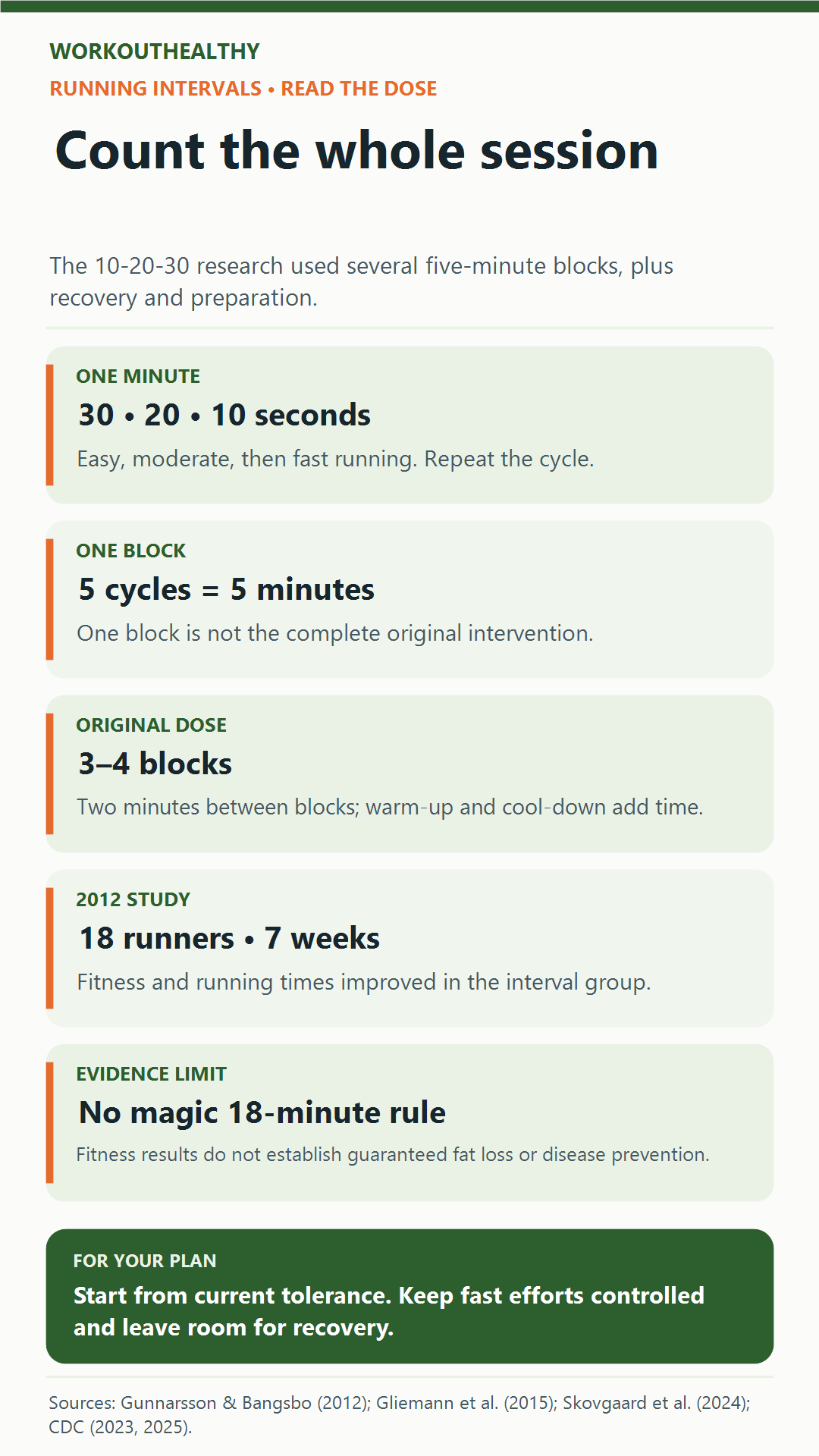
The name describes the order used in the original research: 30 seconds at less than 30% of maximal intensity, 20 seconds at less than 60%, and 10 seconds at more than 90%. Those percentages describe the original research protocol (Gunnarsson & Bangsbo, 2012). They are not percentages of heart rate, and the 10 seconds were near-maximal in that study.
Repeat that one-minute cycle five times to complete a five-minute block. Recover for two minutes, then begin another block.
The 2012 study used three or four five-minute blocks in a session. That means a research-style workout contains 15 to 20 minutes of intervals, plus the recovery periods and an appropriate warm-up and cool-down.
The selected social post mentions 18 minutes three times a week. The original paper does not establish that exact universal dose. Three five-minute blocks plus two two-minute recoveries total 19 minutes before preparation; four blocks plus three recoveries total 26 minutes.
Those totals are arithmetic from the protocol, not separate tested interventions. Counting only the fast segments would make the session look shorter still, while omitting work that helps make it repeatable.
One five-minute block can be an introductory option for a suitably prepared runner, but that is a practical modification. It should not inherit every result from the full research program.
The final 10 seconds should feel very hard while staying technically controlled. Later research suggests that trained runners can still improve without making every fast segment a maximal sprint (Skovgaard et al., 2024).
What the original 2012 study found
Gunnarsson and Bangsbo (2012) assigned 18 moderately trained runners to a 10-20-30 group or a control group for seven weeks. Ten runners performed the interval program, while eight continued their usual training.
The interval group replaced its usual running sessions with three weekly 10-20-30 sessions. Its average training volume fell by 54%, from 30.4 to 14.0 kilometers per week.
Despite the lower volume, maximal oxygen uptake increased by 4%. Average 1,500-meter time improved by 21 seconds, and 5K time improved by 48 seconds.
Systolic blood pressure decreased by 5 millimeters of mercury. Total cholesterol fell by 0.5 millimoles per liter, and LDL cholesterol fell by 0.4 millimoles per liter.
Those results are impressive, but the sample was tiny. A 10-person training group cannot establish the exact response that every runner, beginner, older adult, or person with a health condition should expect.
What later runner studies added
Gliemann et al. (2015) followed 160 recreational runners for eight weeks. The 132 runners assigned to 10-20-30 training replaced two of their three weekly sessions, while 28 controls continued their normal running.
The interval group improved 5K performance by an average of 38 seconds. Maximal oxygen uptake and muscle biopsies were assessed in an 18-runner subgroup; oxygen uptake increased. Systolic blood pressure fell by 2 millimeters of mercury overall, with larger blood-pressure changes among participants who had hypertension.
The researchers did not find changes in muscle fiber composition or capillarization. That matters because better race performance does not require every proposed cellular explanation to be true.
Skovgaard et al. (2024) randomly assigned 19 men to maximal or submaximal fast efforts for six weeks, three sessions a week. Five-kilometer performance improved by 3.0% in the submaximal group and 2.3% in the maximal group; maximal oxygen uptake rose by about 7% in both, with no between-group difference in those changes. Muscle oxidative phosphorylation increased only with maximal effort.
That finding supports a practical point: the fast segment can be very hard without becoming reckless. Consistent, repeatable intervals are more valuable than one uncontrolled sprint that disrupts the rest of the session.
To compare formats, our guide to five running workouts separates strides, fartlek and structured intervals.
Where steady running fits
The claim that steady-state exercise makes a runner efficient at being slow confuses a useful adaptation with a failure. CDC guidance counts both moderate and vigorous aerobic activity toward a wider weekly plan (Centers for Disease Control and Prevention [CDC], 2023). The interval trials do not show that every easy run needs replacing.
Intervals and steady running solve different parts of the training problem. A runner can use easy mileage to build durability and recover, then use 10-20-30 work to add a concentrated speed and aerobic stimulus.
The original study did not compare a complete, well-designed endurance program with an otherwise identical plan that added only this protocol. It compared a small interval group that sharply reduced volume with runners who continued their usual habits.
That is evidence that 10-20-30 training can be time efficient, not that all steady work causes a plateau. The best balance depends on current fitness, event distance, injury history, available time, and tolerance for hard training.
Our short daily cardio guide also explains why a short session belongs within a weekly activity plan.
Intervals and fartlek share variable speed
Fartlek means speed play. A fartlek session usually alternates faster and easier running according to terrain, landmarks, time, or feel, and its structure can range from relaxed surges to demanding race-specific work.
10-20-30 training belongs to the same broad family of variable-speed running, but it is more standardized. Its one-minute cycle and five-minute blocks make the workload easy to repeat, study, and compare over time.
A runner who enjoys flexibility may prefer a fartlek such as ten fast lamppost-to-lamppost surges with relaxed jogging between them. A runner who wants a precise timer-based session may find the 10-20-30 pattern easier to execute.
Neither label automatically determines the physiological effect. Total duration, speed, recovery, terrain, heat, and the athlete’s starting fitness all shape the demand.
What the fat-loss claims leave out
The studies support improved running performance and cardiorespiratory fitness. They do not establish that the protocol produces superior long-term fat loss for everyone or creates an afterburn large enough to ignore total activity and food intake.
Neither the original 2012 running trial nor the later runner studies above establishes a guaranteed fat-loss response. A faster 5K, higher maximal oxygen uptake, lower blood pressure and a change in body fat are different outcomes.
The social caption also mentions blood sugar and reduced disease risk. Those claims should not be assigned to this small 2012 trial: its reported results concern performance, oxygen uptake, blood pressure and cholesterol. Changes in a risk marker are not direct measurements of disease prevention.
Too much hard training without enough recovery can contribute to fatigue and declining performance. The solution is sensible scheduling, not assuming that a session is harmless because its individual sprints last only 10 seconds.
Match vigorous running to your starting point
The method can suit recreational runners who already tolerate continuous running and want one structured interval session. It may also help time-limited runners who need a compact stimulus but can recover from vigorous work.
New runners should first develop basic walking and easy-running tolerance. Starting with short controlled surges is safer than copying the fastest pace of an experienced athlete.
Runners returning from injury should be cautious because rapid acceleration can increase stress on calves, hamstrings, Achilles tendons, and other tissues. Pain, altered gait, or symptoms that worsen from repetition are reasons to stop and reassess.
CDC advises people with chronic conditions to discuss suitable activity with their clinician. It also advises a discussion before vigorous activity for people who have been inactive, have a disability, or have overweight (CDC, 2025). A beginner should not treat a trial in experienced runners as an instruction to sprint maximally.
Chest pressure, fainting or unusual breathlessness are reasons to stop and seek medical assessment. This article does not assess an individual’s readiness.
Count preparation, recovery and the weekly plan
The following is practical programming guidance, not a newly tested dose. Begin with 10 to 15 minutes of easy running and several gradual pickups. The warm-up should make the first fast segment feel prepared rather than abrupt.
For a beginner version, perform one five-minute block of five cycles. Run 30 seconds easy, 20 seconds moderate, and 10 seconds hard, then repeat without stopping until the block is complete.
Walk or jog easily for two minutes. If form, breathing, and pace remain controlled, perform a second block, then cool down for at least five to 10 minutes.
More experienced runners can progress to three blocks and later four. Add a block only after the current session is repeatable, and avoid increasing interval volume and sprint speed at the same time.
One session per week is a sensible starting frequency. Keep at least one easy or rest day afterward, and avoid stacking it beside another demanding run or a hard lower-body strength session.
Two weekly interval sessions may work for conditioned runners when the remaining running is mostly easy. If performance falls, legs remain unusually heavy, sleep worsens, or minor aches accumulate, reduce intensity or frequency.
Combining endurance and strength can be productive when recovery is planned. Our guide to five fitness basics explains why recovery and consistency belong alongside effort.
CDC’s general adult target is at least 150 minutes of moderate activity or 75 minutes of vigorous activity, or an equivalent mix, plus muscle strengthening on two days (CDC, 2023). Some activity is beneficial below that level, but three short interval sessions do not automatically account for an entire week.
Judge the session by work you can repeat with control. Feeling wrecked is not a necessary measurement of a successful interval workout.
Use intervals as a repeatable training tool
10-20-30 training is a legitimate, research-tested interval format. In small and larger runner studies, it improved maximal oxygen uptake and 5K performance while replacing part of the participants’ usual mileage.
The complete research session was not merely five minutes. Runners completed several five-minute blocks, with each block containing five cycles of 30 easy seconds, 20 moderate seconds, and 10 hard seconds.
The evidence does not show that steady running is useless, that fat loss becomes automatic, or that the protocol eliminates cortisol and recovery concerns. Use it as one demanding tool inside a balanced plan.
Get the next evidence check.
Five practical fitness stories worth your time, every Friday.
One email a week. No product pitches. Unsubscribe in one click.
References
Centers for Disease Control and Prevention. (2023, December 20). Adult activity: An overview. https://www.cdc.gov/physical-activity-basics/guidelines/adults.html
Centers for Disease Control and Prevention. (2025, December 4). Adding physical activity as an adult. https://www.cdc.gov/physical-activity-basics/adding-adults/index.html
Gliemann, L., Gunnarsson, T. P., Hellsten, Y., & Bangsbo, J. (2015). 10-20-30 training increases performance and lowers blood pressure and VEGF in runners. Scandinavian Journal of Medicine & Science in Sports, 25(5), e479-e489. https://doi.org/10.1111/sms.12356
Gunnarsson, T. P., & Bangsbo, J. (2012). The 10-20-30 training concept improves performance and health profile in moderately trained runners. Journal of Applied Physiology, 113(1), 16-24. https://doi.org/10.1152/japplphysiol.00334.2012
Skovgaard, C., Christiansen, D., Martínez-Rodríguez, A., & Bangsbo, J. (2024). Similar improvements in 5-km performance and maximal oxygen uptake with submaximal and maximal 10-20-30 training in runners, but increase in muscle oxidative phosphorylation occur only with maximal effort training. Scandinavian Journal of Medicine & Science in Sports, 34(1), e14493. https://doi.org/10.1111/sms.14493
Medical disclaimer: This article is general fitness information, not medical advice. If you have a medical condition, an injury or concerning symptoms, discuss suitable exercise with a qualified healthcare professional before changing your training.