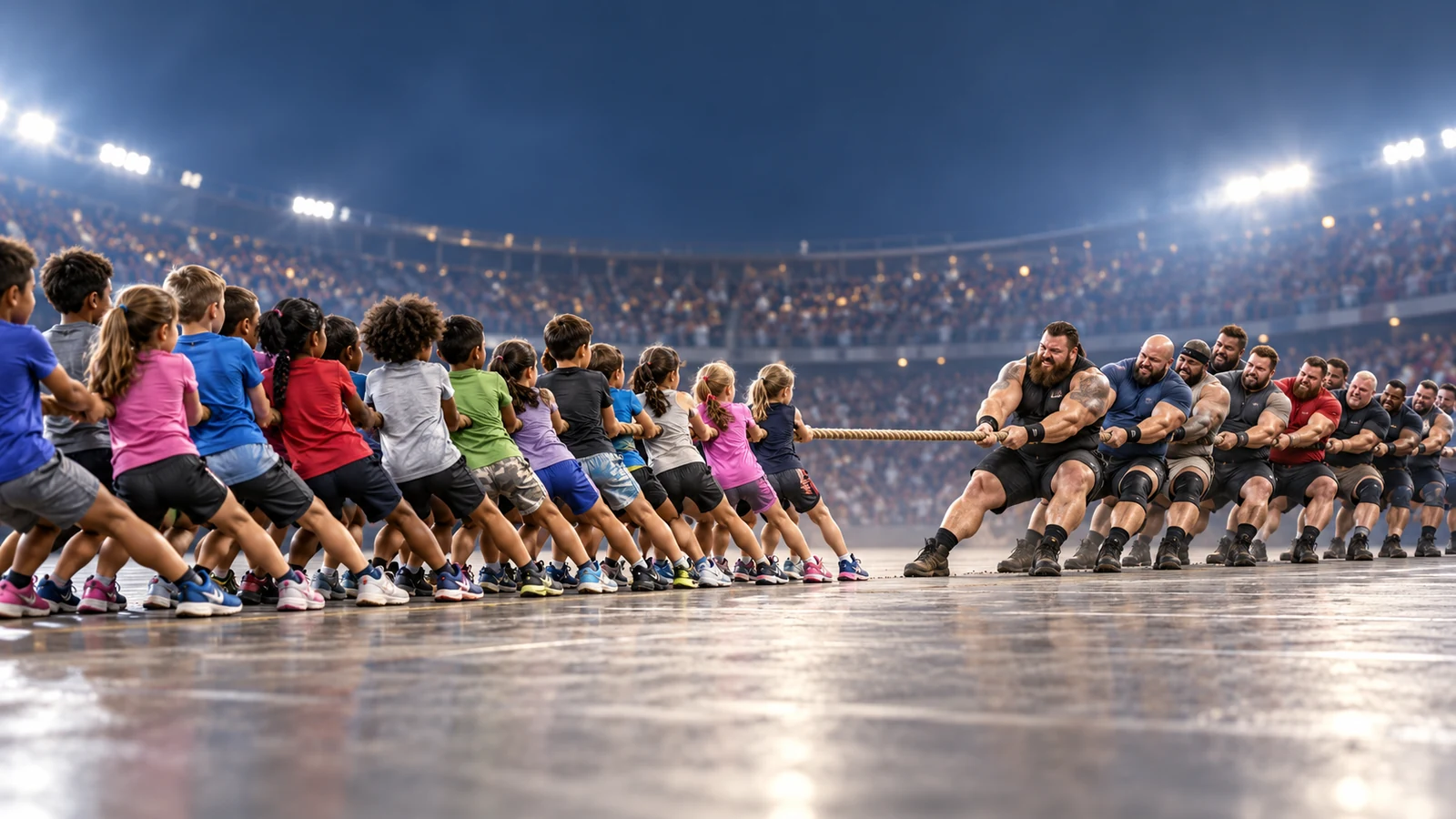

One hundred children beat ten strongmen in the final tug-of-war round of MrBeast’s October 11, 2025 video, 100 Kids Vs World’s Strongest Man! The upset is real within the filmed challenge. It is not evidence that a child can pull harder than a professional strongman.
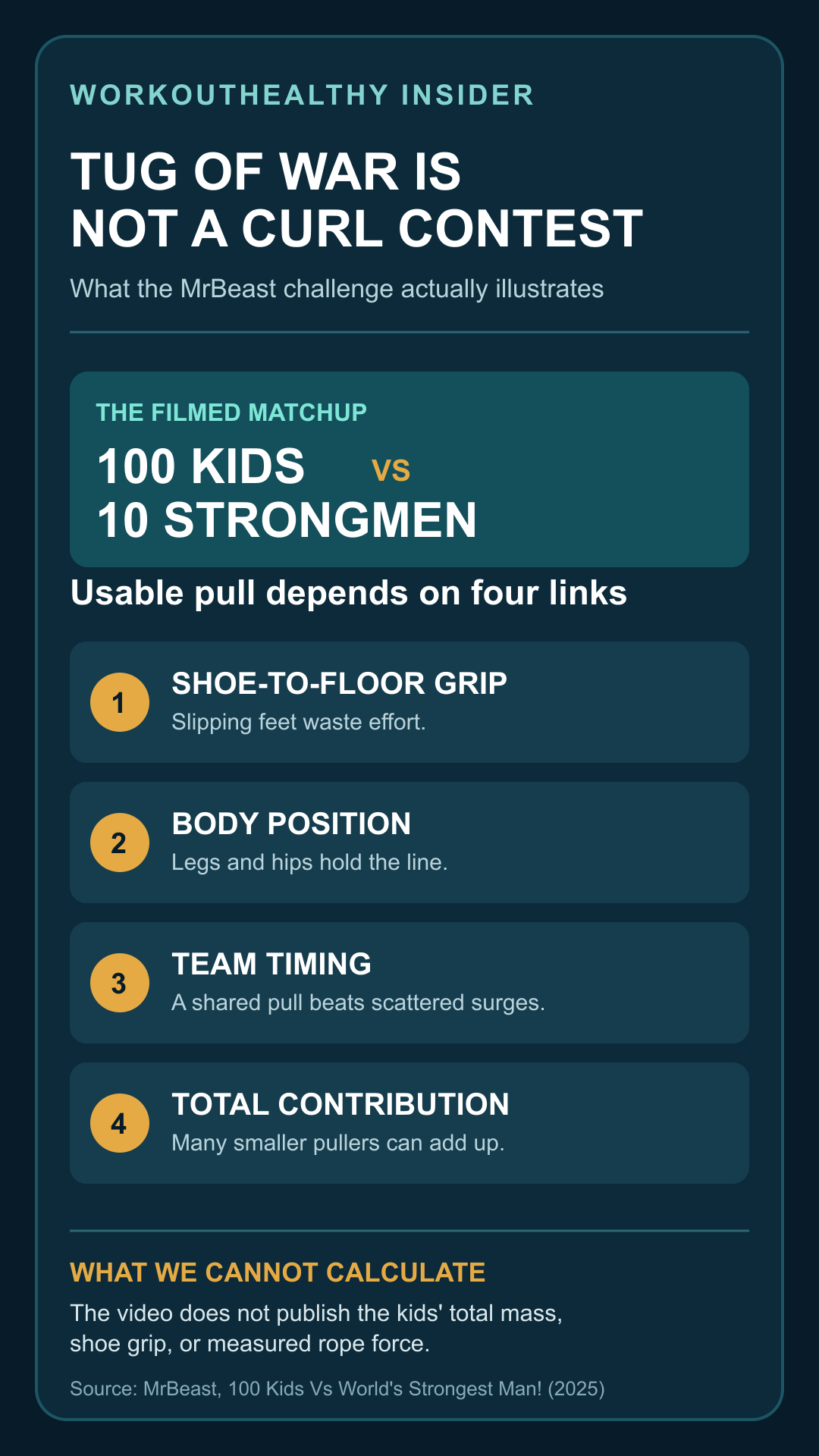
The better explanation is that tug of war is not a simple contest of biceps, backs, or gym numbers. A team can only transfer force into the rope if its members can push against the ground without slipping, hold a useful body position, and coordinate their pull. One hundred smaller athletes can bring a great deal of total mass, many shoe-to-ground contact points, and a long line of people to that problem.
MrBeast’s video says the ten strongmen weighed more than 4,000 pounds combined and held seven world championships. It does not publish the children’s total weight, footwear, measured rope force, or a frame-by-frame test protocol (MrBeast, 2025). That leaves enough information to explain the principles, but not enough to calculate an exact force advantage.
That boundary is important. The physics can explain why the outcome is plausible without pretending the production supplied data that it never measured publicly.
The children did not need every participant to outpull a strongman. They needed the whole line to create more usable force at the rope before either side lost position.
The Video Builds the Match in Stages
The tug-of-war section starts late in the video, after a series of other strength challenges. The children first face the 2019 World’s Strongest Man. When they win, the production adds more strongmen.
The progression moves through four, six, eight, and finally ten strongmen. The final round begins at about 25:45. All one hundred children remain on the other side of the rope, and their line moves the strongmen across the mark.
The video is the correct original source, not a reaction clip or repost. It shows the actual participants and the staged progression that produced the viral claim.
Tug of War Is a Traction Problem
A puller creates rope tension by pushing into the ground. The ground pushes back on the shoes, and that reaction helps the athlete resist being dragged forward. If the feet slip, more muscular effort does not automatically become more useful force at the rope.
This is why body position matters. Competitive pullers lean away from the center, keep the rope close to the body, and use their legs and hips to maintain a stable line. Their goal is not merely to curl the rope toward the chest. They are trying to keep force moving through the feet, body, and hands without losing balance.
Footwear and surface conditions matter too. Tug of War International Federation rules regulate shoes, rope handling, pulling position, and other details because traction and technique can change the contest (Tug of War International Federation, 2022). MrBeast’s challenge was not run as a published federation match, so its setup should not be treated as a laboratory comparison.
The key point is still useful: strength that cannot be transferred through the floor does not decide the pull.
One Hundred Bodies Create a Different System
The strongmen had enormous individual strength. The children had ten times as many participants. That difference changes the system even if every child contributes only a fraction of one strongman’s force.
Each child adds body mass, two contact points with the ground, and another place where force can enter the rope. The team also occupies much more length. If enough of the line remains planted, the opposing side must overcome the combined resistance rather than one person’s gym strength.
We cannot responsibly add up the children’s force because the video does not give their weights or individual outputs. We also cannot assume that all one hundred pulled equally. Some were likely better positioned, heavier, or more synchronized than others.
What the footage does show is a large group moving together well enough to make its scale useful. Total participation can overcome a massive per-person disadvantage.
Coordination Turns Many Pullers Into One Team
A large team has a built-in weakness: people can waste force by pulling at different times or different angles. If one section surges while another stands upright or takes a step, the rope may not receive the full sum of their effort.
The children appear to benefit from a shared count and a visible goal. A coordinated backward lean and repeated steps help turn one hundred separate efforts into a more continuous pull.
Research on competitive tug of war describes the sport as a short-duration maximal-force task, while team rhythm and technique can affect how that effort reaches the rope (Wang et al., 2025). A strong anchor cannot rescue a line that collapses in front. Likewise, a large team cannot use its numbers if the rope goes slack or participants pull across one another.
This is the same broad lesson seen in other sports: force production matters, but the athlete must express it in the exact position and timing the task demands. Our review of low and high repetition strength training explains why gym strength itself also depends on the specific adaptation being tested.
The Result Does Not Make Strongman Strength Fake
The strongmen were specialists in events such as log presses, deadlifts, carries, stones, and loading races. Those contests reward exceptional force and power, often while moving an external implement through a defined course.
Tug of war asks for a different expression of strength. It rewards horizontal force, bracing, traction, pain tolerance, timing, and team organization. Even a world’s strongest man title does not guarantee that one athlete can overcome a hundred bodies connected to the same rope.
The video also does not establish that the ten-man side contained the ten best tug-of-war pullers in the world. It describes them as elite strongmen. That is a meaningful distinction because strength sports have different techniques and rule sets.
A loss in this challenge says nothing negative about the athletes’ legitimate strongman records. It shows that sport strength is specific.
What the Video Cannot Prove
The production is entertainment. Camera cuts, commentary, and the escalating format make the sequence fun to watch, but they do not supply the controls of a research trial.
We are not given the rope’s tension, the exact distance to victory, rest times for the strongmen, the children’s combined mass, footwear specifications, or whether the ground conditions were identical along the full line. The video also does not disclose every rule used to accept a win.
Those omissions do not mean the result was staged. They mean the footage answers a narrower question: in this filmed setup, the children’s team pulled the strongmen across the line.
It cannot tell us how the same groups would perform on an indoor federation lane, on grass, with different shoes, after formal practice, or under a best-of-three format. Treating a viral challenge as a universal law would go beyond the evidence.
Do Not Recreate the Challenge Casually
Tug-of-war injuries can be severe when participants wrap the rope around a hand, wrist, waist, or other body part. Sudden rope movement and falls also create risks for the hands, shoulders, back, and people standing nearby (Fong et al., 2014; Tug of War International Federation, 2022).
Never lock the rope around the body. Use a rope designed for the activity, a clear surface, responsible adult supervision, and rules appropriate to the participants. Children need equipment and distances suited to their size rather than an imitation of a high-budget video.
Strength training can help someone become more capable, but this event is not a reason to test a maximum pull without preparation. Our article on combining strength and cardio training offers a far more practical route to general fitness.
The safest lesson is conceptual, not recreational: the floor, the rope, and the whole team help determine how much force becomes useful.
The Best Explanation Is Team Force, Not a Miracle
MrBeast’s final round worked because the matchup compared exceptional individual strength with extraordinary group scale. The strongmen had the larger athletes. The children had far more bodies, far more contact points, and enough coordination to make that advantage count.
No single factor can be isolated from the public video. Traction, mass, technique, fatigue, timing, and rope position all interact. That is more accurate than saying the children simply wanted it more or that the strongmen were not strong enough.
The outcome is surprising only if tug of war is imagined as an arm-strength contest. Once the ground and the full team enter the picture, one hundred children defeating ten strongmen becomes physically plausible and much more interesting.
Get the next evidence check.
Five practical fitness stories worth your time, every Friday.
One email a week. No product pitches. Unsubscribe in one click.
References
- MrBeast. (2025). 100 Kids Vs World’s Strongest Man!
- Tug of War International Federation. (2022). Rules manual.
- Tug of War International Federation. (2016). Tug of war rules.
- Fong, D. T. P., et al. (2014). Injuries in tug of war: a systematic review.
- Wang, H. K., et al. (2025). Physical characteristics and performance in tug-of-war athletes.
Medical disclaimer: This article is for general information only and is not medical advice. If you have an injury, ongoing pain, or a medical condition, talk to a doctor or physical therapist before you change how you train or eat.