
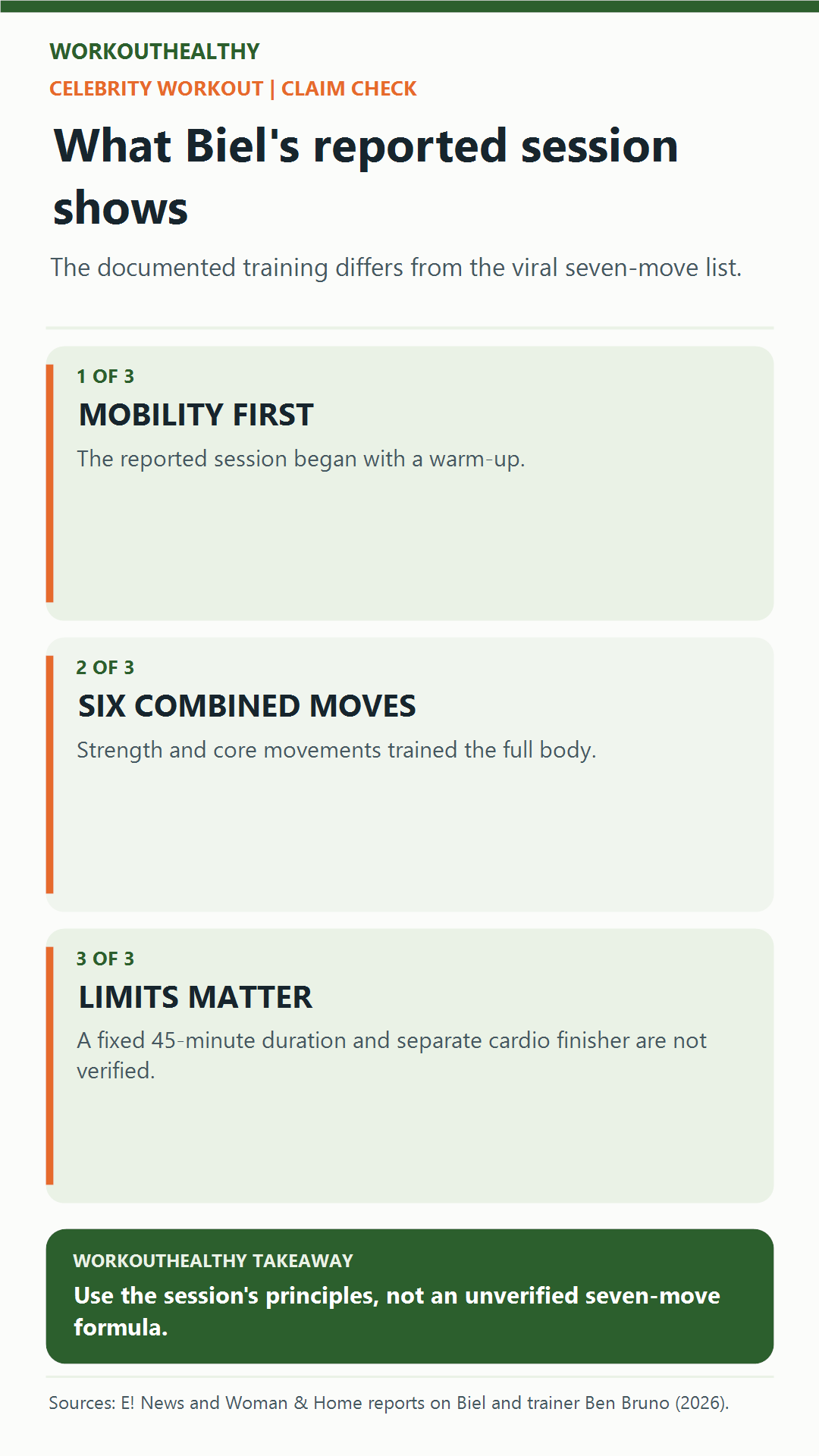
Jessica Biel and longtime trainer Ben Bruno did share a full-body workout that people could borrow from. The report available here describes a mobility warm-up followed by six combined strength-and-core movements; it does not verify a fixed 45-minute duration or a separate cardio finisher.
It was not the viral seven-move formula built from a single-leg deadlift, goblet squat, bench press, one-arm row, lunge, overhead press, and plank rotation. Those are legitimate exercises, but the available record does not show that Bruno presented them as Biel’s exact blueprint.
The Verified Session Began With Mobility
A July 2026 report describes Biel sharing a full-body workout with Bruno. The report lists mobility and six combined movements, rather than the seven-move sequence in the viral caption.
Bruno said the session began with about ten minutes of mobility because Biel enjoys that part of training. A warm-up can raise body temperature, rehearse upcoming positions, and let a coach see how the trainee is moving that day.
Mobility was not included as a decorative extra. Bruno adjusted the lower-body demand because Biel’s legs were still fatigued from the previous workout, which shows that the plan responded to recovery instead of forcing a fixed template.
That is an important detail for anyone copying celebrity training. The exercise list is only one part of programming. The coach also chooses load, range, volume, rest, and substitutions based on the person in front of him.
The Real Strength Work Used Six Main Movements
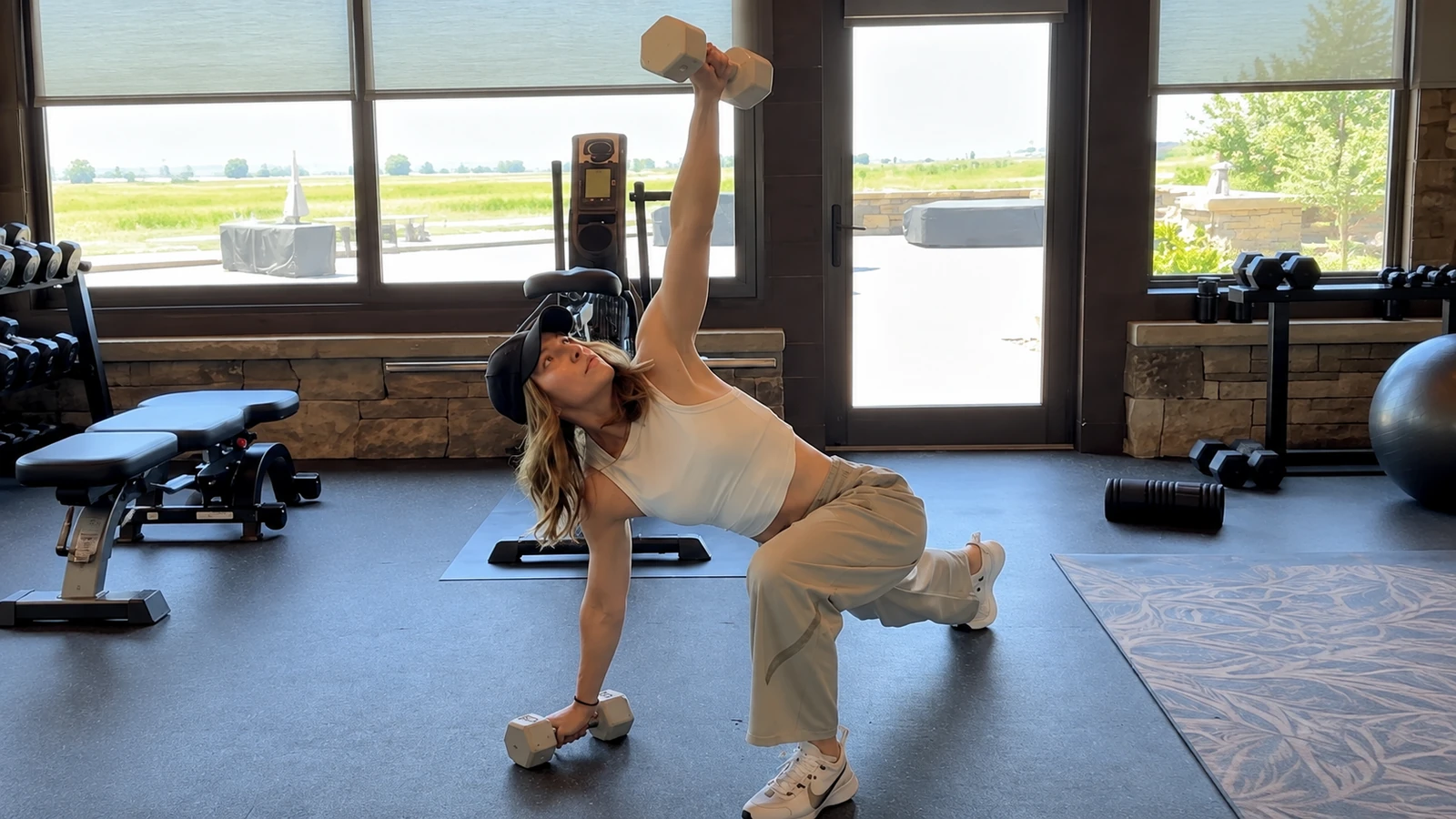
The July report identified six main movements after the mobility work: a lunge with arm rotation, a delt fly to overhead reach, a hip-thrust press, a split-stance batwing row, a lateral raise held in a lunge position, and a side plank with a leg raise.
Several exercises combined upper- and lower-body work. The hip-thrust press paired a bridge position with dumbbell pressing, while the split-stance row asked the legs and trunk to stabilize as the back pulled the weight.
The lateral raise in a lunge position similarly turned a shoulder exercise into a whole-body stability task. The side plank with leg raise combined lateral trunk endurance with hip strength.
These are not beginner exercises simply because they use dumbbells. Holding a lunge while raising weights or adding leg movement to a side plank increases coordination and balance demands.
Bruno openly said people could copy the session or take only selected pieces. That is more responsible than treating the entire workout as mandatory for anyone who owns two dumbbells.
Where the Viral Seven-Move List Goes Wrong
The viral caption names seven familiar patterns and attributes the formula to Biel’s trainer. A search of the reported session, Bruno’s current program descriptions, and coverage of Biel’s recent training does not produce that exact sequence.
The list resembles a generic full-body dumbbell routine. It contains a knee-dominant exercise, a hip hinge, horizontal pushing and pulling, unilateral leg work, vertical pressing, and rotational core work.
That balance makes the list plausible, which is one reason an invented celebrity routine can spread easily. Plausibility is not the same as attribution.
The caption also calls plank rotations anti-rotational work, but a plank rotation intentionally creates trunk rotation. A true anti-rotation exercise asks the torso to resist turning, as in a Pallof press or an offset carry.
It describes single-leg deadlifts as posterior-chain bulletproofing, language that overpromises what an exercise can do. A hinge can strengthen the hamstrings, glutes, trunk, and balance strategy, but no movement makes tissue injury-proof.
Finally, the claim that the routine can simply be performed as a circuit for functional capacity or straight sets for pure strength removes important variables. Strength development depends on load, repetitions, proximity to fatigue, rest, technique, and progression, not only on whether exercises are grouped or separated.
Biel’s Broader Training Is Full Body, Not a Fixed List
Bruno has described training Biel with full-body sessions for more than a decade. For a recent acting project, he said a session might include one back exercise, one shoulder exercise, one triceps exercise, plus leg and abdominal work.
Another documented workout used a four-exercise dumbbell complex performed without putting the weights down. Bruno explained that the combination covered the body and raised heart rate when Biel had limited time or energy.
These examples show a method rather than one permanent workout. Biel trains several movement categories, uses resistance appropriate to the exercise, includes mobility, and adjusts the session to schedule and recovery.
Our article on what one-dumbbell workouts can really do explains why a simple tool can support strength and conditioning without becoming a complete solution by itself.
The evidence on low reps versus high reps also shows why repetition ranges should reflect the goal instead of a celebrity name.
How to Adapt the Verified Workout
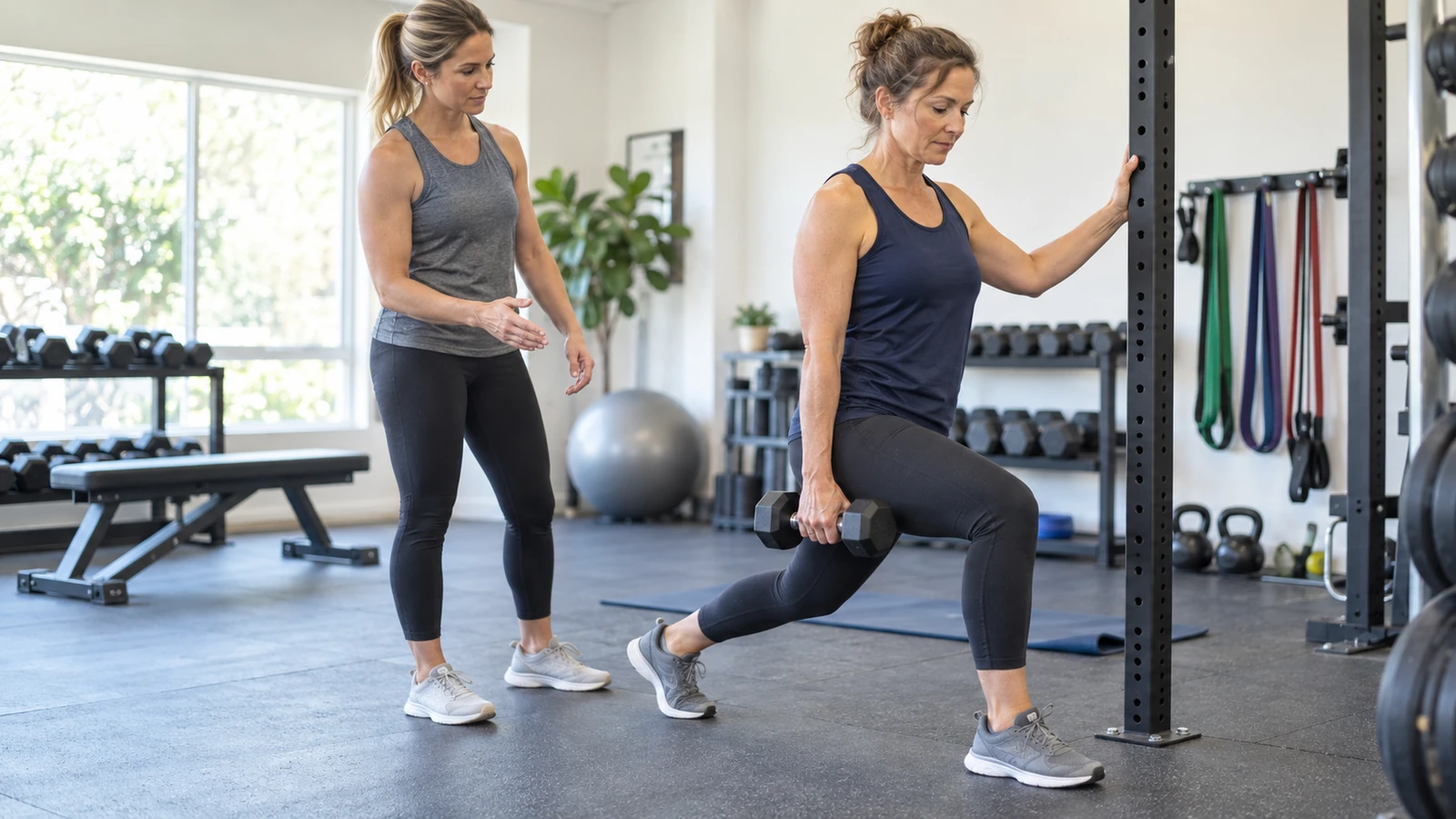
A beginner does not need to reproduce Biel’s combined movements immediately. The session can be separated into simpler patterns that preserve the purpose.
- Lunge with rotation: Begin with a supported split squat and add a small bodyweight rotation only when balance is steady.
- Delt fly to reach: Use no weight or very light dumbbells, because the long lever makes small loads challenging.
- Hip-thrust press: Practice a floor bridge and a floor press separately before combining them.
- Split-stance row: Use a bench or chair for support and keep both feet firmly planted.
- Lunge-position lateral raise: Perform the raise while standing, or hold a shallow split stance rather than a deep lunge.
- Side plank with leg raise: Start with the lower knee on the floor and omit the leg raise.
Choose a weight that allows controlled repetitions without changing joint position to finish the set. Stop the set when technique clearly breaks down rather than treating Biel’s load as a target.
Progress one variable at a time. A person might add a repetition, then a small amount of weight, then a more difficult variation after the current version feels stable.
Load selection should also change across exercises. The dumbbells used for a hip-thrust press will usually be heavier than those used for a delt fly or lateral raise, because smaller shoulder muscles work with a longer lever in the raise. Using one pair for the entire session may be convenient, but it can make one movement too easy and another too difficult.
Rest long enough to reproduce clean repetitions. Advanced trainees sometimes shorten rest for conditioning, while a beginner often learns faster with more time between sets and fewer combined movements.
Circuit Training and Straight Sets Serve Different Needs
A circuit moves through several exercises with limited rest. It can make a session time-efficient and create a larger conditioning demand, but fatigue may reduce the load or technical quality possible on later movements.
Straight sets repeat one exercise with longer rest before moving on. This structure often makes it easier to practice a movement and use heavier resistance, though it is not automatically pure strength training.
Neither format is universally better. A trainee who wants to improve a squat may use straight sets for that lift and finish with a short circuit of simpler accessories.
The review of circuit training benefits and limits can help readers choose based on time, skill, and conditioning rather than a promise that one format is more functional.
A Simple Full-Body Framework Is More Honest
People who want a less complex version can build a session around a squat or split squat, a hinge, a push, a pull, a carry or trunk exercise, and optional conditioning. Two or three strength sessions per week can be enough for meaningful progress when the work gradually becomes more challenging.
Ben Bruno’s own beginner program uses full-body strength work two or three days per week, a complete warm-up, and detailed exercise coaching. His description emphasizes foundations and progress rather than a new viral movement every week.
That approach is closer to the real lesson of Biel’s training. The exercises change, but the program continues to cover the body, respond to recovery, and build skill over time.
The Real Workout Is Better Than the Myth
The viral seven-move list is not dangerous simply because it lacks celebrity verification. Most of its exercises can belong in a sensible program when they are coached and scaled correctly.
The problem is presenting a generic routine as the exact method behind Biel’s fitness. It erases the decade of coaching, the changes made from one session to another, and the work required to perform advanced combinations safely.
The reported Biel workout offers a more useful model. Warm up, train the full body, adjust volume to recovery, and select loads honestly. Add conditioning if it serves your goal; the cited session report does not establish a mandatory cardio finisher.
Readers do not need Hollywood access to use those principles. They need a repeatable plan, exercises that fit their current ability, and enough patience for ordinary progress to accumulate.
Get the next evidence check.
Five practical fitness stories worth your time, every Friday.
One email a week. No product pitches. Unsubscribe in one click.
References
- Johns, G. (2026). Jessica Biel unveils full-body workout routine. E! News.
- Storr, K. (2026). Jessica Biel’s trainer shares her mobility and strength session. Woman & Home.
- Bruno, B. (2026). Beginner strength training program principles. Ben Bruno.
Medical disclaimer: This article is for general information only and is not medical advice. If you have an injury, ongoing pain, or a medical condition, talk to a doctor or physical therapist before you change how you train or eat.