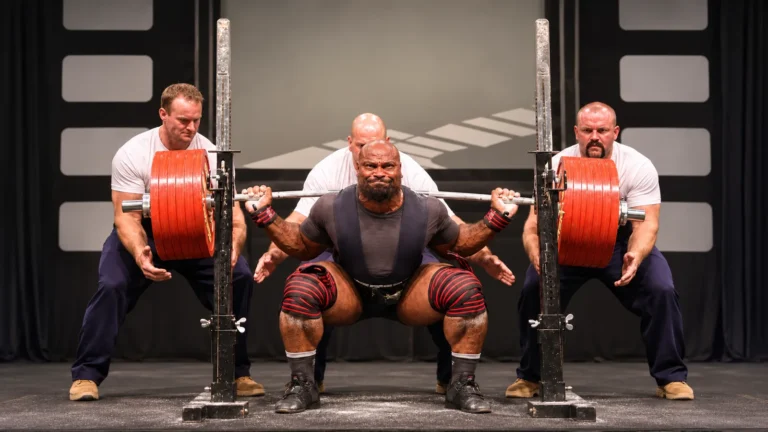

Is a bro split effective? Yes, it can build muscle if you complete enough appropriate work, recover, and keep progressing.
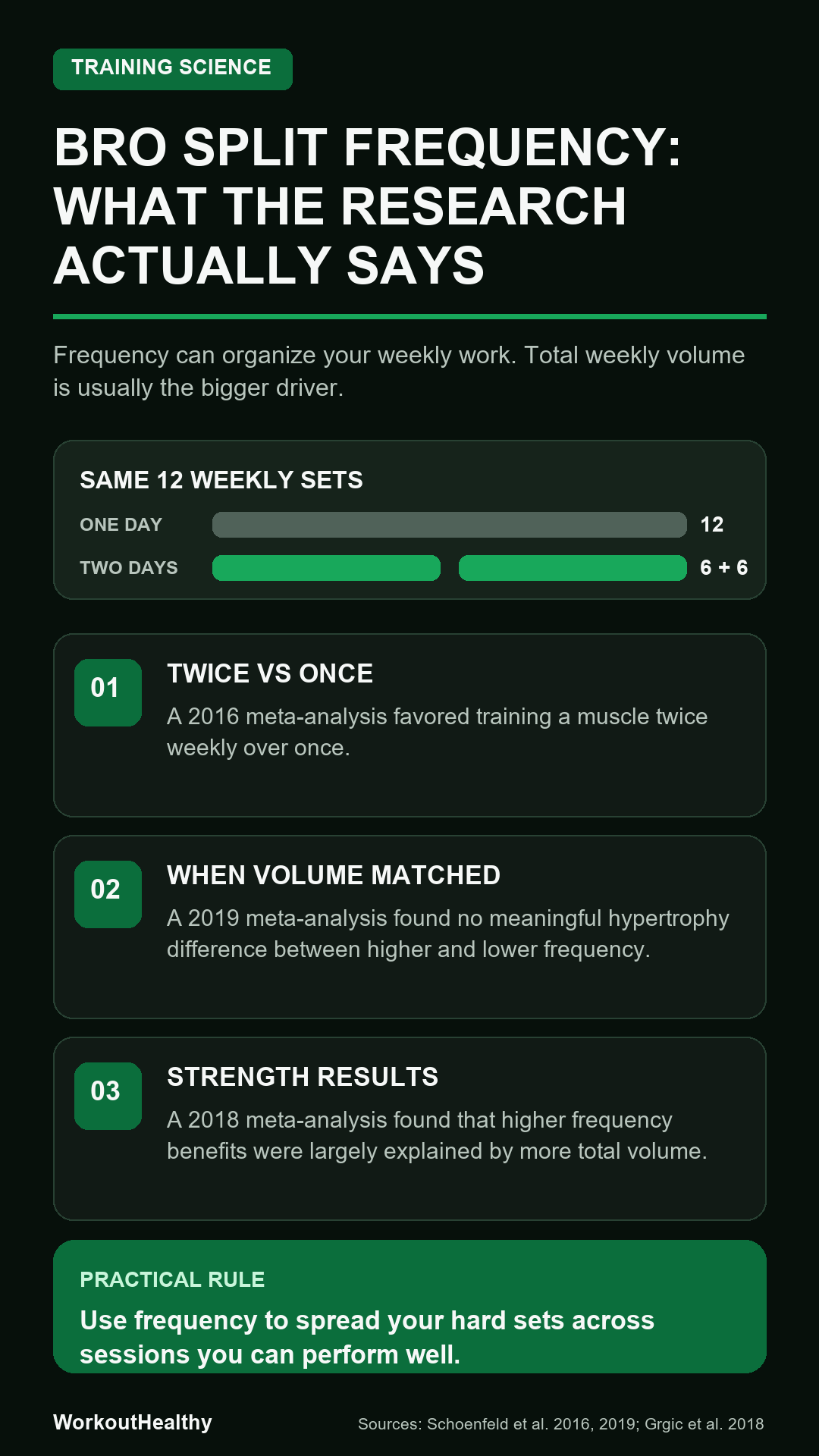
The 2019 frequency review found no meaningful muscle-growth advantage from training a muscle more often when weekly volume was matched. An earlier review favored twice-weekly training, so the evidence deserves a qualified answer.
A bro split usually gives a body part its main session once a week, but exercises overlap: pressing also trains triceps and front shoulders, while pulling uses the biceps. The real choice is where your weekly sets fit best in your calendar.

What counts as a bro split?
A common five-day example gives chest, back, shoulders, arms and legs their own main sessions. The label “once a week” refers to direct focus, not a promise that a muscle is inactive during the other four sessions.
For example, a chest press also asks the triceps and front shoulder to work. A row challenges the back and elbow flexors, so do not assume an arm trained directly later in the week received no work earlier.
What does the frequency research say?
A 2016 meta-analysis favored training a muscle twice rather than once a week in the available volume-equated studies. A larger 2019 meta-analysis also examined volume-equated studies but concluded that frequency itself did not significantly or meaningfully change hypertrophy.
A strength meta-analysis reached a similar volume-sensitive conclusion: higher-frequency groups often did more total work, and the strength advantage was not significant when that volume was matched. These reviews compare training schedules, not every possible bro split against every upper/lower plan.
The American College of Sports Medicine advises healthy adults to train all major muscle groups at least twice weekly as a broad starting point. Its 2026 guidance does not require a named split, and a body-part label alone cannot tell you how often a muscle works directly or indirectly.
A schedule audit you can use
The studies compare training plans, but your own calendar can be checked without borrowing someone else’s set count. Record what you currently do before deciding whether to change the days.
This audit describes a schedule; it does not calculate precise muscle stimulus or prescribe how much work you should perform. A coach can help interpret it if you need an individual plan.
| Question | What to record | What it cannot prove |
|---|---|---|
| How often does each muscle receive direct work? | List the days with exercises primarily focused on that muscle. | A day label does not capture all indirect work. |
| How much work is completed? | Log exercises, working sets, repetitions, load and effort. | Matching a set count does not make two plans equal. |
| Where do muscles overlap? | Note when presses involve triceps or pulls involve elbow flexors. | There is no universal fractional credit for each assisting muscle. |
| Does the schedule fit? | Record session time, missed visits and whether later sets stay controlled. | Convenience alone does not establish a growth advantage. |
That distinction is the practical answer to whether a bro split is effective. It can work, while another arrangement may fit better if a session is too long, easy to miss or difficult to recover from.
Six situations where a bro split may be inconvenient
1. Your schedule cannot support the named days
If you can reliably train two or three days, assigning one large muscle group to each day may leave others with little direct work. A full-body arrangement may fit those visits better.
If five short visits are easier for you than three long ones, a bro split may fit well. The useful schedule is the one you can complete repeatedly.
2. A missed session removes the only direct slot for that muscle
If all your direct leg work sits on one day, missing that visit removes the planned direct leg session for the week. A schedule with direct work on more than one day has a different missed-day consequence.
Neither case proves that one disrupted week causes muscle loss. Log what you actually complete, and discuss a suitable fallback with a coach if missed sessions are frequent.
3. One body-part session becomes too crowded
Putting most work for one body part into a single visit may make that visit longer. Session length depends on exercise selection, rest periods and the amount of work appropriate for you.
Log the time and quality of later sets. If you regularly rush or skip them, discuss whether moving some work would solve the problem without adding unnecessary volume.
4. You mistake frequency for weekly volume
Repeating a full chest day twice without removing sets changes both frequency and volume. If growth improves, you cannot say which change mattered.
When comparing two calendars, record any change in weekly work as well as any change in days. A qualified coach can help choose an appropriate exercise mix and amount for your goal and recovery.
5. You count indirect work as either zero or an exact fraction
Pressing and rowing do involve arms, but the contribution depends on the exercise and effort. There is no universal rule that one bench set equals exactly half a triceps set.
Record each working set under its primary exercise focus, note relevant muscle overlap, and review performance and recovery. This is more honest than turning a rough estimate into precise stimulus arithmetic.
6. You choose a split you dislike and stop using it
A theoretically tidy week does little if you skip its longest day. A body-part split can be useful when focused sessions keep you consistent; a distributed plan can be useful when shorter work for each muscle feels better.
Neither format guarantees results. The repeatable plan with suitable effort, progressive training and enough recovery has the stronger practical case.
Questions to answer before changing a bro split
- Which days and exercises do you actually complete, including working sets, repetitions and load?
- Which exercises are aimed primarily at each muscle, and where do other muscles assist?
- Which training days can you reliably keep, and how long can each session run?
- Does one long session create missed work, declining technique or a recovery problem?
- Would a different calendar address that problem, and does a coach agree the resulting work suits your goals?
A five-minute schedule audit you can copy
Make one row for each working exercise in your current week, then sketch a possible calendar alongside it. This is a discussion worksheet, not a set target or a way to calculate exact muscle stimulus.
| Write down | Current week | Proposed week |
|---|---|---|
| Day, exercise and primary focus | For example: Monday bench press, chest focus | Keep the exercise; record the new day |
| Working sets, reps and load | Record what you completed | Note any change in planned work |
| Other muscles involved | Note triceps and front shoulder for a press | Keep the same overlap note; do not add duplicate sets |
| Time and last-set quality | Record session minutes and whether technique changed | Check whether the new day is practical |
| If this day is missed | Write your current fallback | Discuss a realistic fallback |
If you and a coach decide to change the schedule, log what you complete and whether the sessions become easier to fit. The worksheet cannot prove equal growth, because exercise order, effort and indirect work may change.
Changing exercises, weekly work and frequency together makes any difference harder to interpret. Progress can appear as controlled repetitions, a suitable load increase or another planned improvement without forcing every session to exhaustion.
When a bro split is working and fits your life, its name alone is no reason to abandon it. Use ACSM’s broad twice-weekly guidance for healthy adults as one discussion point when reviewing whether all major muscle groups receive suitable work.
What the studies cannot tell you
The frequency reviews include different programs, populations and durations; they do not establish the best split for every lifter. A volume-matched average also cannot tell you whether a specific person performs later sets well after a long single-muscle session.
The audit table describes your week, not an outcome experiment. Use a training log to compare completed work and the outcome you care about, with individualized advice when needed.
References
- Schoenfeld BJ, Ogborn D, Krieger JW. Effects of resistance training frequency on measures of muscle hypertrophy: a systematic review and meta-analysis. Sports Medicine. 2016;46(11):1689 to 1697. doi:10.1007/s40279-016-0543-8.
- Schoenfeld BJ, Grgic J, Krieger J. How many times per week should a muscle be trained to maximize muscle hypertrophy? Journal of Sports Sciences. 2019;37(11):1286 to 1295. doi:10.1080/02640414.2018.1555906.
- Grgic J, Schoenfeld BJ, Davies TB, et al. Effect of resistance training frequency on gains in muscular strength: a systematic review and meta-analysis. Sports Medicine. 2018;48(5):1207 to 1220. doi:10.1007/s40279-018-0872-x.
- American College of Sports Medicine. ACSM Publishes Updated Resistance Training Guidelines. 2026.
Medical disclaimer: This article provides general fitness information, not medical advice or an individualized training plan. If you have an injury, ongoing pain or a medical condition, ask a doctor or physical therapist about appropriate activity.