
For decades, “running will wreck your knees” was treated as common sense.
Parents said it, coaches said it, and plenty of doctors said it too.
The research points the other way.
A video from the Spark Healthy Runner channel takes the myth apart, and the biggest study on the question backs that up.
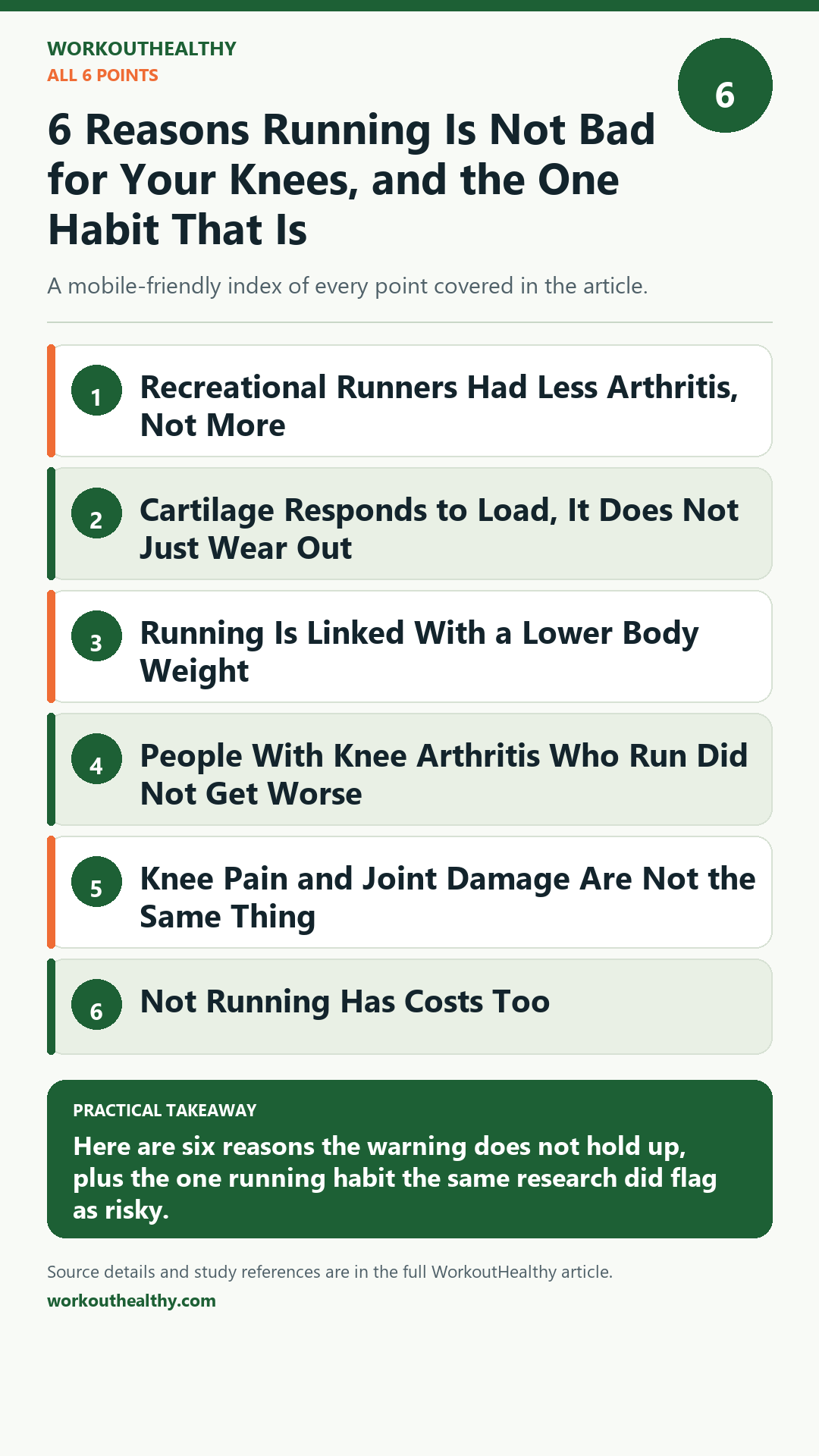
Here are six reasons the warning does not hold up, plus the one running habit the same research did flag as risky.
1. Recreational Runners Had Less Arthritis, Not More
The key study is a 2017 systematic review and meta-analysis in the Journal of Orthopaedic and Sports Physical Therapy.
It pooled 25 studies covering more than 100,000 people.
Recreational runners had a lower occurrence of hip and knee osteoarthritis than both competitive runners and non-running controls.
The reported prevalence was about 3.5 percent in recreational runners.
Competitive runners came in around 13.3 percent.
A sedentary life was associated with more hip and knee arthritis than recreational running was.
2. Cartilage Responds to Load, It Does Not Just Wear Out
The old model treated joints like car tires, with a fixed amount of tread.
Living tissue does not work that way.
Cartilage has no blood supply, so it depends on movement and pressure to move fluid and nutrients in and out.
Regular, moderate loading appears to help that process.
Complete rest is not a neutral option for a joint.
It is its own kind of stress.
Studies that scan knees before and after a run find changes in cartilage thickness that return to normal within hours.
That looks like tissue responding to a load, the same way muscle and bone do.
3. Running Is Linked With a Lower Body Weight

Body weight matters a lot for knee load.
Every step puts several times your body weight through the joint.
People who run regularly tend to carry less body fat than people who do not.
That does not prove running protects the joint by itself.
It does mean the joint is often carrying less load, step for step.
Weight loss is also one of the better studied ways to reduce knee arthritis symptoms.
4. People With Knee Arthritis Who Run Did Not Get Worse
This is the surprising one.
A 2018 study in Clinical Rheumatology looked at people who already had knee osteoarthritis, using data from the Osteoarthritis Initiative.
The researchers compared self reported runners with non runners over several years.
Running was not associated with worse knee pain or with more structural damage on imaging.
That does not mean running is right for everyone with knee arthritis.
It does mean the blanket “never run again” advice is out of step with the data.
5. Knee Pain and Joint Damage Are Not the Same Thing
Imaging changes are common in people with no pain at all.
Plenty of people with cranky knees have clean scans.
Pain is influenced by load, sleep, stress, strength, and how quickly you increased your training, not only by cartilage.
That matters for runners, because most running knee pain comes from doing too much too soon rather than from permanent damage.
The usual fix is a few easier weeks and some strength work, not a permanent ban on running.
6. Not Running Has Costs Too
The alternative to running is rarely a safer form of exercise.
Usually it is less exercise.
Lower activity levels are tied to weaker muscles around the joint, more body fat, and worse cardiovascular health.
If you dislike running, there are many good substitutes.
But quitting movement in order to protect a joint is a bad trade.
Joints do better when the muscles around them are strong and used regularly.
The Habit the Research Actually Flagged
Here is the honest other half of the 2017 review.
Competitive runners, the group with the highest volume and intensity over many years, had a higher occurrence of hip and knee arthritis than recreational runners.
The authors pointed at two ends of the curve.
A sedentary lifestyle on one side, and long exposure to high volume or high intensity running on the other.
Both were associated with more hip and knee osteoarthritis.
The middle, ordinary recreational running, looked like the safest place to be.
For most people reading this, that is the relevant zone.
A few miles a few times a week is not the exposure that showed up as a problem.
Where the Myth Came From
The warning was not invented out of thin air.
Doctors saw plenty of runners with knee pain, and plenty of older adults with worn joints.
It is easy to connect those two things and assume one caused the other.
Elite athletes added to the picture, since decades of very high mileage and old injuries do show up in the data.
The jump in logic was applying an elite workload to a person running three times a week for 30 minutes.
That is the same mistake as warning office workers about rotator cuff wear because major league pitchers need shoulder surgery.
Signs Your Knees Are Handling Running Well
- Soreness after a run settles within a day or two.
- Discomfort fades as you warm up rather than building.
- You can climb stairs normally the next day.
- The knee does not swell, catch, or feel unstable.
- Your weekly mileage is going up slowly and your pace is improving.
If those hold, you are almost certainly fine to keep going.
If two or more do not, take a week of easy walking and cut your next running week in half.
What This Evidence Does Not Prove
These are observational studies, not randomized trials.
People who run tend to differ from people who do not in many ways, including weight, age, and general health.
It is also possible that people whose knees already hurt stop running, which can make runners look healthier than they are.
The 2017 review pooled studies with different definitions of “competitive,” so that number should be read loosely.
The 2018 osteoarthritis study relied on self reported running and looked at a specific population of older adults.
None of this says running is risk free, or that every knee will tolerate it.
Common Mistakes That Actually Hurt Runners
- Adding distance too fast after time off.
- Running every session at the same moderately hard pace.
- Ignoring pain that grows during a run instead of warming up out of it.
- Skipping strength work entirely.
- Running in shoes that are long past worn out.
Strength training supports the joints that running loads, and our guide to squat alternatives by goal is a good place to start if deep knee bending bothers you.
Who Should Talk to a Doctor First
- Anyone with a knee that swells, locks, or gives way.
- Anyone with a diagnosed joint condition or a past knee surgery.
- Anyone with heart disease, diabetes, or uncontrolled blood pressure starting a running program.
- Anyone who is pregnant or recently postpartum.
- Anyone whose pain has lasted more than a few weeks.
A physical therapist can usually get a runner back on the road faster than rest alone.
They can also spot the strength or mobility gap that caused the problem in the first place.
How to Start Running Without Beating Up Your Knees
Build slowly.
Use a run and walk pattern for the first few weeks, such as 1 minute running and 2 minutes walking, repeated for 20 to 30 minutes.
Increase total weekly running time in small steps, not big jumps.
Keep most of it easy.
Most runs should be at a pace where you can hold a conversation.
Save hard efforts for one session a week at most.
Add strength work twice a week.
Focus on the hips, quads, hamstrings, and calves.
Squats, split squats, hip hinges, calf raises, and side leg work all help.
Respect pain rules.
Mild discomfort that fades as you warm up is usually fine.
Pain that grows during the run, changes your stride, or lingers the next day means back off.
Take rest days.
Most beginners do best running every other day.
Two or three runs a week is enough to build real fitness.
Walking on the off days still counts, and our look at daily steps and mortality explains why that matters.
What About Cartilage and Long Term Wear?
Researchers have looked at joint tissue before and after runs, and short term changes tend to recover within hours.
Over years, the pattern in the population data is the one described above.
Moderate running does not show up as a driver of arthritis.
Very high mileage over decades, plus previous joint injury, is where the risk climbs.
If you have had a serious knee injury, that history matters more than the running itself.
Our article on loading a hip hinge safely after 50 covers a similar idea for lifting: the right dose, not zero.
The knee problem in this country is not too much running. It is too much sitting.
Watch the Original Video
Want more common fitness warnings checked against real studies? Subscribe to WorkoutHealthy Insider for practical explanations behind popular fitness claims.
References
Alentorn-Geli, E., Samuelsson, K., Musahl, V., Green, C. L., Bhandari, M., & Karlsson, J. (2017). The association of recreational and competitive running with hip and knee osteoarthritis: A systematic review and meta-analysis. Journal of Orthopaedic & Sports Physical Therapy, 47(6), 373 to 390. https://doi.org/10.2519/jospt.2017.7137
Lo, G. H., Musa, S. M., Driban, J. B., Kriska, A. M., McAlindon, T. E., Souza, R. B., Petersen, N. J., Storti, K. L., Eaton, C. B., Hochberg, M. C., Jackson, R. D., Kwoh, C. K., Nevitt, M. C., & Suarez-Almazor, M. E. (2018). Running does not increase symptoms or structural progression in people with knee osteoarthritis: Data from the osteoarthritis initiative. Clinical Rheumatology, 37(9), 2497 to 2504. https://doi.org/10.1007/s10067-018-4121-3
This article is for general information only and is not medical advice. If you have an injury, ongoing pain, or a medical condition, talk to a doctor or physical therapist before you change how you train or eat.