
Signs of toxic gym culture are worth examining when shared training space stops feeling respectful or usable.
A camera pointed at strangers, a regular claiming a rack or a joke about a beginner can raise a practical question: will the staff address it?
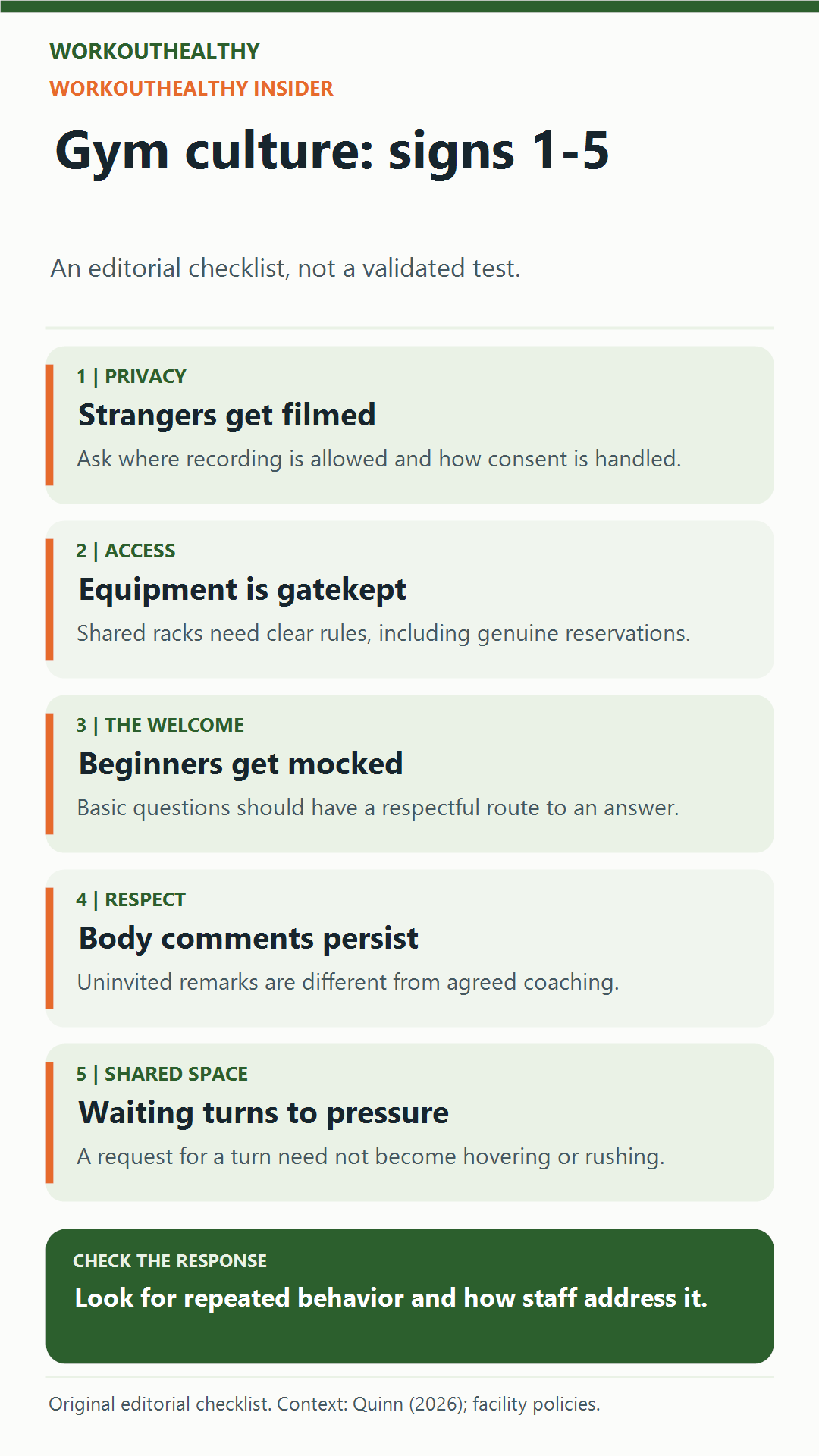
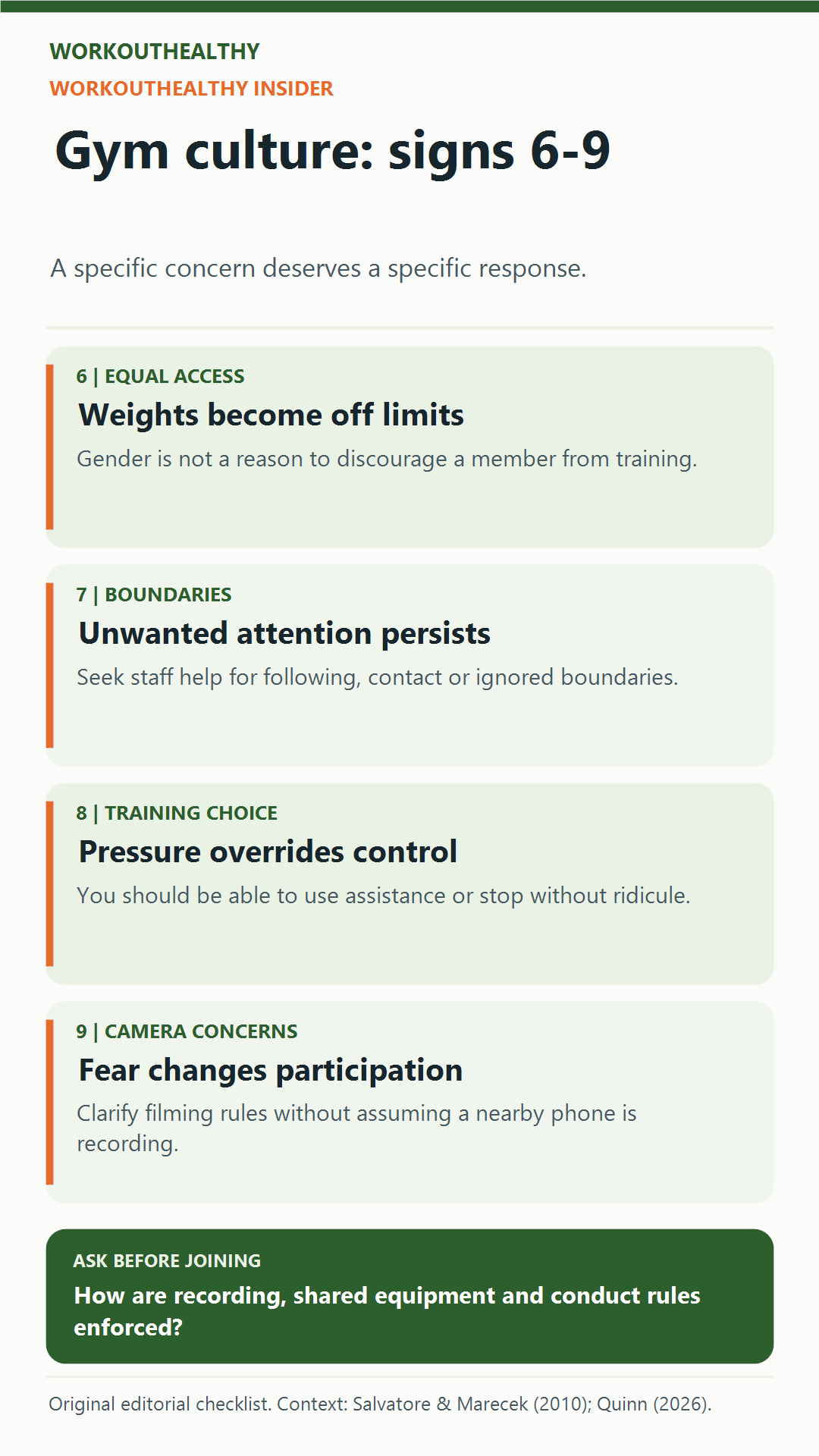
The nine situations below are an editorial checklist, not a validated psychological test or proof that every gym is getting worse.
Research helps explain intimidation, while current facility policies show how some operators define acceptable behavior.
Keep those kinds of evidence separate from viral clips, which cannot establish how often a problem occurs across gyms.
Illustration note: The hero illustrates a member noticing a phone during a dumbbell exercise. It does not document an actual dispute or identify a real person.
Signs 1-3: Privacy, access and the welcome
1. Strangers are filmed without asking
A recording made for someone’s own technique review can still capture another person’s face or voice.
Permission to record yourself should never be treated as permission to publish everyone in the background.
A useful standard is whether members can exercise without being turned into someone else’s content.
Ask staff about the actual filming policy, including where recording is allowed and how they handle a complaint.
Do not assume a phone is recording because it is nearby, but a clear request to stay out of a frame deserves a respectful response.
2. Equipment becomes somebody’s territory
A shared rack should have understandable access rules, including any booked session or class reservation.
Problems arise when a regular claims several stations indefinitely or suggests that another member does not belong in an area.
Check whether staff explain waiting, working in and reservations in a way that applies consistently.
Someone taking a rest between sets is not automatically monopolizing equipment, and a supervised class may have a legitimate reservation.
3. Beginners become a joke
New members need a way to ask basic questions without being mocked for an unfamiliar exercise or machine.
Look for an orientation, visible staff and a clear explanation of how to request help.
A quiet room is not necessarily unfriendly, and nobody has to become your workout partner.
The warning sign is active ridicule or a repeated refusal to explain reasonable access and safety questions.
A member should not have to earn respect by already knowing how to train.
Signs 4-6: Respect in shared space
4. Comments about bodies become routine
An unsolicited remark about someone’s weight, shape, clothing or attractiveness can be unwelcome even when presented as encouragement.
Members can set a boundary without explaining their health history or defending why they look a particular way.
Distinguish an agreed conversation with a coach from repeated personal commentary by someone you have not invited into that role.
For a member, a simple practice is to leave other people’s bodies out of casual feedback and focus on your own session.
5. Waiting turns into pressure or hovering
It is reasonable to ask how many sets remain, then agree on a turn or an appropriate way to share.
Standing over a person, touching their equipment during a set or repeatedly demanding that they hurry creates a different situation.
Staff can clarify the room’s expectations before a disagreement grows.
Equipment scarcity at a busy hour also matters, so observe the gym at the time you would actually use it.
6. Women are discouraged from using the weights
A member’s gender does not tell you which training area they want to use or whether they need advice.
Being redirected away from weights because of an assumption about gender is different from receiving an agreed, individual coaching recommendation.
Observe whether introductions to the free weight area are available to anyone who wants them.
One person’s experience cannot represent every woman’s experience, but an explicit exclusion or stereotype is a concrete issue to raise with staff.
Signs 7-9: Attention, pressure and filming fears
7. Unwanted attention continues after a boundary
Following, repeated personal comments or unwanted contact should not be treated as the price of using a gym.
A brief glance across a room is different from persistent attention, and a short social media clip may omit important context.
Describe the behavior you experienced rather than trying to diagnose another person’s intentions.
Move to staff or another suitable area if you feel unsafe, and seek emergency help for an immediate threat.
8. Pressure to impress overrides your training decision
Members should be able to choose a suitable load, use assistance and stop an exercise without being belittled.
Heavy lifting itself is not evidence of a bad culture, nor is the amount of weight another person chooses a measure of their character.
The concern is pressure to attempt something you have not agreed to or to ignore a clear request for help.
Bring a specific technique or safety question to a qualified coach instead of copying a challenging lift to prove that you belong.
9. Fear of becoming content affects participation
If you avoid asking a question because you worry it will be filmed and mocked, the recording rules deserve clarification.
That concern does not establish that a particular person has filmed you or that every member shares the fear.
Ask whether there is a place to train outside active camera frames and how staff enforce consent.
The important observation is whether the response gives you an understandable way to use the space.
What intimidation research actually establishes
Salvatore and Marecek’s 2010 paper reported four studies examining gender and weight lifting.
In one university sample, women imagining public weight lifting expressed greater evaluation concerns than women imagining aerobic exercise, and those concerns appeared to discourage lifting (Salvatore & Marecek, 2010).
The work also examined cultural images, equipment use and reported discomfort.
It supports attention to social context, but does not establish that all women avoid weights, that discomfort always reflects misconduct or that today’s gyms are worse.
Quinn’s 2026 article proposes the Power-Threat-Meaning Framework as an explanation for some people’s gym anxiety.
It considers how power, perceived threat and personal meaning can shape responses to a setting (Quinn, 2026).
This is a hypothesis and theory article, not a new trial measuring whether a particular policy fixes intimidation.
Its framework also distinguishes gym anxiety from automatically treating a person as having a psychological disorder.
Together, these sources justify examining the environment as well as the individual.
They do not validate our nine-point checklist, supply a national trend line or prove that a viral incident is typical.
What current gym policies say
Life Time’s guest and club policies, effective September 9, 2026, permit personal recording only in public areas with restrictions.
They limit personal images to yourself unless other people give prior express consent, prohibit recording in listed private areas and require recording to avoid disrupting others (Life Time, 2026).
Equinox’s published policies also require permission before capturing other members, guests or staff in areas where personal photography is permitted.
They prohibit recording in private areas and group fitness classes, and disallow commercial recording and professional equipment such as tripods (Equinox, n.d.).
These are examples of current operator rules, not evidence that every branch enforces them perfectly or that all gyms have the same restrictions.
Check your own location’s policy rather than assuming another company’s approach applies.
Equinox also describes respectful conduct and rules for sharing and returning equipment.
A useful conversation with a prospective gym includes how a written rule is explained and what staff do when a member raises a concern (Equinox, n.d.).
A policy becomes useful when a member knows how to ask for it to be enforced.
Questions to ask before joining
Visit during a realistic training hour and ask for specific answers instead of relying on a welcoming advertisement.
You can use the following questions as a personal comparison worksheet, without turning them into a score or a diagnosis:
- Where can members record, and how do you handle people appearing without consent?
- Who should I speak to if someone ignores a boundary or behaves aggressively?
- What is the usual rule for sharing a bench or rack between sets?
- How can a beginner get an introduction to equipment?
- Are class reservations and restricted areas explained before I join?
- What happens after a report, and how can I follow up with a manager?
Watch whether the answers match what you observe, including how staff respond to ordinary questions.
If classes are central to your plan, our guide to CrossFit’s benefits and tradeoffs gives you another way to examine coaching and scaling.
A setting can be technically well equipped and still be a poor fit for your preferences.
You are allowed to compare options without declaring that one uncomfortable visit proves a whole gym is toxic.
A practical response to a specific problem
Start with the concrete issue: what happened, where it occurred and what you need to change.
A request such as keeping you outside a recording frame is easier to address than an argument about whether all influencers are inconsiderate.
Speak to staff, identify the relevant rule and ask who can follow up if the issue repeats.
A private note of the time and situation can help you explain a pattern without filming strangers to create evidence for a public callout.
If the response remains unsatisfactory, compare another session time, class or facility.
You do not have to confront a person directly when you feel unsafe, and a change of setting is not a failure of commitment.
For a different historical approach to welcoming participation, read about Richard Simmons and joyful cardio.
The broader question is whether the environment gives you a reasonable way to participate and return.
The takeaway and original video
Evaluate repeated behaviors and the staff response, rather than treating every awkward interaction as a verdict on the whole gym.
Privacy, access, respectful boundaries and understandable rules offer concrete starting points for that conversation.
Josh Brett’s April 12, 2024 video discusses filming, public shaming and gym confidence.
It is creator commentary and selected examples, not a prevalence study; watch it with the research and policy limits above in mind (Brett, 2024).
Want practical explanations of gym life and training? Subscribe to WorkoutHealthy Insider for useful guides with sources you can check.
References
Brett, J. (2024, April 12). The rise of “toxic gym culture” [Video]. YouTube. https://www.youtube.com/watch?v=YcGkRafBJYg
Equinox. (n.d.). Member policies. Retrieved September 29, 2026, from https://www.equinox.com/member-policies
Life Time. (2026, September 9). Guest and club policies. https://my.lifetime.life/policy/guest-and-club-policy.html
Quinn, F. (2026). Understanding social gym intimidation and anxiety using the power-threat-meaning framework. Frontiers in Sports and Active Living, 8, Article 1712367. https://doi.org/10.3389/fspor.2026.1712367
Salvatore, J., & Marecek, J. (2010). Gender in the gym: Evaluation concerns as barriers to women’s weight lifting. Sex Roles, 63(7-8), 556-567. https://doi.org/10.1007/s11199-010-9800-8
Medical disclaimer: This article is for general information only and is not medical advice. If you have an injury, ongoing pain, or a medical condition, talk to a doctor or physical therapist before you change how you train or eat.