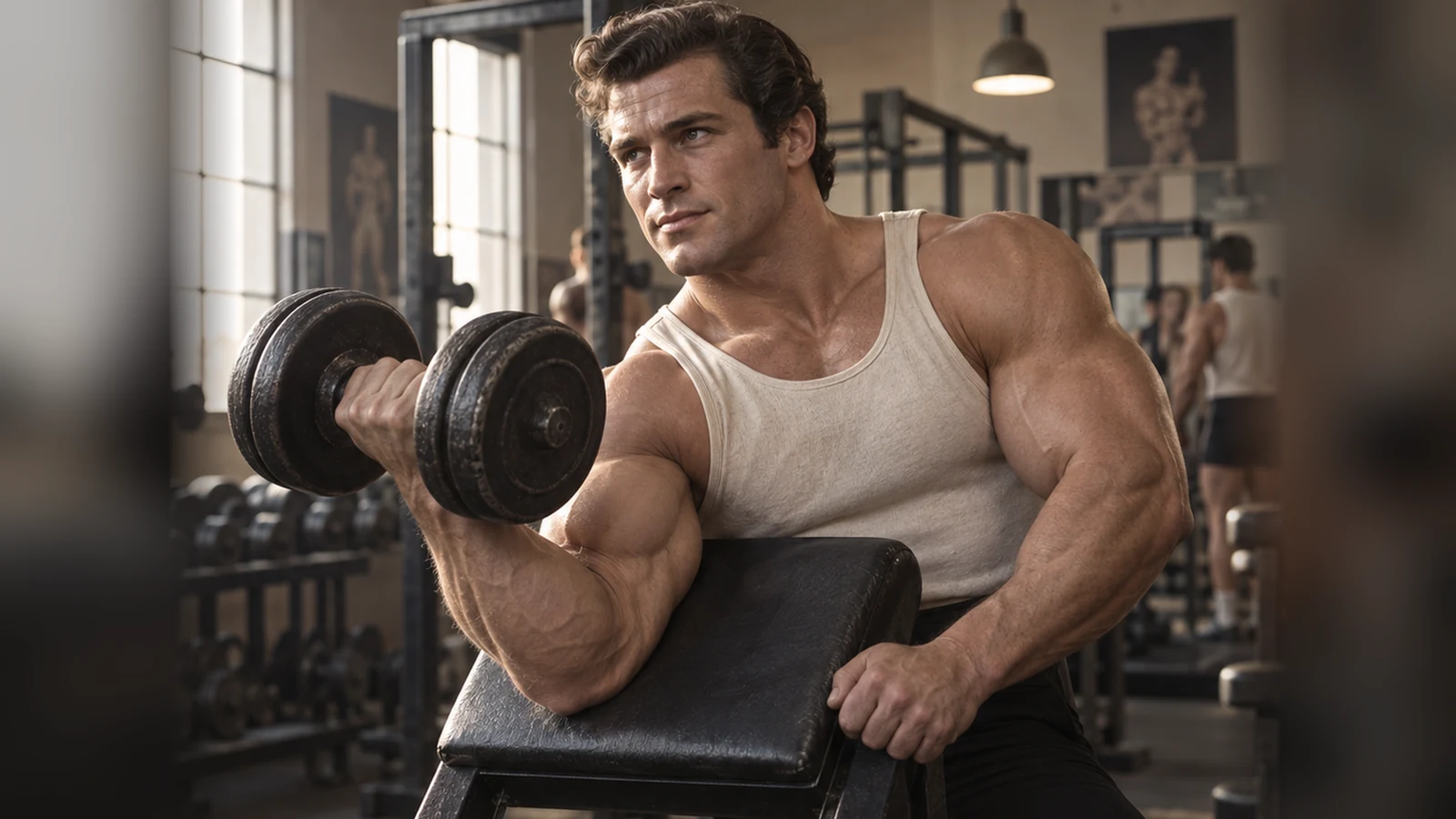

Walk into almost any gym and you will find an angled pad for curls.
Many lifters still call the exercise done there the “Scott curl.”
The name comes from Larry Scott, the first man to win the Mr. Olympia title.
A popular post says Scott popularized the preacher curl bench for strict biceps work with no momentum.
That is accurate, with one important credit that often gets left out.
Who Larry Scott Was
Scott was born on October 12, 1938, in Blackfoot, Idaho.
He died on March 8, 2014, in Salt Lake City, Utah, at age 75.
He won the first Mr. Olympia contest in 1965 and won it again in 1966.
He was best known for his arm development, especially his unusually long biceps.
Wikipedia describes him as the first IFBB professional bodybuilder to build 20 inch upper arms.
Who Actually Invented the Bench
Scott was a student of Vince Gironda, a well known bodybuilder of that era.
According to Wikipedia, Scott credited his biceps to the preacher curl, an exercise invented by Gironda.
Scott used it so much, and became so famous for his arms, that it came to be called the Scott curl.
So the popular post is right that Scott popularized it.
But the credit for the idea itself belongs to his coach.
A widely shared version also promises the exact bench angle and grip Scott used.
We could not confirm those details in reliable sources, so we will not list them.
A pad under your arms does not make a curl strict. Control does.
What the Preacher Pad Does
On a preacher bench, the backs of your upper arms rest on an angled pad.
That makes it hard to swing the weight or lean back to help it up.
The position also keeps your upper arms angled out in front of your body during the curl.
Where the effort peaks during the rep depends on the equipment, such as a barbell versus a cable.
That difference is one of the things researchers have tested.
What Research Says About Preacher Curls
A 2025 study by Kassiano and colleagues compared preacher curls with incline curls in 63 young women over eight weeks.
The incline curl led to a greater increase in muscle thickness near the shoulder end of the elbow flexors.
The preacher curl led to a greater increase near the elbow end.
Strength gains were specific to the exercise each group trained.
A 2020 study by Nunes and colleagues compared barbell and cable preacher curls in 35 young adults.
They trained three times a week for 10 weeks.
Both groups gained elbow flexion strength and biceps thickness.
The barbell group had a greater increase in one of the strength tests, 39% versus 30%.
A 2025 study by Attarieh and colleagues compared preacher curls with a cable curl done with the arm behind the body.
In 15 young men over 10 weeks, both built muscle, with no significant difference between them.
What This Does Not Prove
These studies do not show that the preacher curl is the single best biceps exercise.
They suggest it may favor growth closer to the elbow, while other curls may favor other regions.
The studies lasted only 8 to 10 weeks and involved young adults.
And none of this proves that one exercise built Larry Scott’s arms, since elite physiques reflect years of training, genetics, and much more.
How to Use Preacher Curls Today
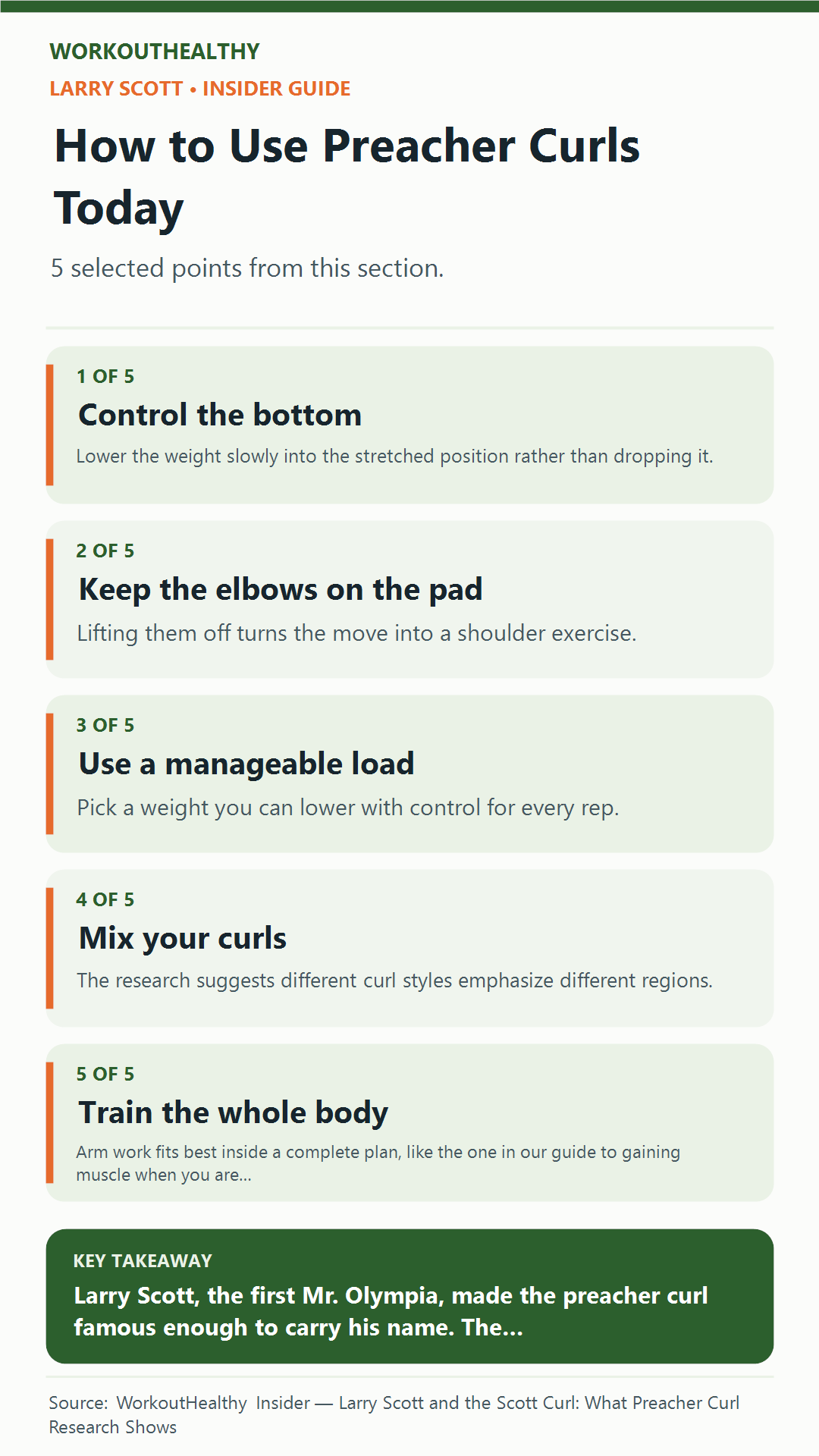
- Control the bottom. Lower the weight slowly into the stretched position rather than dropping it.
- Keep the elbows on the pad. Lifting them off turns the move into a shoulder exercise.
- Use a manageable load. Pick a weight you can lower with control for every rep.
- Mix your curls. The research suggests different curl styles emphasize different regions.
- Train the whole body. Arm work fits best inside a complete plan, like the one in our guide to gaining muscle when you are skinny.
- Learn from modern pros. Today’s Mr. Olympia contenders still build around smart exercise choices, as this look at Derek Lunsford’s back workout shows.
A Sample Preacher Curl Plan
Here is a simple way to add the exercise to a weekly routine.
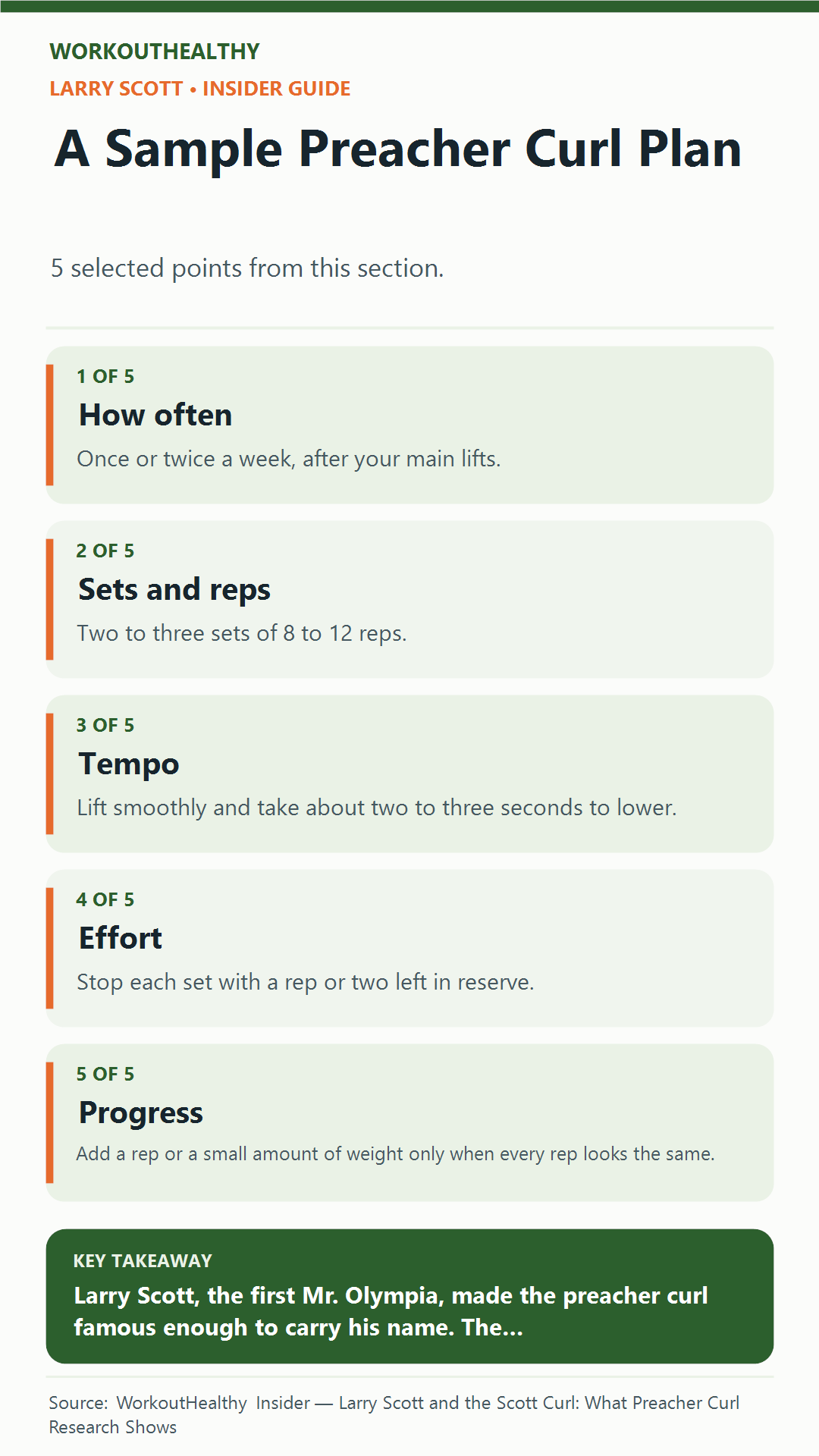
- How often. Once or twice a week, after your main lifts.
- Sets and reps. Two to three sets of 8 to 12 reps.
- Tempo. Lift smoothly and take about two to three seconds to lower.
- Effort. Stop each set with a rep or two left in reserve.
- Progress. Add a rep or a small amount of weight only when every rep looks the same.
- Pairing. Rotate in an incline curl or cable curl on other days for variety.
Beginners can start with a single set and a light dumbbell to learn the position.
Common Mistakes
- Bouncing out of the bottom. A jolt with straight arms can strain the elbow.
- Going too heavy too soon. Strict form limits the weight you can use, and that is the point.
- Cutting the range short. Partial reps skip part of the muscle’s working range.
- Doing only preacher curls. Variety covers more of the muscle.
Who Should Be Careful
Heavy loads with the arms nearly straight can strain the biceps tendon.
A 2008 case report by Rokito and Iofin described a recreational lifter who tore both distal biceps tendons at once during a preacher curl.
That is a rare event, but it is a reason to respect the bottom of the lift.
People with elbow pain, past biceps injuries, or tendon problems should talk to a physical therapist before using heavy preacher curls.
If you feel a sudden pop or sharp pain at the front of the elbow, stop and get it checked quickly.
The Bottom Line
Larry Scott, the first Mr. Olympia, made the preacher curl famous enough to carry his name.
The exercise itself is credited to his coach, Vince Gironda.
Modern studies suggest preacher curls build the biceps well, especially near the elbow, when done with control.
Want more stories like this? Subscribe to WorkoutHealthy Insider for practical explanations behind popular fitness claims.
References
- Attarieh, P., Nunes, J. P., Khani, S., Negahdar, S., Goli, A., Nazarirad, H., Nazarirad, S., Mojtahedi, S., Nosaka, K., & Soori, R. (2025). Comparison between shoulder flexed and extended positions in elbow flexion resistance training on regional hypertrophy and maximum strength: Preacher versus Bayesian cable curls. European Journal of Sport Science, 25(4), e12279. https://doi.org/10.1002/ejsc.12279
- Kassiano, W., Costa, B., Kunevaliki, G., Lisboa, F., Stavinski, N., Prado, A., Tricoli, I., Francsuel, J., Lima, L., Nunes, J. P., Ribeiro, A. S., & Cyrino, E. S. (2025). Distinct muscle growth and strength adaptations after preacher and incline biceps curls. International Journal of Sports Medicine, 46(5), 334 to 343. https://doi.org/10.1055/a-2517-0509
- Nunes, J. P., Jacinto, J. L., Ribeiro, A. S., Mayhew, J. L., Nakamura, M., Capel, D. M. G., Santos, L. R., Santos, L., Cyrino, E. S., & Aguiar, A. F. (2020). Placing greater torque at shorter or longer muscle lengths? Effects of cable vs. barbell preacher curl training on muscular strength and hypertrophy in young adults. International Journal of Environmental Research and Public Health, 17(16), 5859. https://doi.org/10.3390/ijerph17165859
- Rokito, A. S., & Iofin, I. (2008). Simultaneous bilateral distal biceps tendon rupture during a preacher curl exercise: A case report. Bulletin of the NYU Hospital for Joint Diseases, 66(1), 68 to 71.
- Wikipedia contributors. (n.d.). Larry Scott (bodybuilder). In Wikipedia. Retrieved September 16, 2026, from https://en.wikipedia.org/wiki/Larry_Scott_(bodybuilder)
This article is for general information only and is not medical advice. If you have an injury, ongoing pain, or a medical condition, talk to a doctor or physical therapist before you change how you train or eat.