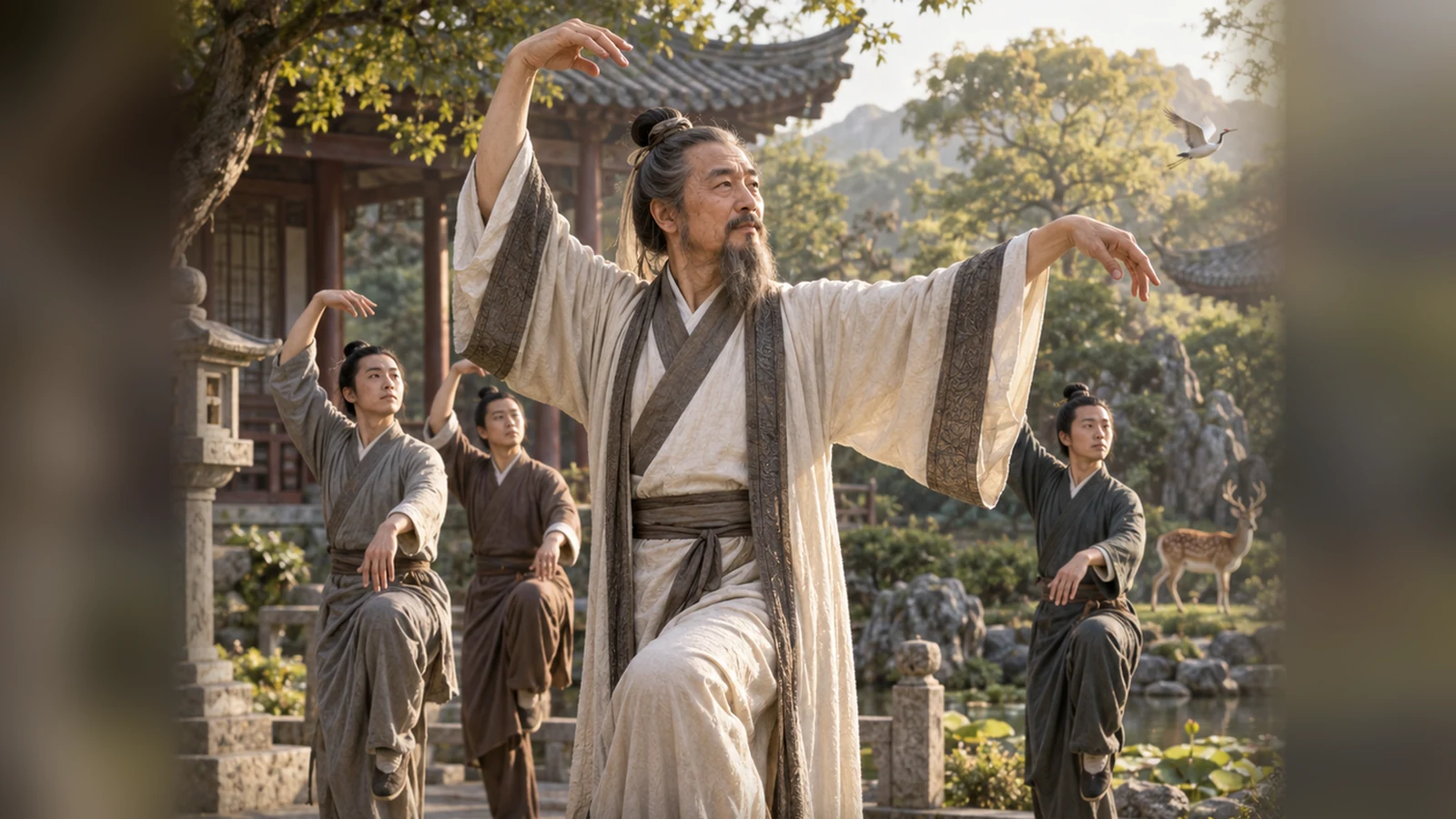

Long before gyms, a Chinese physician built a daily exercise routine around the way animals move.
His name was Hua Tuo, and his routine is known as the Wuqinxi, or the Five Animal Frolics.
A popular post says he taught people to move every day and to stop before exhaustion.
The old record supports the spirit of that advice. The finer details are harder to pin down.
Who Hua Tuo Was
Hua Tuo lived from about 140 to 208 CE.
He is remembered as a renowned physician.
Most of what we know about him comes from two old histories: the Records of the Three Kingdoms and the Book of the Later Han.
Both were written after his death, so some details may have grown in the retelling.
Still, they are the main sources for his exercise teaching.
The Five Animals
According to these histories, Hua Tuo developed the Wuqinxi by studying the movements of five animals.
They were the tiger, the deer, the bear, the ape, and the crane.
A widely shared version calls the ape a monkey. That is a translation choice, not a real disagreement.
The idea was simple. Imitating different animals led the body through different kinds of movement.
The early sources we reviewed do not spell out a precise training target for each animal.
Modern forms of the routine were shaped over many centuries, so they are not a direct copy of his original.
What He Said About Effort
The most useful part of the story is not the animals. It is his view of how hard to work.
One English translation of his biography gives his teaching as: “The human body needs exertion but it shouldn’t be pushed to the limit.”
The same passage says moving the limbs helps digestion and keeps the blood flowing freely.
He compared the body to a door pivot that never rots because it keeps opening and closing.
He also advised that if part of the body felt uncomfortable, a person should get up and do one of the animal exercises until soaked with sweat.
So his advice was not “take it easy.” It was to work until you feel it, then stop short of breaking down.
Why the Door Pivot Image Still Works
A door that swings every day stays loose. A door left shut for years tends to stick.
Hua Tuo used that picture to argue for steady, frequent use of the body.
The image says nothing about lifting heavy or running far.
It is about keeping joints and muscles in regular motion, the way the hinge keeps turning.
That is a useful message for anyone who sits most of the day.
The image also fits his limit on effort.
A hinge that is slammed too hard can fail, just as one left alone can rust.
Move often, work until you feel it, and quit while you still have something left.
What Modern Research Says About Wuqinxi
Wuqinxi is still practiced today as a form of qigong, a slow mind and body exercise.
Researchers have tested it in clinical trials, and a few meta-analyses have pooled those trials.
A 2019 meta-analysis by Zou and colleagues looked at randomized trials in people with risk factors tied to metabolic syndrome.
The authors concluded that Wuqinxi “may be an effective intervention” to ease those risk factors.
They reported positive effects on blood pressure, cholesterol, and triglycerides.
A 2015 meta-analysis by Wei and colleagues looked at Wuqinxi for primary osteoporosis.
It found that Wuqinxi, alone or with other treatment, can improve pain symptoms.
But the effect on bone mineral density was uncertain because of poor study design and inconsistent results.
Those authors suggested practicing for at least six months, five times a week, for about 30 to 60 minutes each time.
What the Research Does Not Prove
These reviews do not prove that Wuqinxi beats other forms of exercise.
The osteoporosis review flagged real quality problems in the trials it pooled.
The studies also tested modern versions of the routine, not Hua Tuo’s exact original.
And no study we found tested his specific rule of stopping just before exhaustion.
What the research does suggest is modest: gentle, regular movement of this kind can help some health markers.
How to Use His Advice Today
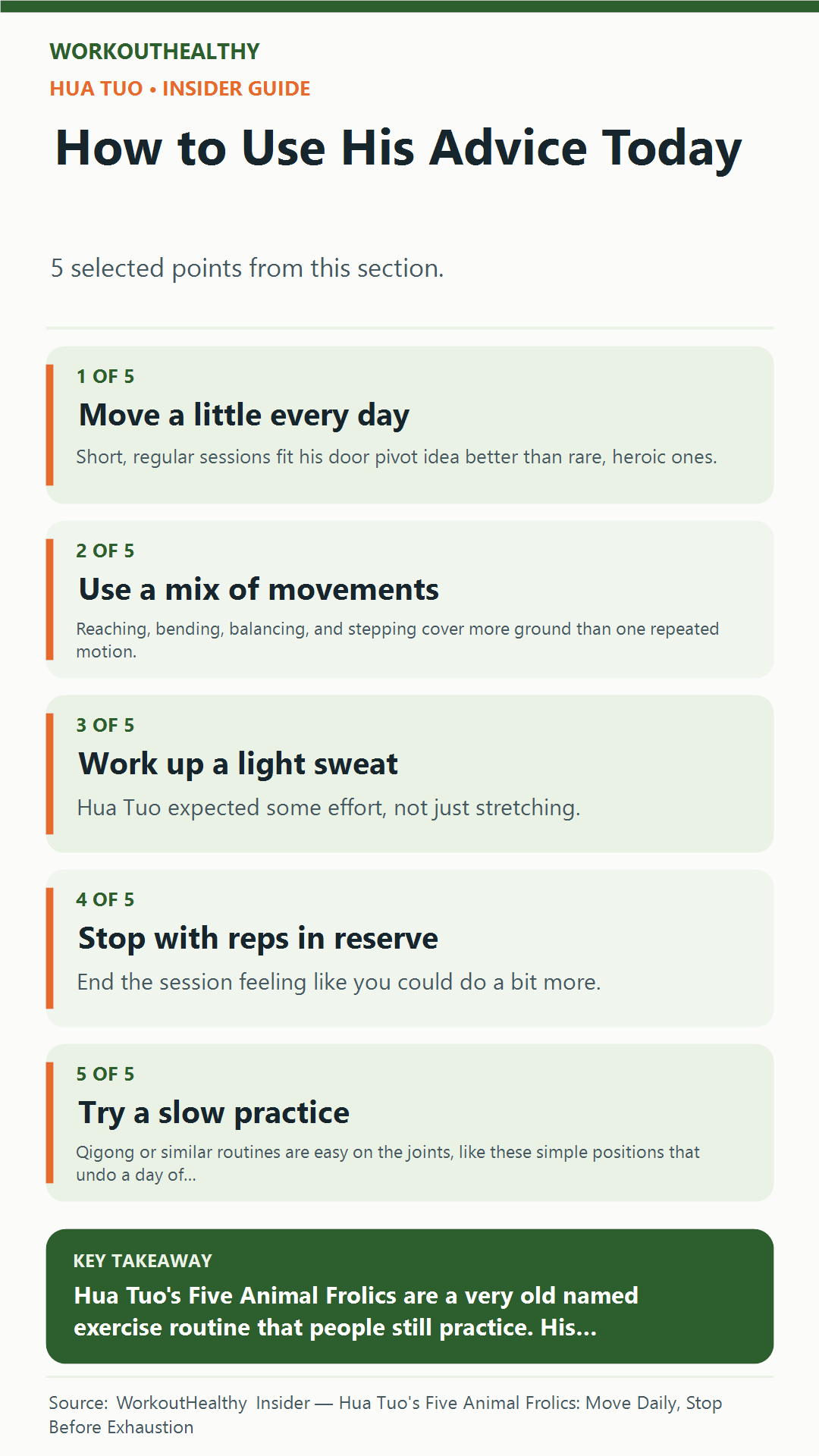
- Move a little every day. Short, regular sessions fit his door pivot idea better than rare, heroic ones.
- Use a mix of movements. Reaching, bending, balancing, and stepping cover more ground than one repeated motion.
- Work up a light sweat. Hua Tuo expected some effort, not just stretching.
- Stop with reps in reserve. End the session feeling like you could do a bit more.
- Try a slow practice. Qigong or similar routines are easy on the joints, like these simple positions that undo a day of sitting.
- Pair it with strength work. Gentle routines do not replace lifting, so see this strength plan for your 40s for a starting point.
Common Mistakes
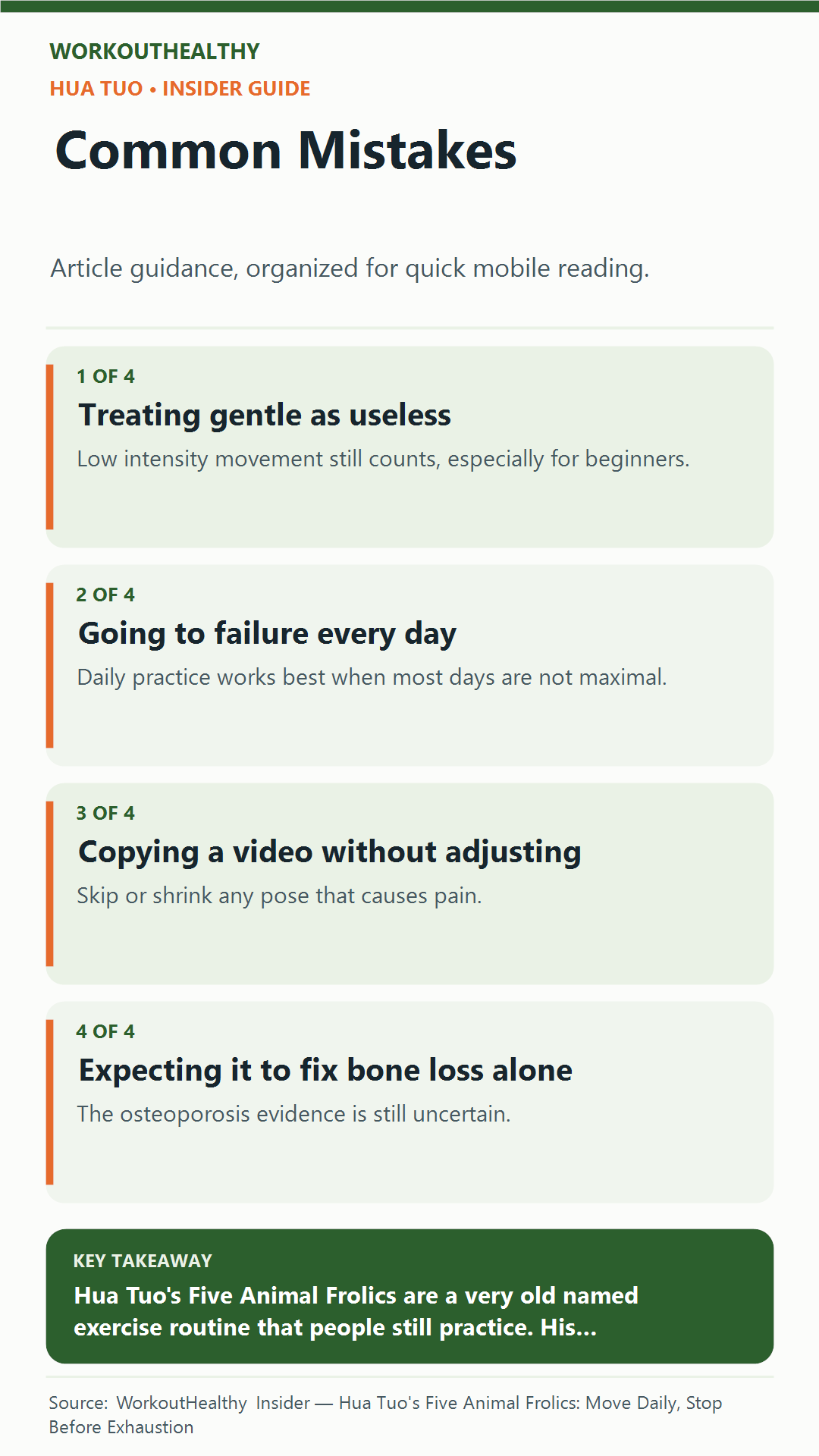
- Treating gentle as useless. Low intensity movement still counts, especially for beginners.
- Going to failure every day. Daily practice works best when most days are not maximal.
- Copying a video without adjusting. Skip or shrink any pose that causes pain.
- Expecting it to fix bone loss alone. The osteoporosis evidence is still uncertain.
Who Should Be Careful
People with osteoporosis should ask a doctor or physical therapist which bending and twisting moves are safe.
Anyone with balance problems should practice near a wall or sturdy chair.
If you have heart or lung disease, get guidance on how hard to push before you start.
Stop and seek care if you feel chest pain, severe shortness of breath, or dizziness.
The Bottom Line
Hua Tuo’s Five Animal Frolics are a very old named exercise routine that people still practice.
His core advice holds up well: move every day, work hard enough to sweat, and do not push to the limit.
Modern trials suggest Wuqinxi can help some health markers, though the evidence is still limited.
Want more stories like this? Subscribe to WorkoutHealthy Insider for practical explanations behind popular fitness claims.
References
- Wei, X., Xu, A., Yin, Y., & Zhang, R. (2015). The potential effect of Wuqinxi exercise for primary osteoporosis: A systematic review and meta-analysis. Maturitas, 82(4), 346 to 354. https://doi.org/10.1016/j.maturitas.2015.08.013
- Zou, L., Zhang, Y., Sasaki, J. E., Yeung, A. S., Yang, L., Loprinzi, P. D., Sun, J., Liu, S., Yu, J. J., Sun, S., & Mai, Y. (2019). Wuqinxi qigong as an alternative exercise for improving risk factors associated with metabolic syndrome: A meta-analysis of randomized controlled trials. International Journal of Environmental Research and Public Health, 16(8), 1396. https://doi.org/10.3390/ijerph16081396
- Records of the Three Kingdoms (Sanguozhi), biography of Hua Tuo.
- Wikipedia contributors. (n.d.). Hua Tuo. In Wikipedia. Retrieved September 16, 2026, from https://en.wikipedia.org/wiki/Hua_Tuo
This article is for general information only and is not medical advice. If you have an injury, ongoing pain, or a medical condition, talk to a doctor or physical therapist before you change how you train or eat.