

Emil Zátopek did not look smooth when he ran.
His face twisted into a grimace, and he often looked like he was suffering.
When asked about it, he reportedly answered, “It isn’t gymnastics or figure skating, you know.”
What mattered was the training behind the grimace.
A popular post says he alternated hard, fast running with short recovery jogs to build speed and endurance together.
That is accurate, though he was not the only person shaping this method.
Who Emil Zátopek Was
Zátopek was born on September 19, 1922, in Kopřivnice, Czechoslovakia.
He died in Prague on November 21, 2000.
At the 1948 London Olympics, he won gold in the 10,000 meters and silver in the 5,000 meters.
At the 1952 Helsinki Olympics, he won the 5,000 meters, the 10,000 meters, and the marathon.
No other athlete has won all three at a single Olympics.
He earned the nickname “the Czech Locomotive.”
How He Trained
World Athletics reports that coach Dr. Ali Haluza introduced Zátopek to interval training.
Zátopek developed enormous sessions, often completing 100 repeats of 400 meters with recoveries between faster efforts.
World Athletics also describes him running 10 to 12 kilometers through deep snow in heavy boots after joining the Czech Army.
His volume was extraordinary and is not a template for recreational runners.
So the core of the popular claim is true. He mixed fast repeats with easy jogging, over and over.
Did He Invent Interval Training?
No, and the popular post does not quite say he did.
World Athletics identifies Dr. Ali Haluza as the coach who introduced Zátopek to intervals, so he did not invent the broader method.
The Olympic Museum separately credits German coach Woldemar Gerschler with systematizing interval training.
Zátopek developed his own high-volume approach and helped make it famous through his results.
Hard efforts build fitness. The easy jogs between them are what let you keep coming back for more.
Why the Easy Jogs Matter
The recovery jog is the part of the workout people tend to rush.
Yet it is what makes the next fast effort possible.
Moving gently between repeats lets your breathing settle and your legs recover a bit.
That means you can run more fast repeats in one session than if you ran hard nonstop.
That extra time at a fast pace is the whole point of the format.
Zátopek’s trotting pace also kept him moving, so the session added up to a large total distance.
For beginners, the lesson is simple.
The easy part of an interval session is not wasted time. It is what lets the hard part happen.
If you cannot keep your fast repeats at a similar pace, your recoveries are probably too short.
What Modern Research Says
Interval training has been studied heavily since Zátopek’s time.
A 2015 meta-analysis by Zoran Milanović and colleagues pooled 28 controlled trials with 723 healthy young and middle aged adults.
Compared with no exercise, continuous endurance training raised VO2 max by about 4.9 milliliters per kilogram per minute.
High intensity interval training raised it by about 5.5.
Head to head, intervals had a possibly small advantage of about 1.2 over continuous training.
Both methods produced substantial improvements.
VO2 max is a measure of how much oxygen your body can use during hard exercise.
Interval length also seems to matter for race style performance.
A 2020 meta-analysis by Michael Rosenblat and colleagues compared high intensity intervals with sprint interval training in moderately trained adults.
Overall, there was no significant difference in time trial performance.
But longer intervals of four minutes or more beat sprint intervals by about 2 percent.
That review included only six studies, so the finding is still early.
For a practical take on this, see the simplest way for runners to raise their VO2 max.
What This Does Not Prove
The research supports intervals in general, not Zátopek’s exact sessions.
His 100 by 400 meter workouts were extreme, even for elite runners.
The Milanović review found only a small edge for intervals over steady running.
In other words, steady running still works well.
Zátopek also ran huge total distances, so his success cannot be credited to intervals alone.
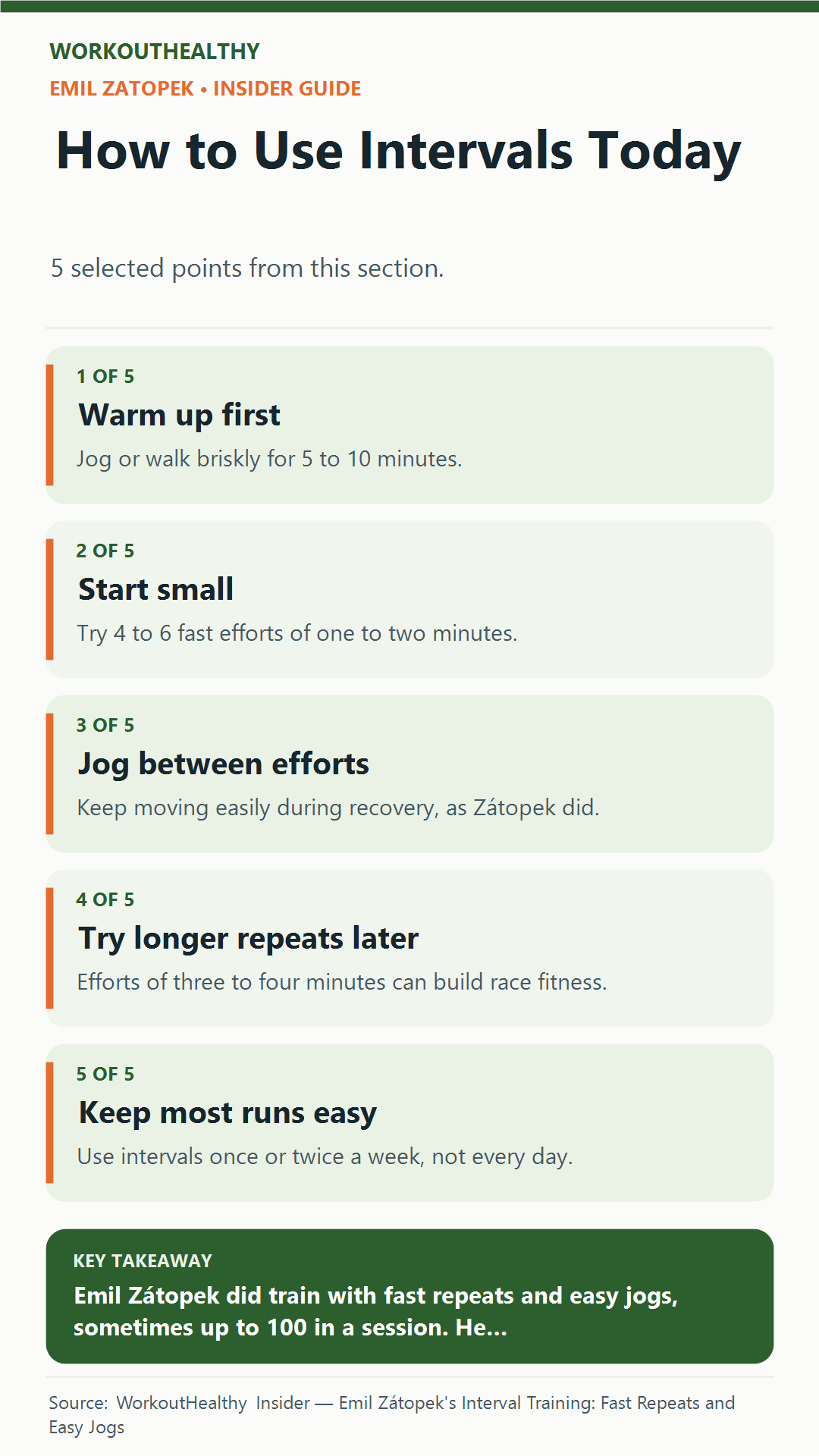
How to Use Intervals Today
- Warm up first. Jog or walk briskly for 5 to 10 minutes.
- Start small. Try 4 to 6 fast efforts of one to two minutes.
- Jog between efforts. Keep moving easily during recovery, as Zátopek did.
- Try longer repeats later. Efforts of three to four minutes can build race fitness.
- Keep most runs easy. Use intervals once or twice a week, not every day.
- Add volume slowly. Increase the number of repeats over several weeks.
If running is not your thing, the same fast and easy pattern works on a bike, a rower, or in the pool.
For a very different take on short, hard efforts, read whether a one minute wall sit can work like cardio.
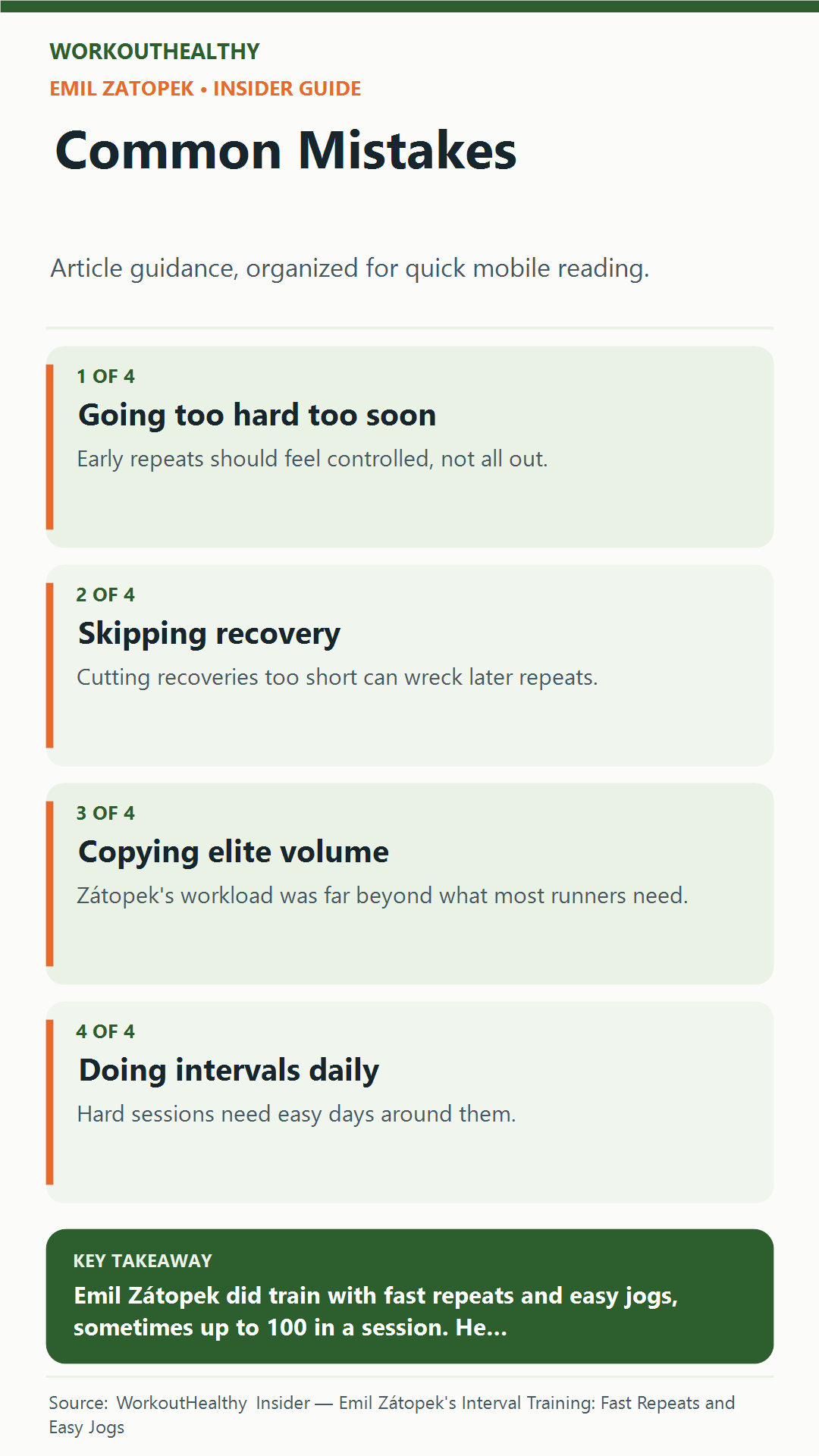
Common Mistakes
- Going too hard too soon. Early repeats should feel controlled, not all out.
- Skipping recovery. Cutting recoveries too short can wreck later repeats.
- Copying elite volume. Zátopek’s workload was far beyond what most runners need.
- Doing intervals daily. Hard sessions need easy days around them.
Who Should Be Careful
High intensity efforts put strain on the heart.
People with heart disease, high blood pressure, or chest pain should talk to a doctor first.
Runners with a history of shin, foot, or tendon problems should add speed work slowly.
Stop if you feel dizzy, faint, or unusually short of breath.
The Bottom Line
Emil Zátopek did train with fast repeats and easy jogs, sometimes up to 100 in a session.
Dr. Ali Haluza introduced him to intervals, while coaches such as Woldemar Gerschler had already helped develop the broader method.
Research shows intervals raise aerobic fitness, with a small edge over steady running.
A few well planned interval sessions a week, paired with easy running, is a sound modern version of his method.
Want more stories like this? Subscribe to WorkoutHealthy Insider for practical explanations behind popular fitness claims.
References
- World Athletics. (2022, September 19). Marking the centenary of the birth of Zátopek. World Athletics.
- Milanović, Z., Sporiš, G., & Weston, M. (2015). Effectiveness of high-intensity interval training (HIT) and continuous endurance training for VO2max improvements: A systematic review and meta-analysis of controlled trials. Sports Medicine, 45(10), 1469 to 1481. https://doi.org/10.1007/s40279-015-0365-0
- Olympic Museum. (n.d.). From fartlek to interval training. Google Arts & Culture. https://artsandculture.google.com/story/from-fartlek-to-interval-training-the-olympic-museum/KgXBPV79_l2TXw
- Rosenblat, M. A., Perrotta, A. S., & Thomas, S. G. (2020). Effect of high-intensity interval training versus sprint interval training on time-trial performance: A systematic review and meta-analysis. Sports Medicine, 50(6), 1145 to 1161. https://doi.org/10.1007/s40279-020-01264-1
- Wikipedia contributors. (n.d.). Emil Zátopek. In Wikipedia. Retrieved September 16, 2026, from https://en.wikipedia.org/wiki/Emil_Z%C3%A1topek
This article is for general information only and is not medical advice. If you have an injury, ongoing pain, or a medical condition, talk to a doctor or physical therapist before you change how you train or eat.