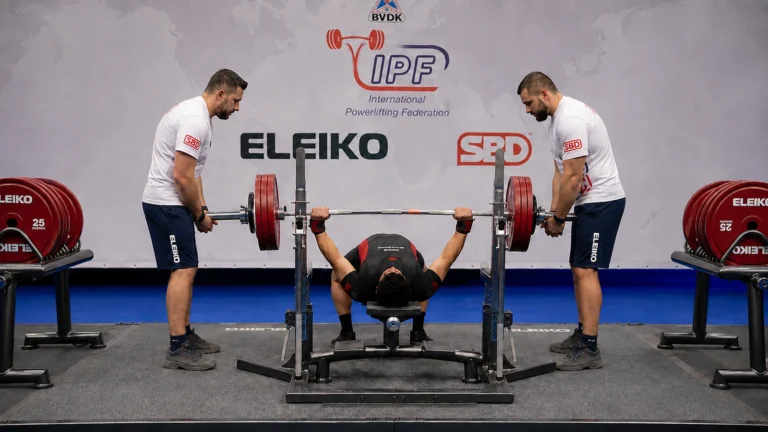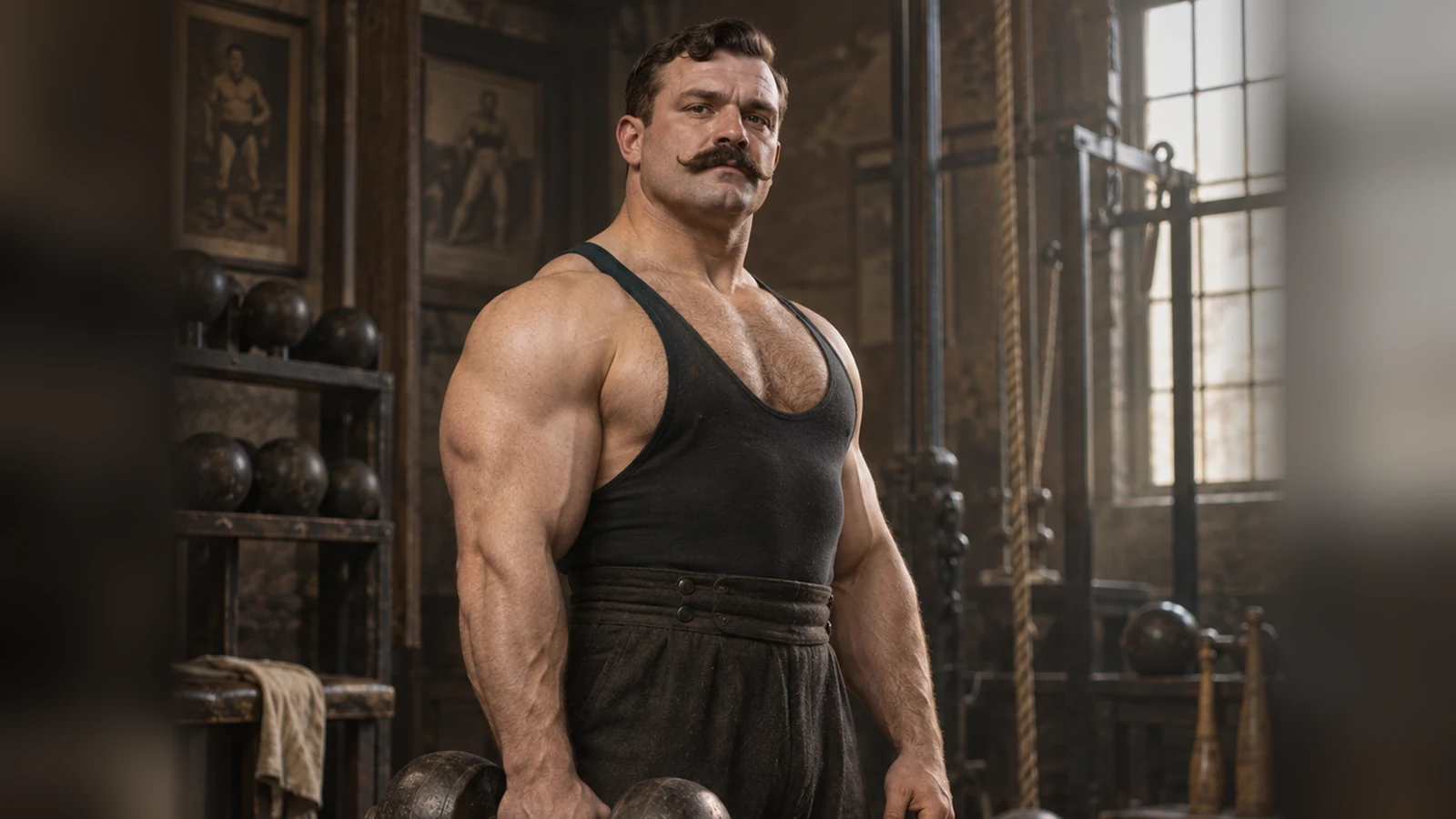

Strength writer George Jowett helped shape early American weightlifting.
He also cared a great deal about hands.
A popular post says Jowett believed grip and forearm work should come after, not before, a base of strength on the big basic lifts.
That sounds like modern programming advice. The question is whether Jowett actually said it.
Here is what his grip course shows, what we could not confirm, and what research says about grip and exercise order.
The Short Answer
Jowett did write a full course on grip training.
We could not find a passage in it that tells readers to build the basics first and add grip work later.
If anything, the course treats grip as a core measure of strength, not an afterthought.
So the “basics first, grip second” rule is better seen as a modern way of framing his work.
That does not make the idea wrong. It just means the credit should be handled with care.
Who George F. Jowett Was
Jowett was born in England in December 1891 and died in July 1969 in Winchester, Ontario, Canada.
He co-founded the American Continental Weightlifting Association in the early 1920s and served as its president.
He edited Strength magazine from 1924 to 1927.
He later worked for Strength & Health magazine before leaving in 1934.
His books included The Key to Might and Muscle in 1926 and The Science of Exercise Specialization in 1938.
By 1955, Muscle Builder magazine was calling him “The Father of American Weightlifting.”
What His Grip Course Actually Says
Jowett published a series of training courses with titles like Molding a Mighty Grip, Molding a Mighty Arm, and Molding a Mighty Back.
A digitized copy of his grip manual, How to Mold a Mighty Grip, is marked copyright 1938.
In it, he called the grip “the barometer of a certain amount of your physical strength and the energy you possess.”
He also made a social case for it, writing that “a firm, strong hand-shake has won many a good job.”
The exercises are old school and creative.
They include lifting iron plates with the fingers, lifting barrels and kegs by the rims, juggling a block weight, and bending a spring lever.
He noted that raising a 75 pound plate with the fingers was generally seen as a sign of a very strong hand.
Your hands are where every pull, carry, and hang begins. Train them on purpose, but put them where they fit your goal.
What Research Says About Grip Strength
Modern science backs Jowett’s view that grip says something about overall strength and health.
The PURE study, published in The Lancet in 2015 by Leong and colleagues, followed 139,691 people in 17 countries.
Median follow up was 4 years.
Each 5 kilogram drop in grip strength was linked to a 16 percent higher risk of death from any cause.
It was also linked to a 17 percent higher risk of cardiovascular death.
The authors reported that grip strength predicted all cause and cardiovascular death better than systolic blood pressure did.
What Research Says About Exercise Order
The “grip after basics” idea is really a question about exercise order.
A 2012 review in Sports Medicine by Simão and colleagues looked at this closely.
It found that people complete more total reps on an exercise when it comes early in a session, whether the muscle group is large or small.
In untrained people, strength gains were greater for the first exercise in a sequence and held back for the last one.
The authors recommended ordering exercises by priority for the training goal, not simply by muscle size.
What This Does Not Prove
The PURE study is observational.
It shows a link between weak grip and higher risk, not that grip training itself lowers that risk.
Grip may simply reflect overall strength, activity, and health, rather than cause better outcomes on its own.
The exercise order review does not say grip work must always come last.
If grip strength is your main goal, the evidence suggests it could deserve an earlier slot.
How to Program Grip Work Today
- Start with your priority. If a big lift is your main goal, do it first. If grip is the goal, give it a fresh slot.
- Protect your main lifts. Heavy grip work before deadlifts or pull ups can tire your hands and limit those sets.
- Let big lifts train grip too. Heavy pulls challenge the hands. For an extreme example, read about the Elephant Bar deadlift record.
- Add simple accessories. Farmer carries, dead hangs, plate pinches, and wrist rollers are easy to add after your main work.
- Pick pulls that fit. Our guide to deadlift alternatives by goal can help you choose.
- Train grip as you age. A strength plan for your 40s is a good place to build it in.
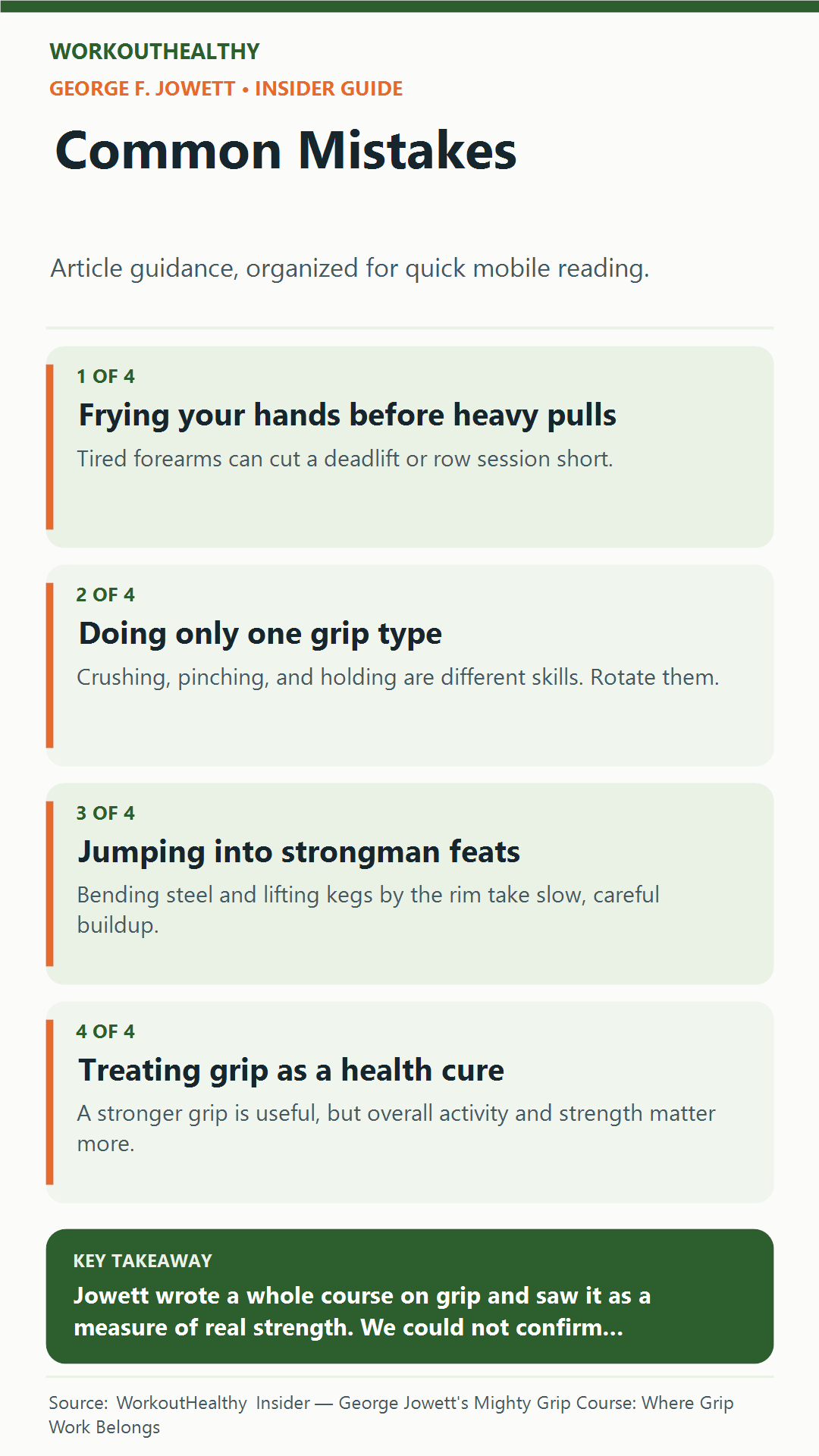
Common Mistakes
- Frying your hands before heavy pulls. Tired forearms can cut a deadlift or row session short.
- Doing only one grip type. Crushing, pinching, and holding are different skills. Rotate them.
- Jumping into strongman feats. Bending steel and lifting kegs by the rim take slow, careful buildup.
- Treating grip as a health cure. A stronger grip is useful, but overall activity and strength matter more.
Who Should Be Careful
People with elbow pain, wrist problems, or carpal tunnel symptoms should add grip work gradually and stop if symptoms worsen.
Old strongman feats like horseshoe bending can strain the hands and wrists and are not a good starting point.
The Bottom Line
Jowett wrote a whole course on grip and saw it as a measure of real strength.
We could not confirm that he told readers to build the basics first and add grip later.
Research supports grip strength as a health marker and shows that exercise order should follow your priorities.
For most people, main lifts first and grip work after is a sensible default, not a law.
Want more stories like this? Subscribe to WorkoutHealthy Insider for practical explanations behind popular fitness claims.
References
- Jowett, G. F. (1938). How to mold a mighty grip. The Jowett Institute of Physical Culture. https://archive.org/details/mighty-grip
- Leong, D. P., Teo, K. K., Rangarajan, S., Lopez-Jaramillo, P., Avezum, A., Jr., Orlandini, A., Seron, P., Ahmed, S. H., Rosengren, A., Kelishadi, R., Rahman, O., Swaminathan, S., Iqbal, R., Gupta, R., Lear, S. A., Oguz, A., Yusoff, K., Zatonska, K., Chifamba, J., . . . Yusuf, S. (2015). Prognostic value of grip strength: Findings from the Prospective Urban Rural Epidemiology (PURE) study. The Lancet, 386(9990), 266 to 273. https://doi.org/10.1016/S0140-6736(14)62000-6
- Simão, R., de Salles, B. F., Figueiredo, T., Dias, I., & Willardson, J. M. (2012). Exercise order in resistance training. Sports Medicine, 42(3), 251 to 265. https://doi.org/10.2165/11597240-000000000-00000
- Wikipedia contributors. (n.d.). George F. Jowett. In Wikipedia. Retrieved September 16, 2026, from https://en.wikipedia.org/wiki/George_F._Jowett
This article is for general information only and is not medical advice. If you have an injury, ongoing pain, or a medical condition, talk to a doctor or physical therapist before you change how you train or eat.