
Watch a skilled lifter move a heavy weight and it rarely looks chaotic.
The bar path is steady, the body is tight, and every rep looks the same.
Pavel Tsatsouline has built much of his teaching around that picture.
His view is that heavy lifting is a practiced skill, and that tension and precision matter on every rep.
Here is where that idea comes from, what motor learning research adds, and how to use tension without overdoing it.
The Skill Idea in His Own Teaching
Tsatsouline is a Minsk born strength coach known for popularizing kettlebells and for founding StrongFirst in 2012.
His books include The Naked Warrior, published in 2003.
His teaching is widely described as rooted in mastering muscle tension.
He returned to the theme on the Huberman Lab podcast in February 2025.
That episode includes a segment titled “Strength as a Skill.”
Published notes from the episode summarize his point simply: strength is a skill, driven heavily by the nervous system.
The same notes quote a practical cue: by gripping tighter, you will instantly increase your strength.
We could not verify every tension cue that circulates online under his name, so this article sticks to the general principles.
What Tension Does
When you squeeze your grip, brace your midsection, and tighten your hips, you create a stiff, stable body.
A stable body gives your working muscles a solid base to push or pull from.
Many coaches believe strong tension in one area can also help nearby muscles fire harder.
Tsatsouline frames it as reducing the brain’s inhibition so more force gets through.
That explanation is plausible, but the exact mechanism is still being studied.
Treat every rep like a rehearsal for your best rep. The weight changes, but the way you move should not.
What Research Says About Strength as a Skill
A 2021 review by Škarabot and colleagues looked at how the nervous system adapts to resistance training.
It says the first increases in force with training are thought to be mainly neural.
The authors describe evidence of changes in motor units and in how the brain controls muscles.
They stress that the exact location of these changes is still unclear.
Still, the big picture supports Tsatsouline’s point.
Getting stronger is not only about bigger muscles. It is also about a nervous system that runs the lift better.
Where Focus Comes In
How you direct your attention during a lift also matters.
A 2019 systematic review by Neumann looked at 16 studies on attentional focus in weightlifting.
Most compared an internal focus, on body parts or muscles, with an external focus, on the movement’s effect.
An external focus was generally better for movement economy.
That included measures like muscle activity and force production.
The review explains this with the idea that an outside focus lets the body run the movement more automatically.
Putting Tension and Focus Together
This research adds a useful twist.
Tension cues work best when they are set up before the rep, then kept without constant self talk.
During the lift, an external cue like “push the floor away” or “drive the bar to the ceiling” may serve you better.
Thinking hard about individual muscles mid rep can make the movement less efficient.
So brace first, then focus on the task.
How to Practice Tension and Precision
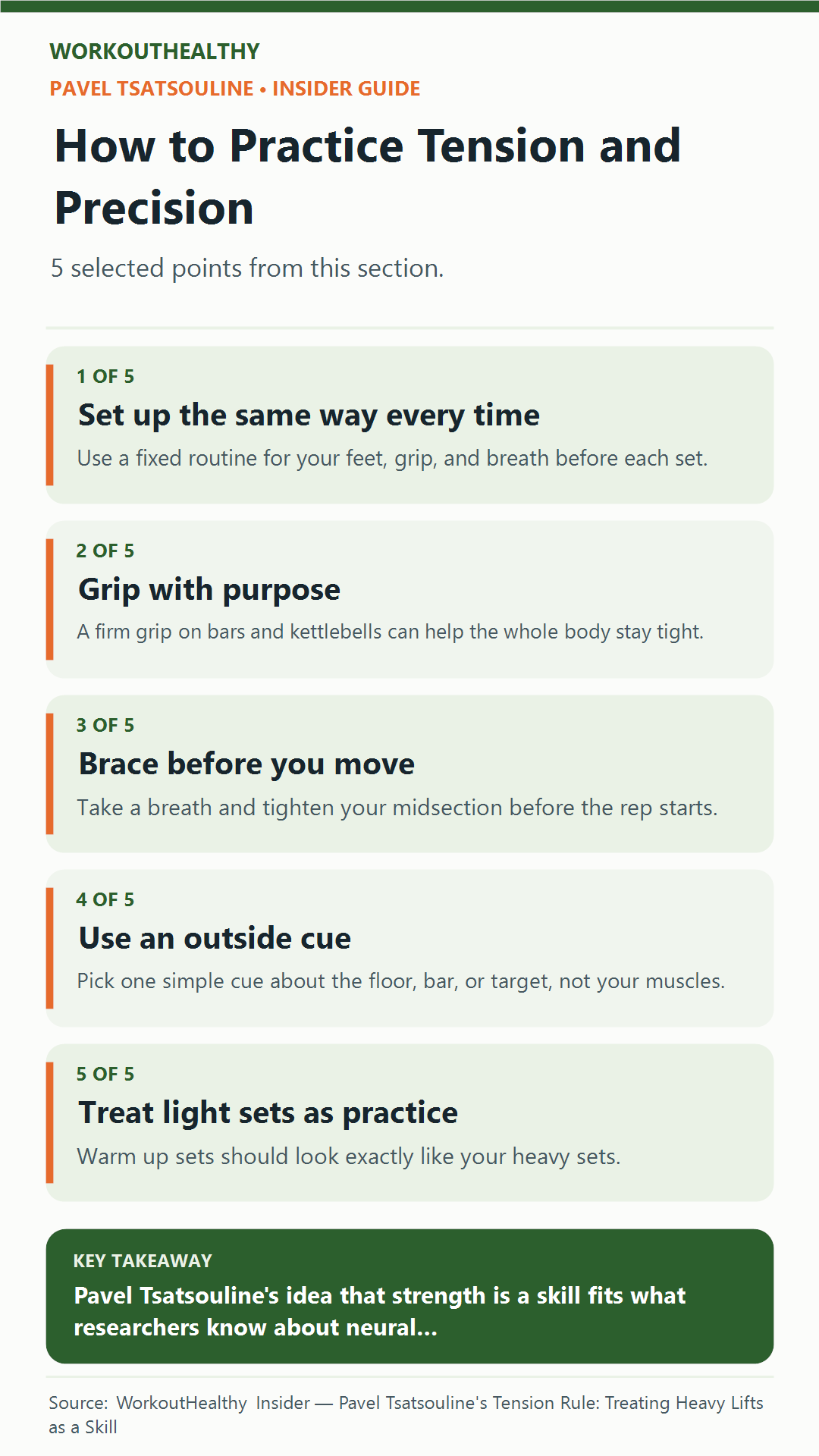
- Set up the same way every time. Use a fixed routine for your feet, grip, and breath before each set.
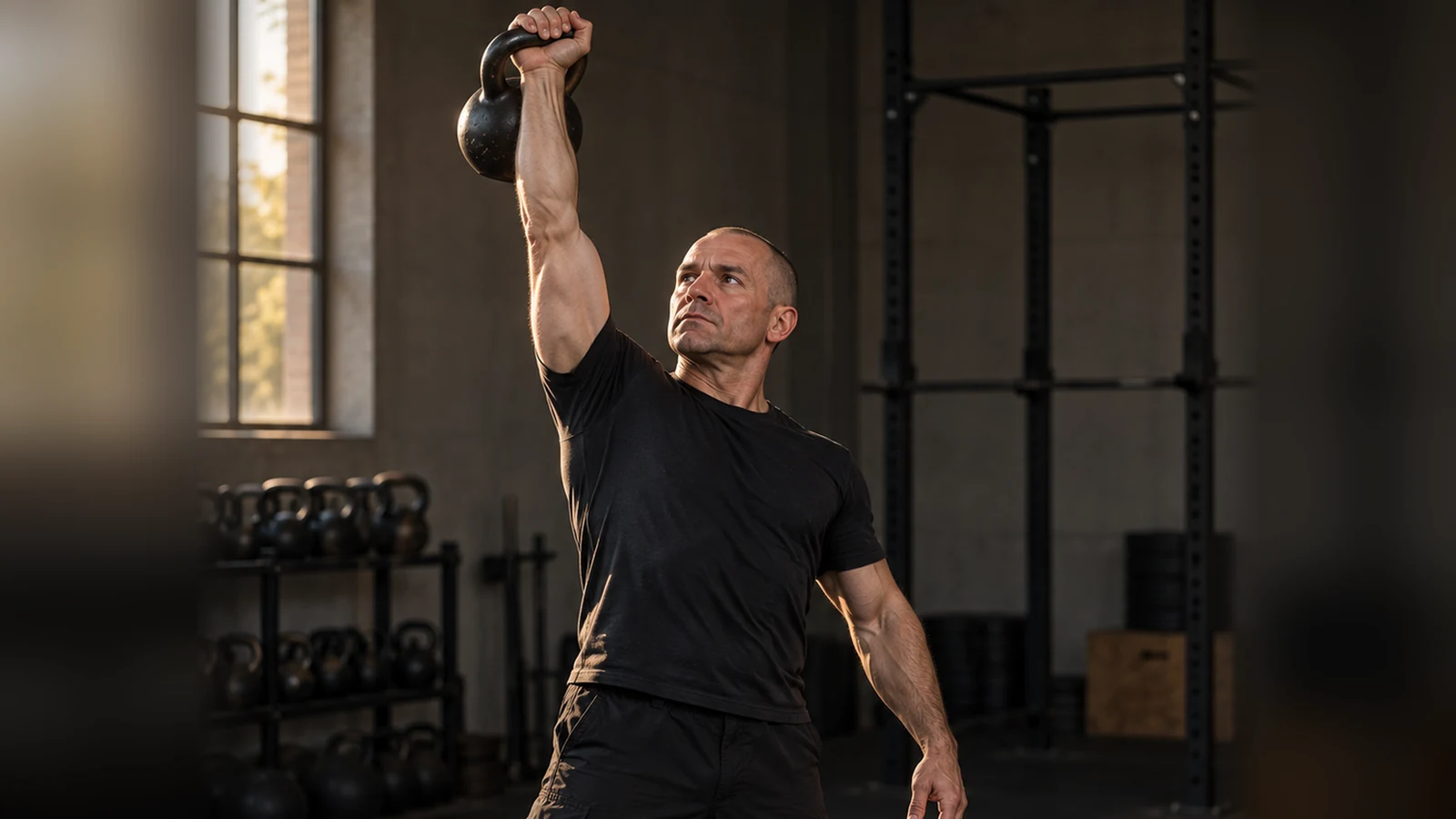
- Grip with purpose. A firm grip on bars and kettlebells can help the whole body stay tight.
- Brace before you move. Take a breath and tighten your midsection before the rep starts.
- Use an outside cue. Pick one simple cue about the floor, bar, or target, not your muscles.
- Treat light sets as practice. Warm up sets should look exactly like your heavy sets.
- Film a set now and then. Video shows whether reps really look the same.
For a way to build trunk stiffness, see which move won in two physical therapists’ ranking of 10 core exercises.
Isometric holds are another way to practice tension, as covered in how a 6 second hold can build tendon strength.
And for training smart around an injury, read Lou Schuler’s knee injury training lessons.
A Simple Tension Drill
You can feel the effect of tension without any weights.
Stand tall and make a loose fist with one hand. Then squeeze it as hard as you can.
Most people notice the forearm, upper arm, and even the shoulder tighten too.
Now try a plank twice.
First hold it with a relaxed grip and soft legs.
Then hold it while you squeeze your fists, tighten your thighs, and brace your midsection.
The second version usually feels harder and more solid.
That difference is the sensation strength coaches want you to learn and carry into heavy lifts.
Keep these drills short, and breathe steadily through them.
Common Mistakes
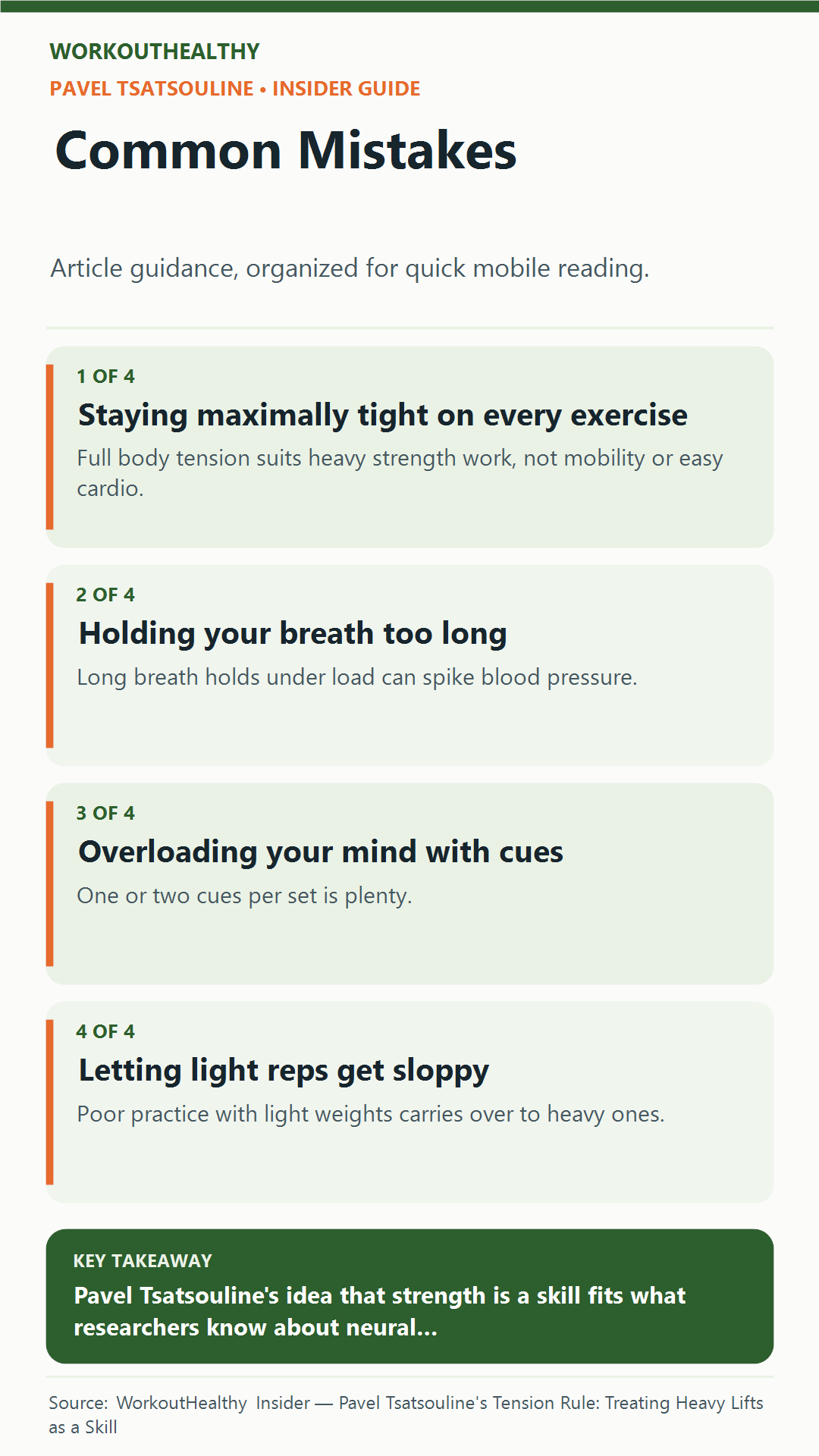
- Staying maximally tight on every exercise. Full body tension suits heavy strength work, not mobility or easy cardio.
- Holding your breath too long. Long breath holds under load can spike blood pressure.
- Overloading your mind with cues. One or two cues per set is plenty.
- Letting light reps get sloppy. Poor practice with light weights carries over to heavy ones.
Who Should Be Careful
Hard bracing and breath holding raise blood pressure during the effort.
People with high blood pressure, heart disease, or a hernia should ask a doctor about safe breathing and bracing.
Anyone recovering from surgery should get guidance before using heavy tension techniques.
The Bottom Line
Pavel Tsatsouline’s idea that strength is a skill fits what researchers know about neural adaptation.
Tension and consistent technique help you express that skill on each rep.
Research on attention adds one refinement: set your tension, then focus on the movement’s outcome.
Practice every rep as if it matters, and heavy lifts start to feel more familiar.
Want more stories like this? Subscribe to WorkoutHealthy Insider for practical explanations behind popular fitness claims.
References
- Huberman, A. (Host). (2025, February 10). Pavel Tsatsouline: The correct way to build strength, endurance and flexibility at any age [Audio podcast episode]. In Huberman Lab. https://www.hubermanlab.com/episode/pavel-tsatsouline-build-strength-endurance-flexibility-at-any-age
- Neumann, D. L. (2019). A systematic review of attentional focus strategies in weightlifting. Frontiers in Sports and Active Living, 1, 7. https://doi.org/10.3389/fspor.2019.00007
- Škarabot, J., Brownstein, C. G., Casolo, A., Del Vecchio, A., & Ansdell, P. (2021). The knowns and unknowns of neural adaptations to resistance training. European Journal of Applied Physiology, 121(3), 675 to 685. https://doi.org/10.1007/s00421-020-04567-3
- Tsatsouline, P. (2003). The naked warrior.
This article is for general information only and is not medical advice. If you have an injury, ongoing pain, or a medical condition, talk to a doctor or physical therapist before you change how you train or eat.