

Running in a weighted vest can improve running economy in some short studies, but the effect is small and the research base is thin.
The load also changes your stride and raises the force your legs absorb on every step.
For most runners, hills, tempo work, strength training, or loaded walking give most of the same upside at a much lower injury cost.
Here is what the evidence supports, how load is normally scaled, who should skip it, and what to do instead.
What does the research actually show?
Less than the marketing suggests, and almost all of it comes from small studies on trained runners over short protocols.
The most cited result is not even a study of running in a vest.
It is a study of warming up in one.
Eleven trained distance runners performed warm-up strides with and without a vest loaded to 20 percent of body mass (Barnes et al., 2015).
After the vest came off, peak running speed improved by about 2.9 percent, leg stiffness rose, and running economy improved by about 6 percent.
That is a real finding. Read the size of it, though.
Eleven people, one session, already trained, and the benefit was measured minutes later.
It says something useful about priming before a race.
It does not say that months of running in a vest will make you faster.
The longer-term picture is thinner still, because most vest training research looks at sprinting and jumping rather than distance running.
So the honest summary is that the mechanism is plausible and the evidence is small.
The idea itself is not silly.
Carrying extra weight raises the energy cost of running at any given speed, so the same pace demands more oxygen and more force from your legs.
The hope is that your body adapts to that higher demand and then feels light once the load comes off.
That is close to the argument people once made for ankle weights, which most coaches now avoid for running.
Load placement is the reason a vest is a better bet than ankle weights, not a reason to assume it works.
A vest is a way to make an easy run harder. There are cheaper ways to make a run harder, and most of them do not change how you land.
How much weight do people actually run with?
Far less than most beginners assume.
Load is normally described as a share of your body weight, because 20 pounds means something very different to a 130 pound runner and a 220 pound runner.
| Load as a share of body weight | What it feels like | Reasonable use |
|---|---|---|
| Under 5 percent | Noticeable at first, then easy to forget | A sensible place to start running |
| 5 to 10 percent | Clearly harder, breathing changes, stride shortens | The upper end most runners should consider |
| 10 to 20 percent | Gait changes inside the first minute | Lab research loads and short bouts, or walking |
| Over 20 percent | Running form falls apart quickly | Walking with load, not running |
For a 180 pound runner, 5 percent is about 9 pounds and 10 percent is about 18 pounds.
Those numbers sound trivial until you carry them for half an hour.
The percentages used in laboratory studies are not training recommendations.
Researchers use 20 or 30 percent because they want a visible effect on a treadmill in a few minutes, not because anyone should train there.
Does vest fit matter as much as vest weight?
Not quite as much, but a bad fit ruins an otherwise reasonable load.
A vest that shifts on every stride turns each step into a small collision between you and the weight.
Three things decide whether the fit is good.
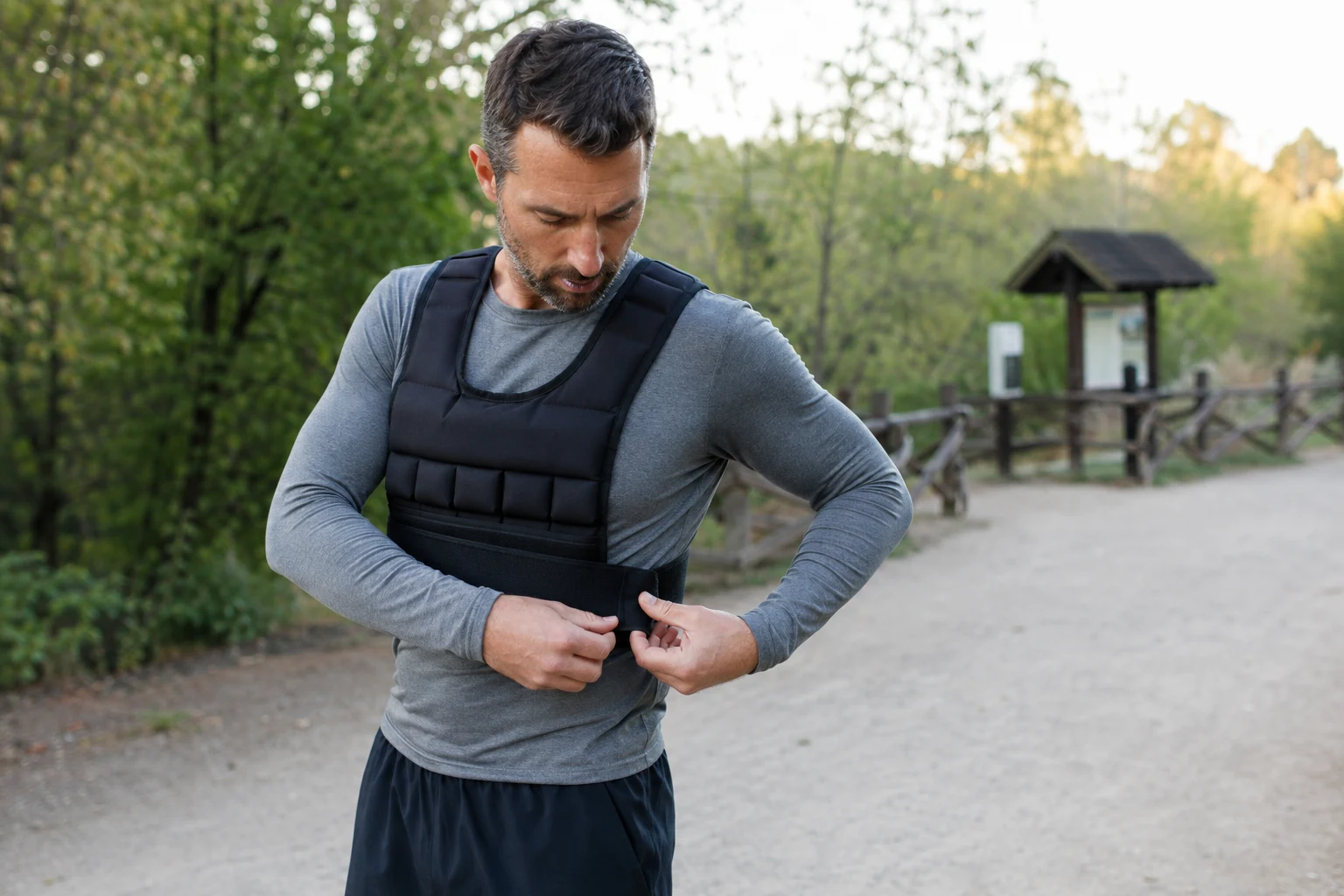
The vest should sit high and close, with the mass near your center of mass instead of sagging toward your hips.
The load should be spread front and back so you are not pulled forward or hauled backward.
Straps should be tight enough that nothing bounces, and loose enough that your ribs can expand fully when you breathe hard.
Heat is the fourth issue, and it is the one people underestimate.
A vest covers the torso, which is where a large share of sweat evaporation happens.
On a warm day that quietly turns an ordinary run into a hotter one at the same pace.
A loaded backpack is a different animal from a vest, and worse for running.
The load sits behind you, which pulls your trunk forward and gives the weight room to swing on every stride.
What does the load do to your stride?
It stiffens your legs and crouches your posture, and it does both immediately.
Twenty-seven recreational runners ran on a force-measuring treadmill at their usual 10 km pace, first unloaded and then in vests carrying 10, 20 and 30 percent of body weight (Silder et al., 2015).
Leg stiffness increased with load, ground contact time got longer, and hip and knee flexion increased at contact and through the stance phase.
Peak vertical ground reaction force rose as well, by roughly 4 to 5 percent for each 10 percent of body weight added.
That last number is the part worth sitting with.
The peak force went up far less than the added load did, because the runners changed how they ran in order to absorb it.
Good news and bad news arrive in the same sentence there.
Your body shields you from the raw force, and it does that by altering the movement pattern you have spent years grooving.
A longer contact time and a more crouched posture are not injuries.
They are simply not the stride you race with.
Who should skip the vest entirely?
More people than the average vest article admits.
Skip it if you have been running consistently for less than a year, because load tolerance is the slowest quality in the body to build.
Skip it if anything currently hurts in your feet, shins, knees, hips or lower back.
Skip it if you have had a bone stress injury in the past year, or if a doctor has raised concerns about your bone density.
Skip it during pregnancy, after abdominal or spine surgery, or if you have a hernia, unless a clinician has cleared you specifically.
Skip it in heat, and skip it on any day your legs already feel beaten up.
None of that is a diagnosis.
It is a list of situations where adding load carries more downside than upside.
There is one more group worth naming.
If your running week is already the maximum you can absorb, the vest is not a new stimulus so much as a new way to overreach.
How would you introduce it without getting hurt?
Slowly, on easy days, and never bolted onto a week that is already at your limit.
The common mistake is treating the vest as a free bonus.
It is not a bonus. It is training load, and it has to be paid for somewhere.
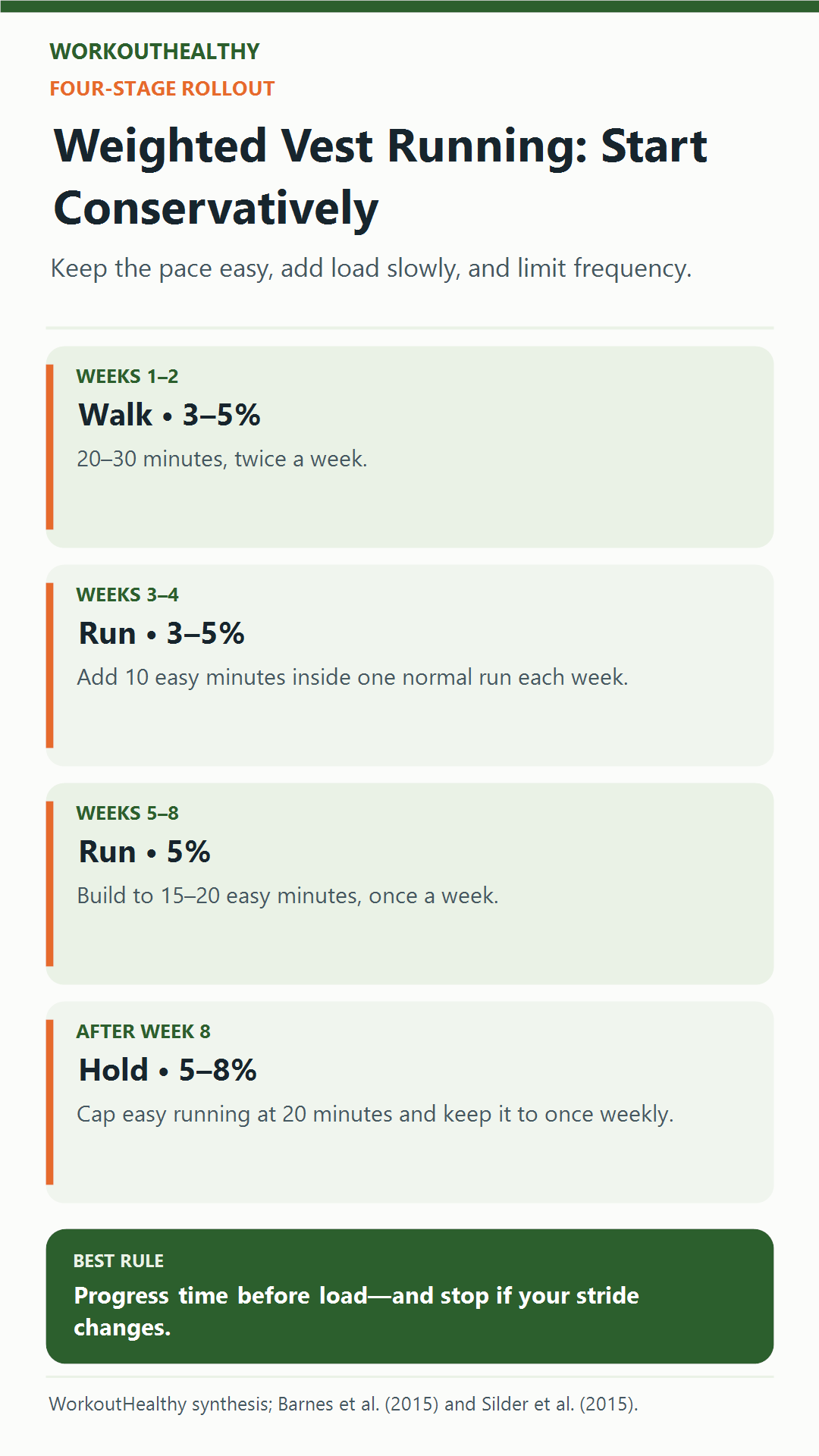
| Stage | Load | Session | Frequency |
|---|---|---|---|
| Weeks 1 to 2 | 3 to 5 percent of body weight | Walking only, 20 to 30 minutes | Twice a week |
| Weeks 3 to 4 | 3 to 5 percent | 10 minutes of easy running inside a normal easy run | Once a week |
| Weeks 5 to 8 | 5 percent | 15 to 20 minutes of easy running | Once a week |
| After that | 5 to 8 percent | 20 minutes at most, easy pace only | Once a week, then hold |
The rules around the table matter more than the table.
Never wear it on a hard session, a long run, or two days in a row.
Never increase load and distance in the same week.
Stop for the day if your stride feels different at the end of the run than it did at the start.
Take the vest off for the last few minutes of the run and pay attention to how you move.
If your form feels sharp and springy, the dose was about right, and if it feels sloppy, it was not.
Adding load without adding recovery is how people end up hurt.
Our piece on what rest days actually do explains why the easy days are what carry the hard ones.
What gives you most of the benefit with less risk?
Hills, threshold work, strength training, and walking with load.
A review of running economy research found that endurance training volume, high-intensity intervals on both level ground and uphill, and short-term resistance and plyometric training all improved running economy (Barnes & Kilding, 2015).
Every one of those is better studied than the vest, and none of them change how you land.
Hills are the closest thing to a vest that does not require one.
Running uphill raises the force your legs have to produce while reducing how hard you land, which is close to the opposite of what added load does.
| Option | What it trains | Why it is lower risk |
|---|---|---|
| Hill repeats | Force production and running economy | Uphill running lowers landing force at the same effort |
| Tempo or threshold runs | Sustainable pace and aerobic fitness | Normal load, normal stride, well understood dosing |
| Heavy or explosive lifting | Leg stiffness and force production | The load sits in the gym, not on every foot strike |
| Walking with load | Aerobic work and load tolerance | Walking impact is a fraction of running impact |
| More easy running | Nearly everything, slowly | The most boring and most reliable option there is |
Loaded walking deserves more attention than it gets.
It gives you the metabolic cost of carrying weight without the repeated landing forces of running.

If you want a baseline for walking volume, our guide to how many miles to walk each day is a reasonable place to set one.
And if you doubt plain walking is worth the time, the pooled evidence on daily steps and mortality is more convincing than anything published on vests.
If your training is already inconsistent, adding weight to it will not fix that. It only makes the inconsistent part heavier.
So is it worth doing?
For a narrow group, maybe.
If you are an experienced runner with a healthy history, a stable weekly routine, and nothing currently sore, one short loaded easy run a week is a defensible experiment.
For everyone else the answer is no, and not because vests are dangerous.
The answer is no because the same hour spent on hills, threshold work, or a squat rack has better evidence behind it.
It also has a lower chance of ending your training block early.
Judge the experiment on your own numbers rather than on a claim.
If your easy pace at the same heart rate improves across eight weeks, keep it.
If your calves, shins or hips start talking to you, the experiment already answered your question.
Get the next evidence check.
Five practical fitness stories worth your time, every Friday.
One email a week. No product pitches. Unsubscribe in one click.
References
Barnes, K. R., Hopkins, W. G., McGuigan, M. R., & Kilding, A. E. (2015). Warm-up with a weighted vest improves running performance via leg stiffness and running economy. Journal of Science and Medicine in Sport, 18(1), 103 to 108. https://doi.org/10.1016/j.jsams.2013.12.005
Barnes, K. R., & Kilding, A. E. (2015). Strategies to improve running economy. Sports Medicine, 45(1), 37 to 56. https://doi.org/10.1007/s40279-014-0246-y
Silder, A., Besier, T., & Delp, S. L. (2015). Running with a load increases leg stiffness. Journal of Biomechanics, 48(6), 1003 to 1008. https://doi.org/10.1016/j.jbiomech.2015.01.051
Medical disclaimer: This article is for general information only and is not medical advice. If you have an injury, ongoing pain, or a medical condition, talk to a doctor or physical therapist before you change how you train or eat.