

You can lift and train endurance in the same week without one ruining the other.
The interference between them is real, but it is smaller and far more specific than gym folklore suggests.
It lands mostly on explosive power, it is worse with running than with cycling, and it grows with endurance volume and with how close the two sessions sit in time.
That last part is the piece you can actually control.
The old advice was to pick a side.
Either you were a lifter who avoided cardio, or you were a runner who stayed away from the squat rack.
Neither position survives contact with the research.
What is the interference effect, really?
Concurrent training means running resistance work and endurance work inside the same program.
The interference effect is the observation that combining them can blunt some of the adaptation you would get from lifting alone.
The idea is old.
It comes from the fact that the signals driving muscle growth and the signals driving endurance adaptation are not identical, and that fatigue from one session lowers the quality of the next.
Where people go wrong is treating that as an on or off switch.
Interference is a dose, not a verdict.
It gets larger as endurance volume rises, as the endurance work becomes more damaging, and as the gap between the two sessions shrinks.
At the volumes most people actually train, the dose is small enough to ignore.
Most people asking whether cardio kills their gains are doing far too little cardio for it to matter.
Which qualities actually take the hit?
This is where a lot of writing on the topic gets the direction backwards, so it is worth being precise about what the numbers say.
The largest and most recent pooled analysis included 43 studies and reported separate effects for maximal strength, explosive strength, and muscle size (Schumann et al., 2022).
Maximal strength came out at 0.06 against the concurrent groups, which was not statistically significant.
Muscle size came out at 0.01, also not significant.
Explosive strength came out at 0.28 against the concurrent groups, and that one was significant.
The authors wrote that concurrent aerobic and strength training “does not compromise muscle hypertrophy and maximal strength development,” but that “explosive strength gains may be attenuated, especially when aerobic and strength training are performed in the same session.”
So the casualty is speed and power.
Not your top set, and not the size of the muscle.
An earlier meta-analysis of 21 studies did find decrements in both size and strength, but only under a specific condition, which brings us to modality (Wilson et al., 2012).
The practical read is simple enough.
If you are chasing a bigger squat or bigger legs, endurance work is close to a non issue at normal volumes.
If you are chasing a vertical jump, a faster first step, or anything measured in fractions of a second, treat it as a real constraint.
Our piece on whether box jumps build muscle covers why explosive work has to happen fresh rather than tacked onto the end of a long session.
Why does running interfere more than cycling?
The 2012 analysis found that resistance training done alongside running, “but not cycling, resulted in significant decrements in both hypertrophy and strength” (Wilson et al., 2012).
The same paper concluded that “interference effects of endurance training are a factor of the modality, frequency, and duration” of the endurance work.
The likely reason is mechanical rather than metabolic.
Running has an eccentric loading component on every stride.
Your legs absorb impact repeatedly, which produces muscle damage and soreness that a stationary bike largely does not.
Cycling and rowing keep the cardiovascular stimulus while cutting most of that damage.

That is why they show up so often in conditioning plans written for lifters.
This is not an argument against running.
It is an argument for noticing that a hilly 10k and a 40 minute easy spin are not interchangeable inputs, even when the heart rate graph looks similar.
Downhill running is the most damaging version of all, and it is the one worth keeping furthest from a heavy leg day.
How much separation between sessions actually helps?
There is a study that tested this directly instead of guessing at it.
Fifty eight amateur rugby players trained for 7 weeks.
They were split into groups doing strength and aerobic work with 0 hours, 6 hours, or 24 hours of recovery between the two sequences, plus a strength only group and a control group (Robineau et al., 2016).
Strength gains in bench press and half squat were lower in the group with no recovery between sessions than in the 6 hour group, the 24 hour group, and the strength only group.
Aerobic capacity improved in all three concurrent groups.
The authors concluded that coaches “should avoid scheduling 2 contradictory qualities, with less than 6-hour recovery between them to obtain full adaptive responses to concurrent training.”
Six hours is the practical number worth remembering.
Not 24. Not “never on the same day.” Six.
A morning lift and an evening run clears that bar easily.
Lifting immediately after a hard interval session does not.
One caution about applying that finding too widely.
Those were trained rugby players lifting first and doing high intensity aerobic intervals second, over a short block.
Six hours is a useful floor, not a law.
So how should you sequence a single day?
If the two qualities have to share a day, put the one you care about most in the slot where you are freshest.
For most people reading this, that means lifting first.
Lifting first is also the order used in the recovery duration study, so the 6 hour finding maps onto that arrangement specifically.
If you are training for an endurance event and the lifting is accessory work, flip it.
Run first, lift later.
Whatever order you pick, the second session of the day should be the easier one.
Two hard sessions six hours apart are still two hard sessions.
Here is the simple version.
Hard plus easy on the same day is fine.
Hard plus hard wants a full day between them.
What does a workable week look like?
Below is a six day template for someone whose main goal is strength and size, with real endurance work kept in the plan rather than apologized for.
Lower body lifting and running are deliberately held apart.
| Day | Morning | Evening | Why |
|---|---|---|---|
| Monday | Lower body lifting | Rest or easy walk | Freshest legs of the week get the heaviest work |
| Tuesday | Rest | Hard intervals, bike or rower | Low impact modality, roughly 30 hours after leg day |
| Wednesday | Upper body lifting | Rest | Different tissue, so leg fatigue is not competing |
| Thursday | Rest | Easy aerobic run, 30 to 45 minutes | Easy pace limits the eccentric damage running causes |
| Friday | Lower body lifting | Rest | A full day of separation from Thursday’s run |
| Saturday | Long easy run or ride | Rest | Volume day placed where nothing heavy follows it |
| Sunday | Full rest | Full rest | The week only works if this day stays empty |
Notice that no hard endurance session sits within 24 hours before a lower body lifting day.
That single rule does most of the work.
The upper body day on Wednesday is doing quiet scheduling work too, because it lets the legs keep recovering while you still train.
The template also leaves a genuine rest day, which is not wasted time.
Our article on whether rest days build muscle explains why recovery belongs in the design rather than sitting there as a gap in it.
What if you only have four days?
Four days is where people panic and start stacking everything on top of itself.
Do not.
Compress the lifting instead of compressing the separation.
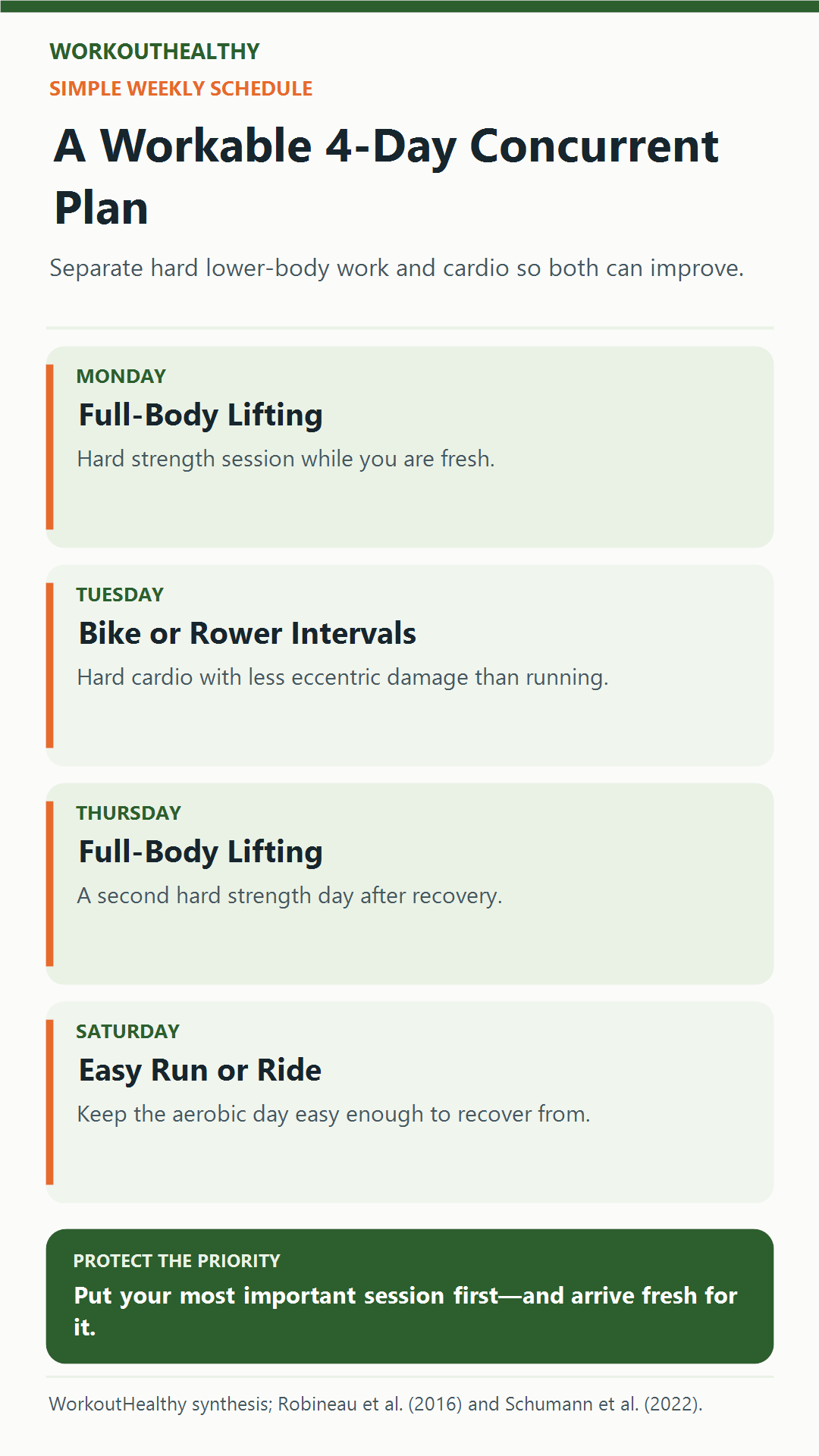
Two full body lifting days and two endurance days is the cleanest fit.
Alternate them so that no two adjacent days ask the legs for the same thing.
| Day | Session | Intensity |
|---|---|---|
| Monday | Full body lifting | Hard |
| Tuesday | Bike or rower intervals | Hard |
| Thursday | Full body lifting | Hard |
| Saturday | Easy run or ride | Easy |
Two full body sessions a week is enough to drive strength and size for most people who are not competitive lifters.
Putting the hard interval day immediately after the lift is a deliberate trade.
It protects Thursday’s lifting at the cost of a slightly compromised Tuesday.
If you would rather protect the intervals, swap which one leads the week.
What you should not do is move both hard days next to each other to free up a longer weekend.
A four day week does not need clever programming. It needs you to stop putting hard legs next to hard legs.
Who does not need to worry about this at all?
Most people, honestly.
If you lift two or three times a week and your cardio is walking, easy cycling, or a conditioning finisher at the end of a session, interference is not your limiting factor.
Consistency is.
The interference literature is built on trained subjects doing substantial endurance volume.
That is a different situation from adding a daily walk.
Walking in particular is close to free.

Our guide on how many miles to walk a day covers what that dose actually buys you, and none of it comes out of your lifting.
Beginners are also largely exempt.
Early in training almost everything works, and both qualities improve at the same time.
Older adults training for general health should ignore interference entirely.
The combination of resistance work and aerobic work is the goal there, not a compromise to be managed.
The people who genuinely need to think about this are a narrow group.
Competitive strength and power athletes carrying real endurance volume, endurance athletes who want lifting without blunting their event, and anyone training six or more hard sessions a week.
If you are not in one of those three categories, the schedule matters more than the theory.
The bottom line
Interference is real, modest, and aimed mostly at explosive power rather than at size or maximal strength.
Running does more of it than cycling because of the eccentric loading, not because of the heart rate.
Six hours between sessions appears to recover most of what you would otherwise give up, and a full day is better when both sessions are hard.
Beyond that, stop optimizing.
Keep your hard leg days away from your hard endurance days and get on with training.
Get the next evidence check.
Five practical fitness stories worth your time, every Friday.
One email a week. No product pitches. Unsubscribe in one click.
References
Robineau, J., Babault, N., Piscione, J., Lacome, M., & Bigard, A. X. (2016). Specific training effects of concurrent aerobic and strength exercises depend on recovery duration. Journal of Strength and Conditioning Research, 30(3), 672-683. https://doi.org/10.1519/JSC.0000000000000798
Schumann, M., Feuerbacher, J. F., Sünkeler, M., Freitag, N., Rønnestad, B. R., Doma, K., & Lundberg, T. R. (2022). Compatibility of concurrent aerobic and strength training for skeletal muscle size and function: An updated systematic review and meta-analysis. Sports Medicine, 52(3), 601-612. https://doi.org/10.1007/s40279-021-01587-7
Wilson, J. M., Marin, P. J., Rhea, M. R., Wilson, S. M. C., Loenneke, J. P., & Anderson, J. C. (2012). Concurrent training: A meta-analysis examining interference of aerobic and resistance exercises. Journal of Strength and Conditioning Research, 26(8), 2293-2307. https://doi.org/10.1519/JSC.0b013e31823a3e2d
Medical disclaimer: This article is for general information only and is not medical advice. If you have an injury, ongoing pain, or a medical condition, talk to a doctor or physical therapist before you change how you train or eat.