

Sean Hayes is a performance coach who posts training vlogs on his 8th Street Gym YouTube channel.
In “Controlled Chaos Day 3,” he mixes strength exercises with athletic performance drills in one training session.
The video’s own title raises a question a lot of lifters and runners quietly wonder about.
Can a person build real strength and build real cardio fitness in the same program?
Or does mixing the two end up holding both back?
Exercise scientists have a name for training this way.
They call it concurrent training, and they have studied it for more than four decades.
This article looks at what that research actually found, separate from any single coach’s personal routine.
The video itself is Day 3 of a multi day series Hayes calls Controlled Chaos.
What the Video Claims
This video is a personal training vlog, not a scientific presentation.
Hayes describes himself, on his own channel, as a performance coach with experience at Penn State, the Houston Texans, WWE and NXT, and the XFL.
He also lists himself as the current Director of Performance for the UFL.
Those credentials come directly from his channel’s own description.
They could not be independently confirmed through outside sourcing for this article.
“Controlled Chaos” appears to be the name Hayes uses for his own training series on the channel.
No independent record of “Controlled Chaos” as a published or peer reviewed training system could be found.
The series title suggests planned variety across multiple training days.
The exact structure across every day of the series was not available to review for this article.
In the video itself, Hayes combines strength movements with athletic performance drills in a single training day.
His title frames this combination as a way to build athletic performance.
That framing is exactly the question concurrent training research has spent decades trying to answer.
This article treats the video as one coach’s personal approach, not as clinical or scientific proof.
Everything below comes from independent, peer reviewed research instead.
What Real Research Shows About Training Strength and Endurance Together
The idea that combining strength and endurance training could backfire is not new.
In 1980, researcher Robert Hickson ran one of the first controlled studies on this exact question (Hickson, 1980).
He split people into three groups.
One group trained for strength only.
One group trained for endurance only.
One group trained for both, in the same program.
All three groups trained several days a week for about ten weeks.
The strength only group kept gaining strength for the entire study.
The combined group gained strength at first, then plateaued, and eventually lost some strength later on (Hickson, 1980).
Endurance gains told a different story.
They were similar whether someone trained endurance alone or combined it with strength work.
This is where the term “interference effect” comes from.
Hickson’s study suggested endurance training can interfere with strength gains, while strength training does not interfere much with endurance gains.
In one of the first controlled studies on combined training, strength gains stalled and even reversed in the group training both qualities, while their endurance gains matched the endurance only group almost exactly.
What Real Research Shows About How Big the Interference Effect Really Is
One study from 1980 is not the whole picture.
In 2012, researchers pooled data from dozens of concurrent training studies into a single meta-analysis (Wilson et al., 2012).
A meta-analysis combines many smaller studies to get a clearer, more reliable average result.
This one found that combining endurance and strength training did reduce strength gains compared to strength training alone.
The effect on muscle size was smaller than the effect on strength.
The biggest effect of all showed up in power and explosive speed, not in raw strength or muscle size (Wilson et al., 2012).
In plain terms, someone doing concurrent training can still get noticeably stronger.
They can still build real muscle.
Their top end power and sprint speed are what tend to suffer the most.
This matters for a video built around the phrase “strength meets athletic performance,” since athletic performance often depends heavily on power output.
It is also why many coaches watch power and sprint speed closely, rather than only tracking how much weight someone can lift.
What Real Research Shows About Scheduling Sessions to Reduce Interference
If some interference is real, timing may help reduce it.
A 2016 study tested this directly with competitive athletes (Robineau et al., 2016).
Researchers had athletes complete strength and endurance sessions with different amounts of rest between them.
Some athletes trained both qualities back to back, with very little rest in between.
Others had six or more hours of recovery between the two sessions.
The group with more recovery time between sessions showed better strength adaptations than the group training both close together (Robineau et al., 2016).
This suggests spacing endurance and strength sessions apart, rather than stacking them back to back, may protect strength and power gains.
It does not mean same day training is off limits entirely.
It means the order and spacing inside that day appears to matter quite a bit.
Some coaches use this research to justify lifting in the morning and saving harder cardio for later the same day.
What Real Research Shows About Muscle Size Versus Explosive Power
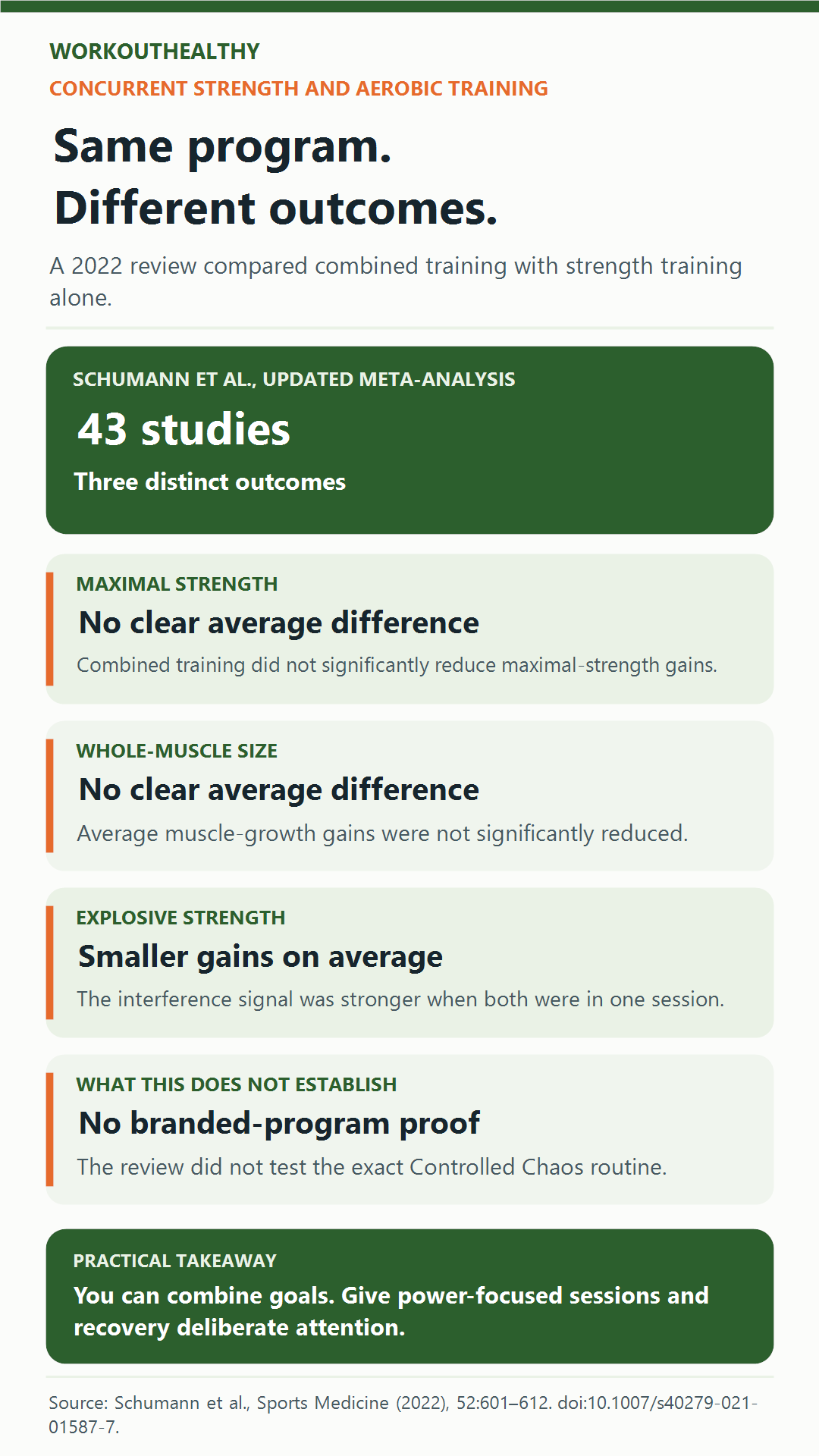
A larger, more recent analysis updated this picture in 2022 (Schumann et al., 2022).
Researchers reviewed newer studies to see if the original interference findings still held up with modern training methods.
They found that concurrent training did not meaningfully reduce muscle size or maximal strength compared to strength training alone.
Explosive, high speed strength qualities were the exception (Schumann et al., 2022).
Those measures were still somewhat reduced when endurance and strength training were combined, especially within the same session.
This lines up with what our article on box jumps and muscle building already covers about power based training needing its own dedicated attention.
Building raw muscle and building explosive power are related goals, but they are not quite the same thing.
Watch the video
The Mechanism
Scientists have also tried to explain why interference happens at the cellular level.
A detailed review looked at the molecular signals triggered by each type of training (Fyfe, Bishop, & Stepto, 2014).
Strength training activates a pathway in muscle cells called mTOR.
That pathway helps build new muscle protein.
Endurance training activates a different pathway called AMPK.
That pathway helps muscles use energy more efficiently.
These two pathways can compete with each other inside the very same muscle cell (Fyfe et al., 2014).
When AMPK is strongly activated, it can blunt the mTOR signal that drives new muscle growth.
This competition appears strongest when both types of training happen close together in time.
It offers a biological reason why spacing sessions apart, as the Robineau study suggested, may genuinely help.
What This Evidence Does Not Prove
This research does not prove that concurrent training is bad for most people.
Most of the interference research comes from athletes doing high volumes of both types of training.
A recreational lifter who walks or jogs a few times a week is a very different case.
The studies also vary widely in how much endurance training was used.
Some used short interval sessions, and others used long distance running.
Longer, harder endurance sessions appear to interfere more than short, easier ones, though this has not been tested in every population.
None of these studies followed people for years, so long term effects in serious athletes are still not fully known.
This research also cannot confirm or deny anything specific about Hayes’s own “Controlled Chaos” program, since that particular program has not itself been studied.
Common Mistakes
One common mistake is doing hard endurance work right before a heavy lifting session.
That is the exact same day, back to back pattern research links to more interference (Robineau et al., 2016).
Another mistake is treating every cardio session as equally demanding.
An easy walk is not the same stress on the body as sprint intervals or a long run.
A third mistake is ignoring recovery between hard sessions of either kind.
Our article on losing weight and muscle mass covers how too much cardio, without enough recovery or protein, can work against muscle goals.
A fourth mistake is expecting peak explosive power and peak endurance to arrive on the exact same training cycle.
Research suggests it is smarter to prioritize one quality at a time during any given training block.
A fifth mistake is assuming one person’s exact split, like the one shown in a single vlog, will fit every schedule, sport, or goal.
Who Should Be Extra Careful
Beginners generally have more room to improve in both areas, so mild interference matters less for them at first.
Competitive athletes chasing a specific power or speed goal should be more careful about how they schedule sessions.
Anyone training for a specific event, like a powerlifting meet or a race, may want to prioritize that quality more heavily as competition day approaches.
Anyone with a heart condition, joint issue, or other medical concern should talk to a doctor before adding intense endurance work to a strength program.
People returning from an injury should also get guidance from a physical therapist on how much combined training their body can currently handle.
Older adults new to structured exercise should build up both strength and cardio gradually, rather than copying an advanced athlete’s full session length.
A Practical Takeaway
The research suggests concurrent training is not something most people need to avoid.
Most people can build real strength and real endurance at the same time without major problems.
Spacing hard strength sessions and hard endurance sessions apart by several hours, or across different days, appears to reduce interference.
A simple starting rule is training strength first, while energy is highest, and saving harder cardio work for later.
Easier cardio, like walking, is a smaller concern here, since our article on how many miles to walk a day explains that walking rarely competes with strength gains the way harder endurance work can.
If a specific goal like explosive power or top end speed matters most, research suggests giving strength training scheduling priority within any given week.
Readers curious about the broader value of strength training on its own may also want to read our article on lifting weights and brain health.
None of this requires abandoning a mixed program like the one shown in the video.
It simply means paying attention to how the pieces get scheduled.

Want more like this? Subscribe to WorkoutHealthy Insider for practical explanations behind popular fitness claims.
References
Fyfe, J. J., Bishop, D. J., & Stepto, N. K. (2014). Interference between concurrent resistance and endurance exercise: Molecular bases and the role of individual training variables. Sports Medicine, 44(6), 743 to 762. https://doi.org/10.1007/s40279-014-0162-1
Hickson, R. C. (1980). Interference of strength development by simultaneously training for strength and endurance. European Journal of Applied Physiology and Occupational Physiology, 45(2 to 3), 255 to 263. https://doi.org/10.1007/BF00421333
Robineau, J., Babault, N., Piscione, J., Lacome, M., & Bigard, A. X. (2016). Specific training effects of concurrent aerobic and strength exercises depend on recovery duration. Journal of Strength and Conditioning Research, 30(3), 672 to 683. https://doi.org/10.1519/JSC.0000000000000798
Schumann, M., Feuerbacher, J. F., Sünkeler, M., Freitag, N., Rønnestad, B. R., Doma, K., & Lundberg, T. R. (2022). Compatibility of concurrent aerobic and strength training for skeletal muscle size and function: An updated systematic review and meta-analysis. Sports Medicine, 52(3), 601 to 612. https://doi.org/10.1007/s40279-021-01587-7
Wilson, J. M., Marin, P. J., Rhea, M. R., Wilson, S. M. C., Loenneke, J. P., & Anderson, J. C. (2012). Concurrent training: A meta-analysis examining interference of aerobic and resistance exercises. Journal of Strength and Conditioning Research, 26(8), 2293 to 2307. https://doi.org/10.1519/JSC.0b013e31823a3e2d
This article is for general information only and is not medical advice. If you have an injury, ongoing pain, or a medical condition, talk to a doctor or physical therapist before you change how you train or eat.