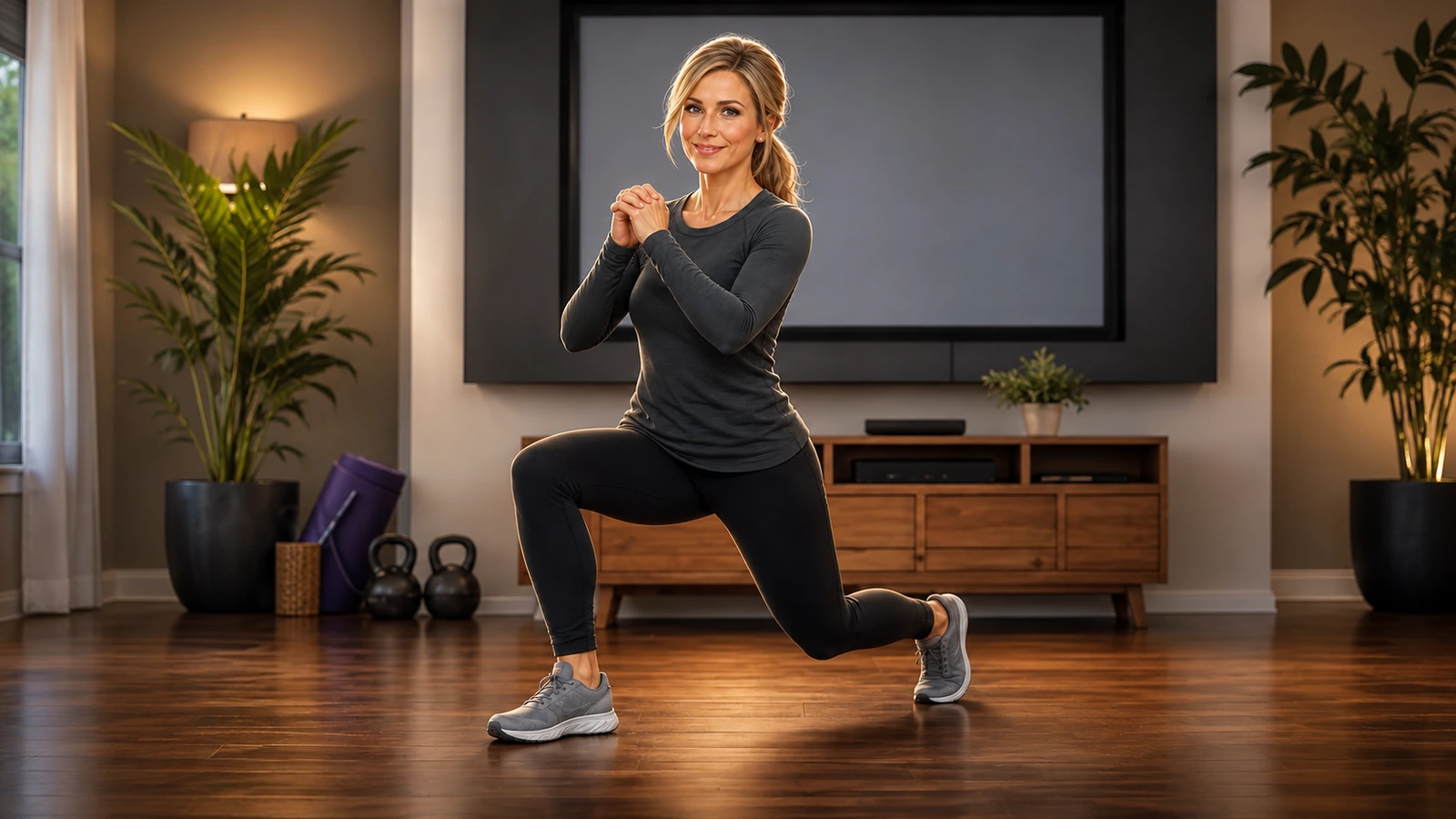

Sarah Michelle Gellar has described a fitness routine that changes with her location. At home in Los Angeles, studio classes and family hikes can fit the week. During work travel, streaming workouts make it possible to train in a hotel without rebuilding the entire schedule.
That flexibility is more useful than copying a celebrity’s exact class list. The durable lesson is to keep the purpose of a workout while changing the format, equipment, or duration to match real life.
Quick answer: streaming workouts can support consistency because they remove travel and scheduling friction. They are not automatically effective or safe. Choose sessions that match your experience, leave room to progress, and keep at least some strength, aerobic activity, mobility, and recovery in the week.
A routine becomes resilient when it can shrink, travel, and change shape without disappearing.
What Sarah Michelle Gellar shared
In a Shape interview, Gellar described using different tools in different settings. She mentioned studio-based Pilates-style training when she was in Los Angeles, hiking near home, and subscription workout services while staying in a hotel for work.
The interview is not a controlled study and does not prove that one platform, class, or exercise created her appearance. It is a personal example of solving a common problem: the best-equipped routine is useless when it cannot travel with you.
Her comments also separated exercise from multitasking. A dedicated workout hour gave her a chance to focus on movement instead of everything else competing for attention.
That psychological boundary can matter. A session has a clear beginning and end, even when it happens in the same room where someone works, watches television, or answers messages.
The practical idea is not that everyone needs an hour. It is that a planned block, however short, is easier to protect than a vague intention to move later.
Gellar’s mix of studio classes, hiking, and digital options also avoids treating one method as mandatory. Variety can distribute stress and preserve enjoyment, provided the week still contains enough repetition to build skill.
Why streaming can make consistency easier
Exercise adherence often fails at the handoff between intention and logistics. A commute runs late, a class fills, childcare changes, or a trip removes access to familiar equipment.
Streaming reduces several of those barriers. The start time is flexible, the room can be private, and the session can be selected by duration. Ten, twenty, and forty minutes become distinct options instead of success or failure.
That does not mean motivation becomes automatic. It means the environment asks for fewer decisions. A mat left in view, a saved class, and a scheduled start time create a smaller first step.
Online libraries also make modification easier. Someone with a tired knee can swap a jumping class for low-impact conditioning. A traveler without weights can choose bodyweight strength or mobility.
The danger is endless browsing. A library with thousands of videos can turn preparation into procrastination. Save three dependable sessions in advance: one short, one standard, and one recovery-focused.
Consistency should not mean performing the same hard workout every day. It means returning to an appropriate training process often enough for adaptation to occur.
Recovery remains part of that process. Our guide to rest days and muscle growth explains why the body needs time to rebuild after training.
What an app cannot decide for you
A prerecorded instructor cannot see your technique, medical history, pain response, or equipment setup. Even a live digital coach sees less than an in-person professional positioned beside you.
Pause when an exercise creates sharp pain, numbness, dizziness, chest pressure, or unusual shortness of breath. A motivational cue on a screen does not override a warning from your body.
Check the floor for slipping, the ceiling for overhead clearance, and furniture for stability. A dining chair is not automatically safe for step-ups or supported balance work.
Beginners should avoid sessions that move too quickly to learn positions. A slower class with clear demonstrations is often more productive than a high-energy video that makes every transition a scramble.
Wearable calorie estimates and class labels such as “advanced burn” are not measures of workout quality. Good training can feel controlled, and a session does not need to exhaust you to be useful.
When balance, recent injury, pregnancy, heart disease, uncontrolled blood pressure, or major joint symptoms change the risk, individualized clinical or coaching guidance may be worth more than another subscription.
The four-lane flexible workout plan
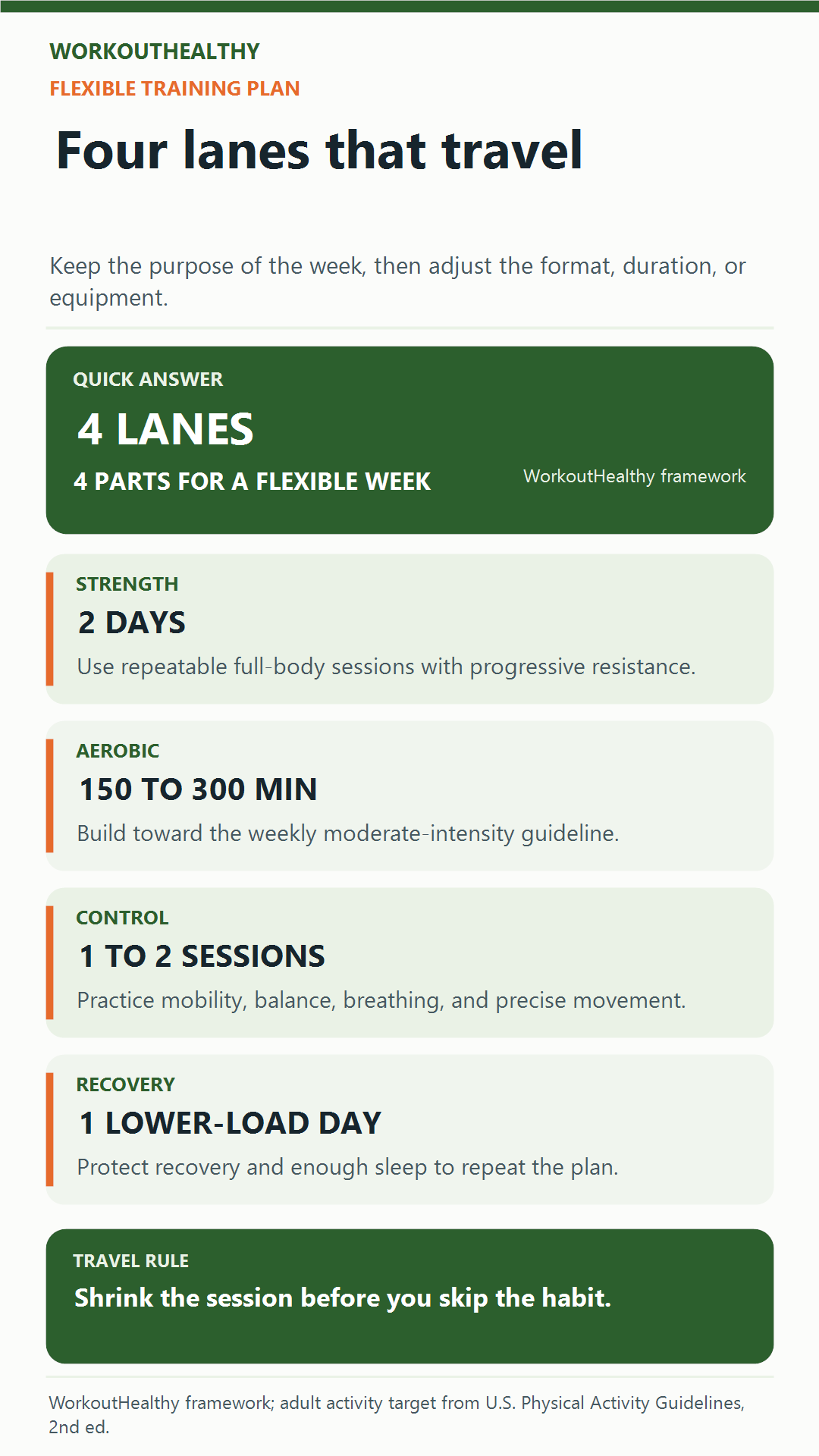
WorkoutHealthy’s four-lane plan gives a streaming routine enough structure to survive changing weeks. The lanes are strength, aerobic work, mobility or control, and recovery.
Lane one, strength: schedule two full-body sessions. Each can include a squat or sit-to-stand, hinge, push, pull, and carry or trunk exercise. Bands, dumbbells, and body weight all count when resistance is challenging enough.
Lane two, aerobic work: build toward a weekly total that fits public-health guidance. Brisk walking, cycling, dance, hiking, and low-impact online cardio can all contribute.
Lane three, mobility and control: use one or two short sessions to practice comfortable range, balance, breathing, and precise movement. Pilates-style work can fit here, though some classes are demanding enough to overlap with strength.
Lane four, recovery: protect at least one lower-load day and enough sleep. Easy walking or gentle mobility can be active recovery; recovery does not require complete stillness.
A sample week might use strength on Monday and Thursday, brisk walking on Tuesday and Saturday, a mobility class on Wednesday, an optional family hike on Sunday, and a flexible rest day on Friday.
The schedule is a planning example, not Gellar’s reported program. Its purpose is to prevent an online library from becoming a random series of whatever looks hardest that day.
How to choose an online class
Start with the instructor’s qualifications and the clarity of the class description. “All levels” should include visible modifications rather than expecting every viewer to keep up with the same pace.
Match the class to the lane you actually need. A fast circuit marketed as toning may be aerobic conditioning, not progressive strength. A stretch video may feel pleasant without addressing strength or aerobic goals.
Read the equipment list before pressing play. Substitute only when the replacement is stable and changes neither the movement nor the risk in a way you do not understand.
Preview difficult transitions. If the instructor moves rapidly from the floor to standing, choose a slower alternative when dizziness, balance, or knee sensitivity makes that sequence difficult.
Use the talk test during cardio. Moderate effort generally allows sentences but not comfortable singing. Stop chasing the instructor’s pace if your form or breathing becomes uncontrolled.
For strength, finish most sets with a few technically sound repetitions still possible. If a video never becomes harder across several weeks, add resistance, repetitions, range, or a more challenging variation deliberately.
A good platform makes it easy to repeat a useful class. Familiarity is not boredom when it lets you notice better control, heavier resistance, or lower effort at the same workload.
Build a travel version before you need it
Do not wait until the first night of a trip to invent a hotel workout. Test a compact version at home where equipment and support are available.
Choose five movements that need only a small floor area: split squat to a chair, push-up against a desk, band row, glute bridge, and dead bug. Confirm that each can be performed safely.
Save one twenty-minute class to the device when internet access may be unreliable. Pack a loop band only if you already know how to use it.
Travel changes sleep, meals, hydration, and daily walking. The goal may be maintenance rather than progress. Two moderate sessions can preserve momentum during a week that cannot support normal training.
Use hotel stairs for walking only when the area is well lit and permitted. Do not improvise lifts with unstable luggage or furniture.
If stress is high, a short breathing practice may be the more appropriate lane. Our box-breathing guide explains a simple pattern and its limits.
The return home also needs a plan. Resume normal volume gradually after long travel, poor sleep, illness, or several missed sessions.
The travel workout succeeds when it protects the habit without pretending travel is a normal week.
How to progress without chasing novelty
Pick a small set of repeatable sessions and log the exercise, resistance, repetitions, and effort. A video title alone does not show whether the body received more work.
Change one variable at a time. Add two repetitions, move to a slightly heavier band, extend the walk by five minutes, or choose a deeper range when control allows.
Repeat the new dose for at least two sessions before changing it again. That makes soreness, joint response, and fatigue easier to interpret.
Novel classes can keep exercise enjoyable, but use them around a stable core. Two dependable strength sessions and a consistent walking target provide an anchor.
Review the week, not one workout. A short session performed on a chaotic day may be the decision that keeps the entire month intact.
Appearance changes are not the only evidence of progress. Better balance, easier stairs, improved technique, more energy, and a lower effort at the same walking pace all matter.
The bottom line
Sarah Michelle Gellar’s use of studio, outdoor, and streaming workouts illustrates a practical fitness skill: change the delivery without abandoning the routine.
Build a week with strength, aerobic work, mobility or control, and recovery. Save a short, standard, and travel-friendly option for each lane, then repeat enough of the plan to measure progress.
Try this next: save one twenty-minute full-body class, one brisk walking session, and one ten-minute mobility session. Put all three on next week’s calendar before browsing for anything new.
Medical disclaimer: This article is general product information, not medical advice. The equipment described here is not a treatment for any condition. If you have an injury, ongoing pain, or a medical condition, talk to a doctor or physical therapist before using any of it.