
Mark Wahlberg’s early workouts have been turned into a simple internet rule: train before breakfast, eat afterward, and the results will follow. His own public comments tell a more complicated story.
In earlier reporting, Wahlberg described eating breakfast before an early workout. Years later, he described a time-restricted routine with his first meal around noon and said intermittent fasting worked for him.
Both accounts can be true because celebrity routines change with age, roles, schedules, preferences, and business commitments. The mistake is treating one snapshot as a permanent prescription for everyone else.
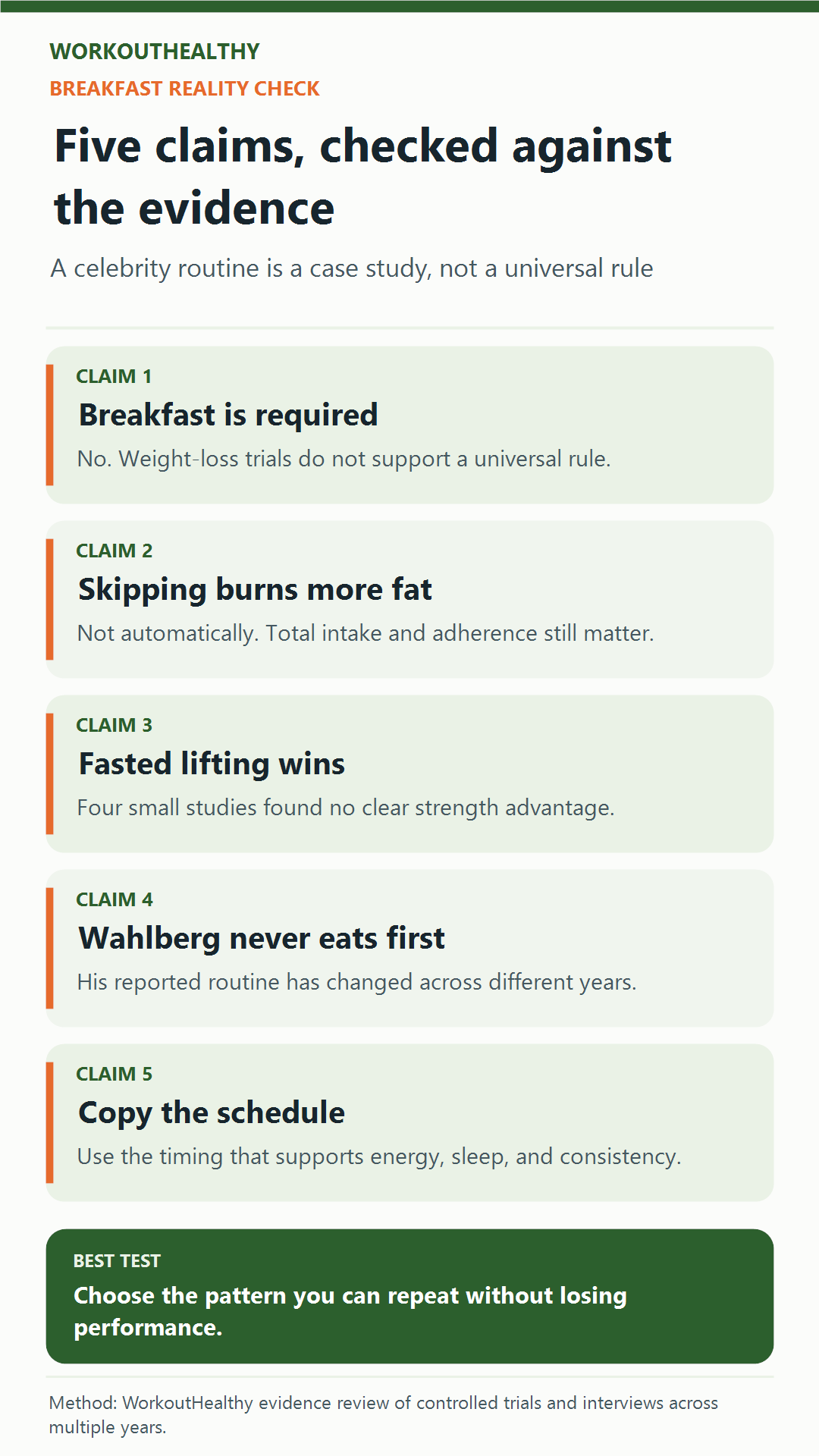
Quick answer: breakfast is neither mandatory nor automatically harmful for fitness. Choose fed or fasted morning training based on performance, comfort, total nutrition, sleep, and the pattern you can repeat.
A celebrity schedule can inspire an experiment, but it cannot decide what your body needs.
What Wahlberg has actually said
The famous early schedule that circulated in 2018 included a 2:30 a.m. wake-up, breakfast around 3:15, and training later in the morning. That version is the opposite of the claim that he always trained fasted.
In a 2023 interview, Wahlberg described a different phase. He said intermittent fasting had worked for him, placed his first meal around noon, and ate again later in the afternoon and before 6 p.m.
He also framed the approach as personal rather than universal. That distinction often disappears when a long interview becomes a short social-media caption.
Actors may adjust food intake to prepare for roles, recover from a weight change, accommodate filming, or manage digestion. They may also have coaches, chefs, flexible work periods, and financial incentives tied to the fitness brands they discuss.
The honest takeaway is not that breakfast is right or wrong. It is that even a highly disciplined person’s routine can change when the goal and circumstances change.
Public routines are also edited stories. They rarely show every snack, travel day, shortened workout, medical consideration, or week when the plan changed, so precision in the published schedule should not be confused with completeness.
For another example of why celebrity context matters, see our breakdown of Jay Cutler’s 1993 bodybuilding diet. A plan can be historically interesting without becoming a template for your life.
Does breakfast control weight loss?
Observational studies have often linked regular breakfast eating with lower body weight. That does not prove breakfast caused the difference, because breakfast eaters may differ in sleep, activity, income, smoking, or other habits.
Randomized trials are more useful for testing cause and effect. A systematic review of 13 trials did not find that assigning adults to eat breakfast produced better weight-loss results, and the studies were generally short and had important limitations.
That result does not prove skipping breakfast is a superior diet. It means the meal itself is not a magic switch that overrides total energy intake and adherence.
Some people eat breakfast and naturally regulate later meals. Others feel hungrier after a small breakfast and prefer waiting until later.
The pattern that helps you sustain an appropriate intake without obsession, fatigue, or rebound eating is more useful than a rule borrowed from someone else’s calendar.
If your morning includes caffeine, remember that timing and dose can affect sleep many hours later. Our guide to caffeine before a workout explains the performance tradeoffs, while our review of caffeine and sleep timing covers the recovery side.
Does fasted lifting build more muscle?
A fasted workout uses a different immediate fuel environment, but short-term fuel use is not the same as long-term fat loss or muscle growth. The body continues to store and use energy across the entire day.
A recent systematic review comparing fasted and fed resistance training found no clear differences in fat-free mass, hypertrophy, or strength. Only four studies qualified, and three were rated at high risk of bias, so confidence should remain modest.
The review found a possible body-fat advantage for fasted training, but the small evidence base and wide uncertainty make it a weak foundation for a universal recommendation.
Training quality still matters. If fasting reduces load, repetition quality, concentration, or total work, the theoretical appeal may not survive contact with the session.
On the other hand, someone who dislikes food early and performs normally may have no reason to force breakfast. Hydration, overall protein, total energy, and a sustainable program can matter more than whether the first set happens before the first bite.
When eating first makes sense
Breakfast can help when the workout is long, high-volume, technically demanding, or scheduled after an overnight fast that leaves you lightheaded. It can also help when you need to train hard again later the same day.
People who wake hungry may perform better with a small meal. A low-fiber, familiar option is usually easier to tolerate than a large, high-fat breakfast immediately before movement.
Eating first can also protect the rest of the day. If fasted training reliably leads to irritability, poor work focus, or an uncontrolled lunch, the schedule is creating costs outside the gym.
Morning training does not need an elaborate menu. A banana with yogurt, toast with eggs, oatmeal with milk, or a smoothie can provide carbohydrate and protein without turning breakfast into a project.
Timing is individual. Some people tolerate food 30 minutes before training, while others need 90 minutes or more.
Keep the first experiment smaller than your appetite suggests. You can add food later, but an overfull stomach is hard to subtract once the warm-up begins.
The WorkoutHealthy two-week decision test
This is an original self-monitoring framework, not a clinical trial. Use it to compare two workable routines without changing your training program at the same time.
During week one, complete your morning workouts with your usual breakfast pattern. Record session performance, hunger at noon, digestive comfort, mood, and the previous night’s sleep on a simple five-point scale.
During week two, change only meal timing. If you usually eat first, try the same sessions before breakfast; if you usually fast, try a small, consistent meal.
Keep caffeine, workout volume, and bedtime as similar as practical. Otherwise, you will not know which change created the difference.
At the end, compare the weekly averages rather than your best or worst day. Give extra weight to training quality and any symptom that affects safety.
Choose fed training if it clearly improves performance or prevents disruptive hunger. Choose fasted training if performance stays stable and the schedule feels easier.
If the result is a tie, use convenience. The goal is not to prove an identity; it is to remove friction from a healthy routine.
Repeat the comparison later if your goal, work schedule, or training volume changes. A choice that works during a maintenance phase may not feel the same during a demanding performance block.
What to eat if you choose breakfast
Build the meal around a source of carbohydrate, protein, and fluid. The exact size depends on how soon you train and how much work the session includes.
Carbohydrate can support higher-intensity work, while protein helps you distribute intake across the day. Foods you already digest well are usually better than a new supplement or a social-media recipe with a dozen ingredients.
If you train immediately after waking, try a smaller option such as fruit and a drinkable protein source. Eat a fuller meal afterward if that feels better.
If you have more time, include a normal mixed meal. There is no prize for using the smallest possible breakfast.
Fasted lifters should still plan the first post-workout meal. Waiting until you are ravenous can make the pattern harder to sustain, especially during a calorie deficit.
Consistency over weeks matters more than a perfect 30-minute window. Your total day needs enough energy and protein to match the goal.
The best breakfast is the one that supports the workout and the life that follows it.
Who should be careful with fasting
Fasting is not a neutral experiment for everyone. People who use glucose-lowering medication, are pregnant or breastfeeding, are under 18, have a history of an eating disorder, or have a condition affected by meal timing should speak with an appropriate clinician first.
Stop a fasted session if you feel faint, confused, unusually weak, or unable to coordinate the movement safely. Those are not signs that the workout is becoming more effective.
Fasting can also become a way to compensate for eating or to create rigid rules. If the schedule increases anxiety around food, it is not serving the original fitness goal.
A person’s public physique does not reveal their health history, medications, bloodwork, support team, or private costs. Copying the visible schedule cannot copy the hidden context.
The bottom line
Mark Wahlberg has publicly described both eating before early workouts and using a later eating window in different periods. That changing history is the strongest argument against turning his routine into a permanent rule.
Breakfast does not guarantee weight loss, and fasted resistance training has not shown a clear muscle or strength advantage. Test the option that fits your body, performance, and day.
Get the next evidence check.
Five practical fitness stories worth your time, every Friday.
One email a week. No product pitches. Unsubscribe in one click.
Medical disclaimer: This article is general product information, not medical advice. The equipment described here is not a treatment for any condition. If you have an injury, ongoing pain, or a medical condition, talk to a doctor or physical therapist before using any of it.