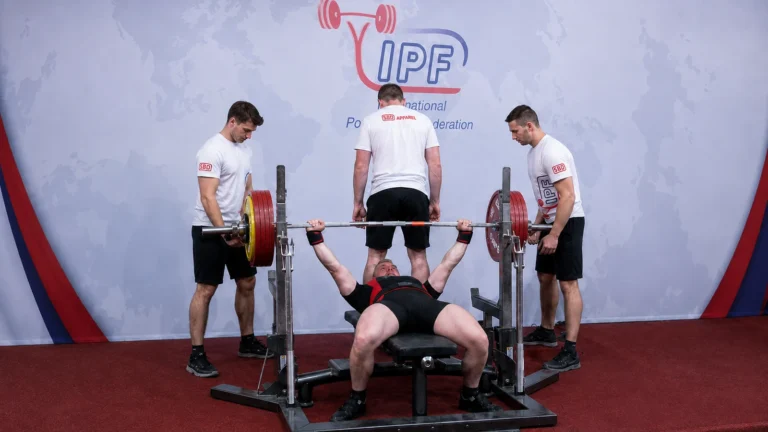

Some athletic feats are impressive because of the number on the bar. Others are impressive because of who is lifting it.
Allan Duong Dinh Hy’s deadlift belongs mostly to the second category.
In August 2024, a 17 year old French lifter competed at the IPF World Junior and Sub-Junior Powerlifting Championships in Malta.
He stepped onto the platform in the 53 kilogram weight class.
He weighed in at 52.2 kilograms. That is about 115 pounds.
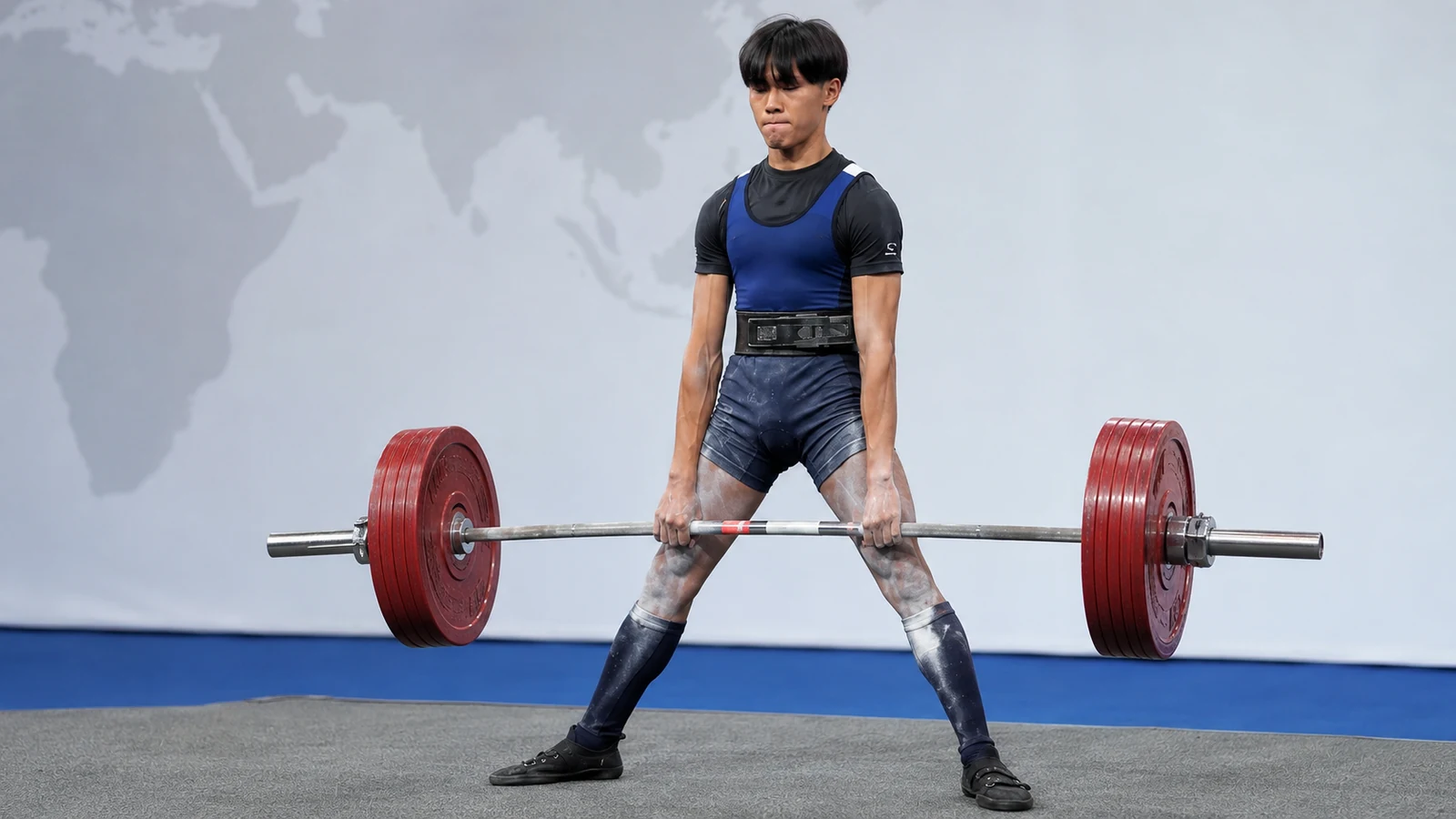
Then he pulled 246.5 kilograms off the floor.
That converts to 543.44 pounds, and it stood as an IPF Sub-Junior world record in the deadlift.
The number alone is impressive. What makes it remarkable is who set it.
Duong Dinh Hy was still 17 years old when he set it.
He had not yet aged out of the age bracket the sport calls sub-junior, a division built for lifters under 19 who are, in most cases, still adolescents by nearly every physical measure that matters for training.
He deadlifted a weight equal to roughly four and a half times his own bodyweight.
He did it before most of his peers had a driver’s license.
This article covers what actually happened in Malta and what the lift means in terms of relative strength.
It also covers how a body this young gets this strong, and what still needs care when it does.
What Happened in Malta
The 2024 IPF World Junior and Sub-Junior Powerlifting Championships ran in St. Paul’s Bay, Malta, in late August.
Duong Dinh Hy competed in the sub-junior men’s 53 kilogram class, in the raw, or classic, division.
That means no supportive suits beyond a lifting belt and knee sleeves.
He opened with a 147.5 kilogram squat.
His third attempt, at 152.5 kilograms, was ruled no lift, so 147.5 stood as his best.
He followed with a 102.5 kilogram bench press.
Then came the deadlift. He pulled 246.5 kilograms, a new IPF Sub-Junior world record.
His total across all three lifts reached 496.5 kilograms.
That was enough for first place in his weight class, edging out American lifter Luke Talley by half a kilogram.
The video embedded on this page was uploaded to YouTube by the International Powerlifting Federation’s own channel.
An oEmbed check of the video confirms both the title and the uploader, and it matches the record exactly: it is IPF’s own official footage, not a fan recording or a secondhand clip.
Multiple independent sources corroborate the numbers. OpenPowerlifting.org’s public results database lists the same meet, weight class, bodyweight, and deadlift figure.
So does Goodlift.info, the IPF’s own affiliated results and records platform.
FitnessVolt’s own sub-junior powerlifting records page independently lists Duong Dinh Hy as the current 53 kilogram record holder in this lift.
Sports outlet BarBend’s coverage of the meet describes the same 246.5 kilogram deadlift and the same narrow margin of victory over Talley.
One thing worth stating plainly: no separate official record page or still photo could be independently tracked down for this specific record, a gap this article’s own research flagged honestly rather than papering over.
That gap does not touch the video itself or the competition data, both confirmed above through multiple independent databases.
It just means this article leans on results platforms and the video itself, rather than one dedicated record announcement page.
A Deadlift Worth Almost Five Times His Bodyweight
Raw numbers on a leaderboard rarely tell the full story.
Relative strength, meaning how much someone lifts compared to their own bodyweight, usually tells more.
Duong Dinh Hy weighed 52.2 kilograms on the day of his record deadlift. His 246.5 kilogram pull works out to about 4.7 times his own bodyweight.
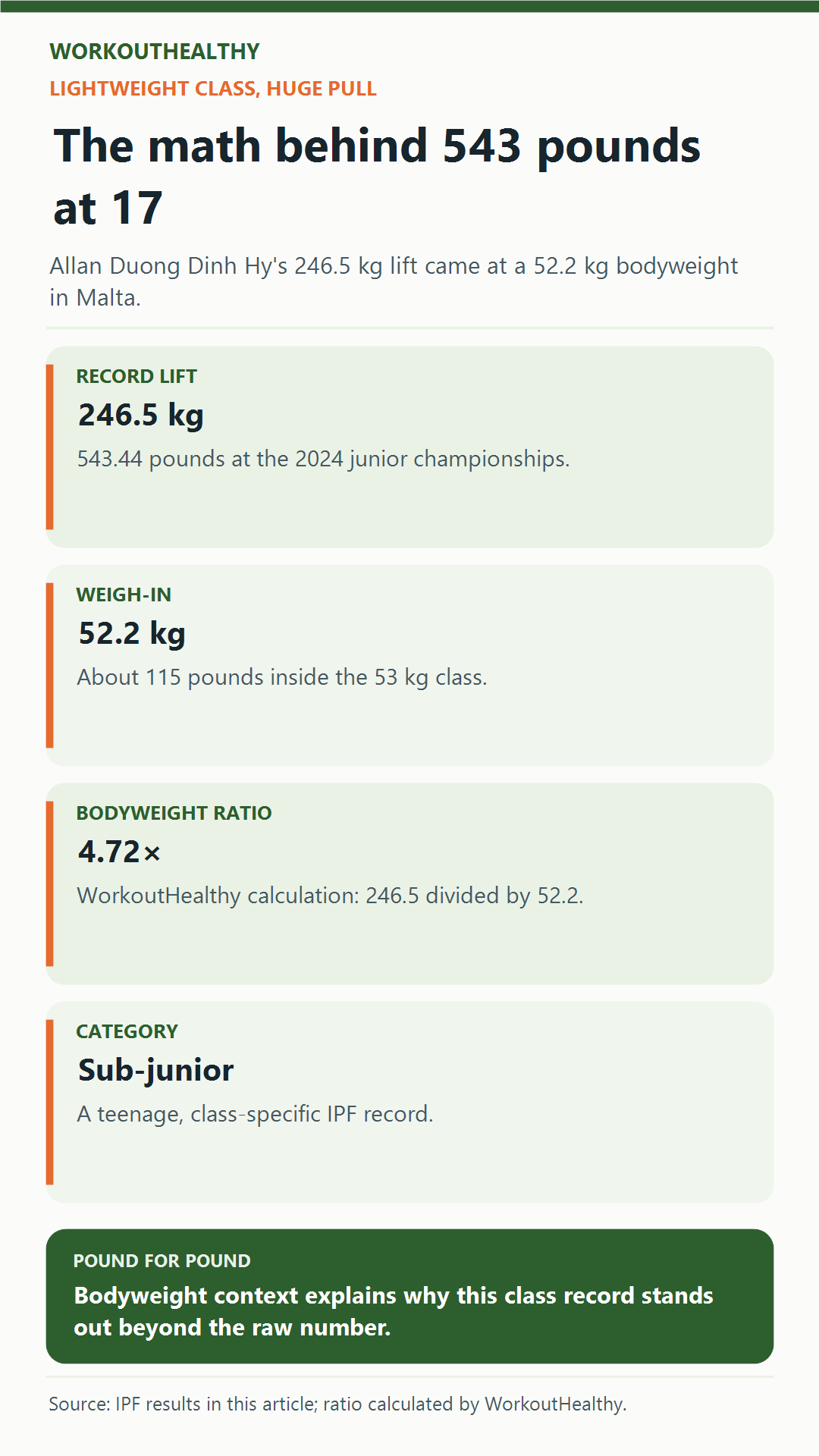
Picture that ratio in more familiar terms. A 115 pound teenager deadlifted roughly the combined bodyweight of two adult men.
Powerlifting also uses a bodyweight-adjusted scoring formula called DOTS to compare lifters of very different sizes on equal footing.
Duong Dinh Hy’s total that day scored 473.39 DOTS points, the same scale used to measure a 52 kilogram lifter’s total fairly against a 120 kilogram lifter’s total.
Context helps here too.
Elite adult male deadlift specialists in heavier weight classes routinely pull two to two and a half times their bodyweight at top level meets.
A ratio approaching 4.7 times bodyweight sits far outside that normal range at any age.
It is one reason lighter weight classes tend to produce the sport’s most dramatic bodyweight ratios.
A lift like this does not happen by accident. It is the product of a nervous system, a set of joints, and a technique that all worked together at exactly the right moment, inside a body that had not yet finished growing into any of them.
For another example of how WorkoutHealthy puts a lighter competitor’s numbers in real context, see our coverage of DonnaJean Wilde’s push-up world record, another case where the pacing and the math behind a record matter as much as the headline number.
What “Sub-Junior” Actually Means in Powerlifting
The IPF divides its competitors into age categories, and sub-junior is the youngest one that competes at a full international championship level.
Sub-junior covers lifters who are 14 to 18 years old on the day of competition.
Junior covers ages 19 to 23.
Open has no upper age limit, and it is where most of the sport’s best known names compete.
Duong Dinh Hy was 17 when he set his deadlift record in Malta. That placed him squarely inside the sub-junior bracket, close to its upper edge.
Records are tracked separately by age division for a specific reason.
A 17 year old’s best deadlift and a 27 year old’s best deadlift are not really the same test.
Training age, muscle mass, bone density, and hormonal development are all still changing throughout adolescence.
Comparing a sub-junior record directly to an open record would be comparing two different physical categories, not correcting for a difference in effort.
That distinction also separates a sub-junior powerlifting record like this one from Olympic weightlifting, a related but separate sport with its own age categories, technical lifts, and record book.
How a Body This Young Gets This Strong
Several factors compound to produce a lift like this, and none of them is a shortcut.
Lighter lifters generally produce higher relative-strength ratios than heavier lifters. Shorter limb lengths mean a shorter distance to pull the bar off the floor.
A smaller frame also typically carries proportionally more muscle relative to total bodyweight than a much larger one does.
Technique matters enormously in the deadlift specifically.
It is a lift that rewards efficient bar path, a tight starting position, and precise timing far more than it rewards raw muscle mass alone.
Training age plays a real role too, and it is often underestimated.
Duong Dinh Hy’s own competition record shows a lifter who had already built a real base before Malta, including a national meet and several regional meets across France in the two years beforehand, each one adding technical refinement and progressive load.
Adolescence itself is not automatically a strength penalty.
Research on youth resistance training has found that properly programmed strength training can produce meaningful strength gains in adolescents well before they reach adult bone maturity, and that much of that early gain is driven by improved neuromuscular coordination rather than muscle growth alone (Faigenbaum et al., 2009).
The Science of Training Teenagers for Heavy Lifts
This is the section that needs the most care, because it is also the part most likely to be misread.
A 17 year old deadlifting more than four and a half times his bodyweight can sound alarming to anyone picturing an unsupervised teenager loading a barbell in a garage.
That is not what produced this lift.
The National Strength and Conditioning Association’s position statement on youth resistance training concluded that properly designed, supervised programs are safe and effective for children and adolescents, with injury rates lower than in many other youth sports (Faigenbaum et al., 2009).
A separate review in the British Journal of Sports Medicine reached a similar conclusion: resistance training among young athletes, when appropriately prescribed and supervised, carries injury rates comparable to or lower than general physical education classes (Faigenbaum & Myer, 2010).
None of that means every teenager should chase a near-maximal deadlift.
It means the underlying activity, structured resistance training under real coaching, is not inherently dangerous for adolescents the way it is sometimes assumed to be.
Growth plates deserve the most precision here: injuries in youth strength sports are strongly associated with poor technique, inadequate supervision, and loads a lifter has not yet earned the competence to control, not with resistance training itself (Faigenbaum et al., 2009).
A federation sanctioned meet, with weigh-ins, judged lifts, and coaches who have spent years building a lifter’s technical base, is a very different context from an unsupervised max attempt.
Biological maturation is also not identical to chronological age.
Two 17 year olds can be at very different points in physical development, which is why researchers recommend adjusting training prescriptions to a young athlete’s maturational stage rather than treating every same-age teenager identically (Lloyd et al., 2014).
What This Lift Does Not Prove
A single world record deadlift, however well documented, does not answer every question a parent, coach, or young lifter might reasonably ask.
It does not prove that a comparable training load is appropriate for every teenager of a similar age or bodyweight.
Duong Dinh Hy’s competition history shows years of progressive meets behind this specific result, not a first attempt at a maximal pull.
It does not prove that a sub-junior record is a fixed, permanent marker of a lifter’s future.
Duong Dinh Hy has already moved up a full weight class since Malta, which is itself a reminder that a teenage athlete’s frame and numbers are still very much in motion.
And it does not settle the broader debate around early sport specialization.
Long-term athletic development research generally favors building a broad movement base before heavy specialization in one lift or one sport, even when a young athlete shows early aptitude for a specific discipline (Myer et al., 2013).
Common Mistakes When Training Young Lifters for Strength
A handful of mistakes show up repeatedly in how well-meaning coaches and parents approach youth strength training, and most of them are avoidable.
Rushing load progression is the most common one: adding weight before a lifter shows consistent, repeatable technique under lighter loads sets up exactly the poor-position lifting the research above ties to higher injury risk.
Skipping a real technical foundation is a close second: a rounded back or a bar path that drifts from the body carries more risk at any age, and that risk compounds while the lifter is still growing.
Ignoring growth spurts is another common misstep: a rapid increase in height can temporarily change a young athlete’s leverages and coordination, so a load that felt easy months earlier can suddenly move differently.
Treating one lift as the entire training plan is a mistake too: elite sub-junior lifters typically train all three competition lifts, general strength qualities, and recovery as one program, not a single lift in isolation.
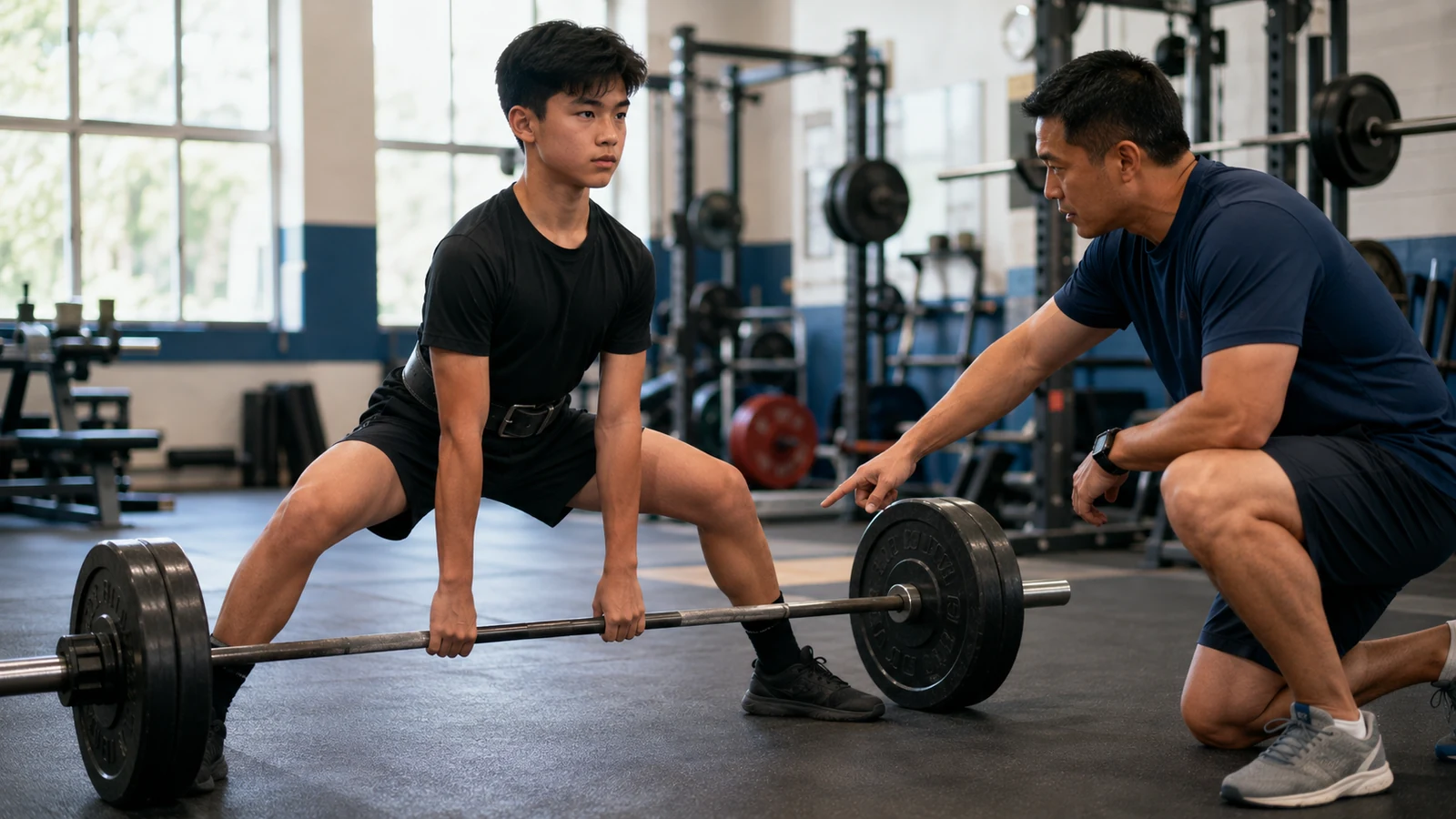
Finally, training without qualified supervision removes the exact safeguard the research above credits for making youth resistance training this safe.
A coach who corrects technique in real time does more for injury prevention than almost any other single factor.
Who Should Be Extra Cautious
Most healthy adolescents can safely take part in a well-coached strength program.
Some situations call for extra caution and a conversation with a doctor or physical therapist before heavy lifting gets added.
Any young athlete recovering from a recent injury, especially one involving a joint or a growth plate, should be cleared by a medical professional before returning to loaded lifting.
A young lifter with unexplained joint pain, especially pain that lingers after training instead of fading within a day, needs that same evaluation before continuing.
Rapid, recent growth in height is also worth flagging to a coach.
It can temporarily affect coordination and joint stability in ways that call for lighter loads while the athlete adjusts.
And any young athlete without access to a qualified, experienced strength coach should build technical competence at lighter loads first, regardless of how strong a peer’s numbers might look online.
Duong Dinh Hy’s Progression Since Malta
The Malta deadlift was not an endpoint. It was one data point inside a longer athletic story.
By August 2025, Duong Dinh Hy had moved up to the 59 kilogram class and competed at the IPF World Junior and Sub-Junior Championships in Costa Rica.
He pulled 286 kilograms there, roughly 630 pounds, and posted a 586 kilogram total. Both were new records in his new weight class.
He kept progressing into 2026, posting a 594 kilogram total at the French Junior Championships that May.
That progression matters for the argument here: a single viral number, on its own, says something about one day.
A multi-year, multi-meet trajectory of records, set through a federation with weigh-ins, judged lifts, and drug testing, says considerably more about a genuinely well-built young athlete than any single highlight clip ever could.
For a look at what a strength record can look like at the opposite end of a lifting career, see WorkoutHealthy’s coverage of Edith Connor’s Guinness record for oldest female bodybuilder, set at age 75.
For more on why lifting weight keeps paying off well past a single competition, see Does Lifting Weights Keep Your Brain Young? What the Research Actually Shows.
Watch the Original Video
Want more record-verified strength stories like this one? Subscribe to WorkoutHealthy Insider for practical explanations behind popular fitness claims.
References
Faigenbaum, A. D., Kraemer, W. J., Blimkie, C. J. R., Jeffreys, I., Micheli, L. J., Nitka, M., & Rowland, T. W. (2009). Youth resistance training: Updated position statement paper from the national strength and conditioning association. Journal of Strength and Conditioning Research, 23(5 Suppl), S60-S79. https://doi.org/10.1519/JSC.0b013e31819df407
Faigenbaum, A. D., & Myer, G. D. (2010). Resistance training among young athletes: Safety, efficacy and injury prevention effects. British Journal of Sports Medicine, 44(1), 56-63. https://doi.org/10.1136/bjsm.2009.068098
Lloyd, R. S., Oliver, J. L., Faigenbaum, A. D., Myer, G. D., & De Ste Croix, M. B. A. (2014). Chronological age vs. biological maturation: Implications for exercise programming in youth. Journal of Strength and Conditioning Research, 28(5), 1454-1464. https://doi.org/10.1519/JSC.0000000000000391
Myer, G. D., Lloyd, R. S., Brent, J. L., & Faigenbaum, A. D. (2013). How young is “too young” to start training? ACSM’s Health & Fitness Journal, 17(5), 14-23. https://doi.org/10.1249/FIT.0b013e3182a06c59
This article is for general information only and is not medical advice. If you have an injury, ongoing pain, or a medical condition, talk to a doctor or physical therapist before you change how you train or eat.