
On October 29, 2016, a Russian powerlifter walked out from behind a loaded barbell inside the Frankston Arts Centre, a short drive from Melbourne, Australia.
The bar held 484.9 kilograms.
That is 1,069.02 pounds.
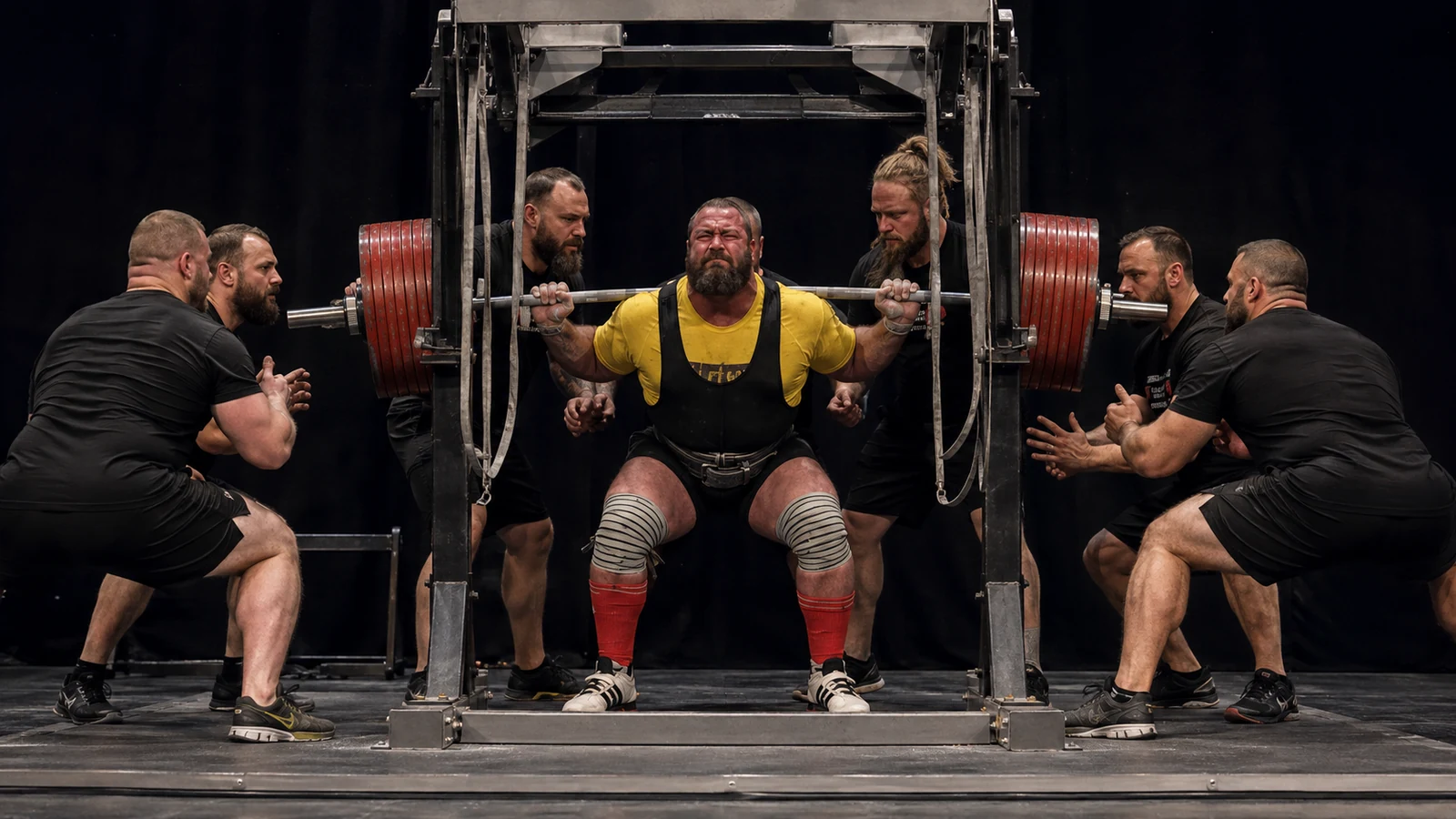
Andrey Malanichev broke below parallel, held the bottom position for a beat, and drove the bar back up in front of a sold-out crowd of 400 people who had paid specifically to watch this.
No supportive squat suit. Just knee wraps, a belt, and years of training built for exactly this moment.
It became the heaviest raw squat with knee wraps ever recorded, a specific and closely tracked category in competitive powerlifting.
What that record actually required, what happened to it afterward, and what the science says about the position underneath it are worth slowing down on.
The Record, Verified
The meet was called Big Dogs, an invitation-only, single-day powerlifting show built for a paying audience rather than the usual two-day competition format.
Promoter Markos Markopoulos called Frankston the powerlifting capital of the world, and for one night in 2016 the claim had some real backing.
Eight lifters from Russia, the United Kingdom, and Australia competed for a 30,000 dollar prize under the ProRaw banner, one of several independent federations that run raw-with-wraps competitions outside the stricter rules of the International Powerlifting Federation.
Malanichev won the meet outright.
His 484.9-kilogram squat, confirmed at 1,069.02 pounds, set a new world record for the heaviest raw squat performed with knee wraps.
He also totaled 1,140 kilograms across squat, bench press, and deadlift that night, a raw-with-wraps total record that stood until 2019.
A Record That Lasted Less Than a Year
Malanichev’s squat mark did not survive long.
In July 2017, Vlad Alhazov, a Russian-born powerlifter who competes for Israel, traveled to Australia and became the first man ever to squat 500 kilograms raw with wraps, set at the NPA Open Israel Championship.
He kept pushing after that.
In 2018, at a ProRaw exhibition held during the Arnold Sports Festival in Australia, Alhazov and fellow lifter Dan Bell each squatted 505 kilograms within a complete meet, sharing that specific record.
Later the same year, at the WRPF Adrenaline Grand Prix in Belarus, Alhazov squatted 525 kilograms, or 1,157.43 pounds, with wraps.
That lift is still recognized today as the heaviest raw-with-wraps squat ever performed in a sanctioned competition.
A training video reportedly showing Alhazov squatting 532.5 kilograms surfaced online around the same period, but it was filmed outside any sanctioned meet, so it has never counted as an official record.
As of this writing, no competition lift has surpassed Alhazov’s 525-kilogram mark from 2018.
Malanichev’s 484.9-kilogram squat remains a genuinely historic lift.
It is simply no longer the heaviest one on record.
This article tells it that way, rather than presenting an old number as current.
What “Raw With Wraps” Actually Means
Powerlifting splits into equipment categories, and the difference between them is not cosmetic.
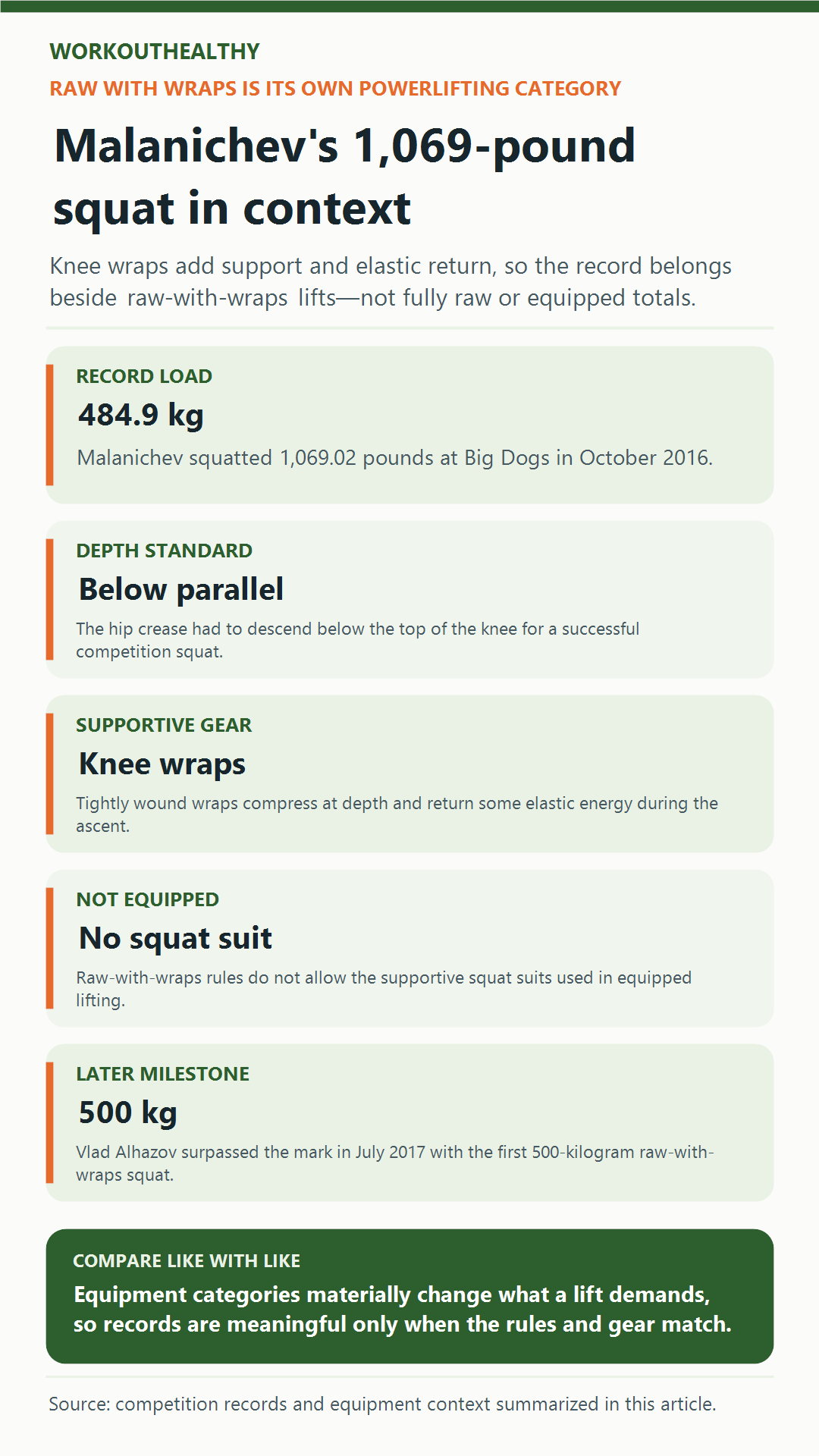
Equipped lifting allows supportive squat suits and bench shirts, thick multi-ply fabric engineered to store and return energy at the bottom of a lift, and equipped totals run far higher than raw ones for the same lifter.
Fully raw lifting, the stricter category used in most International Powerlifting Federation divisions, permits little beyond a belt.
Raw with wraps sits between the two.
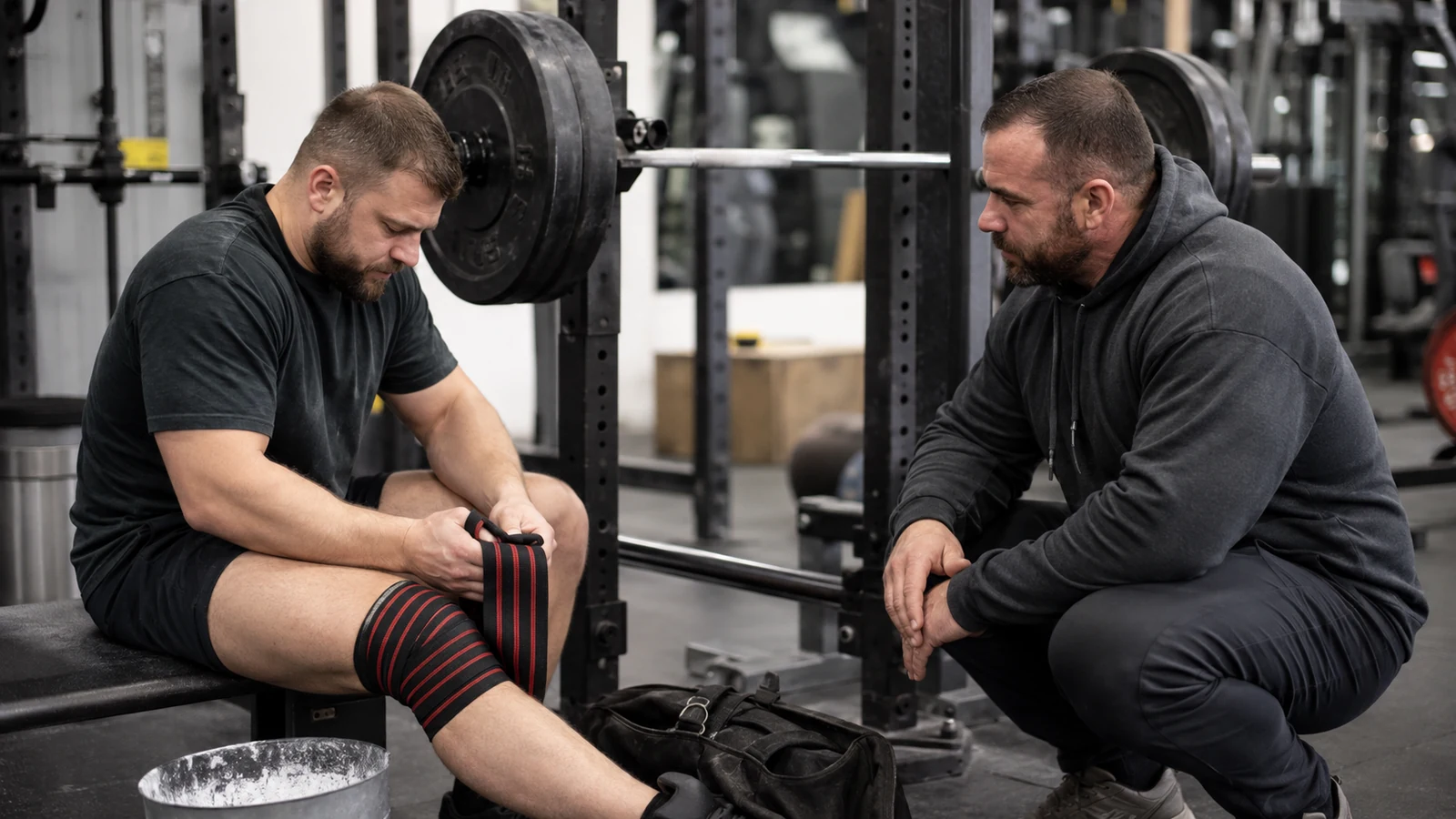
Lifters wind stiff elastic knee wraps tightly around each knee before a squat attempt, along with a belt, and sometimes knee sleeves depending on the federation’s rules.
Malanichev’s 484.9-kilogram lift belonged to this middle category, which is why it should never be compared directly to a fully raw squat record from an IPF meet, even though both get casually called a world record.
The Biomechanics Behind a Half-Ton Squat
A barbell squat is, mechanically, a fight against gravity at the hip, knee, and ankle joints at the same time.
Motion-capture research mapping how those joints share load through a full squat has found that compressive force at the knee can reach several times body weight at the bottom of a deep lift (Escamilla, 2001).
At 484.9 kilograms, those forces scale up enormously, which is part of why elite raw-with-wraps lifters spend years training the position before ever attempting anything near a competition max.
Depth changes the math too.
A squat below parallel, the standard most federations require for a lift to count, produces a longer range of motion and a harder position to escape than a partial squat, because the hip and knee extensors lose leverage as the joint angle closes.
The deeper the squat, the harder the bottom is to leave, and that is exactly the position a raw-with-wraps world record has to survive.
Why Knee Wraps Change the Numbers
Knee wraps are not just padding.
A study using force plates found that wearing knee wraps measurably increased peak power output and barbell velocity during the back squat compared with lifting the same relative load without them (Lake, Carden, & Shorter, 2012).
The wraps compress around the knee joint on the way down, storing elastic energy the way a compressed spring does, then help drive the bar back up out of the bottom position.
That mechanical assist is exactly why federations track raw-with-wraps totals separately from fully raw ones instead of comparing them head to head.
It also explains why a number like 484.9 kilograms should be read in context, as a specific equipment category’s record, not a blanket claim about the heaviest squat any human has ever done under any rules.
The Injury Tradeoff Nobody Talks About
Wraps help move more weight, and that benefit comes with real tradeoffs worth naming honestly.
A systematic review of injuries among competitive weightlifters and powerlifters found the knee is one of the most commonly injured joints in the sport, alongside the shoulder and lower back (Aasa, Svartholm, Andersson, & Berglund, 2017).
The same review noted that acute, sudden injuries are relatively uncommon in powerlifting compared with many other sports.
Overuse injuries built up from years of maximal loading are far more common, particularly at the knee and spine.
Wraps do not remove that risk.
They change where and how force gets applied.
The extra weight a wrap allows a lifter to move can outpace what an undertrained knee is ready to absorb.
That is not an argument against wraps. It is the reason competitive raw-with-wraps lifters spend years building tissue tolerance before loading anywhere near a max attempt.
The same instinct, choosing a training tool that respects joint pain rather than ignoring it, shows up in our own readers too.
When we asked our audience to weigh in, 85 percent said they preferred weightlifting to running.
Many pointed to knee and hip pain as the exact reason for the switch.
The Stance and Setup Behind a Record Squat
Elite raw-with-wraps lifters do not just add wraps and squat the way a beginner would.
Research on stance width has found that a wider stance changes the three-dimensional demands placed on the hip, shifting more of the workload toward the hip extensors and adductors and away from the knee (Hopkins, Hopkins, & Chiu, 2024).
Powerlifting-style squats also tend to use a lower bar position and a more pronounced forward torso lean than a typical gym squat, a difference researchers have measured directly by comparing squat techniques side by side (Swinton, Lloyd, Keogh, Agouris, & Stewart, 2012).
None of that is arbitrary.
A lower bar position and a wider stance shorten the bar’s total travel distance, which matters enormously once the bar is loaded with hundreds of kilograms.
What This Means If You’re Chasing Your Own Squat PR
Almost nobody reading this will ever attempt 484.9 kilograms, and that is fine.
The lessons behind a record squat still apply at any weight.
Depth matters more than most lifters treat it.
Training a full, honest range of motion, the same depth federations require in competition, builds strength through the exact position that limits most lifters, not just the final few inches.
Range of motion changes performance more broadly than just in the squat.
Our look at how a shorter range changes the floor press compared with a bench press covers the same underlying principle from a different lift.
Progressive overload has to stay gradual. Elite raw-with-wraps lifters add kilograms in small increments across years, not months.
If you use knee wraps or knee sleeves, treat them as a tool for a specific training phase or competition attempt, not a substitute for building real strength and control in the joint underneath them.
Who Should Be Extra Careful
Anyone with an existing knee injury, ligament instability, or a recent knee surgery should not model their squat depth or loading on an elite competition lifter without medical clearance first.
The same caution applies to anyone new to lifting.
Bar weight should increase only after form holds up consistently at lighter loads.
Pain during a squat, sharp or otherwise, is a signal to stop and reassess, not a signal to push through.
Older lifters and anyone returning from a long layoff should expect a longer runway to rebuild joint tolerance, even when the muscles feel ready sooner than the joints do.
A Record That Fits a Larger Pattern
Malanichev’s squat belongs to a larger pattern across verified strength and endurance feats, one where a record is rarely the finish line it looks like from the outside.
DonnaJean Wilde’s push-up world record shows the same pattern in a completely different discipline, built on pacing rather than a single burst of effort.
Edith Connor’s Guinness record for oldest female bodybuilder shows that the timeline for building serious strength is far more flexible than most people assume, starting a full career later than Malanichev had already finished his.
A world record squat is not proof that the story is finished. It is proof that, for one night, nobody on earth had gone further.
Watch the Record
ProRaw Powerlifting filmed and published the original footage of Malanichev’s 484.9-kilogram squat at Big Dogs.
Want more world records explained like this one? Subscribe to WorkoutHealthy Insider for practical explanations behind popular fitness claims.
References
Aasa, U., Svartholm, I., Andersson, F., & Berglund, L. (2017). Injuries among weightlifters and powerlifters: A systematic review. British Journal of Sports Medicine, 51(4), 211–219. https://doi.org/10.1136/bjsports-2016-096037
Escamilla, R. F. (2001). Knee biomechanics of the dynamic squat exercise. Medicine & Science in Sports & Exercise, 33(1), 127–141. https://doi.org/10.1097/00005768-200101000-00020
Hopkins, J. E., Hopkins, C. E., & Chiu, L. Z. F. (2024). Greater squat stance width alters three-dimensional hip moment demands. Journal of Biomechanics, 177, Article 112391. https://doi.org/10.1016/j.jbiomech.2024.112391
Lake, J. P., Carden, P. J. C., & Shorter, K. A. (2012). Wearing knee wraps affects mechanical output and performance characteristics of back squat exercise. Journal of Strength and Conditioning Research, 26(10), 2844–2849. https://doi.org/10.1519/JSC.0b013e3182429840
Swinton, P. A., Lloyd, R., Keogh, J. W. L., Agouris, I., & Stewart, A. D. (2012). A biomechanical comparison of the traditional squat, powerlifting squat, and box squat. Journal of Strength and Conditioning Research, 26(7), 1805–1816. https://doi.org/10.1519/JSC.0b013e3182577067
This article is for general information only and is not medical advice. If you have an injury, ongoing pain, or a medical condition, talk to a doctor or physical therapist before you change how you train or eat.