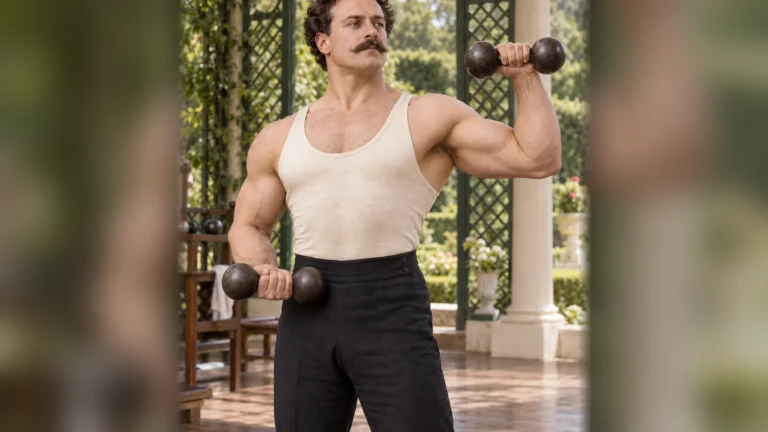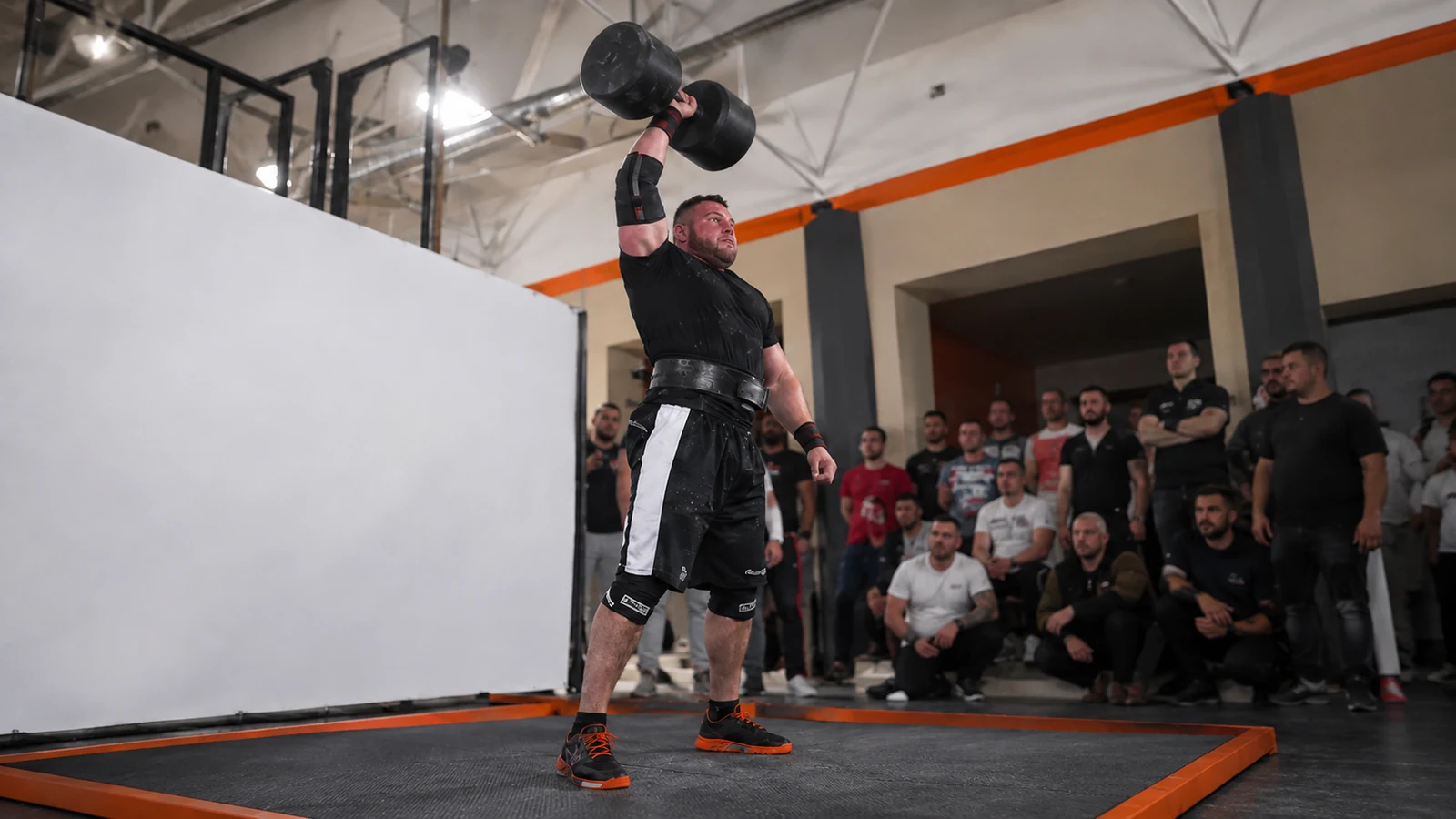

A 220-pound dumbbell is not something most gyms even own.
It looks less like exercise equipment and more like a boulder someone welded a handle onto.
On May 30, 2020, Ukrainian strongman Oleksii Novikov picked one up anyway.
He drove it from his shoulder to a full overhead lockout using one arm, set it back down, and did it again.
Then again, eleven times total, inside a 75-second window, filmed for World’s Ultimate Strongman’s “Feats of Strength” series.
The number sounds almost too large to be real.
Here is what independent reporting actually confirms about it, what is fair to call it, and what a lift like this actually demands from the body.
What Novikov Actually Did in Under 75 Seconds
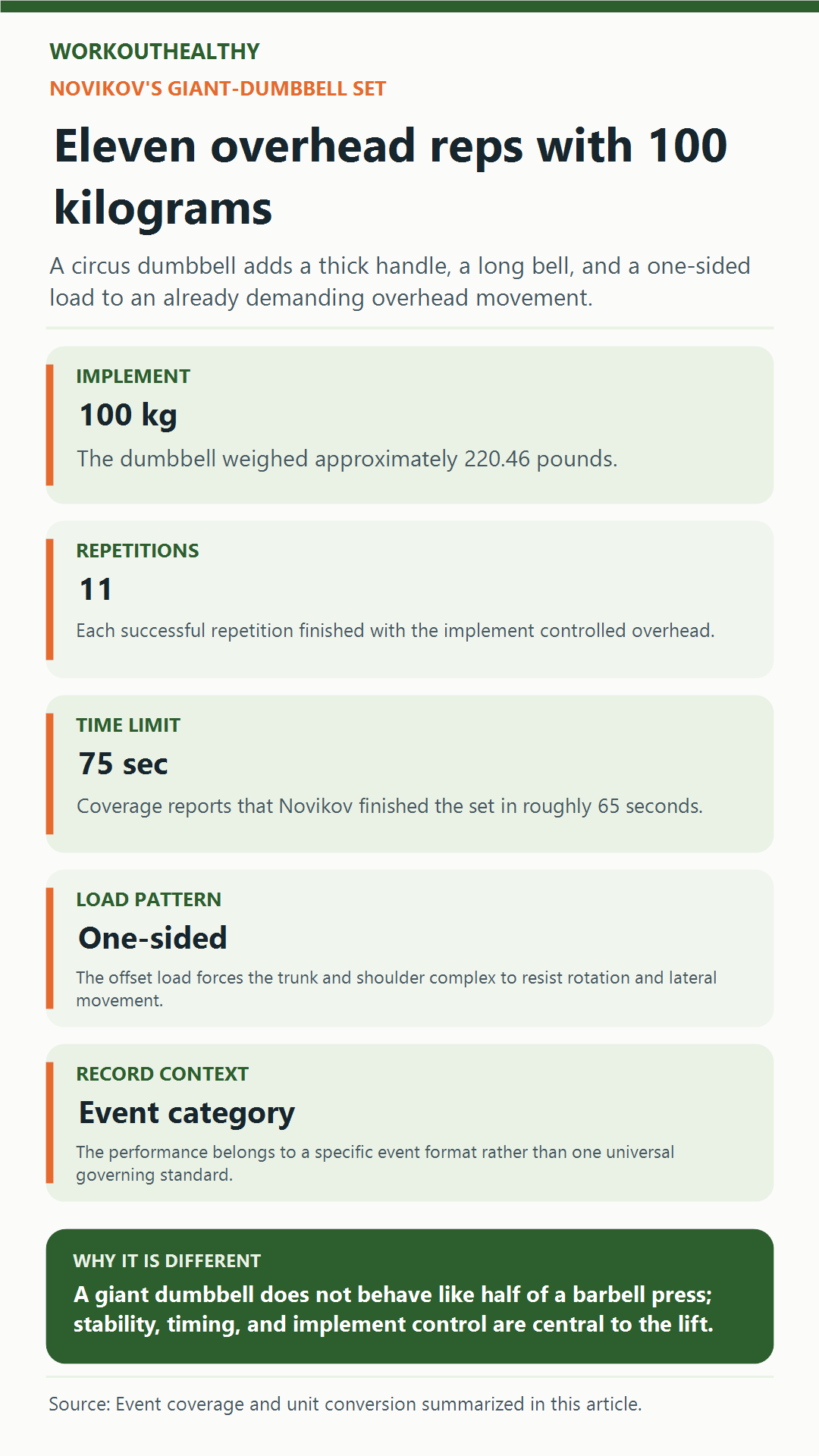
The implement was a 100 kilogram, or 220.46 pound, circus dumbbell, the thick-handled, barrel-ended style strongman competitions use for standing dumbbell press events.
Novikov’s job was simple to describe and brutal to execute.
Clean the dumbbell to the shoulder, drive it overhead to a locked elbow, lower it back down, and repeat as many times as possible before a 75-second clock ran out.
He banked 11 clean reps.
Independent coverage from BarBend and Fitness Volt both confirm the same numbers: 100 kilograms, 11 repetitions, and a finishing time of roughly 65 seconds, leaving about 10 seconds of the limit unused.
The attempt took place during the first season of WUS’s “Feats of Strength” series.
It streamed live on CoreSports.world, officiated remotely by four-time World’s Strongest Man champion Žydrūnas Savickas watching over webcam.
That remote-judging detail is not a small footnote.
The “Feats of Strength” format launched in 2020, during the same stretch of pandemic restrictions that shut down most in-person sport, and it leaned on athletes filming record attempts from home gyms rather than a traditional competition stage.
Is This Really a “World Record”?
World’s Ultimate Strongman is a real, sanctioned strongman promotion, not an amateur stunt channel.
It ran an annual multi-event championship from 2018 through 2021, and its “Feats of Strength” series did produce some marks that Guinness World Records itself later certified, including Hafthor Björnsson’s 501 kilogram deadlift.
Novikov’s dumbbell mark is a different kind of record.
Fitness Volt’s reporting from the time quotes WUS’s own statement describing the feat as setting a new world record rather than breaking an existing one, since no formal body had a standing mark for that exact weight and rep combination.
Novikov has said he believed the previous informal best was 10 reps at 100 kilograms, held by fellow strongman Brian Shaw.
That number does not appear in any certified record book either.
This is a record in the sense strongman fans use the word constantly.
It is the best publicly documented performance at a specific, named challenge, tracked and promoted by a strongman organization.
It is not a Guinness World Record, and no powerlifting or weightlifting federation has any jurisdiction over a circus dumbbell event.
Novikov’s own Wikipedia entry lists the feat plainly: “Circus Dumbbell for Reps, 100 kg (220 lb) x 11, World’s Ultimate Strongman, Feats of Strength series, 2020, World Record,” crediting WUS itself as the record-keeping body.
One more piece of context is worth knowing.
Brian Shaw, the athlete Novikov says he was chasing, publicly criticized the “Feats of Strength” at-home format not long after it launched, arguing that records set outside a real competition setting should not carry the same weight as ones set on a sanctioned stage.
That is a legitimate debate about the series as a whole, even though it was not aimed at Novikov’s lift specifically.
A record set on a livestream, judged by a fellow champion but outside a formal competition, occupies a real but different tier from a Guinness-certified mark. Both are worth taking seriously. They are not the same thing.
Why a Giant Dumbbell Is a Different Problem Than a Barbell
A barbell overhead press loads both arms evenly and lets the bar travel in a straight, predictable line.
A circus dumbbell removes both of those advantages.
The weight sits offset to one side of the body, so the shoulder, obliques, and spine have to fight rotation and side-bending on every rep, not just resist the vertical load.
There is no second hand to help balance the implement, and the barrel-shaped ends common to circus dumbbells make it awkward to control even before it leaves the shoulder.
Cleaning a 100 kilogram odd object to the shoulder is its own separate skill from finishing the press.
Getting the dumbbell from the floor onto the shoulder, called the clean, uses the hips, back, and grip almost as hard as the overhead portion does.
A poor clean can waste seconds or fail the rep entirely before the press even starts.
That combination, an offset load, a single working arm, and repeated heavy cleans under a running clock, is why circus dumbbell events read as a strongman specialty rather than a general strength test.
It rewards a different blend of raw strength, technique, and pacing than a barbell lift does.
The Shoulder and Triceps Demands of Standing Overhead Pressing
Even without the odd-object complications, a standing overhead press is harder on the body than most lifters assume.
Removing a bench or seat back forces the lifter to stabilize the entire torso against the weight rather than letting a support surface do that job.
A 2013 study in the Journal of Strength and Conditioning Research compared muscle activity across standing and seated shoulder presses using both barbells and dumbbells.
It found meaningfully different activation patterns depending on body position, with standing versions demanding more from stabilizing muscles throughout the trunk (Saeterbakken & Fimland, 2013).
The front deltoid and triceps still do most of the direct pressing work in an overhead lockout, since the final range of the movement depends on elbow extension and shoulder flexion strength.
For a single-arm variation like Novikov’s dumbbell press, that stabilization demand roughly doubles on one side of the body.
There is no matching load on the opposite arm to help balance the torso.
The core and the pressing-side shoulder girdle end up doing more independent work than they would pressing a symmetrical barbell overhead.
Why Raw Strength Still Drives Fast, Repeated Reps
Eleven reps in 65 seconds sounds like a conditioning feat as much as a strength one, and pacing certainly mattered.
The deeper driver is still maximal strength.
A widely cited 2016 review in Sports Medicine examined how muscular strength relates to athletic performance across sports.
It found that greater maximal strength consistently improves an athlete’s ability to produce force quickly, not just force overall (Suchomel, Nimphius, & Stone, 2016).
The review’s authors describe strength as allowing an athlete to potentiate earlier and to a greater extent, meaning a stronger lifter reaches a useful level of force output faster in each rep, not only a higher one.
That is exactly the quality a rep-for-time event like Novikov’s rewards.
A 100 kilogram dumbbell represents a near-maximal single effort for most trained lifters.
For Novikov, it was submaximal enough to move quickly and repeatedly.
His underlying strength ceiling is what turned one heavy lift into 11 fast, repeatable ones.
Grip, Core, and the Strongman Training Model
Strongman training does not build its athletes the way a typical barbell program does, and that shows up directly in a lift like this one.
A 2011 survey of 167 competitive strongman athletes, published in the Journal of Strength and Conditioning Research, documented how differently these competitors train compared to conventional lifters.
It found heavy emphasis on odd-object work, grip-specific training, and full-body carrying and pressing movements rather than isolated barbell lifts (Winwood, Keogh, & Harris, 2011).
That grip emphasis is not incidental.
A thick-handled circus dumbbell cannot be gripped the way a barbell can, and a failing grip ends a rep just as surely as a failing shoulder does.
Grip strength itself is also a meaningful marker of overall strength more broadly, not just a strongman quirk.
A 2019 review in Clinical Interventions in Aging described grip strength as largely consistent as an explanator of concurrent overall strength across general-population research, tying hand-grip output to broader measures of muscular capacity (Bohannon, 2019).
For a lift like the giant dumbbell press, that connection runs in both directions.
Grip capacity limits how long an athlete can control the implement, and general strength training that also builds grip carries over directly to odd-object events like this one.
Has the 100 Kilogram Record Been Broken Since 2020?
The research file behind this article flagged this claim as unverified since its original entry, which was the right instinct.
Records like this one do get broken, and often quickly.
An independent check found no evidence that anyone has beaten Novikov’s specific 100 kilogram, 11-rep mark since May 2020.
No subsequent WUS “Feats of Strength” episode, strongman meet recap, or record-tracking outlet turned up a challenger to that exact weight and rep combination.
Novikov himself has since pushed the broader challenge to heavier weights.
He logged 8 reps at 110 kilograms later in 2020 and 7 reps at 125 kilograms in 2022, according to his own competition record.
Those are different, harder challenges rather than a break of the original 100 kilogram mark, since fewer reps at more weight is not a like-for-like comparison.
As of this writing, 100 kilograms for 11 reps appears to remain the standing best publicly documented for that specific challenge.
Novikov’s Career Beyond the Dumbbell
The giant dumbbell record was an early highlight in a career that has only grown since.
Later in 2020, Novikov won the World’s Strongest Man title outright, the sport’s most prestigious overall championship, at just 24 years old.
He backed that up with two separate World’s Ultimate Strongman championship wins in 2021, plus victories at the Giants Live Strongman Classic and the 2022 Europe’s Strongest Man contest.
He has also finished on the World’s Strongest Man podium in both 2022 and 2023, taking third place each year.
He set several additional world records along the way, including a 549 kilogram Hummer tire deadlift in 2022 and a 550 kilogram elevated wheel deadlift in 2025.
The dumbbell press was never the centerpiece of that résumé.
It is a reasonable early snapshot of the explosive pressing strength that has carried through the rest of it.
Common Mistakes, and Who Should Be Cautious With Heavy Overhead Work
Nobody training at home needs to chase 100 kilograms overhead to get value from this event.
The same technical mistakes that ruin a light overhead press ruin a heavy one too.
The most common error is letting the torso lean or arch excessively to help finish a rep.
That shifts load onto the lower back rather than the shoulder and triceps, and it becomes more dangerous, not less, as the weight increases.
A second common mistake is rushing the lockout.
Pressing to a bent elbow instead of full extension both reduces the training stimulus and increases instability at the top of the lift, since a partially locked joint has less structural support for the weight above it.
People with existing shoulder impingement, a history of rotator cuff injury, or uncontrolled high blood pressure should be especially cautious with any maximal or near-maximal overhead pressing, whether that is a barbell, a dumbbell, or an odd object like a circus dumbbell.
Overhead lifts place unique compressive and shear stress on the shoulder joint at end range, and heavy single-arm work adds spinal loading on top of that.
Anyone in those categories should check with a doctor or physical therapist before adding heavy overhead pressing to a program.
How to Build Toward a Stronger Overhead Press
Nobody starts at a 220-pound dumbbell, and Novikov did not either.
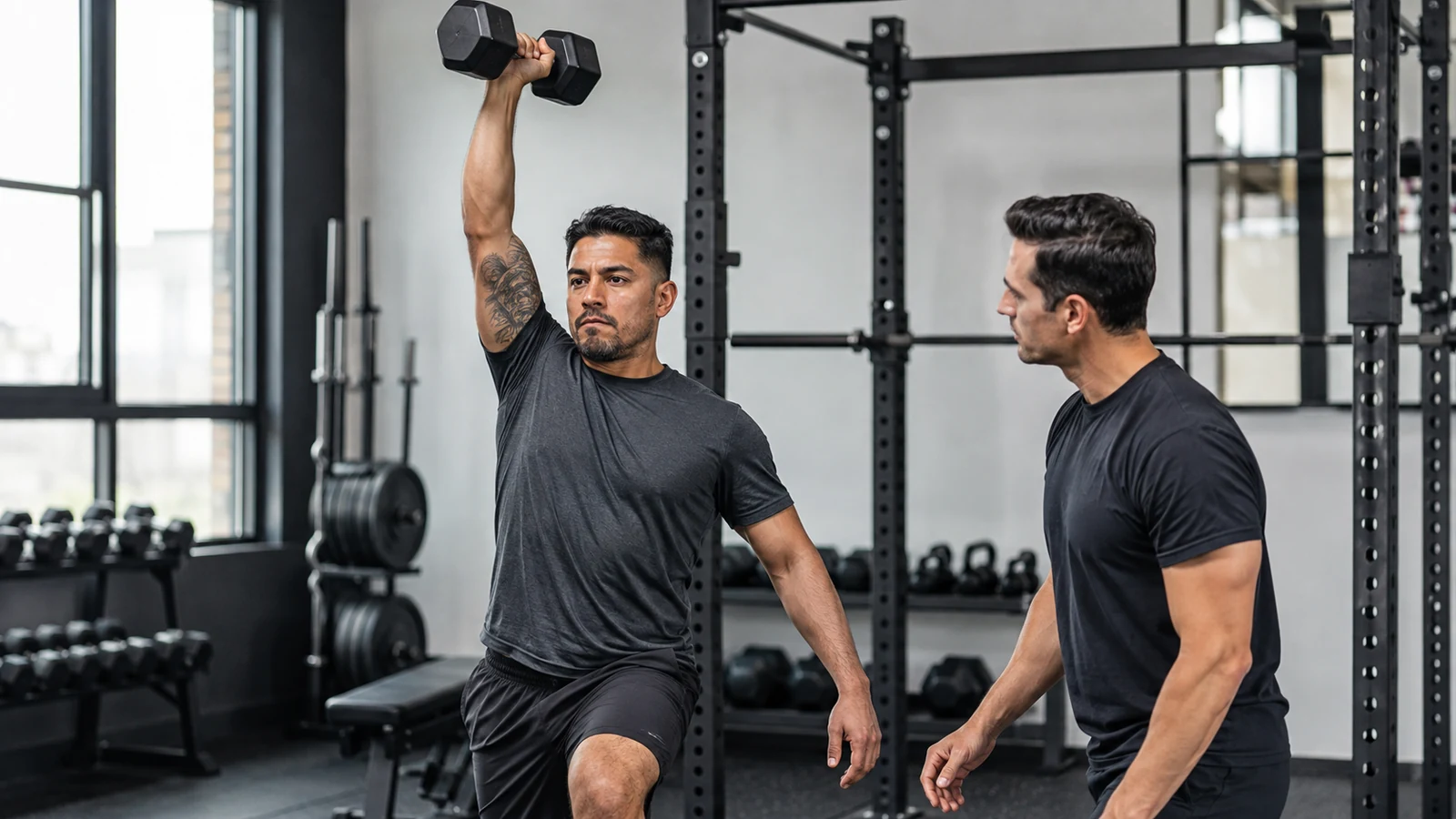
Build the base with a standard barbell or dumbbell overhead press first.
Our breakdown of Floor Press vs Bench Press: What Actually Changes is a useful starting point for understanding how body position changes the demand on your shoulders, even though that guide covers a horizontal press rather than an overhead one.
From there, progress load gradually and track it honestly rather than chasing a number that outpaces your technique.
Small, consistent jumps in weight over months, not years, tend to work better than large jumps that sacrifice range of motion or tempo.
Grip and core work deserve dedicated attention too, not just leftover effort at the end of a session.
Farmer’s carries, suitcase carries, and dead hangs all build the kind of grip endurance that odd-object pressing eventually demands, and they carry over to ordinary daily tasks in the meantime.
Pacing matters even outside of strongman-style timed events.
The same lesson behind Novikov’s 65-second finish shows up in DonnaJean Wilde’s Push-Up World Record: The Pacing Math Behind It, where a controlled, sustainable pace beat a start that looked impressive for only the first few minutes.
Explosive strength like the kind this lift requires is not the exclusive property of elite strongmen either.
Research on jump training summarized in Can Box Jumps Build Muscle? What Research Says shows that ordinary lifters can build real explosive capacity with appropriately scaled training, not just maximal barbell work.
Age is a smaller barrier than most people assume, too.
Edith Connor’s Guinness World Record for competitive bodybuilding, set in her mid-seventies after she started serious training in her sixties, is a reminder that the ceiling for building real strength opens later than most people think.
The gap between a beginner’s first overhead press and Novikov’s 220 pounds is enormous. The gap between doing nothing and starting is the only one that actually matters at the beginning.
Watch the Lift
Want the next record fact-checked before you share it? Subscribe to WorkoutHealthy Insider for practical explanations behind popular fitness claims.
References
Bohannon, R. W. (2019). Grip strength: An indispensable biomarker for older adults. Clinical Interventions in Aging, 14, 1681 to 1691. https://doi.org/10.2147/CIA.S194543
Saeterbakken, A. H., & Fimland, M. S. (2013). Effects of body position and loading modality on muscle activity and strength in shoulder presses. Journal of Strength and Conditioning Research, 27(7), 1824 to 1831. https://doi.org/10.1519/JSC.0b013e318276b873
Suchomel, T. J., Nimphius, S., & Stone, M. H. (2016). The importance of muscular strength in athletic performance. Sports Medicine, 46(10), 1419 to 1449. https://doi.org/10.1007/s40279-016-0486-0
Winwood, P. W., Keogh, J. W. L., & Harris, N. K. (2011). The strength and conditioning practices of strongman competitors. Journal of Strength and Conditioning Research, 25(11), 3118 to 3128. https://doi.org/10.1519/JSC.0b013e318212daea
This article is for general information only and is not medical advice. If you have an injury, ongoing pain, or a medical condition, talk to a doctor or physical therapist before you change how you train or eat.