
Dave Depper spends most of his year on a stage, not a starting line.
He plays guitar for Death Cab for Cutie, and he has also performed live with Postal Service members over the years.
In November 2025, he traded a setlist for a starting corral at the TCS New York City Marathon.
He ran the race alongside his Death Cab bandmate Ben Gibbard, according to Runner’s World.
The two were raising money for Protect Our Winters, a nonprofit focused on climate advocacy.
Depper finished in 3 hours, 54 minutes, and 21 seconds, a strong debut for a touring musician training between shows.
As a team, the group reportedly raised more than twenty thousand dollars for the cause.
Who Is Dave Depper
Depper grew up in Bend, Oregon, and studied computer and information science at the University of Oregon.
He worked as a software engineer before shifting to music full time.
He built a career as a touring musician for several Pacific Northwest artists before joining Death Cab for Cutie’s live band in 2015.
He became a full member of the band after founding guitarist Chris Walla’s departure, and has since contributed to the group’s recorded work.
Depper is also a distance runner in his own right.
He has described often running 6 to 12 miles before shows, a habit he shares with Gibbard.
Depper released his own debut solo album in 2017, titled Emotional Freedom Technique, which drew positive attention from music critics.
He has spent his career mostly working behind other artists’ names, first as a session and touring player, then as a full member of one of indie rock’s more enduring bands.
A marathon fits that pattern in an odd way. It is a very public number attached to a lot of private, unglamorous effort that nobody sees.
A Marathon Squeezed Between Tour Dates
Touring musicians rarely have a predictable weekly schedule.
Hotel gyms, unfamiliar cities, late soundchecks, and inconsistent sleep all work against a normal training plan.
A 3:54:21 marathon finish is not an elite time, but it is a genuinely strong one for a first attempt.
It suggests real, consistent training happened somewhere between tour stops, not a last-minute decision to just show up and run.
Why He Ran It With a Bandmate
Running alongside Gibbard was not incidental to the story. It may have been part of what made the training stick.
Gibbard has his own well documented running history.
He stopped drinking alcohol in 2008 and started running seriously not long after, eventually moving into ultramarathon distances.
He completed the Western States 100 mile endurance run in June 2025, one of the most demanding trail races in the country.
Research on exercise and social influence supports what that partnership suggests.
A widely cited meta-analysis by researchers Albert Carron, Heather Hausenblas, and Diane Mack reviewed how social influence affects exercise behavior across many studies.
The review found that support from training partners and social groups was consistently associated with better exercise participation and adherence.
A training partner adds accountability that is easy to underestimate until a workout gets skipped alone but not with someone waiting.

For two touring musicians on an unpredictable schedule, having each other as a fixed point may have mattered more than any specific training plan.
The Cause Behind the Miles
Protect Our Winters is a real, established nonprofit, not a one-off charity built around this race.
Professional snowboarder Jeremy Jones founded the organization in 2007.
Its mission centers on climate policy and legislation, working through campaigns on carbon pricing, public lands, and clean energy.
The group has partnered with major outdoor brands and has been active in national and international climate advocacy efforts for nearly two decades.
Running a marathon for a cause like this is a common structure in charity fundraising, and it can genuinely help with training motivation.
Committing publicly to a fundraising goal creates a form of accountability that private goals do not always provide.
The TCS New York City Marathon course itself is not an easy one to raise money on quietly, either.
It winds through all five boroughs, crosses five bridges, and draws crowds of spectators along nearly the entire route, which tends to help a fundraising campaign gain visibility as runners post updates from along the course.
Pairing a demanding physical goal with a cause outside of yourself is also a well documented motivational strategy, separate from any specific charity.
Runners training for a cause often report that the fundraising commitment keeps them showing up for training runs on days when personal motivation alone would not have been enough.
What Training for a Marathon on Tour Actually Requires
Musicians on tour face a specific kind of chronic stress: irregular sleep, constant travel, and performance pressure night after night.
A large review published in Sports Medicine by researchers Matthew Stults-Kolehmainen and Rajita Sinha examined how stress affects physical activity and exercise behavior.
The review found that stress has a complicated relationship with exercise. It can either crowd exercise out entirely or become a reliable outlet, depending largely on existing habits and routine.
People who already have exercise built into their identity, the way Depper and Gibbard both clearly do, are more likely to protect that habit even under stress.
For someone without an established running habit, tour life would likely make training harder, not easier.
For someone who already runs before shows as a matter of routine, a tour schedule becomes something to train around rather than something that erases training altogether.
How Much Training a Marathon Debut Like This Actually Needs
A common assumption is that a strong first marathon requires a huge amount of weekly mileage.
The research on this is more forgiving than that assumption suggests.
A classic 1981 study in Medicine and Science in Sports and Exercise, from researchers Hagan, Smith, and Gettman, looked at what actually predicted marathon finish times in a group of recreational and competitive runners.
Weekly training mileage and measures of aerobic conditioning were strong predictors of performance.
But the relationship was not a straight line where more was always better.
Runners who trained consistently in a moderate range performed well, without needing the extreme volume associated with elite competitive programs.
That matters for anyone training around a job, a family, or a tour bus schedule.
A 3:54 marathon does not require professional-athlete mileage. It requires steady, unglamorous consistency over several months.
That is a very different bar than most people picture when they imagine “marathon training,” and it is a more realistic one for someone juggling a demanding career.
What This Story Doesn’t Tell Us
The public reporting on this race does not include Depper’s specific training plan or weekly mileage.
It is not clear how much of his training happened on the road versus at home between tour legs.
The fundraising total and finish time both come from Runner’s World’s own reporting rather than an independently verified race database entry tied to his name specifically.
None of that changes the core, verifiable facts: Death Cab for Cutie’s 2025 touring schedule was demanding, and a 3:54 marathon debut under those conditions is a real accomplishment.
Common Mistakes When Training Around a Chaotic Schedule
The biggest mistake touring or traveling athletes make is treating training as all-or-nothing.
Skipping a run because the full planned distance isn’t possible often means skipping it entirely, when a shorter run would have preserved the habit.
Another common mistake is ignoring recovery while on the road, since travel days and poor sleep already add fatigue that training plans built for a stable schedule don’t account for.
A third mistake is waiting until race week to test race-day nutrition and gear, rather than practicing that routine during training runs in different cities and conditions.
How to Train for a Marathon With an Unpredictable Schedule
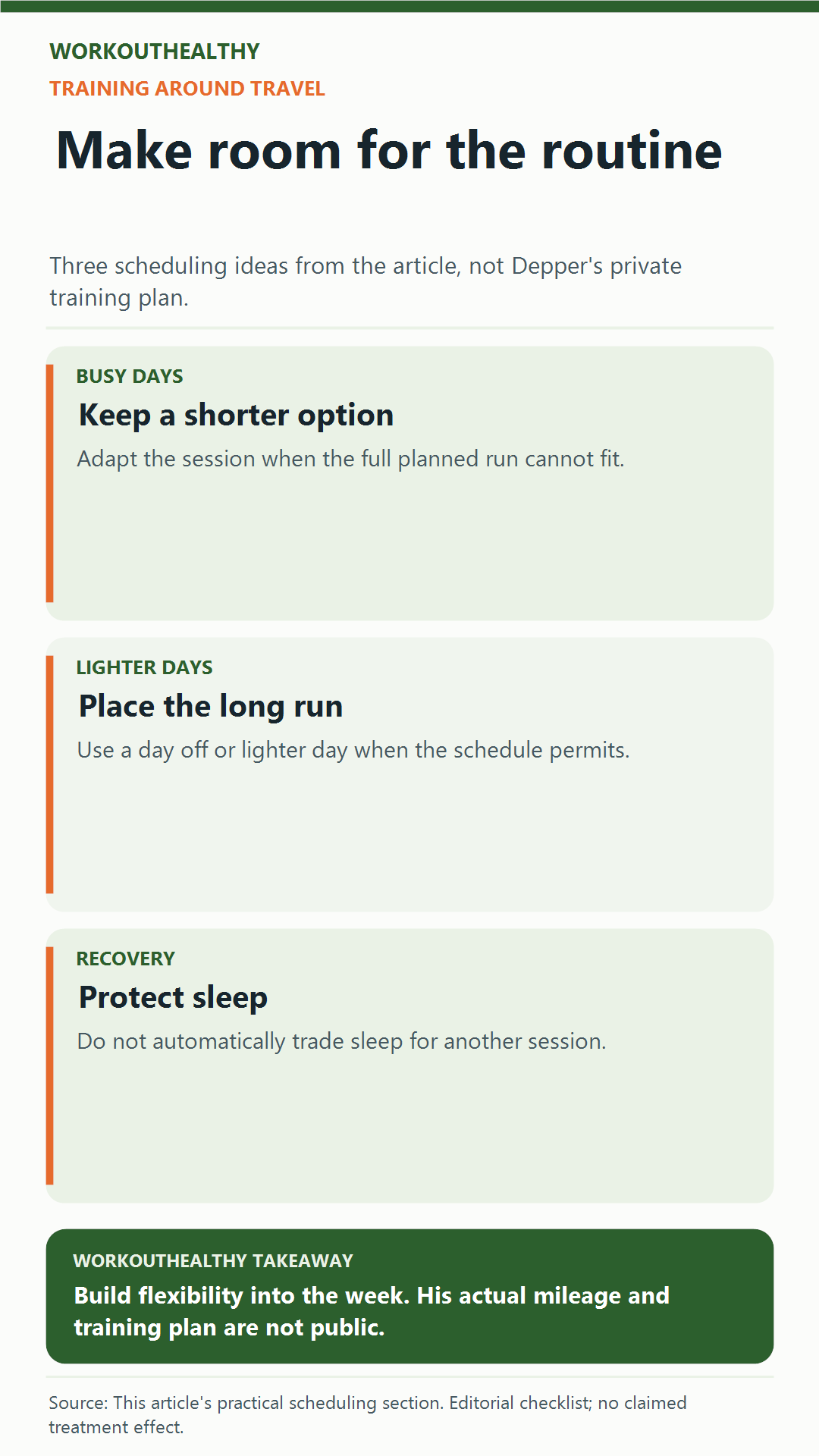
Build flexibility into the training plan from the start, with a minimum “just show up” run for the busiest days.
Anchor long runs to days off or lighter show days whenever the schedule allows, even if that means moving the long run around week to week.
Use a portable, simple strength routine that can happen in a hotel room, since consistent strength work supports the joints and connective tissue that high running volume stresses.
Track effort by feel on heavy travel weeks, not just pace, since jet lag and poor sleep can make an easy run feel much harder than it should.
Find a training partner or an online community for accountability if a regular in-person partner isn’t available on the road.
Prioritize sleep over an extra training session whenever the two conflict, especially in the final weeks before the race.
Who Should Talk to a Doctor First
Anyone starting marathon training after a long period of inactivity should get a checkup first, especially with any history of heart or lung conditions.
People managing chronic sleep disruption, whether from touring, shift work, or another cause, should talk to a doctor about how that affects training safety and recovery.
Anyone who develops persistent chest tightness, unusual fatigue, or joint pain during training should see a doctor before continuing to increase mileage.
References
- Carron, A. V., Hausenblas, H. A., & Mack, D. (1996). Social influence and exercise: A meta-analysis. Journal of Sport and Exercise Psychology, 18(1), 1-16. https://doi.org/10.1123/jsep.18.1.1
- Stults-Kolehmainen, M. A., & Sinha, R. (2014). The effects of stress on physical activity and exercise. Sports Medicine, 44(1), 81-121. https://doi.org/10.1007/s40279-013-0090-5
- Runner’s World. (2025). 2025 New York City Marathon: Which celebrities ran? https://www.runnersworld.com/news/g69178419/2025-new-york-city-marathon-celebrities/
- Hagan, R. D., Smith, M. G., & Gettman, L. R. (1981). Marathon performance in relation to maximal aerobic power and training indices. Medicine and Science in Sports and Exercise, 13(3), 185-189. https://doi.org/10.1249/00005768-198103000-00007
- Protect Our Winters. Our mission. https://protectourwinters.org/
This article is for general informational purposes only and is not a substitute for professional medical advice. Always talk to a qualified healthcare provider before starting a new exercise program, especially if you have an existing health condition. Individual results from any training approach can vary.