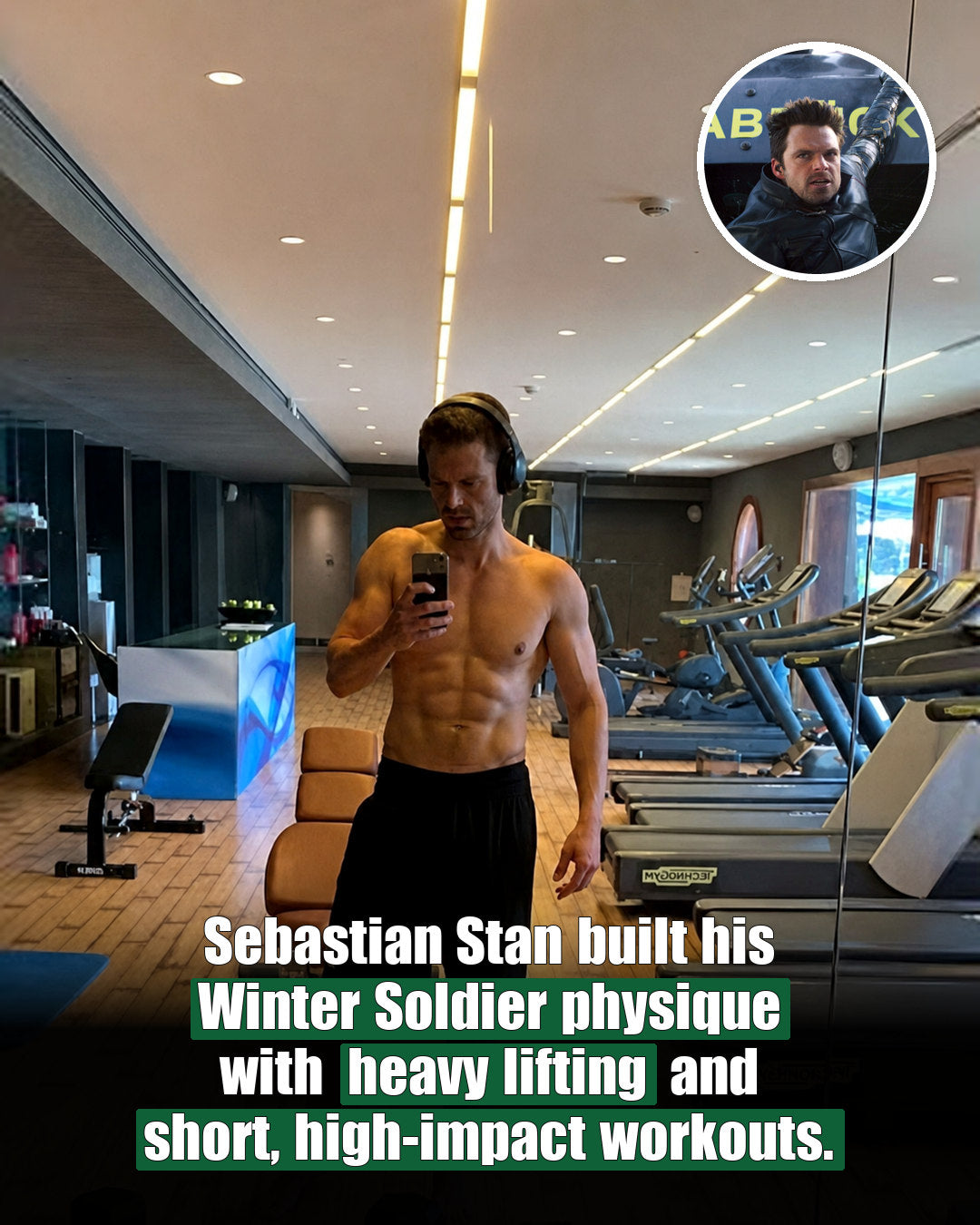

Sebastian Stan has played Bucky Barnes, also known as the Winter Soldier, across more than a decade of Marvel films and shows.
The character’s look was never about pure size. Reporting on Stan’s preparation for the role describes a mix of functional strength work, calisthenics, and boxing style conditioning.
The goal was a physique that reads as tactical and combat ready. That is a different target than the kind of bulk associated with other comic book roles.
Who Is Sebastian Stan
Stan was born August 13, 1982, in Romania. He moved to Vienna at age eight, then later to New York, and became a U.S. citizen in 2002.
His early television work included roles on Law & Order and Gossip Girl. He also appeared in Black Swan and The Martian before his Marvel career took off.
Stan signed a nine picture deal with Marvel, playing Bucky Barnes starting with Captain America: The First Avenger in 2011.
He has reprised the role across multiple films and the Disney+ series The Falcon and the Winter Soldier.
His career has grown well beyond the Marvel universe in recent years. He won a Golden Globe and the Silver Bear for Best Leading Performance for A Different Man in 2024, and earned an Oscar nomination for playing a young Donald Trump in The Apprentice.
What the Training Reportedly Looked Like
Training reports describe Stan’s Winter Soldier preparation as functional rather than purely aesthetic. The emphasis was on strength that translates to real movement, not just size for its own sake.
Calisthenics played a role in that approach. Bodyweight exercises like pull ups, push ups, and dips build strength using your own body as resistance, without requiring a fully equipped gym.
Boxing style conditioning also factored into the reported training. This combination targets cardiovascular fitness, coordination, and explosive power together, rather than isolating any single quality.
Stan has not published a detailed breakdown of exact workouts, sets, or a weekly schedule tied to this specific role.
This article describes the training approach as it has been reported, not as a confirmed program laid out by Stan himself.
Why the Character Called for This Approach
Bucky Barnes is written as a soldier and assassin, not a bodybuilder. That distinction matters for how a costume designer and trainer would approach building his on screen physique.
A soldier archetype calls for lean, functional muscle. The character needs to look capable of sudden, explosive movement rather than looking built primarily for size.
That is a different training target than characters written as pure powerhouses. Physical roles like this typically pull from a different toolkit for each specific look.
Stan has taken on several different physical transformations across his career for different roles. That range says as much about training adaptability as it does about genetics.
The Science Behind Functional Strength and Conditioning
Calisthenics has real research behind it as a strength building method. A study published in the Journal of Strength and Conditioning Research examined a calisthenics and light strength training program and its effects on lower body strength and body composition.
The study found measurable improvements in strength and body composition from the program. That supports the idea that bodyweight based training can produce real physical adaptations, not just a feeling of being worked out.
Boxing style conditioning adds a different physiological demand. A 2023 study in The Journal of Sports Medicine and Physical Fitness measured the intensity of boxing rounds in trained fighters.
Researchers found that boxing rounds reliably pushed heart rate and blood lactate into vigorous intensity territory, even across short bursts.
That makes boxing conditioning an efficient way to build cardiovascular fitness alongside strength work.
Combining strength training with conditioning work is sometimes called concurrent training. It has its own body of research.
A 2012 meta-analysis in the Journal of Strength and Conditioning Research, led by researcher Jacob Wilson, examined how combining these two training types affects overall results.
The research found that concurrent training can support both strength and endurance gains. Very high volumes of both at once, though, can blunt maximum strength gains compared to strength training alone.
Balance between the two matters more than doing as much of both as possible.
How This Compares to General Fitness Guidance
The Physical Activity Guidelines for Americans call for regular aerobic activity plus muscle strengthening work each week.
A functional training approach that blends calisthenics and conditioning can meet both needs at once.
This style of training also appeals to people without access to a full gym. Calisthenics in particular requires very little equipment, which makes it one of the more accessible entry points into serious strength training.
It is not automatically the fastest route to maximum muscle size. Traditional progressive weight training still tends to build more mass faster for people whose primary goal is size rather than functional capability.
For general fitness, athleticism, and a lean, capable look, this combined approach holds up well.
It reflects how many athletes and military style training programs are actually structured.
Training for a Character Versus Training for a Look
There is a real difference between training to look a certain way and training to move well.
Both can produce a lean, athletic physique.
Training focused purely on appearance often targets specific muscle groups in isolation. It optimizes for how a body looks from a specific angle, under specific lighting, at a specific moment.
Functional training takes a different starting point. It builds capability first, on the theory that a body trained to move well will also tend to look the part.
This distinction matters for anyone choosing a training style off screen too. A goal built around genuine capability, like running faster, lifting more, or moving better, tends to hold up over time better than a goal built purely around appearance.
That does not mean aesthetic goals are wrong. It means functional training offers a second, often more sustainable, reason to stick with a program even on days motivation about appearance alone would not be enough.
Common Mistakes People Make With This Style of Training
A common mistake is treating calisthenics as automatically easy because it skips weights.
Bodyweight training can be just as demanding as weight training when done with proper progression and intensity.
Another mistake is skipping progression entirely. Doing the same push ups and pull ups indefinitely, without adding reps, difficulty, or new variations, eventually stalls progress the same way any unchanging program does.
People also tend to neglect pulling exercises in favor of pushing ones. Push ups and dips are popular, but pull ups and rows matter just as much for balanced upper body development.
Combining boxing conditioning with strength training without managing total volume is another common error. Too much of both at once increases injury risk and can blunt strength gains, based on the concurrent training research.
Finally, many people underestimate how much recovery this style of training demands. Functional training that combines strength, calisthenics, and boxing conditioning taxes the body from multiple directions, and skipping rest days catches up quickly.
How to Build a Functional, Tactical Style Program
Start with foundational calisthenics movements. Push ups, pull ups, dips, and bodyweight squats cover the major movement patterns and scale to any fitness level.
Add boxing conditioning two to three times a week. Boxing training remains one of the most efficient ways to build cardiovascular fitness alongside strength, at nearly any age or starting point.
Include explosive movements for power development. Plyometric exercises like box jumps build the kind of fast, forceful movement a tactical physique depends on.
Balance pushing and pulling exercises in every training week. This keeps the shoulders and upper back healthy and prevents the muscular imbalances that come from favoring one direction.
Progress your bodyweight work deliberately. Add reps first, then move to harder variations, like moving from knee push ups to standard push ups to decline push ups over time.
Schedule real rest days into the week. Two to three full training days with lighter activity or complete rest between them supports recovery from this demanding combination of training styles.
Track your training the same way you would a weight lifting program. Recording your reps, rounds, and how sessions felt lets you confirm real progress instead of guessing.
If you are new to structuring a program like this, working with a trainer for a few sessions can help you build a safe, balanced weekly plan you can then run on your own.
A Sample Weekly Structure
This is a general template, not a copy of any specific actor’s program. Adjust volume and intensity to match your own experience level.
Monday can focus on upper body calisthenics. Push ups, pull ups, and dips, done across several sets, build pressing and pulling strength together.
Tuesday can focus on boxing conditioning. A structured session of rounds on a bag or with pads builds cardiovascular fitness and coordination.
Wednesday can be a lighter recovery day. Mobility work, light walking, or complete rest lets the body recover from the first two harder sessions.
Thursday can focus on lower body and explosive work. Bodyweight squats, lunges, and jump variations build leg strength and power together.
Friday can combine a shorter boxing session with core work. Rounds on the bag followed by planks and rotational core exercises tie the week together.
Saturday can be flexible, used for a longer conditioning session or an additional full body circuit.
Sunday can be reserved for full rest.
This structure balances strength, conditioning, and recovery across the week. It can be adjusted based on your schedule, as long as hard sessions are not stacked back to back without recovery time between them.
References
- Tsourlou, T., Gerodimos, V., Kellis, E., Stavropoulos, N., & Kellis, S. (2003). The effects of a calisthenics and a light strength training program on lower limb muscle strength and body composition in mature women. Journal of Strength and Conditioning Research, 17(3), 590-598.
- Bruzas, V., Venckunas, T., Kamandulis, S., Snieckus, A., Mockus, P., & Stasiulis, A. (2023). Metabolic and physiological demands of 3×3-min-round boxing fights in highly trained amateur boxers. The Journal of Sports Medicine and Physical Fitness, 63(5).
- Wilson, J. M., Marin, P. J., Rhea, M. R., Wilson, S. M., Loenneke, J. P., & Anderson, J. C. (2012). Concurrent training: a meta-analysis examining interference of aerobic and resistance exercise. Journal of Strength and Conditioning Research, 26(8), 2293-2307.
- U.S. Department of Health and Human Services. Physical Activity Guidelines for Americans, 2nd edition.
This article is for general educational purposes only. It does not replace individualized advice from a doctor, physical therapist, or certified trainer. Anyone starting a new strength, calisthenics, or boxing style training program, especially with a prior injury or health condition, should talk to a qualified professional first.