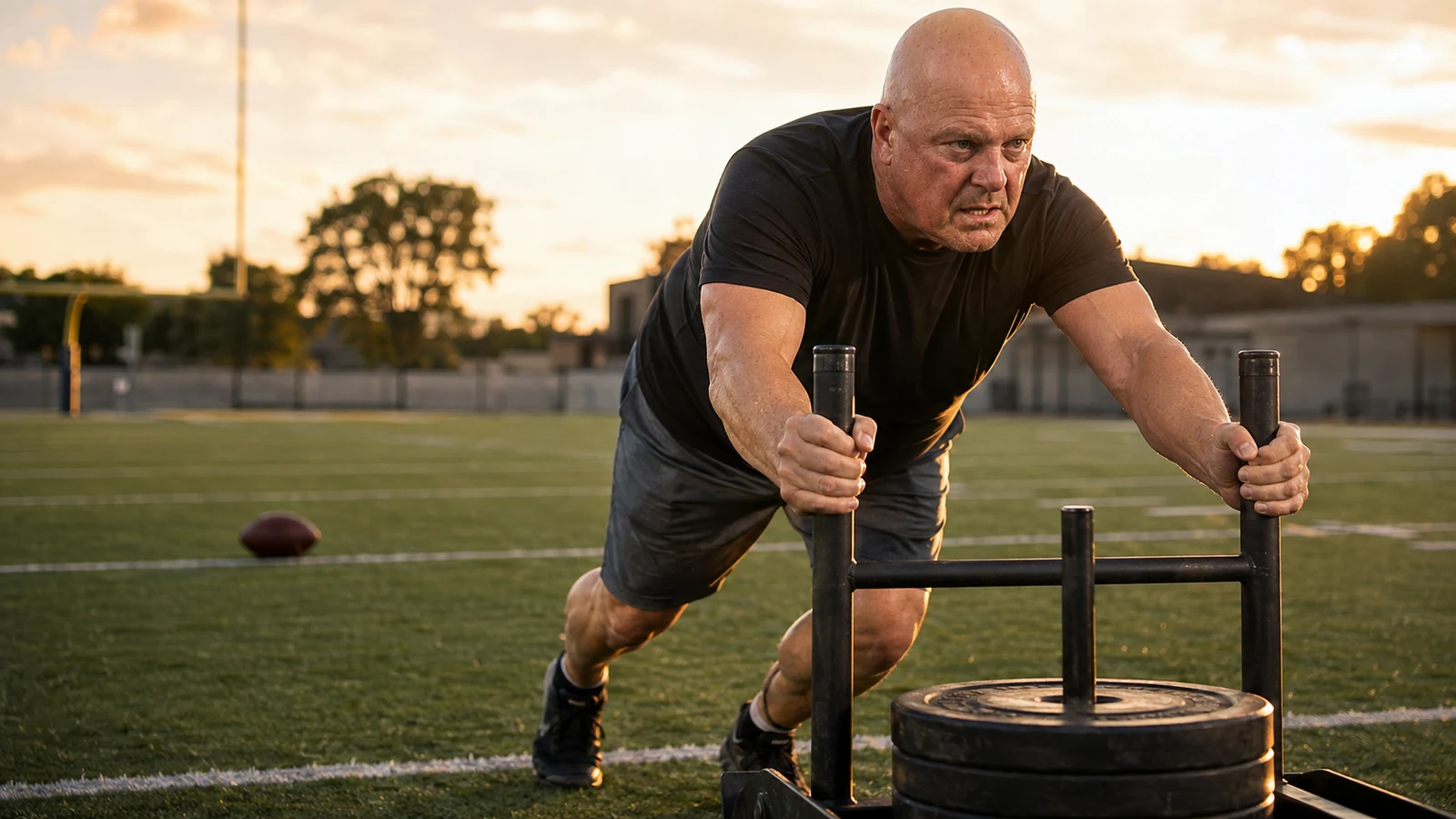

Michael Chiklis has spent decades playing tough, physical characters, from a hardened detective on The Shield to a super powered strongman in Fantastic Four.
For his role in the film The Senior, he took on a different kind of physical challenge, one based on a true story rather than a comic book.
Chiklis plays Mike Flynt, a real former college football player who returned to the sport at 59 years old, decades after his original playing days ended.
To play the part convincingly, Chiklis got back into football shape himself, at 62 years old.
Chiklis was born in August 1963, which put him right around 62 during the physical preparation for this role.
He remains an active working actor, with recent television roles including Hotel Cocaine and an upcoming part in BMF.
His career has spanned procedural dramas, comic book adaptations, and now a sports biography, giving him a wide range of physically demanding roles to draw on.
What Actually Happened
The Senior tells the true story of Mike Flynt, who was expelled from Sul Ross State University in Texas during his senior year in 1971 after a campus altercation.
Decades later, a former roommate challenged Flynt to go back and finish what he started.
Flynt sold his home, moved to Alpine, Texas, and walked onto the Sul Ross State football team as a linebacker at age 59, making his debut in a game in October 2007.
He is believed to be the second oldest college football player in NCAA history.
Chiklis was cast to play Flynt in the film adaptation, directed by Rod Lurie, which had a nationwide theatrical release through Angel Studios in September 2025.
Playing a linebacker on screen meant Chiklis needed to look and move like a real football player, not just act like one.
Reporting on the production described Chiklis performing around ninety percent of his own football scenes rather than relying entirely on a stunt double.
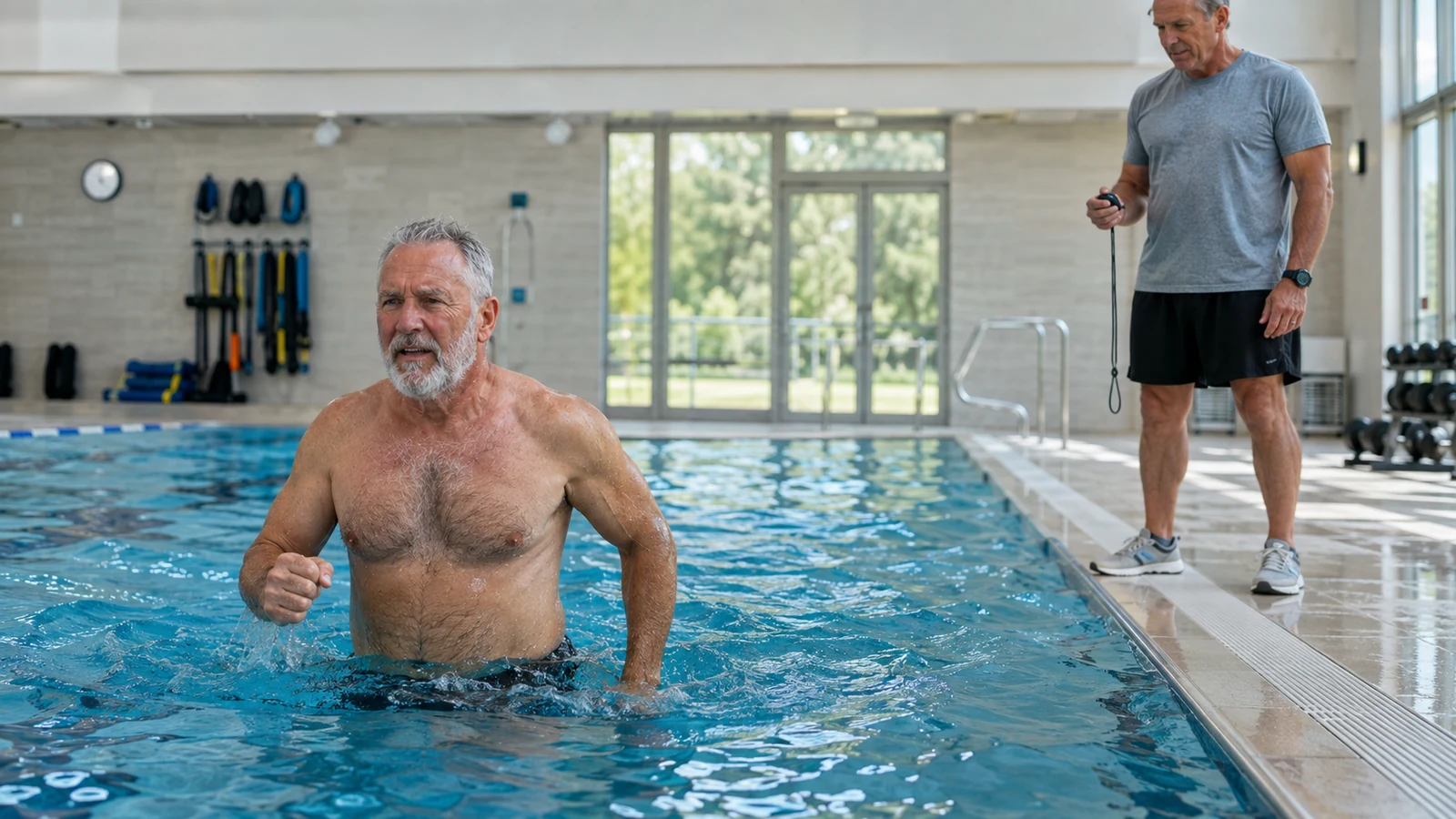
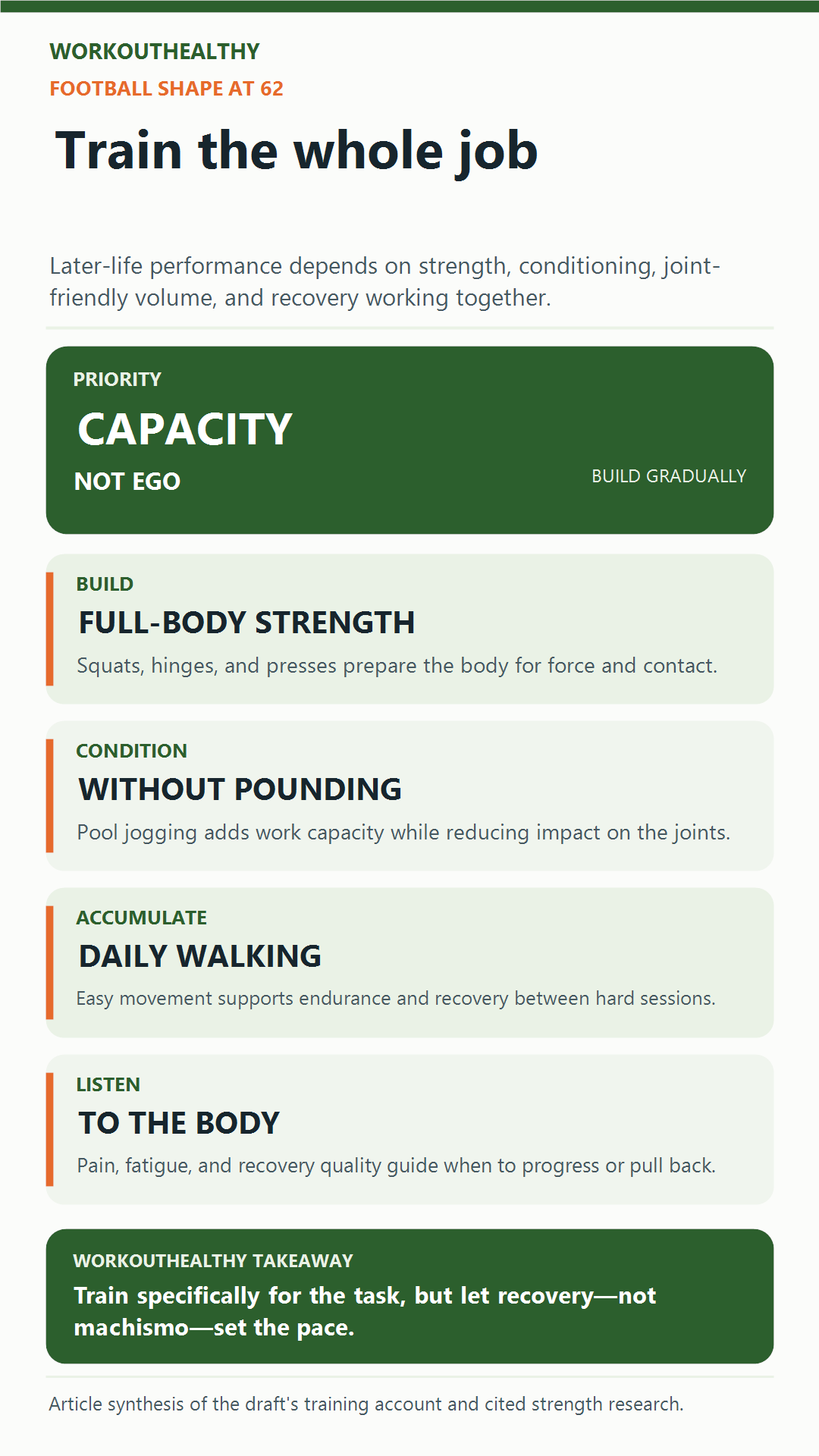
Getting there took a real training program, built around squats, deadlifts, and presses for strength, along with pool jogging and daily walking to build endurance without adding excess wear on his joints.
Tom Brady is reported to have given Chiklis advice as part of his preparation, and a trainer worked with him directly to help him play football safely at his age.
That combination, input from a legendary player known for his own longevity, plus a dedicated trainer, points to how seriously the production treated player safety for a lead actor performing real contact football scenes at 62.
Football involves fast direction changes, contact, and sudden bursts of speed, all of which carry real injury risk for anyone, let alone an actor in his sixties without a recent competitive football background.
His Approach to Training Later in Life
Chiklis has described his training philosophy in general terms as centered on listening to his own body rather than chasing a specific number for its own sake.
That approach reflects a shift away from ego driven training, where the goal is topping a previous personal best, toward training built around strength and injury prevention.
Reporting on his preparation for the role described his stated goal as staying strong and avoiding injury, not proving anything through sheer physical dominance.
That mindset, prioritizing smart training over reckless training, is a theme that shows up again and again in research on exercise and aging.
The Science of Strength Training Later in Life
Chiklis’s approach lines up with decades of research showing that the human body remains capable of building real strength well into older age.
One of the most striking demonstrations of this came from a landmark 1994 study published in the New England Journal of Medicine.
Researcher Maria Fiatarone and colleagues put frail nursing home residents, with an average age in their late eighties, through a ten week high intensity resistance training program.
The study found that even at that advanced age, muscle strength increased dramatically, by more than one hundred percent on average, and several participants improved their walking speed and ability to climb stairs.
If muscle can respond that strongly to training in people in their eighties and nineties, the same basic principle clearly applies to someone in their sixties preparing for a physically demanding role.
The other core piece of Chiklis’s described approach, listening to his own body rather than chasing arbitrary numbers, also has a real scientific basis.
Sports scientist Gunnar Borg developed a widely used scale in 1982, published in Medicine and Science in Sports and Exercise, for rating perceived exertion during exercise.
The Borg scale asks a person to rate how hard an activity feels on a simple numbered scale, rather than relying purely on external numbers like weight lifted or pace.
Decades of exercise research have found that perceived exertion tracks closely with actual physiological strain, including heart rate and oxygen use, which is why trainers still use it today to guide safe, appropriately hard training, especially for older or returning exercisers.
What This Evidence Does Not Prove
The Fiatarone study involved frail nursing home residents in their eighties and nineties, a very different starting point from an actor already active enough to be cast in a physically demanding role.
The point of citing it here is not that Chiklis and those study participants are directly comparable, but that if muscle can adapt that strongly under supervised training even in the frailest older adults, a healthy 62 year old has clear room to build real strength too.
Reports on Chiklis’s specific training program, including exact sets, reps, and schedule, come from entertainment press coverage rather than a published training log, so the details here should be read as generally reported rather than independently verified minute by minute.
How This Compares to General Guidance for Training Past 60
Most exercise guidance for people over 60 emphasizes a combination of strength training, low impact cardio, and attention to recovery, which closely matches Chiklis’s reported program.
General guidelines typically recommend resistance training at least twice a week, along with regular moderate cardio and activities that support balance and joint health.
Pool based cardio, like the pool jogging Chiklis reportedly used, is a common recommendation for people who want cardiovascular benefit with less impact on the knees, hips, and back.
His story shares real similarities with other public comeback stories built on training later in life, where patience and a gradual buildup mattered more than raw intensity.
Common Mistakes People Make Training After 60
One common mistake is avoiding strength training altogether out of fear of injury, when appropriately loaded resistance training is actually one of the most protective things an older adult can do for long term function.
A second mistake is training at maximum intensity every session instead of varying intensity and building in real recovery time.
A third mistake is ignoring joint friendly options like pool based cardio or cycling in favor of high impact activities that carry more injury risk.
A fourth mistake is skipping a professional assessment before starting a new, more demanding training program, especially after a long period of inactivity.
Working with a qualified trainer, the way Chiklis reportedly did for this role, can help identify a safe starting point and catch form issues before they become injuries, and knowing how to choose a personal trainer is a useful first step.
A fifth mistake is comparing your own training intensity to a professional actor with a full support team, a personalized program, and significant recovery resources.
A Practical Way to Train Like This
Start with a full body strength program two to three days a week, focusing on foundational movements like squats, presses, and hip hinges using manageable, controlled loads.
Add low impact cardio, like pool jogging, cycling, or brisk walking, on the days between strength sessions to build endurance without extra joint stress.
Use a simple perceived exertion scale to guide your intensity, aiming for a level that feels challenging but sustainable, rather than always training to complete exhaustion.
Get a professional movement assessment before starting a more demanding program, especially if it has been a long time since you trained consistently.
Build in at least one full rest day between hard training sessions, and treat sleep and recovery as part of the plan rather than an afterthought.
Progress gradually, adding small amounts of weight or a few extra minutes of cardio only once your current level feels controlled and comfortable.
Pay close attention to any joint pain that lingers beyond normal muscle soreness, and adjust or pause training around that specific movement rather than pushing through it.
Set a specific, meaningful goal, whether that is a physical role, an event, or simply staying capable of an activity you love, since a clear purpose tends to make consistent training easier to sustain.
Keep a simple training log noting what you did, how heavy it felt, and how you recovered, so you can spot patterns over weeks rather than guessing from memory.
Revisit your program every four to six weeks and adjust the load, volume, or exercises as your strength and confidence improve.
References
- Men’s Health, Train Like a Celebrity coverage: menshealth.com
- Fiatarone, M. A., O’Neill, E. F., Ryan, N. D., Clements, K. M., Solares, G. R., Nelson, M. E., Roberts, S. B., Kehayias, J. J., Lipsitz, L. A., & Evans, W. J. (1994). Exercise training and nutritional supplementation for physical frailty in very elderly people. New England Journal of Medicine, 330(25), 1769 to 1775.
- Borg, G. A. (1982). Psychophysical bases of perceived exertion. Medicine and Science in Sports and Exercise, 14(5), 377 to 381.
This article is for general information and is not medical advice. Talk with a doctor before starting a new strength training program, especially if you have an existing injury, joint condition, or have not exercised regularly in a while.