
Morris Chestnut has been camera ready for more than three decades.
Now 57, he is currently starring as Dr. Watson in the CBS series Watson, following recent roles in Reasonable Doubt and Diarra from Detroit.
Staying in front of the camera at that level for that long takes more than good genetics.
Chestnut has pointed to one factor above the workouts themselves: accountability.
Here is the real story behind his approach, and what research says about why having someone to answer to actually works.
Who Morris Chestnut Is Today
Chestnut was born on January 1, 1969, which makes him 57 years old as of this writing.
He built his career with roles in films like Boyz n the Hood and The Best Man, then extended it across three decades of steady film and television work.
His recent credits include the CBS drama Watson, where he plays Dr. Watson, and the BET+ series Diarra from Detroit.
He also appeared in the second season of the Hulu legal drama Reasonable Doubt in 2024.
That level of ongoing, physically visible work is part of why his approach to staying fit has drawn attention from fitness outlets over the years.
The Program That Grew Out of One Movie Role
Chestnut’s structured approach to fitness traces back to 2013, when he prepared to reprise his role as a former professional football player in The Best Man Holiday.
To get ready for that role, he trained with celebrity fitness trainer Obi Obadike.
That collaboration led to something bigger than one film. Chestnut and Obadike went on to co-write a book together, published in 2017, called The Cut: Lose Up to 10 Pounds in 10 Days and Sculpt Your Best Body.
The book combines structured workout drills with simple, practical recipes, treating nutrition and training as part of the same habit rather than two separate challenges.
Fitness coverage of Chestnut in the years since has repeatedly returned to one theme from that collaboration: he has credited having a training partner to answer to as being more important to his consistency than any specific exercise.
The exact wording of that comment could not be independently verified against the original interview for this article.
The underlying idea, though, that accountability drives consistency more than motivation alone, is well supported by real research, described in detail below.
Why Accountability Works Better Than Willpower
Most people start a fitness routine relying on motivation, a feeling that naturally rises and falls over time.
Accountability works differently. It creates an external reason to show up on days when motivation alone would not be enough.
Having a trainer, workout partner, or program to answer to adds a social and structural layer on top of personal willpower.
That layer tends to hold up better over months and years, since it does not depend entirely on how someone feels on a given day.
This distinction matters most during the exact moments willpower typically fails. Bad weather, a busy week, or simple boredom with a routine.
What Happens Without a Built In Partner
Fitness coverage describing Chestnut’s approach has also noted a second part of his stated philosophy, for the times a training partner is not available.
Without that kind of built in support, the outlets describe him framing consistency as coming down to how badly a person actually wants the result.
That framing matters because it acknowledges accountability is not always available on demand.
A trainer might be unavailable. A workout partner might move away or change schedules.
Having a backup mindset, built around personal commitment, is a reasonable second layer for exactly those situations.
It does not replace the value of real accountability. It simply covers the gaps when structured support is not an option that day.
What the Research Says About Social Support and Exercise
A landmark 1999 study published in the Journal of Consulting and Clinical Psychology tested this idea directly.
Researchers Rena Wing and Robert Jeffery studied weight loss participants, comparing those who joined with friends against those who joined alone.
Participants who recruited friends to join their program with them had significantly better weight loss results, and were more likely to maintain that weight loss over time, compared with those who went through the same program solo.
The researchers specifically linked this benefit to increased social support and accountability built into the group structure, not to any difference in the exercise or diet plan itself.
Separately, a 2012 review published in Current Sports Medicine Reports by researcher Wayne Westcott examined the broader health case for structured resistance training, particularly as people move through midlife.
Westcott’s review described resistance training as producing measurable improvements in strength, metabolic health, and functional independence, benefits that compound when training is consistent over years rather than done occasionally.
Consistency is exactly what accountability structures are designed to protect.
Westcott’s review also carries specific relevance for someone in Chestnut’s age range.
Adults naturally begin losing muscle mass starting around middle age if strength training is not part of a regular routine.
Resistance training two or more times a week is one of the most well established ways to slow that process, alongside supporting bone density and everyday functional strength.
For a working actor whose job depends partly on physical presence, protecting that muscle and strength over decades is a practical career consideration, not just a wellness goal.
Consistency, not motivation, is usually the real variable separating people who stick with training for years from people who stop after a few weeks.
How This Applies Beyond Celebrity Fitness
Chestnut’s situation involves a public career and professional stakes most people do not have.
The underlying lesson still applies broadly, since accountability is one of the most consistently studied predictors of exercise adherence in the general population, not just among actors and public figures.
National surveys on exercise habits repeatedly find that most people who quit a new fitness routine do so within the first few months, often citing lost motivation as the reason.
Structural accountability, whether a partner, a class schedule, or a paid trainer, directly targets that specific failure point.
It does not require a book deal or a Hollywood career to apply. It requires building a system that does not depend entirely on daily motivation.
What This Evidence Does Not Prove
This research does not prove that accountability alone explains Chestnut’s specific fitness results.
Genetics, career demands, and years of consistent training all likely play a role that no single study can isolate.
The Wing and Jeffery study also focused specifically on weight loss outcomes, not general strength or muscle maintenance, so its findings describe one specific goal rather than fitness broadly.
Accountability also is not a guaranteed fix for everyone. Some people respond better to independent, self-directed routines than to partner based or trainer based structures.
The right structure depends on the individual, not a single universal formula.
Common Mistakes People Make With Accountability
A common mistake is choosing an accountability partner who has a very different fitness level or schedule, which can create friction instead of support.
Another mistake is relying entirely on one person, so a partner’s illness, vacation, or busy stretch derails the whole routine.
Some people also treat accountability as a short term boost rather than a long term structure, dropping it once initial motivation returns.
That approach misses the point. Accountability is most valuable specifically when motivation is low, not just at the start.
Skipping the nutrition side of a program, while focusing only on workouts, is another common gap, even though Chestnut and Obadike’s own book treats both as connected habits.

How to Build Real Accountability Into Your Routine
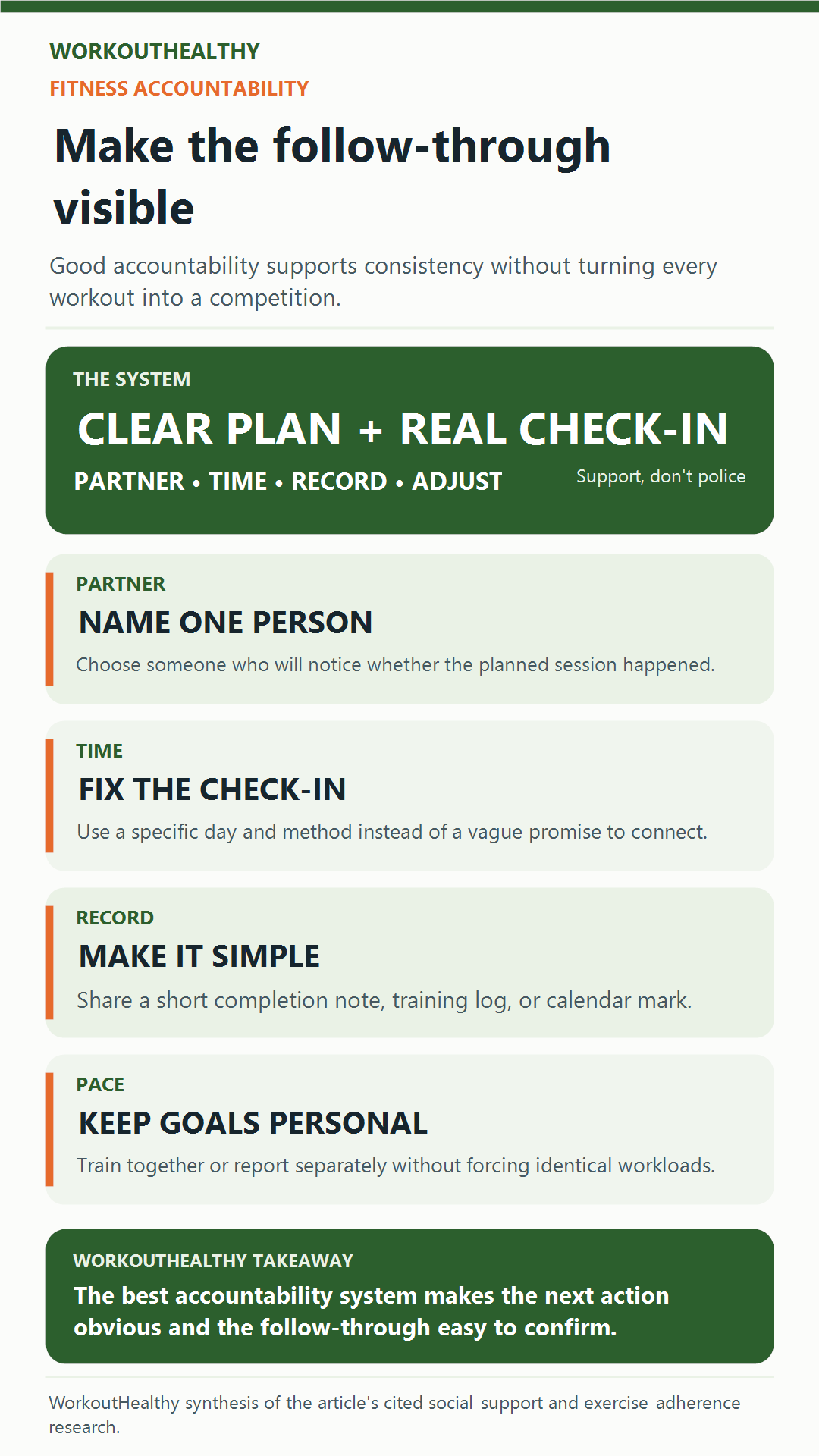
Choose a workout partner or group with a similar schedule and fitness level, so the arrangement feels sustainable rather than mismatched.
Set a specific, recurring time to train together, rather than a loose plan to “coordinate later,” which tends to fall apart quickly.
Consider a personal trainer if a workout partner is not available, since a paid, scheduled appointment creates its own strong accountability structure.
Track progress together, whether through a shared app, a simple text check-in, or a weekly conversation about how the week went.
Build in a backup plan for when a partner cannot make it, like a solo version of the same workout, so one missed day does not turn into a missed month.
Pair structured training with simple, planned meals, following the same logic Chestnut and Obadike built their book around.
Revisit the arrangement every few months and adjust it honestly if it stops working, rather than abandoning the whole idea of accountability altogether.
Write down the specific reason the arrangement is not working before changing it, since a vague sense of boredom often points to a fixable scheduling or format problem rather than a reason to quit entirely.
Our full breakdown of how training with a partner boosts motivation and results covers this exact topic in more depth, including safety and form benefits beyond accountability alone.
If a workout partner is not realistic for your schedule, our guide on deciding whether you need a personal trainer walks through how to evaluate that option instead.
References
Wing, R. R., & Jeffery, R. W. (1999). Benefits of recruiting participants with friends and increasing social support for weight loss and maintenance. Journal of Consulting and Clinical Psychology, 67(1), 132 to 138. https://doi.org/10.1037/0022-006X.67.1.132
Westcott, W. L. (2012). Resistance training is medicine: Effects of strength training on health. Current Sports Medicine Reports, 11(4), 209 to 216. https://doi.org/10.1249/jsr.0b013e31825dabb8
Wikipedia contributors. Morris Chestnut. Retrieved 2026 from en.wikipedia.org.
This article is for general information only and is not medical or fitness advice. Details about Morris Chestnut’s personal comments on accountability are based on public reporting and could not all be independently verified. Talk to a qualified coach or your doctor before starting a new exercise or nutrition program.