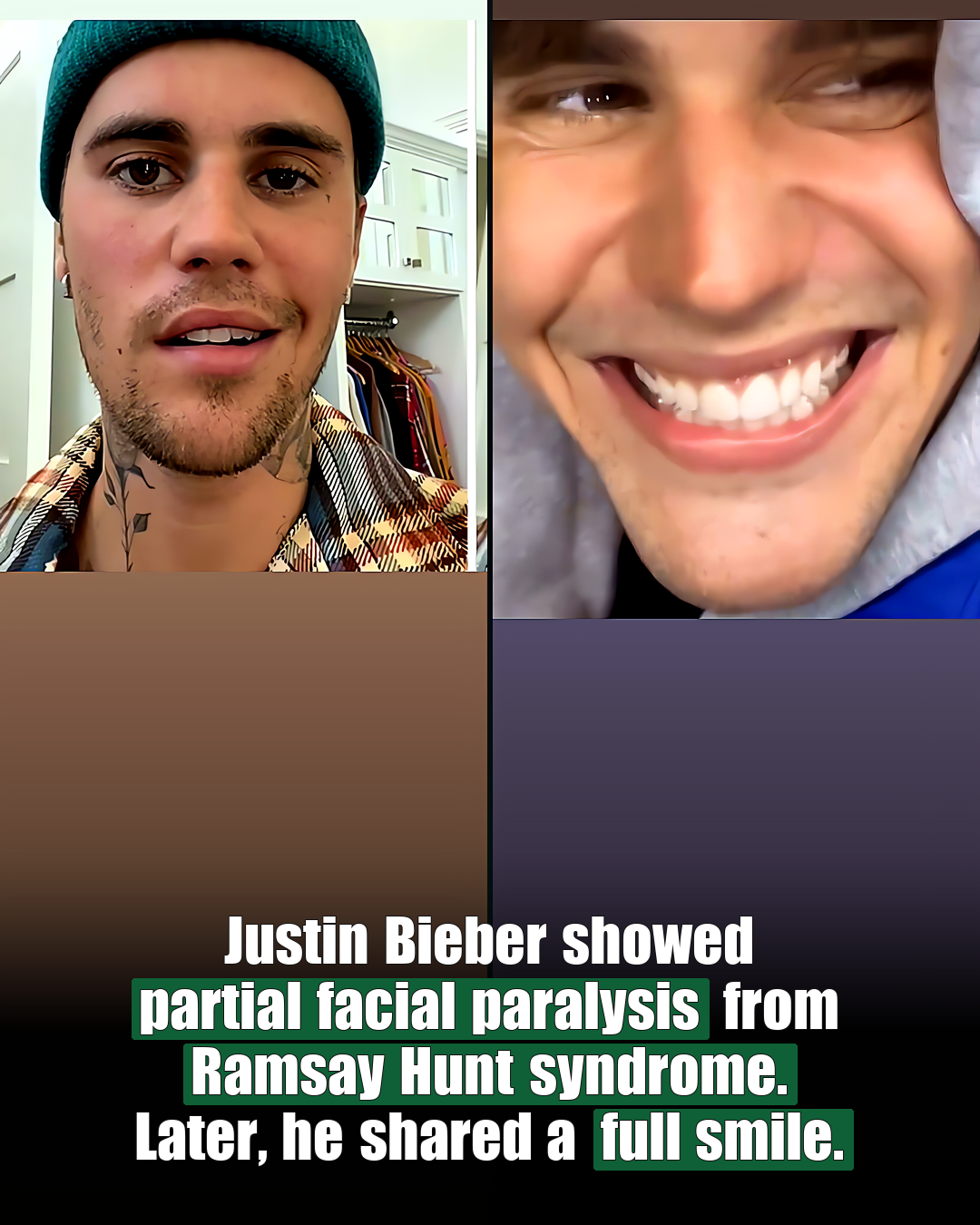

Justin Bieber looked into a phone camera in June 2022 and showed fans something most people had never seen from him before.
One side of his face would not move.
He explained that doctors had diagnosed him with a condition called Ramsay Hunt syndrome, and that it had partially paralyzed the right side of his face.
That moment brought mainstream attention to a rare condition many people had never heard of.
Here is what actually happened, what the condition is, and where Bieber’s health and career stand today.
Who Justin Bieber Is Today
Bieber is a multi platinum recording artist who has been a fixture in mainstream pop music since his teenage years.
He is married to model and entrepreneur Hailey Bieber, and the couple is raising a young son together.
As of this writing, Bieber is active and performing. He headlined Coachella in April 2026 and released two albums, Swag and Swag II, in 2025.
That level of activity is itself meaningful context for anyone following his health story, since headlining a major festival requires sustained physical and vocal stamina.
Bieber has not published a detailed medical update confirming full facial recovery in his own words, and this article does not claim to know his current facial function with certainty.
What can be said honestly is that his ongoing public performances, years after the 2022 diagnosis, are consistent with meaningful recovery, even without a specific medical statement to cite.
What Actually Happened in 2022
In June 2022, Bieber was in the middle of his Justice World Tour when he began experiencing facial paralysis.
He canceled a Toronto tour date, citing what was described at the time as complications related to Ramsay Hunt syndrome type 2.
Several more North American tour dates were postponed in the days that followed, including shows in Washington D.C., New York City, Philadelphia, and other cities.
In the video he posted to Instagram around that time, Bieber showed followers that he could not blink one eye fully, could not smile evenly, and could not move one nostril.
He explained that the condition was affecting the nerve that controls facial movement and told fans he needed to rest his face and stop performing for a period of time.
He also said he planned to work on facial exercises as part of his recovery, and that he expected to improve with time and rest.
The tour resumed in Europe the following month, though the remaining dates were ultimately canceled later that year.
What Ramsay Hunt Syndrome Actually Is
Ramsay Hunt syndrome is caused by the same virus that causes chickenpox, called varicella zoster virus.
After a person recovers from chickenpox, the virus does not fully leave the body. It stays dormant in nerve tissue for years, sometimes decades.
In some people, the virus reactivates later in life, most commonly as shingles.
Ramsay Hunt syndrome happens when that reactivation specifically affects a nerve near the ear that also controls facial muscles.
According to the Mayo Clinic, the condition typically causes a painful rash near the ear along with facial weakness or paralysis on the affected side.
Other common symptoms include hearing changes, ear pain, ringing in the ears, vertigo, and altered taste.
The condition is uncommon, and doctors do not always know exactly why the virus reactivates in one person and not another.
Why Early Treatment Matters So Much
A landmark 1997 study published in the Annals of Neurology looked directly at how treatment timing affects recovery from Ramsay Hunt syndrome.
Researchers led by Shingo Murakami found that patients who started combined antiviral and steroid treatment within three days of symptom onset had significantly better facial nerve recovery than patients who started treatment later.
That finding has shaped how doctors approach the condition since, and it is part of why quick diagnosis matters so much with sudden facial weakness.
Mayo Clinic’s current patient guidance echoes this same point directly, noting that starting treatment within three days of symptoms can help prevent long term complications.
Facial nerve damage, once it happens, does not always reverse completely, which is exactly why the timing of treatment carries so much weight in the medical literature.
The Role of Facial Exercises in Recovery
Bieber specifically mentioned facial exercises as part of his recovery plan, and that detail lines up with real, published research.
A study published in Otology and Neurotology by researchers Carien Beurskens and Peter Heymans looked at a structured approach called mime therapy for people with lasting facial paralysis.
Mime therapy uses guided facial exercises, often with a mirror, to help retrain the muscles and improve coordination on the affected side.
The study found real improvements in facial stiffness, lip mobility, and patients’ own reported sense of facial disability after this kind of structured exercise program.
A separate Cochrane systematic review, led by researcher Lazaro Teixeira, examined physical therapy approaches for Bell’s palsy, a related but distinct form of facial paralysis.
That review found some evidence supporting facial exercise and neuromuscular retraining, though the authors noted that many individual studies were small and that more high quality research was still needed.
Facial nerve recovery tends to be gradual, and the exercises that support it work more like physical therapy than like a quick fix.
How Ramsay Hunt Syndrome Compares to More Common Facial Paralysis
Most people who experience sudden facial paralysis actually have a different, more common condition called Bell’s palsy, not Ramsay Hunt syndrome.
Bell’s palsy also involves facial nerve inflammation, but it is not linked to the same reactivated chickenpox virus, and it is roughly ten times more common.
Ramsay Hunt syndrome tends to involve more severe symptoms on average, including the painful rash and the hearing and balance issues that Bell’s palsy usually does not cause.
Both conditions share a similar general recovery approach, which is part of why Bell’s palsy research, including the Cochrane review discussed above, is often used to inform care for Ramsay Hunt syndrome as well.
Doctors typically need to examine a patient directly to tell the two conditions apart, since the visible facial paralysis can look similar at first glance.
What This Evidence Does Not Prove
This research does not prove that facial exercises alone caused Bieber’s recovery.
Most people who receive prompt antiviral and steroid treatment for Ramsay Hunt syndrome see meaningful improvement, and exercises are typically one part of a larger treatment plan, not a replacement for medical care.
The mime therapy study also focused on people with longer standing facial paralysis, not necessarily the exact early recovery window Bieber was in during 2022.
Every case of Ramsay Hunt syndrome is different, and outcomes depend on how much nerve damage occurred before treatment started, not on effort or exercise alone.
It also is not possible to know from public reporting exactly which treatments Bieber received or how his personal recovery timeline compared to the research described here.
Who Should Talk to a Doctor First
Sudden facial weakness or paralysis on one side of the face is always a reason to seek medical care quickly, not to wait and see.
Facial paralysis can also be a sign of a stroke, which requires emergency treatment, so a medical professional needs to rule that out first.
Anyone experiencing new facial weakness, a rash near the ear, ear pain, or sudden hearing changes should contact a doctor the same day if possible.
Early treatment within the first few days makes a documented difference in recovery odds for Ramsay Hunt syndrome specifically.
Anyone recovering from facial paralysis who wants to start facial exercises should do so under the guidance of a doctor or a physical therapist trained in facial rehabilitation, not from a general internet routine.
People managing any lasting facial weakness should also have their eye checked regularly if blinking is affected, since incomplete blinking can leave the eye vulnerable to dryness and irritation.
What Facial Rehabilitation Typically Involves
A typical program starts with gentle, controlled movements rather than forceful ones.
A therapist often uses a mirror so the patient can watch and correct their own movement in real time.
Small, repeated movements, like slowly raising the eyebrows or attempting a gentle smile, are common starting exercises.
Sessions are usually short and done multiple times a day, rather than one long session.
Overworking the muscles too aggressively is generally discouraged, since it can lead to unwanted muscle tightness or abnormal movement patterns called synkinesis.
Progress is often slow and measured in weeks and months, not days.
Patience and consistency, done under professional guidance, tend to matter more than intensity.
Anyone going through a similar recovery should expect a gradual process, and should lean on their care team for realistic expectations rather than comparing their timeline to anyone else’s, celebrity or otherwise.
Stress management is also worth mentioning, since a demanding schedule can make any recovery feel harder to manage.
Bieber paused touring specifically to focus on his health in 2022, a decision that reflects a broader, well supported principle in recovery from any nerve related condition.
Rest and reduced physical strain during an active recovery period are not a setback. They are often part of the treatment itself.
Our guide on how to evaluate a fitness or rehabilitation professional covers questions worth asking before starting structured guided exercise with any new provider.
References
Murakami, S., Hato, N., Horiuchi, J., Honda, N., Gyo, K., & Yanagihara, N. (1997). Treatment of Ramsay Hunt syndrome with acyclovir prednisone: Significance of early diagnosis and treatment. Annals of Neurology, 41(3), 353 to 357. https://doi.org/10.1002/ana.410410310
Beurskens, C. H. G., & Heymans, P. G. (2003). Positive effects of mime therapy on sequelae of facial paralysis: Stiffness, lip mobility, and social and physical aspects of facial disability. Otology & Neurotology, 24(4), 677 to 681. https://doi.org/10.1097/00129492-200307000-00024
Teixeira, L. J., Valbuza, J. S., & Prado, G. F. (2011). Physical therapy for Bell’s palsy (idiopathic facial paralysis). Cochrane Database of Systematic Reviews, Issue 12, CD006283. https://doi.org/10.1002/14651858.cd006283.pub3
Mayo Clinic. Ramsay Hunt syndrome: Symptoms and causes. Retrieved 2026 from mayoclinic.org.
Wikipedia contributors. Justin Bieber; Justice World Tour. Retrieved 2026 from en.wikipedia.org.
This article is for general information only and is not medical advice. Ramsay Hunt syndrome and facial nerve recovery vary a great deal from person to person. If you or someone you know has sudden facial weakness or paralysis, seek medical care immediately, since it can be a medical emergency, and follow your own doctor’s guidance for treatment and rehabilitation.