
Nick Jonas turns 34 this month, and he is in the middle of one of the biggest tours of his career.
The Jonas Brothers kicked off their Burning Up tour in August 2026, playing arenas including Madison Square Garden.
That kind of schedule, three hour shows, constant travel, and high physical demand night after night, would be a challenge for anyone.
Jonas has managed it for two decades while also managing type 1 diabetes.
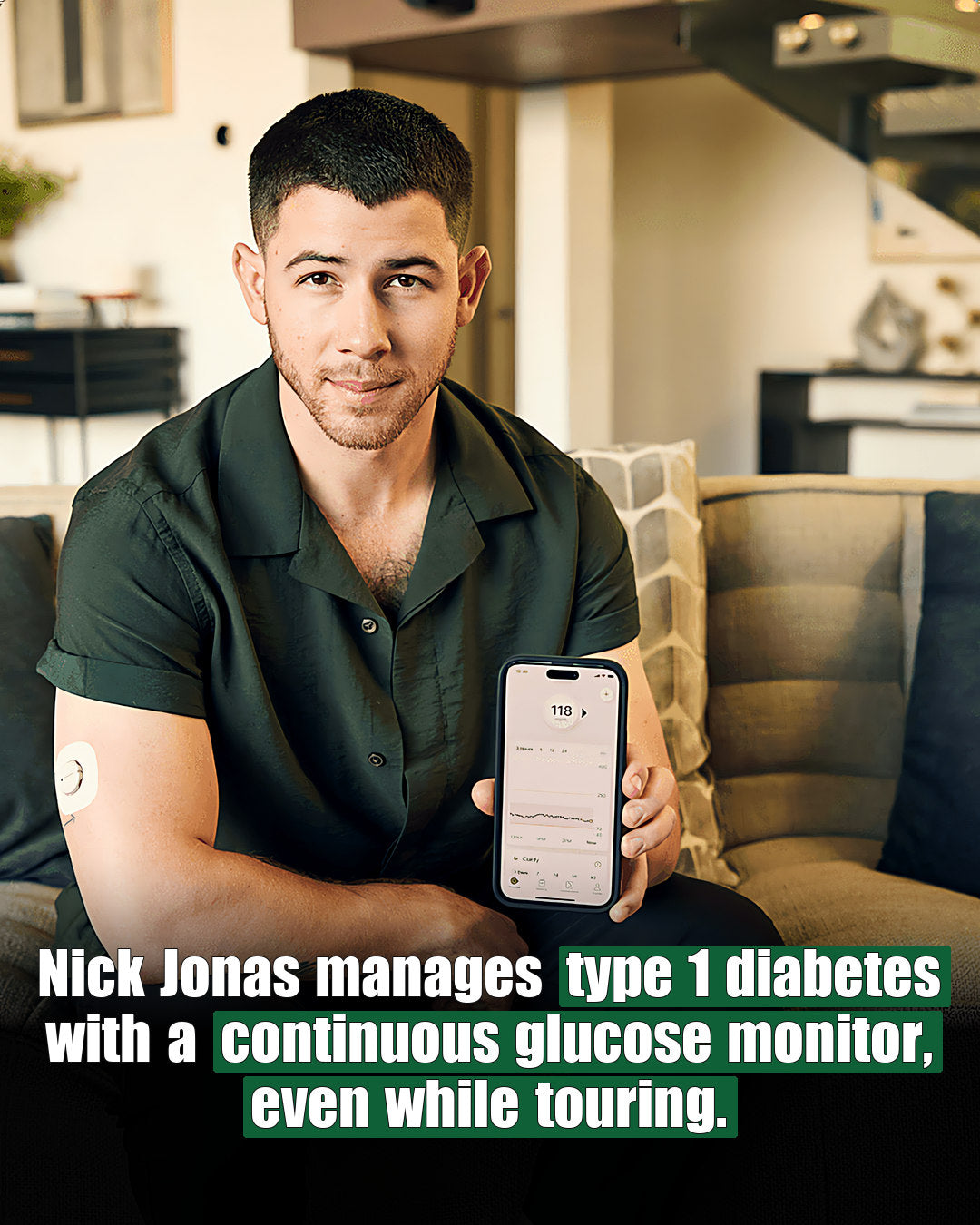
A WorkoutHealthy Facebook post described his approach this way. Nick Jonas manages type 1 diabetes with a continuous glucose monitor even during full concerts.
That framing is accurate, and Jonas has talked about this part of his life openly and often.
Diagnosed at 13, Managing It Ever Since
Jonas was diagnosed with type 1 diabetes in November 2005, when he was 13 years old.
His blood sugar at diagnosis was around 900, far above a normal range of roughly 70 to 120.
He has described the lead up to that diagnosis in stark terms. “I started feeling like I was evaporating, physically and emotionally,” he has said.
The diagnosis did not stop his career. Jonas has said that within a day and a half of being diagnosed, he was back on stage.
“I’m not going to let this slow me down,” he said, describing his mindset at the time.
That determination has stayed consistent for two decades since his diagnosis.
Type 1 diabetes is different from type 2. It is an autoimmune condition in which the body’s immune system attacks the cells in the pancreas that produce insulin.
People with type 1 diabetes need external insulin for life, delivered through injections or a pump, and they need to track their blood sugar closely to avoid dangerous highs and lows.
How Continuous Glucose Monitoring Changed His Routine
Jonas started using an early continuous glucose monitor, or CGM, not long after his diagnosis.
A CGM is a small sensor, usually worn on the arm or abdomen, that tracks blood sugar levels in real time throughout the day.
“I fell in love with it,” Jonas has said about his first experience with the technology.
He has also talked about how much the technology has improved since then. “The integration of the phone, I never thought that would be possible,” he said, describing how modern CGMs sync directly to a smartphone app.
That real time data matters most during exactly the kind of high intensity, unpredictable physical activity a concert involves.
Jonas has said touring, somewhat surprisingly, makes his diabetes easier to manage, not harder.
“I find it easier to manage my diabetes when I’m on the road,” he has said.
“My time in range over the last couple of months while on tour was the best,” he added.
Time in range is a real clinical measure. It refers to the percentage of time a person’s blood sugar stays within a healthy target range.
A structured touring schedule, with predictable meal times and consistent physical activity, appears to help Jonas hit that target more consistently.
An unstructured schedule at home can sometimes make that harder, not easier.
His Approach to Support and Advocacy
Jonas has spoken about the importance of building a support system around a chronic condition, not just managing it alone.
“The first thing I say to the people I love,” he has said, is to tell people in your inner circle when your glucose is high, so they understand what is happening and can offer support.
He wears his CGM visibly on stage rather than hiding it, describing it as something closer to a badge of honor than something to conceal.
Jonas has also built advocacy directly into his career. He co-founded Beyond Type 1, a nonprofit focused on diabetes education and support, and has called that work what he is most proud of, ahead of his music career achievements.
He has partnered publicly with Dexcom, a major CGM manufacturer, including a Super Bowl advertisement built around raising awareness of the technology.
That kind of visible advocacy matters for a condition that is often invisible to people who do not live with it.
A person managing type 1 diabetes can look perfectly healthy from the outside.
Behind that appearance, they may be carefully tracking numbers and adjusting insulin all day long.
Jonas choosing to make that management visible, rather than hiding it, has become part of how he talks about the condition publicly.
What the Research Says About CGMs and Exercise
Jonas’s experience lines up with a growing body of clinical research on continuous glucose monitoring in people with type 1 diabetes.
The DIAMOND randomized clinical trial, published in JAMA in 2017, is one of the most cited studies in this space.
Researchers compared CGM use against standard fingerstick testing. The study group was made up of adults with type 1 diabetes who were using multiple daily insulin injections.
The CGM group achieved meaningfully better blood sugar control over the trial period.
They spent less time in dangerously low or high blood sugar ranges than the group using standard testing.
That kind of improvement matters enormously for someone managing physically demanding, high stakes work like touring.
A separate 2017 consensus statement, published in The Lancet Diabetes and Endocrinology, focused specifically on exercise and type 1 diabetes.
An international panel of researchers reviewed the evidence. They looked closely at how physical activity affects blood sugar in people with the condition.
The panel’s guidance emphasized that exercise type, intensity, and timing all affect blood sugar differently, and that real time glucose data, the kind a CGM provides, is one of the most useful tools for adjusting insulin and food intake around activity safely.
That research helps explain why Jonas’s own experience, that touring, a physically demanding and unpredictable activity, becomes more manageable with a CGM rather than less, fits a pattern seen across the broader type 1 diabetes community.
What This Means for the Average Reader
Most readers do not have type 1 diabetes, but the broader lesson in Jonas’s story applies well beyond that specific condition.
Managing a chronic health condition well often comes down to preparation, structure, and the right tools, rather than restriction alone.
Jonas’s own description of his approach echoes this directly.
He treats performing itself as intense exercise, planning meals and insulin around the physical demands of a show in advance, rather than reacting after the fact.
For the roughly 2 million Americans living with type 1 diabetes, and millions more managing other chronic conditions worldwide, that kind of planning, paired with modern monitoring technology, has changed what an active, high performance life can look like.
Careers built around unpredictable physical demand, touring musicians, professional athletes, and people with physically active jobs, once seemed genuinely difficult to combine with a strict insulin schedule.
Real time glucose data has narrowed that gap considerably over the past two decades.
Jonas’s own career is a visible example of how far that gap has closed.
Who Should Talk to a Doctor First
Anyone newly diagnosed with type 1 diabetes, or a parent of a newly diagnosed child, should work closely with an endocrinologist to build a personalized management plan before making major changes to diet or activity level.
People with type 1 diabetes who are starting a new exercise routine, especially anything high intensity or long duration like touring style physical activity, should talk with their care team about adjusting insulin dosing and carbohydrate timing around that activity.
Anyone experiencing frequent high or low blood sugar readings despite following their current management plan should bring that pattern to their doctor rather than adjusting insulin doses on their own.
Family members and close friends of someone with type 1 diabetes should ask that person directly what warning signs of low blood sugar look like for them specifically, since symptoms can vary from person to person.
How to Support Someone Managing Type 1 Diabetes
Learn the basic difference between type 1 and type 2 diabetes. Type 1 is an autoimmune condition requiring insulin for life, not a condition caused by diet or lifestyle.
Ask the person directly what their own warning signs look like. Low blood sugar symptoms can include shakiness, confusion, sweating, or irritability, but the exact pattern is different for everyone.
Do not offer unsolicited advice about diet or “curing” the condition. Type 1 diabetes cannot be reversed through diet changes, and well meaning suggestions along those lines are a common source of frustration for people managing it.
If you know someone starting to use a CGM or insulin pump for the first time, be patient during the adjustment period.
Learning new technology while also managing a demanding condition takes real time.
Support consistent routines where you can. Jonas’s own experience shows that predictable meals, activity, and rest tend to make blood sugar easier to manage than an unpredictable schedule.
If you are the one managing type 1 diabetes and considering a more physically demanding lifestyle, whether that is a new sport, a demanding job, or something like touring, loop your endocrinology team in early rather than figuring it out alone.
References
- STAT News, “‘What I’m most proud of’: Nick Jonas talks about managing diabetes, his career, and building community,” statnews.com
- DiaTribe, “An Inside Look at Living with Type 1 Diabetes with Nick Jonas,” diatribe.org
- Healthline, “What to Know About the Dexcom Glucose Monitor from Nick Jonas Super Bowl Ad,” healthline.com
- Beck, R.W., Riddlesworth, T., Ruedy, K., et al. (2017). Effect of continuous glucose monitoring on glycemic control in adults with type 1 diabetes using insulin injections: the DIAMOND randomized clinical trial. JAMA, 317(4), 371-378.
- Riddell, M.C., Gallen, I.W., Smart, C.E., et al. (2017). Exercise management in type 1 diabetes: a consensus statement. The Lancet Diabetes and Endocrinology, 5(5), 377-390.
This article is for general information only and is not personal medical advice. Nick Jonas’s experience with type 1 diabetes is described here based on his own public interviews and is not a management plan for any individual reader. Anyone with type 1 or type 2 diabetes, or anyone concerned about their blood sugar, should work directly with their doctor or endocrinologist rather than relying on this or any general health article.