
Ashton Kutcher spent much of his career known for comedy roles and tech investing. In August 2022, he became known for something else. He told the public he had spent roughly a year recovering from a rare autoimmune disease that had briefly taken away his vision, his hearing, and his balance.
A few months after sharing that story, Kutcher laced up his shoes and ran the New York City Marathon.
He crossed the finish line in just under four hours. Along the way, he raised more than a million dollars for a cause he has worked on for years.
Kutcher is alive and active today. He continues to act, invest, and speak publicly about his health. His story offers a real look at what recovering from a serious illness and training for a major physical goal can actually involve.
What Actually Happened
Around 2020, Kutcher started having strange symptoms. His vision blurred. His hearing dropped. His sense of balance disappeared almost overnight.
Doctors eventually diagnosed him with a rare form of vasculitis. Vasculitis is a group of conditions where the immune system attacks the body’s own blood vessels by mistake. The attack causes inflammation, which can narrow blood vessels and cut off blood flow to organs and tissues.
Kutcher did not name the exact subtype of his condition publicly. He described it only as an unusual, sudden case that hit multiple senses at once. That combination is unusual enough that most people who saw him for it likely had never treated a case quite like his.
He spent close to a year working to recover basic function. Once he had rebuilt his health, he set a new goal. He decided to run the New York City Marathon in November 2022, one of the most demanding courses in the world.
He trained for months. On race day, he finished in 3 hours, 54 minutes, and 1 second. That beat his own goal of finishing under four hours. He also raised more than a million dollars for Thorn, a nonprofit focused on stopping the sexual exploitation of children online.
Kutcher has been connected to Thorn’s work for more than a decade. The organization was originally founded in 2009 under a different name and builds technology used to identify and rescue child trafficking victims and remove abuse material from the internet. Choosing that cause for his marathon fundraiser was not a one-off gesture. It reflected work he had already been doing long before he ever laced up running shoes for it.
In His Own Words
Kutcher has talked about the illness in detail in several interviews, including one for the Paramount+ series “The Checkup with Dr. David Agus.”
“I woke up one day and was having vision issues. I could hardly see. It knocked out my hearing, which threw off my equilibrium, my balance, and I couldn’t walk.”
He described just how disorienting it was to lose those senses so quickly.
“Suddenly, you can’t see.”
Kutcher has also spoken about how long it took to feel normal again.
“It took me like a year to build it all back up.”
Looking back, he has said the experience left him with a new appreciation for his health, and a clear sense of how close the situation had been.
“I’m lucky to be alive.”
After his recovery, he described his motivation simply. He wanted to get back to where he had been before.
“You want to reclaim the health that you once had.”
The Science Behind Vasculitis and Recovery
Vasculitis is not one single disease. It is a category that includes many different conditions. Some affect large blood vessels. Others affect small ones. Some are linked to infections or medications. Others appear to happen without any clear trigger at all.
A physician quoted by the University of Virginia’s health system explained that vasculitis can occur “without an underlying condition or inciting event.” In other cases, it connects to smoking, certain medications, infections, or other autoimmune and inflammatory conditions.
Doctors generally group vasculitis cases by the size of the blood vessels involved. Large vessel vasculitis affects major arteries. Medium vessel vasculitis affects the arteries that feed organs like the kidneys and intestines. Small vessel vasculitis affects the tiniest blood vessels, including the ones that supply the eyes, ears, and inner ear balance system. Kutcher’s combination of vision, hearing, and balance symptoms points toward small vessel involvement, though he has not publicly confirmed which specific subtype he had.
Because blood vessels are involved, the damage can show up almost anywhere in the body.
Reported symptoms include skin rashes, kidney problems, lung problems, and vision changes. In more severe cases, symptoms can include aneurysms or blood clots.
The standard treatment is medication that calms down the immune system. That often means steroids combined with other immune-suppressing drugs.
Recovery timelines vary a great deal from person to person. They depend on the specific type of vasculitis, how early it was caught, and how the body responds to treatment.
A slow, staged return to normal activity is common after a serious autoimmune flare. That is the kind of recovery Kutcher described.
The Science Behind Marathon Training
Once someone is medically cleared to train, structured aerobic exercise like marathon training has real, measurable effects on the body, even for people who have never run seriously before.
A 2020 study published in the Journal of the American College of Cardiology followed 138 first-time marathon runners preparing for the London Marathon.
None of them had a history of serious heart disease. Researchers measured their blood pressure and the stiffness of their aorta, the body’s largest artery. They took those measurements before and after roughly 17 weeks of beginner-level training.
After training, participants had lower blood pressure on average. Drops averaged about 4 points systolic and 3 points diastolic.
Their aortas had also become noticeably more flexible. The researchers estimated the improvement was equal to reversing about four years of natural, age-related arterial stiffening.
Interestingly, the biggest improvements showed up in older runners, slower runners, and men, not necessarily the fastest or youngest athletes.
That detail matters for anyone assuming marathon training only benefits elite performers. The researchers noted the effect might be even larger in people who start with high blood pressure. That group would still need closer medical supervision before attempting anything like a marathon.
What This Means for Everyday Readers
Most people reading this will never run a marathon, and that is completely fine. The lesson from Kutcher’s story is not “everyone should run 26.2 miles.” It is about the value of rebuilding capacity slowly and with a real goal attached to it.
After a serious illness, many people feel pressure to bounce back quickly. Kutcher’s own account pushes back on that idea. A year is a long timeline by most standards, and he needed all of it. George Foreman’s boxing comeback tells a similar story about patience outlasting doubt, on a much longer timeline.
The marathon research also carries a broader point. You do not need to already be fit to benefit from training. The London Marathon study specifically recruited first-timers, and they still saw real cardiovascular improvements in under five months. Structured, gradual training works even when you are starting from close to zero.
There is also a lesson in how Kutcher framed his own goal. His stated “A goal” was simply to finish and raise money for Thorn. Breaking four hours was described as a secondary, “B goal.” Putting the meaningful outcome first and the performance number second is a pattern worth borrowing, whether the goal is a marathon, a return to the gym after being sick, or any other long process that takes months rather than days.
Who Should Talk to a Doctor First
Anyone recovering from an autoimmune condition, an illness affecting the heart, lungs, or blood vessels, or any prolonged hospitalization should get individualized medical clearance first.
This applies before starting any endurance training plan. It is not a step to skip.
People with a personal or family history of unexplained vision loss, hearing loss, or balance problems should see a doctor promptly.
Do not assume the symptoms will pass on their own. Kutcher’s case shows how fast they can appear and how serious the underlying cause can be.
Anyone with high blood pressure, a known heart condition, or other cardiovascular risk factors should be evaluated by a doctor before beginning marathon-level training.
The cardiovascular benefits described above come from a supervised, gradual program. They do not come from suddenly attempting a long run.
People currently on immune-suppressing medication should also loop in their treating physician before ramping up training intensity, since some medications affect how the body handles physical stress and heat.

How to Build Toward a Big Physical Goal Safely
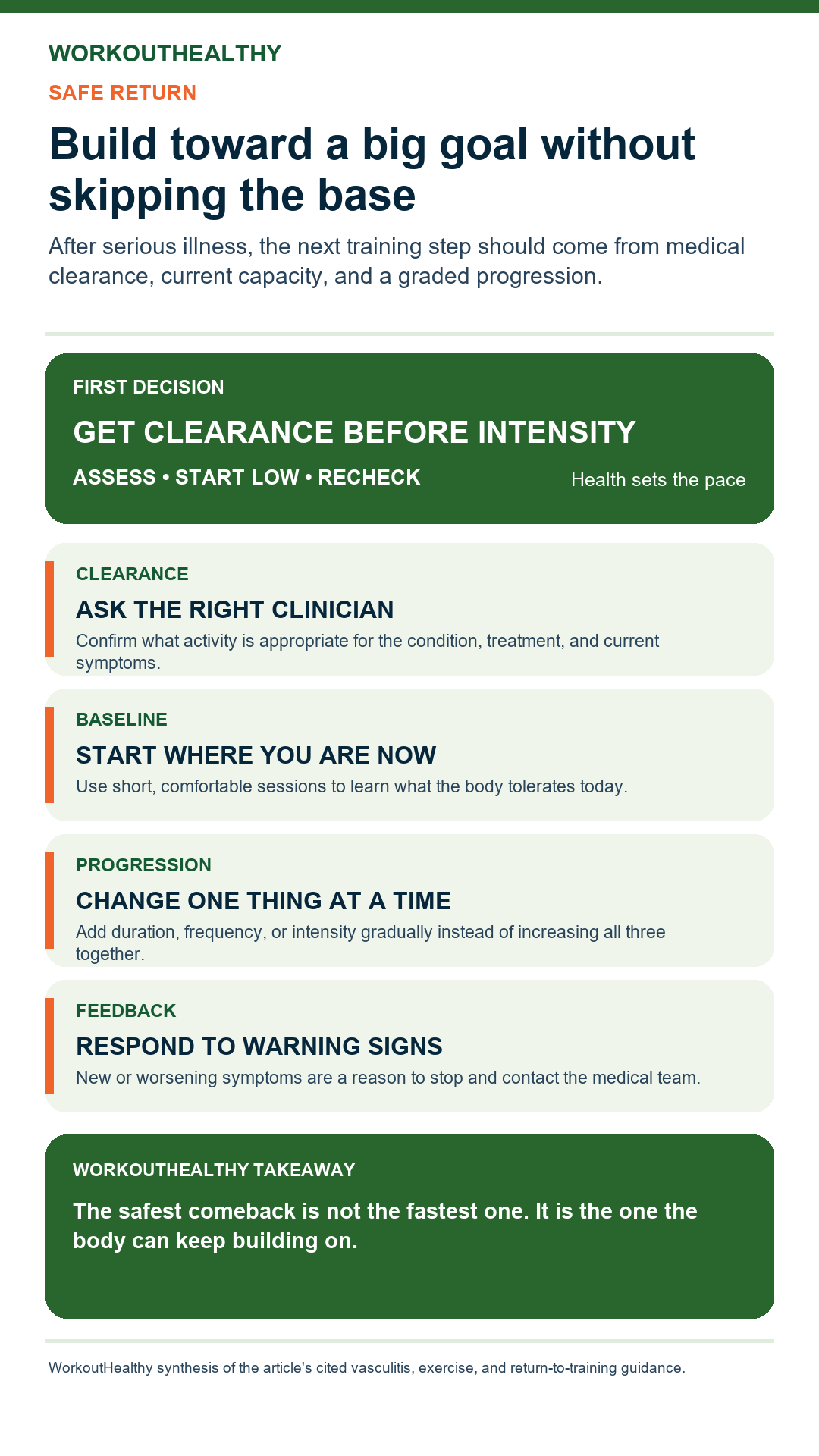
1. Get cleared first. If you are recovering from any illness, talk to your doctor before starting a new exercise program, especially one involving sustained cardiovascular effort.
2. Start smaller than you think you need to. Early training should feel easy. Walking, then walk-run intervals, then short easy runs is a normal, effective progression, and even daily step counts alone are linked to real health benefits before you ever add running.
3. Build volume slowly. A common guideline is to increase weekly training distance by no more than about 10 percent from one week to the next. Big jumps in mileage are one of the most common causes of overuse injury.
4. Follow a real training plan. Beginner marathon plans, like the type used in the JACC study, typically run 16 to 20 weeks and include planned rest days. Rest is part of the training, not a break from it.
5. Track how you feel, not just your pace. Persistent fatigue, resting heart rate that stays elevated, or pain that does not improve with rest are signs to slow down or check in with a doctor.
6. Attach a purpose to it if you can. Whether that is a cause you care about, a personal milestone, or simply proving something to yourself, having a reason beyond the workout itself tends to help people stick with long training blocks.
7. Respect the taper. In the final weeks before a big event, reduce training volume so your body can recover and arrive at the start line rested, not exhausted.
8. Expect setbacks along the way. A missed week from illness or fatigue does not erase months of progress. Kutcher himself has described his recovery as taking about a year, not a straight line of steady improvement. Building in flexibility for bad weeks, rather than treating one off day as a failure, makes it far more likely you will actually reach race day.
References
- Washington Post, “Ashton Kutcher says he had vasculitis, a rare autoimmune disease,” August 2022
- CNN, “What is vasculitis, the condition that affected Ashton Kutcher?” August 2022
- University of Virginia Health, “Q&A: What You Need to Know About Ashton Kutcher’s Disease, Vasculitis”
- CBS News, coverage of Ashton Kutcher’s interview on “The Checkup with Dr. David Agus,” Paramount+
- Canadian Running Magazine, “Ashton Kutcher throws down in his New York City Marathon debut,” November 2022
- Bhuva, A.N., et al. (2020). “Training for a First-Time Marathon Reverses Age-Related Aortic Stiffening.” Journal of the American College of Cardiology, 75(1), 60-71.
This article is for general information only. It is not personal medical or fitness advice. Talk with a qualified healthcare provider before starting a new exercise program, especially after an illness or diagnosis, or if you have an existing health condition.