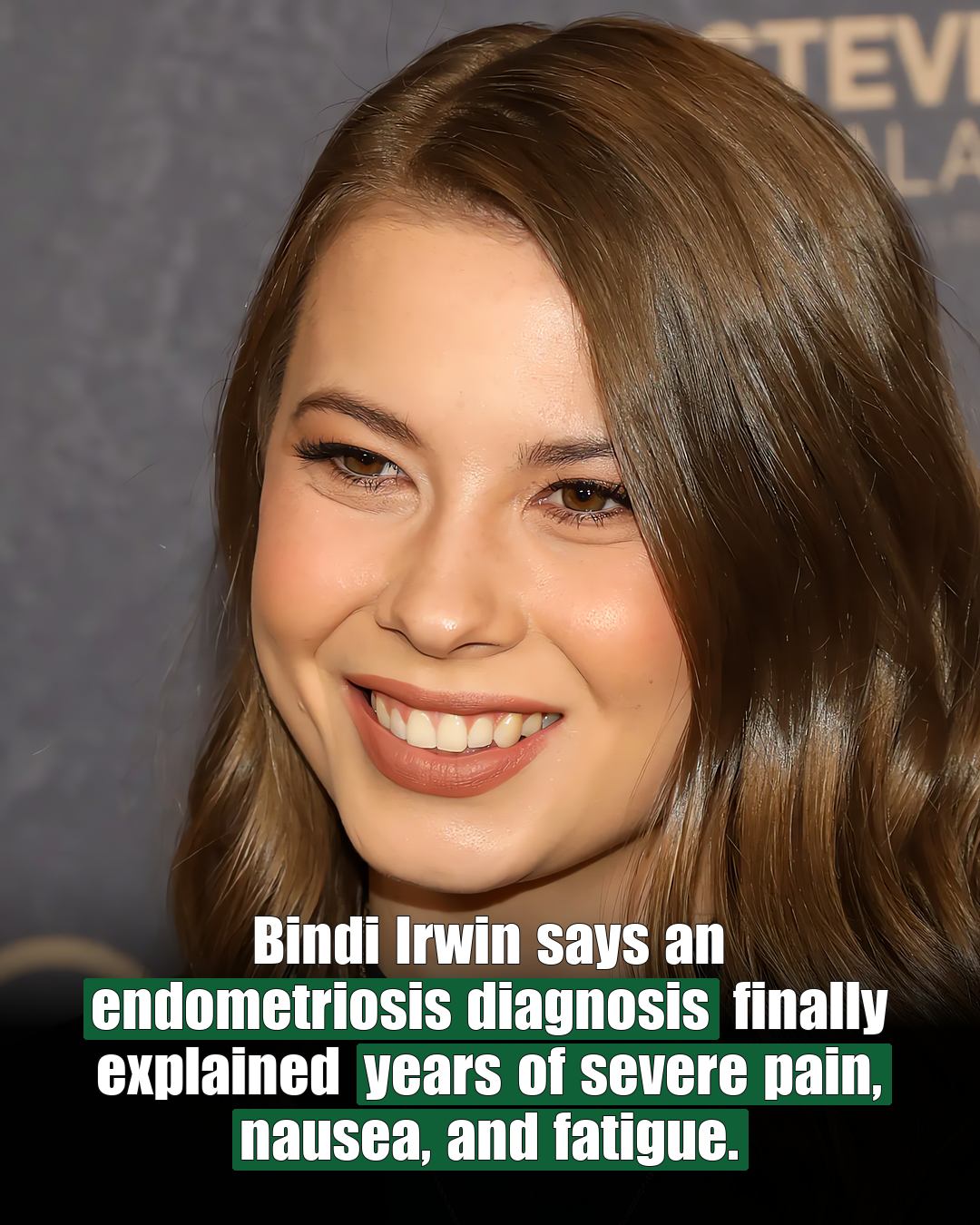

Bindi Irwin spent close to ten years trying to find out why her body hurt so much.
Doctors often told her it was normal. It was not normal.
In 2023, she finally learned she had endometriosis. It is a condition that had quietly been damaging her body since her teenage years.
Her story is not just about one diagnosis. It is about what happens when real pain gets dismissed for years.
It is also about what current research actually says about living with a condition this common, and what it does not yet say.
Who Bindi Irwin Is and Her Real Situation
Irwin is a conservationist and the daughter of the late Steve Irwin. She helps run Australia Zoo alongside her mother Terri and brother Robert.
For years, Irwin quietly managed severe pain, nausea, and daily fatigue. She avoided hiking, exercise, and social events because the pain made them too hard.
She has said doctors often blamed her symptoms on hormones or on simply being a young woman.
That explanation left her real condition undiagnosed for roughly a decade. In a 2024 interview with the advocacy group EndoTV, she said plainly: “I didn’t really know anything about the world of endometriosis.”
That is a common experience among people with this condition. Many spend years searching for a name for their pain before anyone gives them one.
In March 2023, surgeon Dr. Tamer Seckin operated on Irwin and found more than 30 endometriosis lesions along with an endometrioma, a cyst filled with blood that had been fused to her side. That surgery gave her a name for what she had been living with.
It did not end her story. In August 2025, Irwin shared that she had undergone additional procedures, removing 51 lesions total along with her appendix and repairing a hernia from childbirth. She wrote on Instagram that she could finally function in daily life without pain forcing her to stop.
As of a May 2026 family update, Irwin was continuing to improve. She was still managing her recovery carefully.
Her mother Terri said travel remained difficult for Bindi at that point. That is why Irwin skipped a Las Vegas gala honoring her late father that month, choosing to stay closer to home.
Terri put it this way: “Bindi is doing so much better now. So, things like a lot of travel are a bit challenging for her at the moment.”
Irwin has continued her conservation work at Australia Zoo throughout her recovery. Her brother Robert has said she still helps manage day to day operations across the zoo’s large property and staff.
What Endometriosis Actually Is
Endometriosis happens when tissue similar to the lining of the uterus grows in places outside the uterus.
Doctors call these growths lesions. They can form on the ovaries, the fallopian tubes, or other organs in the pelvis.
Like the normal uterine lining, this tissue responds to hormones. It thickens, breaks down, and bleeds with each menstrual cycle, the same way the uterine lining does.
The difference is that this blood has no way to leave the body the way a normal period does.
That trapped blood and tissue causes inflammation, scarring, and often severe pain.
Sometimes it forms a cyst on an ovary, filled with old, dark blood. Doctors sometimes call these chocolate cysts.
That is the kind of cyst surgeons found and removed during Irwin’s first surgery in 2023.
It had fused to the side of her body, which her doctors said explained a large share of her stabbing pain.
Endometriosis is also a common condition, not a rare one. Major health organizations estimate it affects roughly one in ten women of reproductive age worldwide, though exact numbers vary because so many cases go undiagnosed for years.
Why Diagnosis Often Takes So Long
Irwin’s decade-long wait for a diagnosis is common, not unusual. A 2024 research review from the University of York looked at 22 existing studies on this exact problem.
It found an average diagnostic delay of about 6.6 years worldwide. In some countries, individual cases stretched much longer.
The researchers pointed to several causes. Many patients and even some doctors still do not recognize how severe endometriosis pain can be.
Painful periods often get written off as a normal part of being a woman. Stigma around discussing period pain openly can also keep people from seeking help earlier.
Poor medical recordkeeping and a lack of awareness among general practitioners were also cited as contributing factors.
Many patients see several different doctors before anyone connects their symptoms to endometriosis specifically.
What Current Research Says About Exercise and Endometriosis
A 2025 systematic review published in the journal PLOS ONE looked specifically at physical activity and exercise for women with endometriosis.
Researchers Xie, Qing, Huang, Zhang, Tu, Guo, and Zhang combined data from six randomized controlled trials.
Together, those trials involved 251 women.
The exercise programs studied included stretching, lower body and core resistance training, Hatha yoga, and structured aerobic activity at a moderate intensity.
Two of the trials, pooled together, showed real improvement in three areas. Those areas were pain levels, feelings of being in control of the condition, and emotional wellbeing.
The review also found exercise appeared to support mental health in the women studied. It also helped preserve bone density in women receiving hormone based treatment, which can otherwise weaken bones over time.
No serious safety problems came up across the six studies. That matters, since some women worry that movement will make their pain worse rather than better.
Bindi’s Own Words on Her Recovery
Irwin has spoken directly about how her surgeries changed her daily life. After her first procedure, she said: “I could feel the difference from the moment I woke up.”
She has also described what living with untreated pain felt like before that. One doctor, after hearing her full history, reportedly asked her: “How did you live in this much pain?”
After her more extensive 2025 surgeries, Irwin wrote that she was “genuinely healing” and could function in everyday life again “without wanting to throw up or pass out from the pain.”
She has also spoken as an advocate for others. She has said: “Severe pain with menstruation is not normal and people should seek help.”
What This Evidence Does Not Prove
The 2025 exercise review is encouraging, but it has real limits. Only six small trials met the criteria for inclusion, and only two of them could be combined into the main pain analysis.
The studies used different types of exercise and different ways of measuring results. That makes it hard to say exactly which specific activity works best, or by how much.
None of the research suggests that exercise can shrink existing lesions. It also does not suggest exercise can replace surgery or medication for someone who needs them.
Exercise research in this area also cannot say whether movement prevents endometriosis from developing in the first place.
It only speaks to symptom management in people who already have the condition.
The review only pooled two of the six trials into its main pain analysis. That means the overall pain finding rests on a fairly small number of women.
Larger, longer trials are still needed before doctors can make strong, specific recommendations about exercise for endometriosis.
Who Should Talk to a Doctor First
Anyone with pelvic pain that disrupts daily life, especially pain that gets worse with periods, should see a doctor rather than assuming it is normal.
People recovering from endometriosis surgery need clearance from their own surgeon before starting or resuming exercise.
Recovery timelines vary depending on what procedures were done, so there is no single safe date that applies to everyone.
Sharp, sudden, or worsening pain during any activity is a signal to stop and check with a doctor, not to push through it.
Anyone with heavy bleeding, pain during sex, or pain with bowel movements should also bring these specific symptoms to a doctor, since they are common but often unspoken signs of endometriosis.
A Practical Section for Readers
People managing endometriosis symptoms, and those simply trying to be better advocates for themselves, can take a few general, evidence-informed steps.
- Track your symptoms, including timing, pain intensity, and location, so you have specific information to bring to an appointment.
- If your pain is being dismissed, ask directly about endometriosis and request a referral to a gynecologist who specializes in it.
- Low-impact movement, like walking or gentle stretching, is generally considered safe to start with once you’re cleared for activity.
- Rest on high-pain days rather than forcing a workout. Consistency over months matters more than any single session.
- Consider working with a pelvic floor physical therapist, since pelvic muscle tension often plays a role in this kind of pain.
- Build a support system, since the isolation many patients describe is a real and common part of this condition.
- Bring a written symptom log to appointments rather than relying on memory, since pain intensity can be hard to describe on the spot.
- If one doctor dismisses your symptoms, it is reasonable to seek a second opinion, especially from a gynecologist with specific endometriosis experience.
Irwin’s story is a reminder that persistent pain deserves a real answer, not a shrug.
Getting there sometimes takes years. But the research increasingly backs what patients like her have been saying all along: the pain was real, and it was worth taking seriously.
References
The List, “Irwin Family Gives Update On Bindi’s Health Amid Endometriosis Journey,” May 2026.
Just Jared, “Robert Irwin, Mom Terri Give Update On Bindi Irwin’s Health Amid Ongoing Endometriosis Battle,” May 3, 2026.
AOL / People, “Bindi Irwin Says Her Appendix and ’51 Endometriosis Lesions’ Were Removed in Latest Health Update,” August 13, 2025.
TODAY.com, “Bindi Irwin Opens Up About Her Health After Endometriosis Treatment,” March 2024.
Xie, M., Qing, X., Huang, H., Zhang, L., Tu, Q., Guo, H., and Zhang, J. (2025). “The effectiveness and safety of physical activity and exercise on women with endometriosis: A systematic review and meta-analysis.” PLOS ONE, 20(2), e0317820.
University of York, Department of Health Sciences, research led by Jodie Fryer and Dr. Amanda Mason-Jones, “Diagnosing endometriosis takes an average of almost 7 years, study shows,” February 2024.
This article is for general information only and is not personalized medical advice. Endometriosis symptoms and treatment needs vary widely from person to person. Talk with a gynecologist or your own doctor about your specific situation before starting any new exercise or treatment plan.