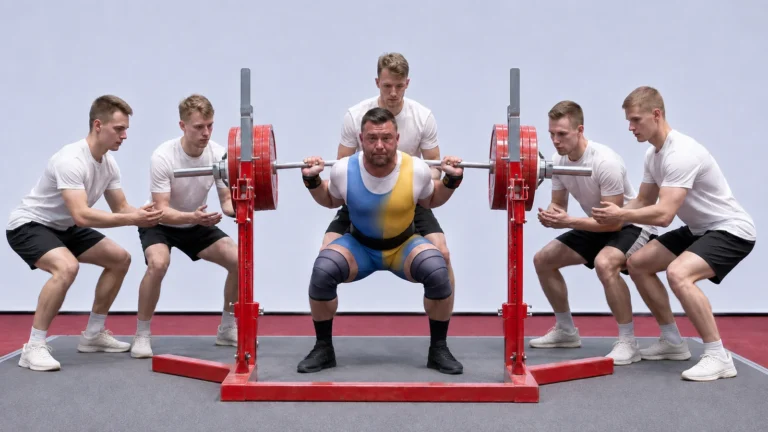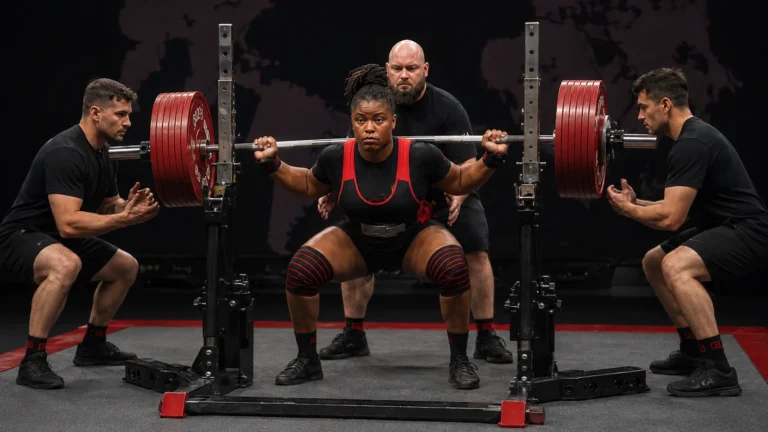

Millions of people now take GLP-1 medications like semaglutide and tirzepatide to lose weight.
A video from the channel Longevity Exercise Physiology and Personal Training takes a different angle on this trend.
It asks whether that weight loss actually holds up over time, and what it costs the body along the way.
That is a longevity question, not just a scale question.
WorkoutHealthy has already covered the basic case for lifting weights alongside GLP-1 drugs in an earlier article.
This article goes further into two specific problems tied to sustainable, long-term results.
The first is losing lean muscle during rapid, medication driven weight loss.
The second is gaining the weight back after stopping the medication.
Here is what real, peer reviewed research says about both.
What the Video Claims
The video’s title promises a longevity angle, framing strength training as the key to “sustainable weight loss” on GLP-1 drugs.
The channel behind it, Longevity Exercise Physiology and Personal Training, is an Australian exercise physiology and personal training business.
It is not run by one solo creator with a personal following.
Its public channel page describes a company offering one on one, gym based exercise services from allied health professionals.
It states that its practitioners hold at least a bachelor’s degree and are accredited through Exercise and Sport Science Australia, known as ESSA.
ESSA accreditation is a real, recognized credential for exercise physiologists in Australia.
The channel also says it operates more than 20 locations across New South Wales, Victoria, the Australian Capital Territory, Queensland, and Canada.
What we could not confirm is the name of the specific person speaking in this particular video.
No individual presenter is named in the video’s public title, description, or metadata.
That is worth knowing before treating the video as a single expert’s personal medical opinion.
The video’s central claim is that resistance training helps make GLP-1 weight loss more sustainable, partly by protecting muscle.
That claim touches on two separate research questions, and both have real evidence behind them.
What Real Research Shows About Muscle Loss During GLP-1 Treatment
Losing muscle during GLP-1 treatment is a documented pattern, not just online speculation.
A 2024 review in the journal Diabetes, Obesity and Metabolism looked specifically at this issue (Neeland et al., 2024).
The review confirmed that lean body mass drops alongside fat mass during treatment with GLP-1 based drugs.
Across major GLP-1 trials, lean mass has typically made up a meaningful share of total weight lost.
The authors called this a real clinical concern, especially for older adults who start out with less muscle.
They also made a more useful point.
This problem has known mitigation strategies, not just risks.
The review specifically named resistance exercise and adequate protein intake as strategies worth building into GLP-1 treatment plans from the start.
That is a more specific, more research grounded claim than simply “lifting weights helps.”
It suggests muscle loss is a manageable risk, not an unavoidable side effect people just have to accept.
What Real Research Shows About Sarcopenic Obesity Risk
Doctors have a specific term for losing muscle while still carrying excess body fat.
It is called sarcopenic obesity, and it is not a new idea invented for GLP-1 drugs.
A classic 2010 review in the journal Nutrition Reviews studied this exact tradeoff during weight loss (Weinheimer et al., 2010).
The researchers reviewed studies that combined calorie restriction with different types of exercise in middle aged and older adults.
People who lost weight through diet alone, with no exercise, tended to lose more fat-free mass relative to fat.
People who added exercise, especially resistance training, held onto more fat-free mass during comparable weight loss.
That pattern held across the different studies the review examined.
This review predates GLP-1 drugs by more than a decade.
But the underlying biology has not changed just because a new drug class arrived.
Rapid weight loss, without a clear reason for the body to keep its muscle, still tends to cost muscle.
People who lost weight through diet alone tended to lose more fat-free mass than people who added resistance training to a comparable weight loss.
What Real Research Shows About Weight Regain After Stopping Treatment
The word “sustainable” in the video’s title points at a real, well documented problem.
Weight lost on GLP-1 drugs tends to come back once the drug stops.
Clear evidence for this comes from the SURMOUNT-4 trial (Aronne et al., 2024).
Researchers gave every participant tirzepatide for the first 36 weeks of the study.
By that point, the average weight loss across the group was 20.9 percent of starting body weight.
After week 36, participants were randomly split into two groups.
One group kept taking tirzepatide for another year.
The other group switched to a placebo, with no more active medication.
The group that kept taking the drug lost more weight, reaching 25.3 percent total loss by week 88.
The group switched to placebo regained weight during that same year.
Their total loss from the start of the trial shrank to just 9.9 percent by week 88.
Nearly 90 percent of the group that stayed on tirzepatide kept at least 80 percent of their original weight loss.
Only about 17 percent of the placebo group managed to keep that much.
This trial did not test resistance training directly.
But it confirms the video’s “sustainable” framing points at something real, not just marketing language.
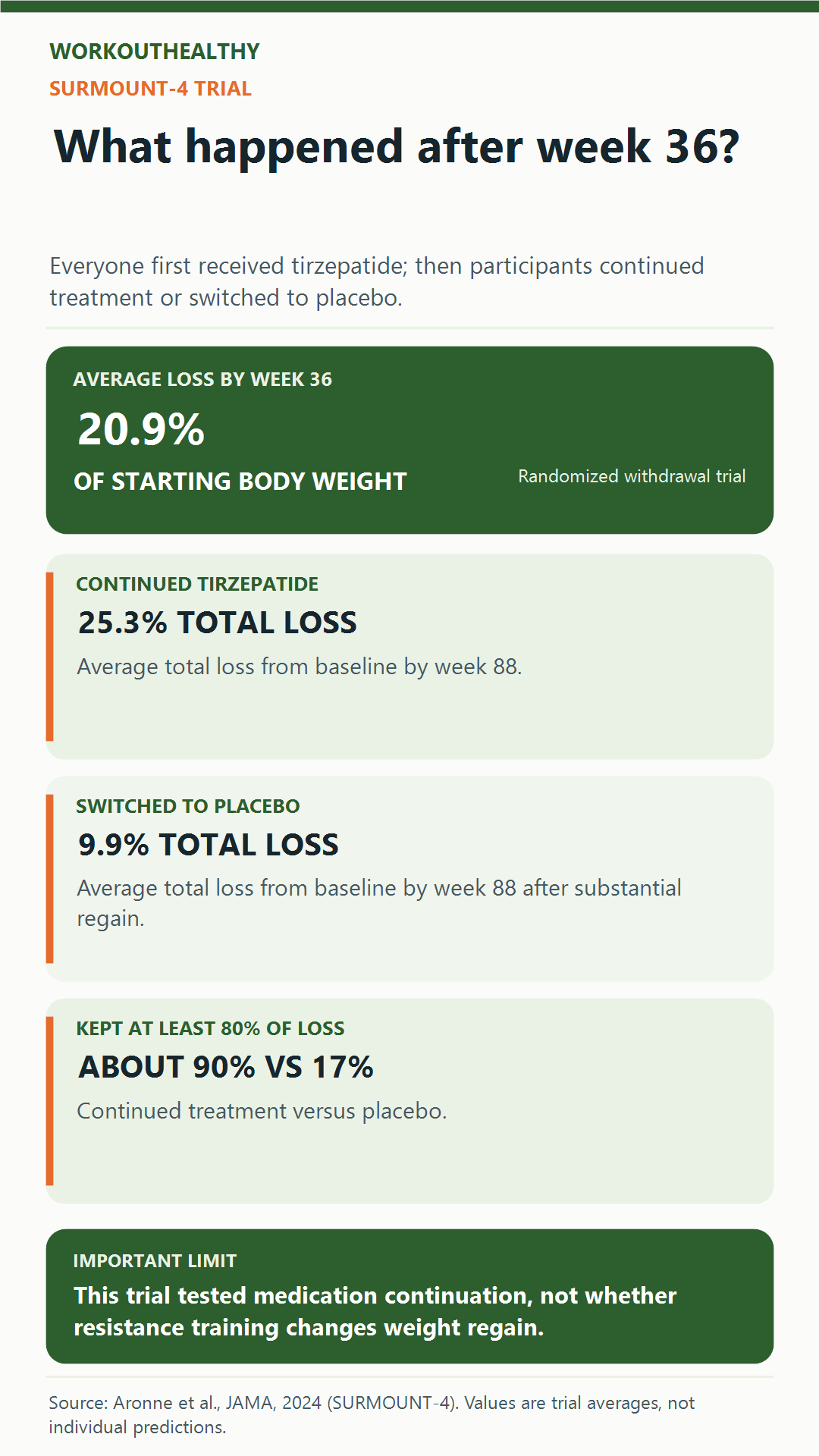
Nearly 90 percent of the group that stayed on tirzepatide kept at least 80 percent of their weight loss. Only about 17 percent of the group switched to placebo kept that much.
What Real Research Shows About Combining Exercise With GLP-1 Treatment
One study went further and tested exercise directly alongside a GLP-1 drug.
A trial published in the New England Journal of Medicine followed adults with obesity through a year long program (Lundgren et al., 2021).
Everyone in the study first lost about 12 percent of their body weight through a low calorie diet.
After that, participants were randomly assigned to one of four groups for the following year.
One group received a placebo, with no structured exercise program and no active medication.
One group followed a structured, supervised exercise program.
One group took liraglutide, an earlier GLP-1 drug, with no structured exercise program.
The last group combined the supervised exercise program with liraglutide.
The combined group came out ahead on fat loss and lean mass preservation compared with either approach used alone.
Exercise alone and medication alone both helped, but the combination outperformed both individual approaches.
This is one of the few trials that actually tested exercise and a GLP-1 drug together, rather than assuming the combination works.
It used liraglutide, not semaglutide or tirzepatide, so it is not a perfect match for every GLP-1 drug on the market today.
But it is real evidence that the combination approach, not medication alone, produces the best body composition results.
The Mechanism
GLP-1 drugs work partly by slowing digestion and sharply reducing appetite.
People taking them often eat far less food overall, not just less of certain foods.
That drop in intake reduces protein along with everything else.
Protein is the raw material muscle needs to repair and rebuild itself.
Eating less protein during a calorie deficit makes muscle loss more likely.
Resistance training sends the body a different, competing signal.
Lifting weights creates mechanical stress on muscle fibers.
That stress tells the body those specific muscles are still needed for daily life.
Paired with enough protein, that signal can help protect muscle even during a large calorie deficit.
Muscle is also metabolically active tissue, meaning it burns more calories at rest than fat does.
Losing a large amount of muscle can lower resting metabolic rate over time.
A lower resting metabolic rate makes weight regain easier once a drug’s appetite suppressing effect fades.
That link matters for the regain problem the SURMOUNT-4 trial documented.
Appetite tends to return toward baseline once someone stops taking a GLP-1 drug.
A person with more preserved muscle, and a higher resting metabolic rate, has a bit more room to absorb that shift.
Resistance training does not cancel out the biology of stopping a medication.
But it changes the starting position a person is working from when they do.
What This Evidence Does Not Prove
This evidence does not prove that resistance training fully prevents muscle loss on GLP-1 drugs.
No large trial has tested that exact question using semaglutide or tirzepatide specifically.
The SURMOUNT-4 trial proved that stopping tirzepatide leads to weight regain.
It did not test whether resistance training changes that regain pattern.
The Lundgren trial tested exercise alongside a GLP-1 drug, but it used liraglutide, an older medication.
Semaglutide and tirzepatide have different effects on appetite and the body, so results may not transfer exactly.
The sarcopenic obesity research is general weight loss physiology, not GLP-1 specific data.
It shows a pattern that has held across many kinds of weight loss, not proof about this exact drug class.
None of this evidence proves that every pound of lean mass lost is muscle specifically.
Lean mass includes muscle, but also organs, water, and other non-fat tissue.
This evidence also does not prove that skipping resistance training guarantees muscle loss for any one person.
Genetics, age, starting fitness level, and total protein intake all play a role too.
Longer, GLP-1 specific trials testing exercise directly are still needed to close these gaps.
Who Should Work With a Clinical Team
Anyone starting a GLP-1 medication should raise exercise and nutrition planning with their prescribing doctor early.
This is not a decision a workout article can make for someone else.
People with ongoing nausea or very low food intake should flag that to their doctor before adding hard exercise.
Low energy intake can make intense resistance training unsafe until eating stabilizes.
People with joint problems, osteoporosis, or heart conditions need individualized guidance from a professional before starting a new lifting program.
Older adults trying strength training for the first time should consider working with a trainer or physical therapist early on.
A registered dietitian can help build a realistic protein plan around a reduced appetite.
Anyone planning to eventually stop a GLP-1 medication should talk to their doctor about that transition ahead of time, not after the fact.
The SURMOUNT-4 data suggests stopping is a real turning point worth planning for, not a quiet exit.
Anyone with a history of disordered eating should approach both the medication and any exercise changes carefully, with professional support.
The right pace and plan depends on a person’s full health history, not a general rule from a video or an article.
A Practical Takeaway
For most people on a GLP-1 medication, two to three resistance training sessions a week is a reasonable starting point.
Full body sessions that hit the major muscle groups tend to work well for beginners.
Basic movements like squats, rows, presses, and hip hinges cover most of what matters.
Protein intake matters just as much as the workouts themselves.
Spreading protein across meals, instead of saving it for one meal, helps the body use it for muscle repair.

Starting resistance training early, alongside the medication, gives muscle more chances to adapt along the way.
Waiting until most of the weight is already gone tends to make preserving muscle harder, not easier.
WorkoutHealthy has covered the broader relationship between losing weight and losing muscle mass in more general terms.
Cardio and daily movement still matter, and WorkoutHealthy has looked at what the evidence says about daily steps and long term health.
But cardio alone does not create the same mechanical signal that resistance training does for muscle.
WorkoutHealthy readers have shown a clear preference for lifting over running in past surveys, and this fits that pattern: most readers favor weightlifting over running when asked directly.
The bigger long-term question is what happens after someone eventually stops the medication.
Building a resistance training habit while still on the drug makes that transition less abrupt.
Consistency over months matters more than intensity in any single session.
None of this requires becoming a serious lifter overnight.
Watch the video
Want more like this? Subscribe to WorkoutHealthy Insider for practical explanations behind popular fitness claims.
References
Aronne, L. J., Sattar, N., Horn, D. B., Bays, H. E., Wharton, S., Lin, W. Y., Ahmad, N. N., Zhang, S., Liao, R., Bunck, M. C., Jouravskaya, I., Murphy, M. A., & SURMOUNT-4 Investigators. (2024). Continued treatment with tirzepatide for maintenance of weight reduction in adults with obesity: The SURMOUNT-4 randomized clinical trial. JAMA, 331(1), 38 to 48. https://doi.org/10.1001/jama.2023.24945
Lundgren, J. R., Janus, C., Jensen, S. B. K., Juhl, C. R., Olsen, L. M., Christensen, R. M., Svane, M. S., Bandholm, T., Bojsen-Møller, K. N., Blond, M. B., Jensen, J. B., Stallknecht, B. M., Holst, J. J., Madsbad, S., & Torekov, S. S. (2021). Healthy weight loss maintenance with exercise, liraglutide, or both combined. New England Journal of Medicine, 384(18), 1719 to 1730. https://doi.org/10.1056/NEJMoa2028198
Neeland, I. J., Linge, J., & Birkenfeld, A. L. (2024). Changes in lean body mass with glucagon-like peptide-1-based therapies and mitigation strategies. Diabetes, Obesity and Metabolism, 26(S4), 16 to 27. https://doi.org/10.1111/dom.15728
Weinheimer, E. M., Sands, L. P., & Campbell, W. W. (2010). A systematic review of the separate and combined effects of energy restriction and exercise on fat-free mass in middle-aged and older adults: Implications for sarcopenic obesity. Nutrition Reviews, 68(7), 375 to 388. https://doi.org/10.1111/j.1753-4887.2010.00298.x
This article is for general information only and is not medical advice. If you have an injury, ongoing pain, or a medical condition, talk to a doctor or physical therapist before you change how you train or eat.