
Short workouts sell themselves on a promise: big results, tiny time investment.
A YouTube video from the channel Talk Science pushes that promise further than most.
The related Facebook post claims a seven-minute workout can affect belly fat and attributes as many as 350 extra post-workout calories to a Nature Communications clinical trial. The linked video is also framed around “deep belly fat loss” through the afterburn effect.
Those are several separate claims: how much energy is used after exercise, whether a short session changes visceral fat, and whether a specific trial measured 350 additional calories.
One claim is about total calorie burn after exercise, a real phenomenon exercise scientists call EPOC.
The other claim is about where on the body that fat loss shows up.
Real research supports part of this story and directly contradicts another part of it.
This article checks the video’s premise against peer reviewed studies on short workouts, afterburn, and fat loss.
What the Video Claims
The video’s title promises a specific outcome: “deep belly fat loss” from a 7 minute routine.
It frames that result through “the afterburn effect,” implying the workout keeps burning calories long after it ends.
We could not independently verify every statement inside the video, so we focus on its title and the separate, more specific 350-calorie claim in the Facebook caption. We could not identify a Nature Communications clinical trial showing that this exact seven-minute, equipment-free routine burns 350 additional calories after it ends. Without a study citation, that number should not be presented as a measured result.
The phrase “7 minute workout” is not just a vague marketing term.
It points to a specific, well documented style of training with a real research origin.
That origin is the right place for a fair evaluation to start.
What Real Research Shows About the 7-Minute Workout
The “7 minute workout” traces back to a real, peer reviewed source.
Exercise physiologists Brett Klika and Chris Jordan published it in ACSM’s Health & Fitness Journal in 2013 (Klika & Jordan, 2013).
Their article described a bodyweight circuit built from 12 exercises, done in rapid sequence with brief rest between each move.
The goal was simple: pack a real training stimulus into a workout short enough that almost nobody could claim they had no time for it.
Klika and Jordan built the protocol around existing research on high intensity interval training and circuit style resistance training.
They were not claiming to have discovered a new physiological effect.
They were packaging known training principles into a format busy people would actually complete.
That distinction matters for how you should read every claim built on top of their work since.
Other short, explosive bodyweight moves follow a similar logic of packing real stimulus into less time, the kind we cover in our look at whether box jumps build muscle.
A short workout can absolutely be a real, effective workout.
Research on high intensity circuits generally shows real gains in cardiovascular fitness and muscular endurance when the routine is repeated consistently over weeks.
What the original 2013 article does not claim, and was never designed to test, is fat loss from any specific body region.
That specific claim came later, from marketing built around the concept, not from Klika and Jordan’s own research.
The 7 minute workout was built to pack a real training stimulus into a short window. It was never built or tested as a fat loss tool for one body part.
What Real Research Shows About Afterburn
“Afterburn” has a specific, less catchy name in exercise science: excess post-exercise oxygen consumption, or EPOC.
After you stop exercising, your body keeps using more oxygen than it would at rest.
That extra oxygen use costs a small number of extra calories, spread out over the hours after a workout.
A widely cited review pooled the exercise science research on EPOC and how large it really is (LaForgia, Withers, & Gore, 2006).
The review’s conclusion was consistent across dozens of studies: EPOC is real, but it is modest.
In studies that produced prolonged EPOC, the review reported extra oxygen consumption amounting to about 6–15% of the net oxygen cost of the exercise. That range is from different protocols, often much longer or more intense than this video; it is not a per-person calorie multiplier or a prediction for a seven-minute bodyweight circuit.
That is a genuine physiological effect, not evidence for hundreds of extra calories from this routine.
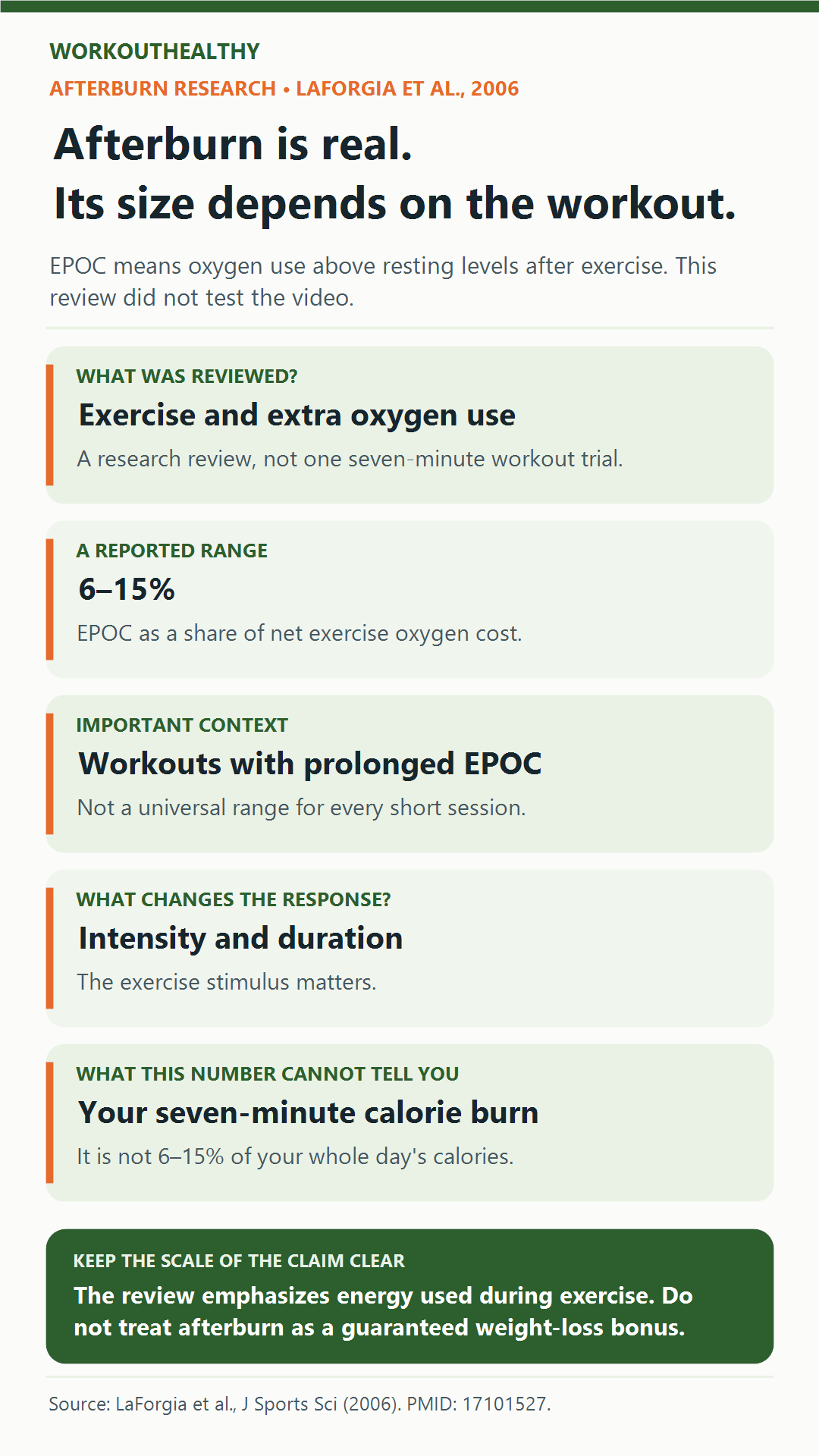
A seven-minute bodyweight circuit is short, so it is implausible to infer a large post-workout calorie total from duration alone. The review’s 6–15% figure should not be applied mechanically to this unmeasured video. The 350-extra-calorie claim remains unverified.
Higher intensity and longer duration exercise tends to produce a larger EPOC effect than a short, lower intensity session.
The review concluded that most exercise-related energy expenditure comes during activity itself, not afterward. A seven-minute session can still be useful, but its effect depends on what was done and how often.
For comparison, a longer session of continuous intense cardio, like the kind covered in our breakdown of calories burned jumping rope, burns more total calories during the activity itself.
What Real Research Shows About Belly Fat and Exercise
The video’s biggest claim is not really about afterburn.
It is about where the fat comes off, specifically “deep belly fat,” meaning visceral fat around the organs.
This is where the evidence gets much less kind to the video’s framing.
Fat loss from exercise is systemic, not local.
Your body does not pull fat preferentially from the muscles doing the most work.
A direct test of that idea used six weeks of dedicated abdominal exercise training (Vispute, Smith, LeCheminant, & Hurley, 2011).
Participants did daily abdominal training for six straight weeks.
Their abdominal muscle endurance improved significantly by the end of the study.
Their abdominal fat, measured directly, did not decrease any more than in a group that did no abdominal training at all.
That result is one of the clearest experimental rejections of “spot reduction” in the exercise science literature.
Working a body part hard does not selectively strip fat from that part.
Training a muscle group hard makes that muscle group stronger. It does not tell your body to release fat specifically from the skin above it.
Visceral fat specifically, the deeper fat the video’s title refers to, does respond to exercise.
A systematic review and meta-analysis pooled controlled trials on aerobic and resistance exercise and visceral fat (Ismail, Keating, Baker, & Johnson, 2012).
Aerobic exercise training reduced visceral fat significantly across the pooled trials, even in people who did not lose much weight on the scale.
Resistance training alone showed a smaller, less consistent effect on visceral fat in that same review.
The exercise programs behind those results ran for at least four weeks, not one session.
None of the visceral fat reductions in that review came from a single short workout.
They came from repeated aerobic activity, done consistently, over a real training period.
A 7 minute circuit, done occasionally, is not the same intervention as the programs in that research.
Total fat loss, wherever it eventually shows up first, still depends on the same basic energy math covered in our guide to losing weight without losing muscle mass.
The Mechanism
Two separate mechanisms are actually in play here, and the video blends them into one story.
The first mechanism is EPOC itself.
High intensity exercise depletes stored energy in your muscles and raises your body temperature and heart rate.
Restoring those systems to a resting state takes extra oxygen, and extra oxygen use costs extra calories.
The duration of EPOC depends on the exercise stimulus. The cited review discusses prolonged responses lasting several hours and sometimes up to 24 hours after demanding protocols; duration alone does not tell us the calorie total.
The second mechanism is fat mobilization, which is a completely different process.
When your body needs energy beyond what your last meal provided, it releases stored fat from fat cells across your whole body.
Which fat cells release fat first depends mostly on genetics, hormones, and overall body fat levels.
It does not depend on which muscles you just finished training.
Visceral fat around your organs tends to be more metabolically active than fat just under the skin.
That is part of why it often responds first once a real calorie deficit is in place.
That response is still a whole body process, driven by total energy balance over days and weeks.
It is not a targeted reaction to seven minutes of exercise aimed at your midsection.
Watch the video
What This Evidence Does Not Prove
None of this research proves a single 7 minute session changes your body composition.
Every study behind the fat loss findings above used repeated sessions over weeks or months.
The EPOC research does not prove afterburn adds up to a meaningful calorie deficit on its own.
It says nothing about someone who ignores diet or total daily activity otherwise.
The visceral fat research does not prove any specific workout style is required.
It shows only that consistent aerobic activity over time is associated with real reductions.
None of these studies were built around a bodyweight circuit exactly like the one in this video.
They studied the underlying mechanisms the video borrows from, not the video’s specific routine.
Individual results also vary a lot based on starting fitness, diet, sleep, and genetics.
No single study can control perfectly for all of those factors at once.
Common Mistakes
The most common mistake is expecting a short workout to spot reduce belly fat on its own.
The research above shows that is not how fat loss works, no matter how hard the seven minutes feel.
Another mistake is treating afterburn as permission to eat significantly more after a short workout.
The extra calories from EPOC are small, and eating back more than that erases any deficit the workout created.
Skipping proper form to move faster through the circuit is a real risk with any high intensity bodyweight routine.
Fatigue sets in fast during moves like jump squats or mountain climbers.
Form tends to break down right when injury risk is highest.
Relying on seven minutes as your only exercise for the week is another common mistake.
A short circuit is a useful tool, not a complete fitness program on its own.
Who Should Be Extra Careful
Anyone new to exercise should ease into high intensity circuits rather than starting at full effort.
The Klika and Jordan protocol is intentionally intense, and that intensity is not appropriate for every fitness level on day one.
People with joint problems in the knees, hips, or shoulders should modify or skip high impact moves like jump squats.
People managing high blood pressure or an existing heart condition should talk to a doctor before doing any high intensity interval workout.
Short bursts of near maximal effort raise heart rate and blood pressure quickly.
That is exactly what makes the workout effective, and exactly what makes it risky for some people.
Pregnant individuals should get clearance from a doctor before starting or continuing high intensity circuit training.
Anyone recovering from a recent injury should wait for clearance before returning to explosive bodyweight moves.
Our breakdown of what hip replacement recovery actually takes shows how much patience real injury recovery requires before returning to explosive movement.
A Practical Takeaway
A seven-minute bodyweight circuit can be an evidence-informed way to fit movement into a busy day. The original 2013 paper described a training format; it did not prove that this specific video causes deep belly-fat loss or a 350-calorie afterburn.
Use it as a time efficient way to raise your heart rate and challenge your muscles.
Do not use it as a belly fat solution on its own.
Pair it with daily movement outside the workout itself, since total weekly activity matters more than any single session.

Our guide to how many miles you should walk a day is a good place to start building that daily baseline.
If visceral fat loss is your actual goal, plan for months of consistent aerobic activity, not minutes.
The visceral-fat trials in the cited review used repeated aerobic training over at least four weeks, with widely varying protocols. There is no single session count or duration from that review that guarantees a reduction for an individual.
Combine that aerobic base with resistance training for benefits neither one provides alone.
Track progress with something other than the scale alone, like how your clothes fit or how many reps you can complete.
Judge a new routine by sustainable weekly activity, strength or fitness progress, and any clinically relevant measures over time rather than by an immediate belly-fat promise.
The cited interventions varied in length; use repeated sessions and a realistic longer-term plan instead of treating one short video as a test of success.
Want more like this? Subscribe to WorkoutHealthy Insider for practical explanations behind popular fitness claims.
References
Ismail, I., Keating, S. E., Baker, M. K., & Johnson, N. A. (2012). A systematic review and meta-analysis of the effect of aerobic vs. resistance exercise training on visceral fat. Obesity Reviews, 13(1), 68 to 91. https://doi.org/10.1111/j.1467-789X.2011.00931.x
Klika, B., & Jordan, C. (2013). High-intensity circuit training using body weight: Maximum results with minimal investment. ACSM’s Health & Fitness Journal, 17(3), 8 to 13. https://doi.org/10.1249/FIT.0b013e31828cb1e8
LaForgia, J., Withers, R. T., & Gore, C. J. (2006). Effects of exercise intensity and duration on the excess post-exercise oxygen consumption. Journal of Sports Sciences, 24(12), 1247 to 1264. https://doi.org/10.1080/02640410600552064
Vispute, S. S., Smith, J. D., LeCheminant, J. D., & Hurley, K. S. (2011). The effect of abdominal exercise on abdominal fat. Journal of Strength and Conditioning Research, 25(9), 2559 to 2564. https://doi.org/10.1519/JSC.0b013e3181fb4a46
This article is for general information only and is not medical advice. If you have an injury, ongoing pain, or a medical condition, talk to a doctor or physical therapist before you change how you train or eat.