
High blood pressure gets more common with every decade of adult life.
The linked livewell after60 video advertises three exercises to lower blood pressure “naturally.” We could not independently verify the presenter’s clinical credentials or the video’s exact exercise list, so its title is context—not medical authority or a reason to change prescribed treatment.
That is an appealing pitch for anyone over 60 who wants fewer pills and more control over their own numbers.
The good news is that exercise really does lower blood pressure, and the research behind it runs deep.
The important nuance is what “naturally” should and should not mean once you are already on blood pressure medication.
This article checks the video’s premise against real, peer reviewed studies on aerobic exercise, isometric holds, and resistance training in older adults.
What the Video Claims
The video’s title promises three exercises that lower blood pressure after 60, without naming a drug or a doctor’s visit.
Channels in this corner of YouTube, aimed at viewers over 60, tend to group blood pressure exercises into three familiar categories.
Usually that means some kind of low impact cardio like walking, a held position like a wall sit, and a light strength move using body weight or dumbbells.
We could not confirm the video’s exact wording or any specific numbers it claims beyond the title itself.
So this article treats “top 3 exercises” as a category claim.
It checks each of the three exercise types against real research, rather than repeating any single number from the video as fact.
The word “naturally” in the title is marketing language, not a medical claim.
It should not be read as a statement that exercise can substitute for prescribed treatment.
What Real Research Shows About Aerobic Exercise and Blood Pressure
Aerobic exercise is the most studied blood pressure intervention there is.
A meta-analysis pooled 54 randomized controlled trials on aerobic exercise and blood pressure, covering both healthy people and people with hypertension (Whelton et al., 2002).
Across those trials, aerobic exercise lowered blood pressure by an average of 3.8 points systolic and 2.6 points diastolic.
The effect was larger in people who already had high blood pressure, with drops closer to 4.9 points systolic.
That pattern shows up again and again in blood pressure research.
Exercise tends to help the most in the people who need it the most.
The blood pressure drop from aerobic exercise showed up whether or not participants also lost weight, which suggests the benefit does not depend on the scale moving at all.
Walking is the easiest way most people over 60 access this benefit.
Our guide to how many miles you should walk a day breaks down how much walking it actually takes to move the needle for heart health.
You do not need to run or take a spin class to get the benefit seen in these trials.
Brisk walking, cycling, swimming, and water aerobics all count as aerobic exercise in the research, as long as the activity raises your heart rate for a sustained stretch of time.
What Real Research Shows About Isometric Exercise and Blood Pressure After 60
Isometric exercise means holding a muscle contraction without moving the joint, like a wall sit or a handgrip squeeze.
It has a shorter research history than aerobic exercise, but the results have been surprisingly strong.
One randomized controlled trial tested isometric handgrip training specifically in middle aged and older adults who were not on blood pressure medication (Okamoto et al., 2020).
After eight weeks of the handgrip program, resting blood pressure dropped in the older adult group, and a measure of artery stiffness improved too.
That age specific detail matters.
A lot of exercise research is done on younger volunteers, and their results do not always carry over neatly to a 65 year old.
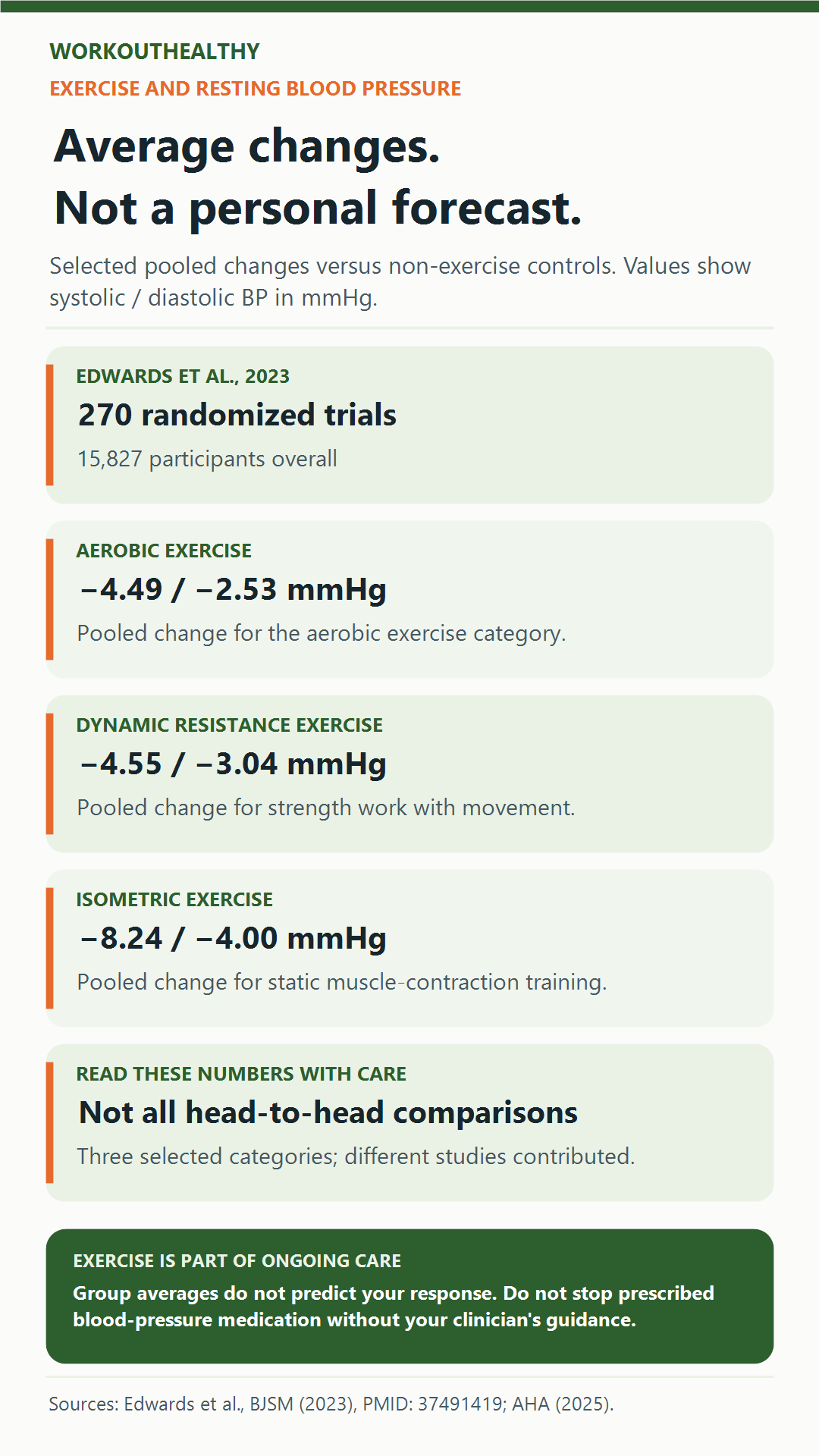
A separate, much larger analysis compared isometric holds directly against aerobic exercise, resistance training, and interval training across roughly 270 combined trials and 15,827 participants (Edwards et al., 2023).
Isometric training ranked highest for lowering resting systolic blood pressure in that network analysis. The categories drew on different trials and protocols, however; the ranking does not show that any short home hold outperforms a person’s walking or prescribed care.
Researchers do not fully agree yet on why isometric holds work this well.
The pooled result is promising, but individual trials vary in size, participants, supervision, and exercise dose.
Structured isometric training can lower average resting blood pressure, but a brief home squeeze is not automatically equivalent to the protocols tested in trials.
None of this means isometric holds should replace the other two categories.
It means they deserve a place next to walking and strength work, not below them.
What Real Research Shows About Resistance Training and Blood Pressure
Resistance training covers exercises where muscles work against weight or resistance, like light dumbbells, resistance bands, or body weight moves.
A meta-analysis of 64 controlled studies looked specifically at dynamic resistance training as a stand alone treatment for blood pressure, not paired with cardio (MacDonald et al., 2016).
The training programs in these studies typically ran about three days a week for roughly 14 weeks.
They produced average reductions of about 3.0 points systolic and 2.1 points diastolic blood pressure.
Those numbers are smaller than the isometric findings above.
Dynamic resistance training also builds strength and can help preserve muscle mass—reasons to include it beyond a blood-pressure comparison.
Muscle mass matters more after 60 than most people realize.
It protects against falls, supports metabolism, and slows age related muscle loss.
It is never too late to start.
Edith Connor set a Guinness World Record as the oldest competitive female bodybuilder well into her 80s, training with resistance the entire way there.
Her case is one story, not a study.
But it shows the ceiling on resistance training and age is much higher than most people assume.
The Mechanism
These three exercise types lower blood pressure through a few overlapping pathways, not one single trick.
Aerobic exercise trains the heart to pump more blood per beat, so it does not have to work as hard at rest.
It also improves how well blood vessels relax and widen, a property researchers call endothelial function.
Isometric holds work differently.
Sustained muscle tension briefly reduces blood flow to the working muscle, then blood rushes back in once the hold ends.
Researchers believe that repeated pattern, restricted flow followed by a rush of blood, trains blood vessels to stay more flexible over time.
Resistance training builds muscle tissue, which changes how the body uses blood sugar and eases strain on the cardiovascular system indirectly.
All three also appear to calm the sympathetic nervous system to some degree, the system that keeps blood pressure elevated under chronic stress.
None of these mechanisms belong to just one exercise type.
The three categories can complement one another, but these separate studies do not establish that combining all three produces the largest blood-pressure reduction for every person.
Our breakdown of what the research says about sauna use and heart health looks at a different, related way the body adapts its blood vessels to a repeated stress.
Watch the video
What This Evidence Does Not Prove
None of these studies prove that one specific ten minute video routine will lower your blood pressure by a specific number.
Meta-analyses pool many different protocols, populations, and measurement methods.
That is a strength for finding an overall pattern, and a weakness for predicting one person’s result.
Most of the underlying trials ran for weeks to a few months, not years.
So the evidence says less about what happens after a decade of consistent training.
Some participants in these trials already had diagnosed hypertension, and some did not.
That mix affects how large a drop any one person should realistically expect.
None of this research proves exercise can replace blood pressure medication a doctor has already prescribed.
It proves exercise is a genuine, evidence backed tool that works alongside medical care, not instead of it.
Common Mistakes
The most common mistake is holding your breath during an isometric hold or a resistance exercise.
Straining against a closed airway, called the Valsalva maneuver, spikes blood pressure far higher than the exercise itself would.
Another mistake is starting too hard, too fast, especially with isometric holds.
A wall sit or a handgrip squeeze can feel deceptively easy for the first ten seconds.
Skipping the aerobic piece entirely because isometric holds “won” in the research above is also a mistake.
These studies tested each exercise type on its own, not as a reason to drop walking or cardio altogether.
Treating one good workout as enough is the last common mistake.
Every study behind these numbers used weeks of repeated sessions, not a single session.
Who Should Check With a Doctor First
Anyone currently taking blood pressure medication should not stop or reduce it because of a new exercise routine.
Talk to a doctor first.
Blood pressure medication and exercise can work together.

Stopping medication abruptly can be dangerous, even if a new habit feels like it is helping.
Anyone with uncontrolled high blood pressure, meaning readings that stay high despite treatment, should get medical clearance before starting isometric or resistance training.
Isometric holds and resistance training both cause a real, temporary spike in blood pressure while you are doing them.
That spike is normal in a healthy cardiovascular system.
It is worth clearing with a doctor first if your baseline numbers are already high.
Anyone with a heart condition, a recent cardiac event, or symptoms like chest pain, dizziness, or shortness of breath during activity needs medical evaluation before starting any new exercise program.
That goes for this program or any other.
Gabrielle Union has spoken publicly about training around her own family history of high blood pressure, which is a reasonable model for anyone with a family history and no diagnosis yet.
Get checked, then build a plan around what your doctor confirms.
A Practical Takeaway
Start with brief, consistent sessions rather than one long workout you dread.
For aerobic exercise, aim for 30 minutes of brisk walking most days of the week.
Break it into two 15 minute walks if that fits your day better.
If you monitor your blood pressure at home, discuss a safe starting activity level and a way to track progress with your clinician, especially if your readings are high or you have symptoms.
For isometric holds, ask whether a handgrip or supported wall sit is appropriate for you. Research protocols generally prescribe specific hold lengths, intensities, and frequencies; a 20-second home squeeze should not be assumed to deliver the pooled trial result.
Breathe steadily through every hold instead of holding your breath.
Breath holding spikes blood pressure further than the exercise itself.
For resistance training, two short sessions a week is enough to start.
Use light dumbbells, resistance bands, or body weight moves like sit to stands.
Add a little extra time, weight, or reps every week or two.
Do not jump to a much harder version right away.
Track your numbers if you have a home blood pressure cuff.
Check before you start a consistent routine, then again after six to eight weeks.
That is roughly how long the trials above ran before showing a measurable change.
Consistency across weeks matters more than the intensity of any single session.
Want more like this? Subscribe to WorkoutHealthy Insider for practical explanations behind popular fitness claims.
References
Edwards, J. J., Deenmamode, A. H. P., Griffiths, M., Arnold, O., Cooper, N. J., Wiles, J. D., & O’Driscoll, J. M. (2023). Exercise training and resting blood pressure: A large-scale pairwise and network meta-analysis of randomised controlled trials. British Journal of Sports Medicine, 57(20), 1317 to 1326. https://doi.org/10.1136/bjsports-2022-106503
MacDonald, H. V., Johnson, B. T., Huedo-Medina, T. B., Livingston, J., Forsyth, K. C., Kraemer, W. J., Farinatti, P. T. V., & Pescatello, L. S. (2016). Dynamic resistance training as stand-alone antihypertensive lifestyle therapy: A meta-analysis. Journal of the American Heart Association, 5(10), e003231. https://doi.org/10.1161/JAHA.116.003231
Okamoto, T., Hashimoto, Y., & Kobayashi, R. (2020). Isometric handgrip training reduces blood pressure and wave reflections in East Asian, non-medicated, middle-aged and older adults: A randomized control trial. Aging Clinical and Experimental Research, 32(8), 1485 to 1491. https://doi.org/10.1007/s40520-019-01330-3
Whelton, S. P., Chin, A., Xin, X., & He, J. (2002). Effect of aerobic exercise on blood pressure: A meta-analysis of randomized, controlled trials. Annals of Internal Medicine, 136(7), 493 to 503. https://doi.org/10.7326/0003-4819-136-7-200204020-00006
Whelton, P. K., Carey, R. M., Aronow, W. S., Casey, D. E., Collins, K. J., Dennison Himmelfarb, C., et al. (2018). 2017 ACC/AHA/AAPA/ABC/ACPM/AGS/APhA/ASH/ASPC/NMA/PCNA guideline for the prevention, detection, evaluation, and management of high blood pressure in adults. Hypertension, 71(6), e13 to e115. https://doi.org/10.1161/HYP.0000000000000065
This article is for general information only and is not medical advice. If you have an injury, ongoing pain, or a medical condition, talk to a doctor or physical therapist before you change how you train or eat.