
Can one workout erase a day spent sitting? The short answer is no: movement helps, but there is no precise exchange rate that turns eight seated hours into a harmless day. That does not make your workout pointless. It means both parts of the day deserve attention.
For most adults, the useful plan is simple: move more often, build enough weekly aerobic activity, and train the major muscle groups. A brisk walk and a modest strength routine can do much more for long-term health than an occasional punishing session. If you have been inactive, start from where you are.
Here is how to interpret the evidence without turning a chair or a missed workout into a scare story.
What the Facebook post gets right—and what needs context
The related WorkoutHealthy post makes three practical points: prolonged sitting matters; walking pace can change the intensity of a walk; and strength training belongs in a heart-health plan. These are reasonable themes, but each needs a boundary.
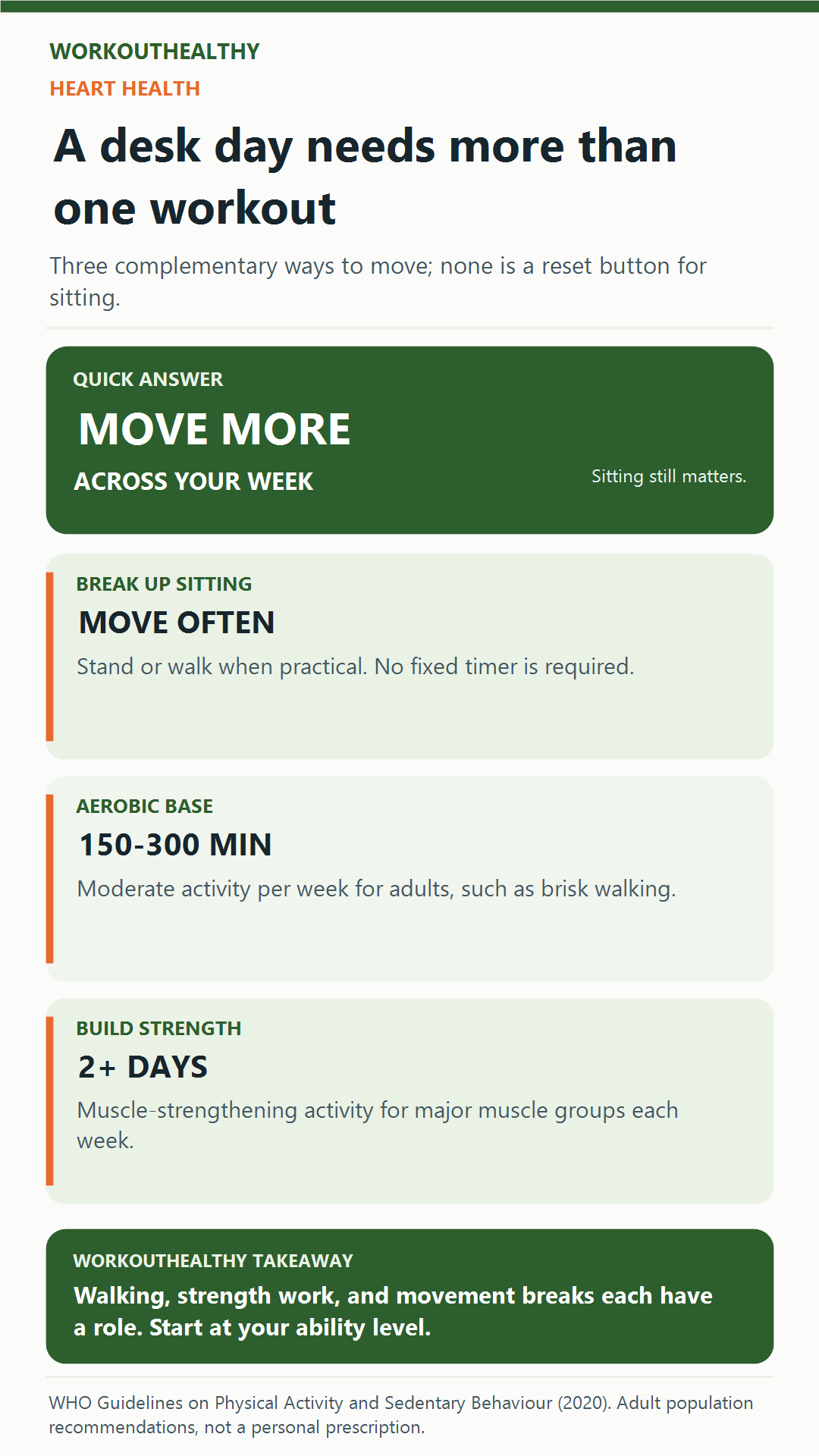
The World Health Organization (WHO) recommends that adults limit sedentary time and replace it with activity of any intensity. The guidelines also say that adults should aim for 150 to 300 minutes of moderate aerobic activity per week, or 75 to 150 minutes of vigorous activity, plus muscle-strengthening work on at least two days.
Those are population guidelines, not a promise that reaching a minute count eliminates every risk from sitting. They are also not a reason to dismiss a slower walk. Any movement can be a useful starting point, particularly for someone who has been inactive or has mobility limits.
Brisk walking often qualifies as moderate-intensity activity. The US Centers for Disease Control and Prevention (CDC) gives a more personal check than a speed number: at moderate intensity, you can talk but not sing. A comfortable pace for one person may be a challenging pace for another.
Can exercise cancel out a day of sitting?
There is no proven formula in which a specific workout cancels a specific number of seated hours. Sitting is a behavior, not a toxin that has to be flushed out in one session. Long periods of low movement often coexist with other patterns—less daily energy expenditure, fewer opportunities to use the leg muscles, and less frequent cardiovascular stimulation.
The WHO guidelines report associations between higher sedentary time and worse health outcomes, including cardiovascular disease and mortality. They recommend replacing sedentary time with physical activity of any intensity. They also recognize that higher amounts of moderate-to-vigorous activity can help counter some of the health risks associated with high sedentary time.
That is a more useful message than “your workout does not count.” A walk after work still counts. So does a morning strength session. The extra opportunity is to interrupt sitting during the remaining hours when it is practical.
Research on sitting and health is often observational. People who sit more may differ in many ways from people who sit less, and an individual’s risk cannot be calculated from one day at a desk. The recommendation to move more rests on the broader evidence for physical activity, not on a claim that a single chair directly causes a heart event.
Why walking pace matters without making slow walks worthless
Walking is accessible, inexpensive, and easy to scale. A leisurely walk gets you moving. A brisk walk usually raises breathing and heart rate enough to count toward moderate-intensity aerobic minutes. That is why the pace in the Facebook caption matters.
But “brisk beats slow” is too blunt as a rule for every person. If a slow pace is all you can manage safely today, that is a valid beginning. As fitness improves, the same route may feel easier; you can then walk a little faster, farther, or more often. The CDC’s talk test lets you judge effort relative to your own capacity instead of chasing somebody else’s miles-per-hour target.
Try alternating a few minutes at a comfortable pace with a few minutes that feel purposeful but sustainable. You should still be able to speak in sentences. For a novice, the best pace is one they can repeat consistently. Our guide to how much to walk each day explains how to choose a realistic starting distance.
Step counts can also help you see your baseline, though they are not a clinical score. If a tracker shows 3,000 steps on a typical day, adding a short walk may be more useful than immediately trying to hit a number copied from social media. Our review of daily steps and mortality separates associations in the research from guarantees for any one person.
Where strength training fits into heart health
Resistance training is not only for muscle size. An American Heart Association scientific statement on resistance exercise reports benefits for cardiovascular risk factors including blood pressure, blood glucose regulation, blood lipids, and body composition. The effects vary by person and program, and lifting is not a substitute for medication or medical care when those are needed.
Muscle-strengthening activity also appears alongside aerobic activity in the WHO guidelines. The two forms of training complement each other. Walking challenges the cardiorespiratory system repeatedly; resistance training challenges muscle and supports strength for everyday tasks. Neither requires an extreme workout to be worthwhile.
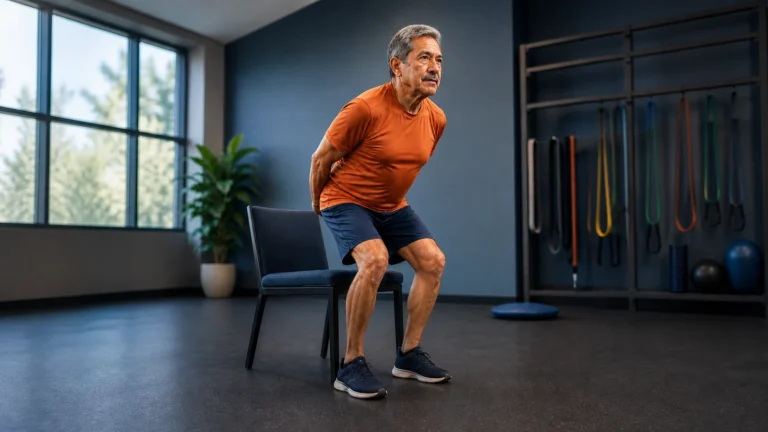
A beginner might train the major muscle groups twice a week with movements such as a chair sit-to-stand, a supported row, a wall push-up, and a hip hinge. Start with a manageable effort and build gradually. The best routine is one that fits your health, ability, and schedule—not one that leaves you exhausted for the rest of the week.
For people with known cardiovascular disease or complex medical conditions, exercise choices and intensity should be individualized with a clinician. The AHA statement addresses both people with and without cardiovascular disease, but it does not mean every person should begin with the same weights.
A realistic week for a desk-bound adult
Imagine a person who works at a computer most days and is starting from little planned exercise. A workable first week could include a 10-minute walk on several days, two short full-body strength sessions, and standing or walking breaks between long seated stretches. That is an example, not a prescription.
Over time, the walking can grow toward the WHO’s 150-minute moderate-activity minimum. Thirty minutes on five days is one way to get there, but shorter sessions can accumulate too. Strength sessions do not have to be long: they need to challenge the major muscle groups at an appropriate level and allow recovery.
It helps to choose cues you already encounter. Walk after lunch, take a call standing, or get up when you refill water. If your job does not allow frequent breaks, use the breaks you do control. Avoid turning a helpful guideline into a demand for a perfect, uninterrupted streak.
Progression should be gradual. Adding a little time or effort each week is usually more sustainable than leaping from inactivity to hard intervals. If a week goes badly, resume with an easier session instead of trying to make up every missed minute at once.

Do movement breaks have to follow a strict timer?
No. The WHO recommends limiting sedentary time and replacing some of it with activity, but it does not provide a universal “stand every 30 minutes” rule that suits every job, body, or condition. A reminder can be useful if you routinely lose track of time; it is a tool, not a medical threshold.
Choose a break you will actually use. Stand to stretch, walk to another room, take stairs if they are comfortable, or do a few gentle calf raises. A person with pain, disability, or balance concerns may need a different option, including seated movement. The goal is more movement across the day, not a performance test at every break.
These breaks are an addition to a weekly exercise plan, not proof that the weekly plan is unnecessary. Conversely, missing a break does not erase the benefits of a walk or lift later.
Warning signs are more important than a step target
Most people can begin with light activity and increase gradually, but symptoms should change the plan immediately. The American Heart Association advises stopping activity and seeking medical evaluation for warning signs such as chest pressure, dizziness, an unusually irregular heartbeat, or extreme shortness of breath. If symptoms are severe, sudden, persistent, or suggest a heart attack, seek emergency care.
Do not use an online article or fitness tracker to rule out a medical problem. A person with existing heart disease, a recent event, concerning symptoms, or a clinician’s activity restrictions should get individualized advice before substantially increasing exercise intensity.
For the generally healthy desk worker, the safer lesson is not “avoid exercise.” It is to begin at a sustainable level, notice how you respond, and build a repeatable pattern.
What the evidence cannot tell you
Guidelines describe patterns that benefit populations; they cannot guarantee an outcome for an individual. They do not tell us exactly how many minutes of walking offset one hour of sitting, nor can they promise that brisk walking prevents a specific heart attack.
Claims about walking pace also need context. Faster walkers may differ from slower walkers in baseline health, and pace itself can reflect illness or disability. Do not interpret a slower pace as a personal failure. Use your own capacity and clinician advice to choose a safe challenge.
Similarly, resistance exercise can improve risk factors on average without replacing the full care plan for high blood pressure, diabetes, or cardiovascular disease. The practical value is in combining feasible habits over time, not in treating one workout as a cure.
The takeaway
A seated day is not made harmless by a single workout, but that workout still matters. The strongest plan has more than one layer: move during the day when you can, accumulate regular aerobic activity, and strengthen major muscle groups at least twice weekly.
Start with one change you can repeat next week: a short walk, a slightly brisker stretch of your usual route, or a modest full-body session. Build from there. Consistency and gradual progression are more useful than trying to “cancel” yesterday’s chair time in one exhausting hour.
Sources and further reading
- World Health Organization, Guidelines on Physical Activity and Sedentary Behaviour (2020). Weekly aerobic and strengthening targets; recommendations to limit and replace sedentary time.
- CDC, How to Measure Physical Activity Intensity. Moderate-intensity examples and the talk test.
- American Heart Association, Resistance Exercise Training in Individuals With and Without Cardiovascular Disease: 2023 Update. Cardiovascular risk-factor benefits of resistance training.
- American Heart Association, Develop a Physical Activity Plan for You. Exercise warning signs and individual planning.
This article is for general information only and is not medical advice. If you have a medical condition or concerning symptoms, ask a qualified clinician about an activity plan that fits you.