

Millions of people now take GLP-1 drugs like semaglutide and tirzepatide for weight loss.
A recent CBS19 news segment covered a concern doctors are raising about these medications.
The concern is simple.
Not all the weight lost on these drugs is fat.
Some of it is muscle, and that matters for long term health.
This article examines one potentially useful strategy that keeps coming up in that conversation: resistance training, alongside adequate nutrition and clinical monitoring. It is not a guaranteed fix.
We looked at the actual peer reviewed research behind that recommendation, not just the headline.
What the Video Claims
The CBS19 segment centers on GLP-1 drugs and their effect on muscle mass.
It reports that health experts want people to pay closer attention to muscle health while using these medications.
A full transcript of this specific segment was not available for this article.
So this piece treats the segment as a prompt, not as its main source of evidence.
Instead, it checks the video’s core idea against the actual medical research on the topic.
That core idea is not controversial among obesity researchers.
Substantial weight loss can include a reduction in fat-free mass; fat-free mass is not the same as skeletal muscle.
Medication-assisted weight loss has renewed attention to lean-mass changes and the need to assess function, not just scale weight.
Doctors have been raising this exact concern in medical journals for several years now.
The sharper question is what actually protects muscle while the weight comes off.
What Real Research Shows About Resistance Training During Weight Loss
The idea that exercise protects muscle during weight loss is not new.
It has been tested directly in a major clinical trial.
Researchers led by Dennis Villareal published that trial in the New England Journal of Medicine in 2017.
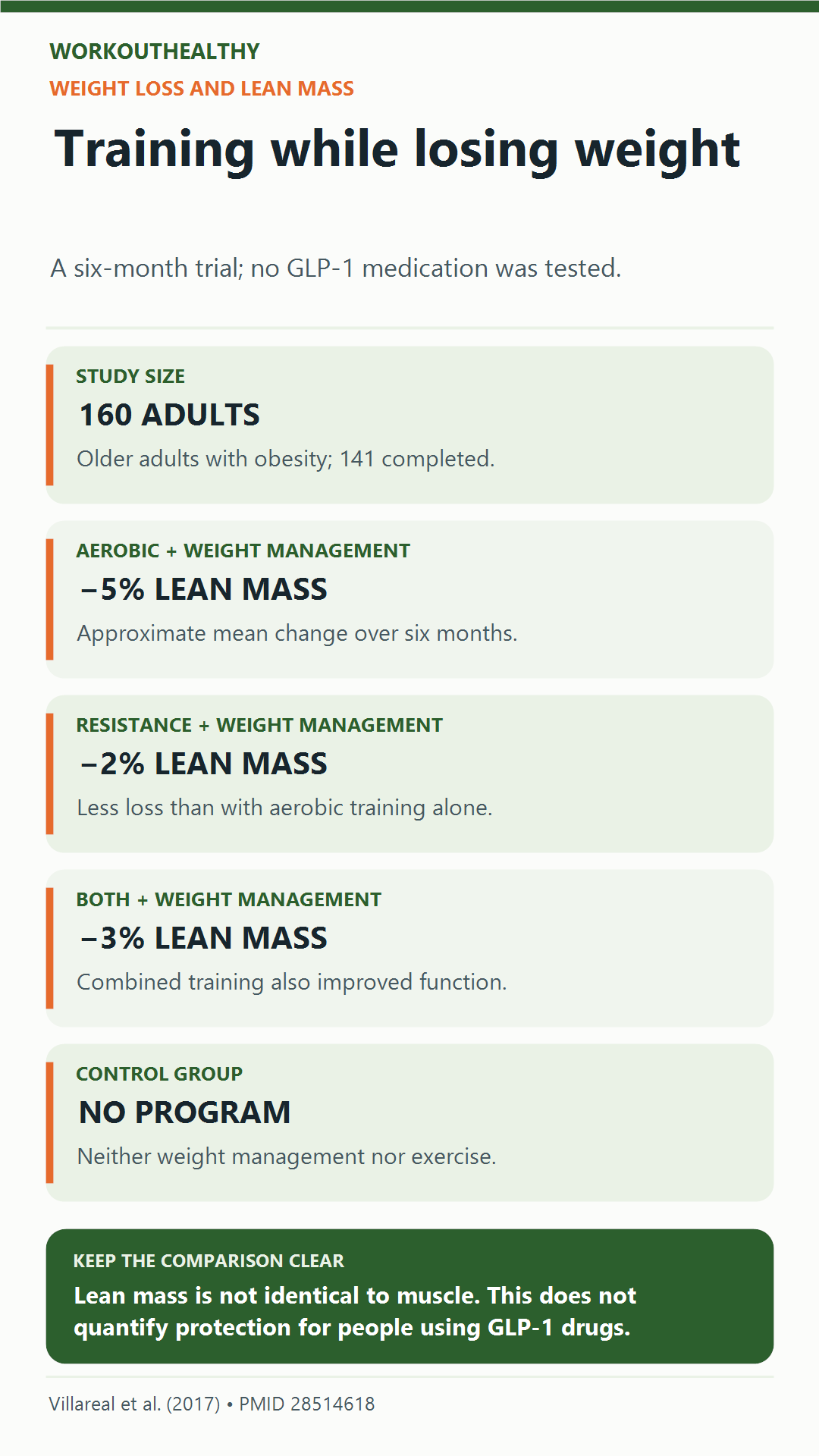
The study enrolled obese adults over age 65, a group already prone to losing muscle.
Participants in the three exercise groups followed a weight-management program designed to produce weight loss. The control group received neither the weight-management program nor structured exercise.
Researchers then split them into different exercise groups for six months.
One group did aerobic exercise only.
Another group did resistance exercise only.
A third group combined both types of training.
The comparison control group had no weight-management program and no structured exercise.
The three weight-management-plus-exercise groups lost similar amounts of weight; the non-dieting control group is not part of that comparison.
But the makeup of that weight loss looked very different between groups.
The resistance training group held onto noticeably more lean mass and bone density than the aerobic only group.
The combined group did well across the board, including tests of physical function.
This trial did not involve GLP-1 medications at all.
It still matters here because the underlying problem is the same one.
Any method that creates a calorie deficit puts muscle at some risk.
Resistance training can help reduce lean-mass loss during calorie restriction in studied populations, though the amount of benefit varies and is not established for every medication user.
A separate line of evidence backs this up.
Researchers Eileen Weinheimer, Laura Sands, and Wayne Campbell reviewed 52 separate studies in 2010.
Their review, published in Nutrition Reviews, focused on middle aged and older adults.
It looked specifically at what happens to fat free mass during weight loss.
The review compared diet alone against diet paired with exercise.
Exercise, especially resistance training, consistently helped preserve more fat free mass.
That pattern held true across very different study designs and populations.
Two large, independent bodies of research point in the same direction.
Neither study used a light, casual approach to training.
The resistance sessions in this research involved real effort against real resistance.
Think barbells, machines, or resistance bands loaded enough to feel genuinely hard.
Researchers did not test a few easy stretches or a light walk as a substitute.
That detail matters, because the protective effect seems tied to real training intensity.
If you want more background on how weight loss and muscle loss get tangled together, this Insider article on losing weight and muscle mass covers the basics.
Two decades of exercise science point to the same answer for weight loss and muscle. People who lift weights while dieting keep more of it.
The Direct Evidence on Resistance Training and GLP-1 Drugs
Older research proves resistance training protects muscle during ordinary dieting.
The newer question is whether that holds true specifically for GLP-1 medications.
Researchers are now testing that question directly.
A trial called LEAN-PREP was published as a study protocol in BMJ Open in 2026.
The research team is led by Ameenah Alawadhi and colleagues.
The trial enrolls people taking semaglutide or tirzepatide for weight loss.
One study arm adds structured resistance exercise and protein guidance to standard medical care.
The main measurement is muscle size in the thigh, tracked with MRI scans.
Researchers will also track body composition, strength, and physical function over six months.
This is a protocol paper, which means it describes the plan for the study.
It does not yet report final results, because the trial is still running as of this writing.
Its existence still tells us something important.
Researchers consider this question serious enough to fund a dedicated randomized trial.
The protocol shows that investigators consider the question worth testing; it is not evidence of a treatment effect by itself.
It also means the most specific answer, exact results for GLP-1 users, is still being measured.
Why Lifting Weights Protects Muscle During a Calorie Deficit
The mechanism behind this effect is fairly well understood.
Muscle tissue responds to the demands placed on it.
When a muscle is regularly asked to lift a challenging load, the body works to maintain it.
When that same muscle mostly sits unused, the body has less reason to keep it.
Weight loss can reduce both fat mass and fat-free mass. Fat-free mass includes muscle but also other tissues and water, so a change in a body-composition scan is not a direct measure of muscle loss.
Resistance exercise provides a stimulus that can help retain strength and lean tissue during an energy deficit. Its effects depend on training dose, nutrition, and the individual; it does not force weight loss to come only from fat.
This is why resistance training tends to outperform aerobic only exercise for this specific goal.
Aerobic exercise has important cardiovascular and functional benefits. In the cited older-adult weight-loss trial, resistance training preserved more lean mass than aerobic training alone, while combined training improved a broader set of functional outcomes.
There is a second reason muscle matters beyond appearance.
Muscle tissue burns more calories at rest than fat tissue does.
Changes in body size and lean mass can affect resting energy expenditure during weight loss, but the relationship is complex. Preserving strength and physical function is a clearer near-term goal than promising to prevent later weight regain.
Protecting muscle during weight loss is not just about strength today.
Maintaining strength and function is worthwhile even when the long-term effect on weight maintenance is uncertain.
Readers curious about the wider research on lifting weights can see this Insider breakdown of strength training research for more context.
What This Evidence Does Not Prove
It is worth being clear about the limits of this research.
The Villareal and Weinheimer studies did not test people taking GLP-1 medications.
They tested ordinary calorie restricted diets, not drug assisted weight loss.
GLP-1 drugs may affect appetite, muscle, and metabolism in ways diet alone does not.
The LEAN-PREP trial is designed to answer that exact question.
Its results are not published yet.
No study has proven one specific number of weekly workouts that guarantees muscle protection on these drugs.
Nobody has proven that resistance training fully cancels out the risk either.
The honest summary is that resistance training is supported by weight-loss studies without these medications, while its specific effect during semaglutide or tirzepatide treatment remains under study.
The precise amount of protection it offers alongside GLP-1 drugs is still being measured.
Common Mistakes People Make
A few patterns show up often in people trying to protect muscle during weight loss.
The first mistake is doing only cardio and skipping resistance training entirely.
Cardio supports heart health, but it does not target muscle preservation the same way.
The second mistake is training too lightly to create a real stimulus.
Very light weights, done for a few easy reps, may not challenge the muscle enough.
A previous Insider survey found that most readers already favor weightlifting over running for body composition goals.
That preference lines up with what the muscle preservation research actually shows.
The third mistake is jumping into a demanding new program right when starting a new medication.
Appetite and energy levels can shift quickly on GLP-1 drugs.
Ramping up training volume too fast during that adjustment period can backfire.
The fourth mistake is treating protein or supplements as a replacement for actual training.
Nutrition supports muscle, but it cannot substitute for the mechanical signal that lifting provides.
Who Should Check With a Doctor First
Anyone starting a GLP-1 medication should already be working with a prescribing doctor.
That relationship is the right place to raise questions about exercise and muscle health.
People with joint problems, heart conditions, or past injuries need individualized guidance.
People who are new to structured exercise should also ask about a safe starting point.
A doctor or physical therapist can help set a realistic, safe training plan.

This article cannot replace that kind of personalized medical advice.
A Practical Takeaway
The research reviewed here points toward a simple, low risk strategy.
Add structured resistance training two to three times per week.
Focus each session on major muscle groups, not just one body part.
Use compound movements like squats, presses, rows, and hip hinges.
Choose a weight that feels genuinely challenging by the last few reps of a set.
Aim for roughly two to four sets per exercise, in the six to fifteen rep range.
Try to slowly add weight or reps over time, a principle called progressive overload.
Rest at least one day between sessions that train the same muscle groups.
Keep a simple log of weights and reps so you can see real progress over time.
Expect some sessions to feel harder than others, especially early on a new medication.
Appetite changes can affect energy levels, so adjust intensity on tough days instead of quitting entirely.
Consistency over months matters more than any single workout.
The medication-specific evidence is still developing. Older weight-loss trials support resistance training for preserving lean mass and function, but do not quantify its benefit for every GLP-1 user.
None of this replaces a conversation with your own doctor about your specific plan.
Watch the Original Video
Want more like this? Subscribe to WorkoutHealthy Insider for practical explanations behind popular fitness claims.
References
Alawadhi, A. A., Alroudhan, D., Alsaeed, D. J., Almarshad, B. W., Alshehabi, D. H., Allahou, B. A., Mashankar, A., Al Ozairi, E., & Gray, S. (2026). LEAN mass Preservation with Resistance Exercise and Protein during semaglutide and tirzepatide therapy (LEAN-PREP study): A protocol for a randomised controlled trial. BMJ Open, 16(4), e116911. https://doi.org/10.1136/bmjopen-2026-116911
Villareal, D. T., Aguirre, L., Gurney, A. B., Waters, D. L., Sinacore, D. R., Colombo, E., Armamento-Villareal, R., & Qualls, C. (2017). Aerobic or resistance exercise, or both, in dieting obese older adults. New England Journal of Medicine, 376(20), 1943 to 1955. https://doi.org/10.1056/NEJMoa1616338
Weinheimer, E. M., Sands, L. P., & Campbell, W. W. (2010). A systematic review of the separate and combined effects of energy restriction and exercise on fat-free mass in middle-aged and older adults: Implications for sarcopenic obesity. Nutrition Reviews, 68(7), 375 to 388. https://doi.org/10.1111/j.1753-4887.2010.00298.x
Wilding, J. P. H., Batterham, R. L., Calanna, S., Davies, M., Van Gaal, L. F., Lingvay, I., McGowan, B. M., Rosenstock, J., Tran, M. T. D., Wadden, T. A., Wharton, S., Yokote, K., Zeuthen, N., & Kushner, R. F. (2021). Once-weekly semaglutide in adults with overweight or obesity. New England Journal of Medicine, 384(11), 989 to 1002. https://doi.org/10.1056/NEJMoa2032183
This article is for general information only and is not medical advice. If you have an injury, ongoing pain, or a medical condition, talk to a doctor or physical therapist before you change how you train or eat.