
Stuart Phillips has spent decades studying how the body uses dietary protein.
He is a Professor of Kinesiology at McMaster University in Canada.
His name appears on hundreds of peer reviewed papers about muscle and protein.
A YouTube video from the channel Exercise Science, titled “Stuart Phillips’ All-Time Greatest Protein Explainer,” pulls together his views on how much protein people actually need.
This article checks those claims against Phillips’ own published research.
Protein advice online swings between two extremes.
One camp says almost any amount is fine as long as calories are in check.
The other camp pushes numbers well above what most research supports.
Phillips has built a career studying the middle ground, using controlled lab studies rather than guesswork.
His research group at McMaster runs some of the most cited protein and muscle studies in the field.
That track record is why his name shows up so often in fitness content, including videos like this one.
What the Video Claims
The video frames itself as a full rundown of Phillips’ protein advice.
It covers three main ideas, based on the video’s public title and description.
How much protein a person needs each day.
Whether the timing of protein meals matters.
And where that protein should come from.
No public transcript of the video was available for this article.
So specific claims below are described as coming from “the video,” not quoted directly from Phillips himself.
The underlying science, though, comes straight from his published studies.
Dietary protein research has moved past a single daily number and toward a fuller picture of amount, timing, and food quality.
How Much Protein You Actually Need
The current U.S. and Canadian recommendation for protein is 0.8 grams per kilogram of body weight per day.
That Recommended Dietary Allowance is intended to cover the needs of nearly all healthy adults; it was not designed as an optimal muscle-building target (Institute of Medicine, 2005).
Phillips has argued that people doing resistance training may benefit from more protein than the basic adult allowance. That does not make 0.8 grams per kilogram inadequate for every active person.
In 2018, Phillips and ten other researchers published a large review in the British Journal of Sports Medicine.
They pooled data from 49 separate studies on protein supplementation and resistance training (Morton et al., 2018).
In the meta-regression, higher total protein intake was associated with greater gains in fat-free mass during resistance training, up to an estimated plateau (Morton et al., 2018).
Benefits leveled off around 1.6 grams of protein per kilogram of body weight per day.
For a 175 pound person, that works out to roughly 127 grams of protein a day.
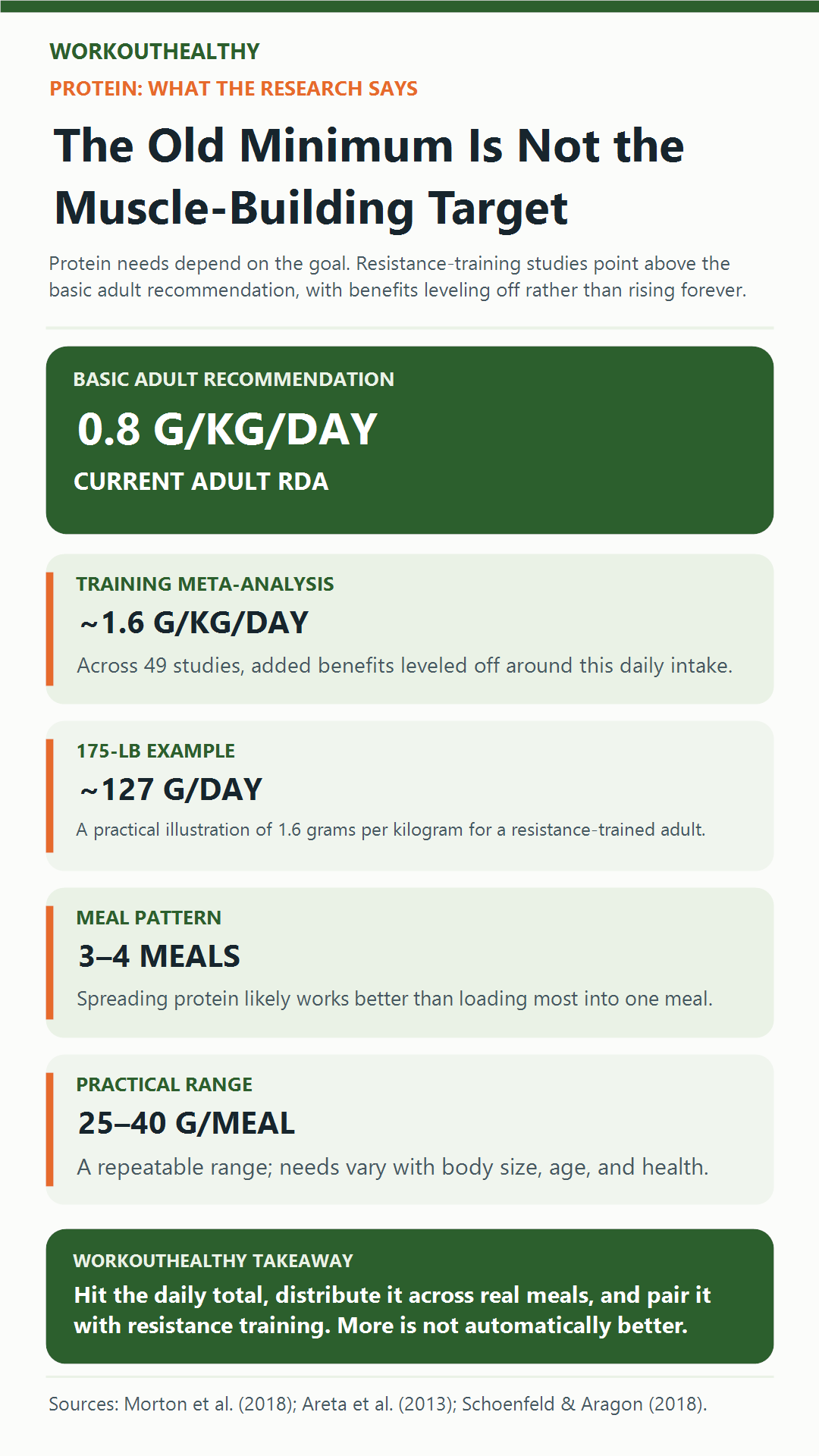
Above about 1.6 grams per kilogram per day, the pooled analysis did not detect further average fat-free-mass gains. This is an estimate across studies, not a hard ceiling for every person; its upper confidence interval extended higher.
That finding matters for anyone reading claims about extreme high protein diets.
Our breakdown of Jay Cutler’s reported 1993 diet runs the math on one famous example of eating far beyond that range.
Protein also plays a defensive role during weight loss.
Cutting calories without enough protein tends to cost muscle along with fat.
Our article on losing weight and muscle mass covers why that trade off happens and how to avoid it.
Where that protein comes from matters too, though less than the total amount.
Animal sources like eggs, dairy, poultry, fish, and lean beef contain all nine essential amino acids in one package.
Nutrition scientists call these complete proteins.
Plant sources like beans, lentils, tofu, and quinoa can supply the same amino acids across a full day of eating.
They just tend to need more variety and slightly larger portions to match an animal based diet gram for gram.
Neither source is required specifically, as long as the daily total and food variety are covered.
Does Protein Timing and Meal Distribution Matter
The video reportedly addresses when to eat protein, not just how much.
Phillips has co-authored research on exactly this question.
A 2013 study led by José Areta, with Phillips as a co-author, tested three ways of spreading the same total protein across a day (Areta et al., 2013).
One group ate two large protein doses.
A second group ate four moderate doses.
A third group ate eight small doses.
The four dose pattern produced the highest rate of muscle protein synthesis over the following twelve hours.
That works out to a solid protein source roughly every three to four hours.
A separate 2018 review by Brad Schoenfeld and Alan Aragon looked at how much protein a single meal can actually use for muscle building (Schoenfeld & Aragon, 2018).
They concluded that spreading protein across three to four meals a day, with real protein at each one, likely works better than loading most of it into a single meal.

This lines up with a common real world habit worth naming.
Many people eat very little protein at breakfast and load up at dinner.
The research above suggests that pattern may be less effective than spreading protein more evenly.
Resistance training is still what creates the demand for that protein in the first place.
Readers curious about how popular strength training is compared to cardio can check our survey results on weightlifting versus running.
The Mechanism Behind Muscle Protein Synthesis
To understand why timing and amount both matter, it helps to know what protein actually does inside a muscle cell.
Muscle tissue is constantly being broken down and rebuilt.
Scientists call the rebuilding process muscle protein synthesis.
Exercise, especially resistance training, raises the rate of muscle protein synthesis for hours afterward.
Eating protein raises it further by supplying amino acids, the building blocks muscle is made from.
One amino acid called leucine appears to act like a trigger for this process.
Phillips’ own dose response research measured how much protein is needed to fully hit that trigger.
In a study led by Daniel Moore, with Phillips as senior author, young men ate different amounts of egg protein after a leg workout (Moore et al., 2009).
Muscle protein synthesis rose with each increase in protein, but it leveled off around 20 grams.
Eating 40 grams in one sitting did not double the muscle building response compared to 20 grams.
The extra protein was still used by the body, just not mainly for building new muscle tissue in that window.
That is the biological reason behind the advice to spread protein across several meals instead of one giant serving.
It helps to picture muscle protein synthesis and muscle protein breakdown as two sides of a scale.
Muscle grows only when synthesis outpaces breakdown over time.
A single workout tips that scale toward breakdown at first.
A protein rich meal afterward tips it back toward synthesis.
Repeat that pattern often enough, across weeks and months, and the muscle gets bigger and stronger.
This is also why one great meal cannot undo weeks of eating too little protein overall.
The scale has to tip toward synthesis often, not just once.
One small leg-exercise study found no extra short-term muscle-protein-synthesis response at 40 versus 20 grams. A different workout or person may respond differently.
What This Evidence Does Not Prove
None of this research proves that any single video’s advice applies perfectly to every viewer.
Most of the underlying studies were done on young, healthy men, often college aged.
Older adults tend to need more protein per meal to get the same muscle building response.
Researchers call this reduced sensitivity anabolic resistance, and it becomes more common with age.
The Moore et al. dose response numbers also came from a single style of resistance workout.
Real training programs vary a lot in volume, intensity, and which muscles get worked.
Short term measurements of muscle protein synthesis are not the same thing as long term muscle growth.
A meal that spikes synthesis in a lab test does not guarantee visible muscle gain over months.
People with kidney disease or other medical conditions may need very different protein targets entirely.
None of the studies cited here tested that population.
The video itself was not available as a transcript for this article.
So any specific numbers Phillips states on camera could not be independently checked here.
What can be checked is that the general claims match his published body of work.
It is also worth remembering that a single video, even a good one, compresses years of research into a few minutes.
That compression can flatten nuance that matters for a specific reader’s situation.
A pregnant person, a growing teenager, and a competitive bodybuilder do not share the same protein needs.
None of the studies referenced in this article were designed to answer questions for those specific groups.
Common Mistakes and a Practical Takeaway
One common mistake is chasing perfect protein timing while ignoring total daily protein.
The daily total appears to matter more than hitting an exact post workout window.
Another mistake is assuming more protein always means more muscle.
The Morton et al. review found a plateau, not an unlimited climb.
A third mistake is skipping resistance training and expecting protein alone to build muscle.
Protein without a training stimulus mostly just gets used for other things in the body.
A fourth mistake is assuming powders and shakes are required.
Whole foods like eggs, dairy, poultry, fish, beans, and tofu supply the same amino acids as a supplement.
For a healthy adult who trains with resistance exercise, roughly 1.6 grams per kilogram per day can be an evidence-informed planning example, not a universal prescription (Morton et al., 2018).
Spread that total across three to four meals rather than one or two.
Aim for something like 25 to 40 grams of protein at each of those meals.
Age, energy intake, training volume, and health status may change an appropriate target. Do not automatically raise intake based on a single trait; ask a registered dietitian or clinician for individualized guidance when needed.
Check with a registered dietitian if you have a kidney condition or another reason to be cautious about protein intake.
A simple way to check your intake is reading nutrition labels for a few days.
Most food labels list protein in grams per serving, which makes daily totals easy to add up.
A typical chicken breast has roughly 25 to 30 grams of protein.
A cup of Greek yogurt or cottage cheese usually has close to 20 grams.
Two eggs provide about 12 to 14 grams.
Tracking totals for even a few days can reveal whether you are near the target or far from it.
Small, steady changes tend to stick better than a sudden overhaul of every meal at once.
Watch the video
Want more like this? Subscribe to WorkoutHealthy Insider for practical explanations behind popular fitness claims.
References
Institute of Medicine. (2005). Dietary Reference Intakes for Energy, Carbohydrate, Fiber, Fat, Fatty Acids, Cholesterol, Protein, and Amino Acids. National Academies Press. https://nap.nationalacademies.org/catalog/10490/dietary-reference-intakes-for-energy-carbohydrate-fiber-fat-fatty-acids-cholesterol-protein-and-amino-acids
Areta, J. L., Burke, L. M., Ross, M. L., Camera, D. M., West, D. W. D., Broad, E. M., Jeacocke, N. A., Moore, D. R., Stellingwerff, T., Phillips, S. M., Hawley, J. A., & Coffey, V. G. (2013). Timing and distribution of protein ingestion during prolonged recovery from resistance exercise alters myofibrillar protein synthesis. Journal of Physiology, 591(9), 2319 to 2331. https://doi.org/10.1113/jphysiol.2012.244897
Moore, D. R., Robinson, M. J., Fry, J. L., Tang, J. E., Glover, E. I., Wilkinson, S. B., Prior, T., Tarnopolsky, M. A., & Phillips, S. M. (2009). Ingested protein dose response of muscle and albumin protein synthesis after resistance exercise in young men. American Journal of Clinical Nutrition, 89(1), 161 to 168. https://doi.org/10.3945/ajcn.2008.26401
Morton, R. W., Murphy, K. T., McKellar, S. R., Schoenfeld, B. J., Henselmans, M., Helms, E., Aragon, A. A., Devries, M. C., Banfield, L., Krieger, J. W., & Phillips, S. M. (2018). A systematic review, meta-analysis and meta-regression of the effect of protein supplementation on resistance training-induced gains in muscle mass and strength in healthy adults. British Journal of Sports Medicine, 52(6), 376 to 384. https://doi.org/10.1136/bjsports-2017-097608
Schoenfeld, B. J., & Aragon, A. A. (2018). How much protein can the body use in a single meal for muscle building? Implications for daily protein distribution. Journal of the International Society of Sports Nutrition, 15, Article 10. https://doi.org/10.1186/s12970-018-0215-1
This article is for general information only and is not medical advice. If you have an injury, ongoing pain, or a medical condition, talk to a doctor or physical therapist before you change how you train or eat.