

A recent video from Hypertrophy Academy tackles three training variables at once.
It covers volume, intensity, and frequency for building muscle.
It also flags warning signs that show up when you train hard in a calorie deficit.
This article checks those claims against real, published exercise science.
What the Video Claims
The video frames volume, intensity, and frequency as a kind of seesaw.
Push one variable up and something else often has to come down.
It also warns that dieting hard while lifting hard can backfire.
According to the video, ignoring these tradeoffs is a common reason people stall out.
Weightlifting is already popular with our own readers, based on a recent survey showing most favor weights over running.
That makes questions about how to program lifting even more useful to answer correctly.
Training volume, training intensity, and training frequency do not work in isolation. Push one higher and something else in the system usually has to give.
The core idea behind a seesaw is reasonable on its face.
Nobody has unlimited capacity to recover from training.
The real question is whether research backs up the specific tradeoffs the video describes.
What Real Research Shows About the Volume, Intensity, and Frequency Tradeoffs
Volume usually means the number of hard sets done for a muscle each week.
A 2017 meta-analysis by Schoenfeld and colleagues looked at this question directly.
They found a clear dose response relationship between weekly sets and muscle growth (Schoenfeld, Ogborn, & Krieger, 2017).
People who did more than ten hard sets per muscle group per week grew more than people doing fewer sets.
The benefit did not keep climbing forever, though.
Gains leveled off well before volume reached extreme levels.
A separate randomized trial from the same lead author tested this more directly.
Trained men were split into low, moderate, and high volume groups for eight weeks.
The high volume group built more muscle than the low volume group did (Schoenfeld et al., 2019).
Strength gains were similar across all three groups.
More volume helped muscle size more than it helped raw strength.
Intensity in strength training usually means how heavy the weight is, not just how hard a set feels.
A 2017 review compared low load training against high load training for muscle growth (Schoenfeld, Grgic, Ogborn, & Krieger, 2017).
Researchers pooled results from many separate training studies.
Muscle growth ended up similar between low load and high load groups.
That was true as long as sets were taken close to failure.
Strength gains, though, still favored the heavier loads.
This tells you load selection is more about your specific goal than one fixed rule.
The likely mechanism ties back to total mechanical tension placed on a muscle.
Heavier loads create more tension within each single rep.
Lighter loads taken close to failure build similar total tension across more reps.
Either path can signal a muscle to grow, as long as effort stays high.
Not every lifter responds to added volume the same way.
Some people in these studies kept growing well past twenty sets per week.
Others saw their best results closer to ten sets per week.
Training age, genetics, and recovery capacity likely explain much of that gap.
Frequency means how often a muscle gets trained each week.
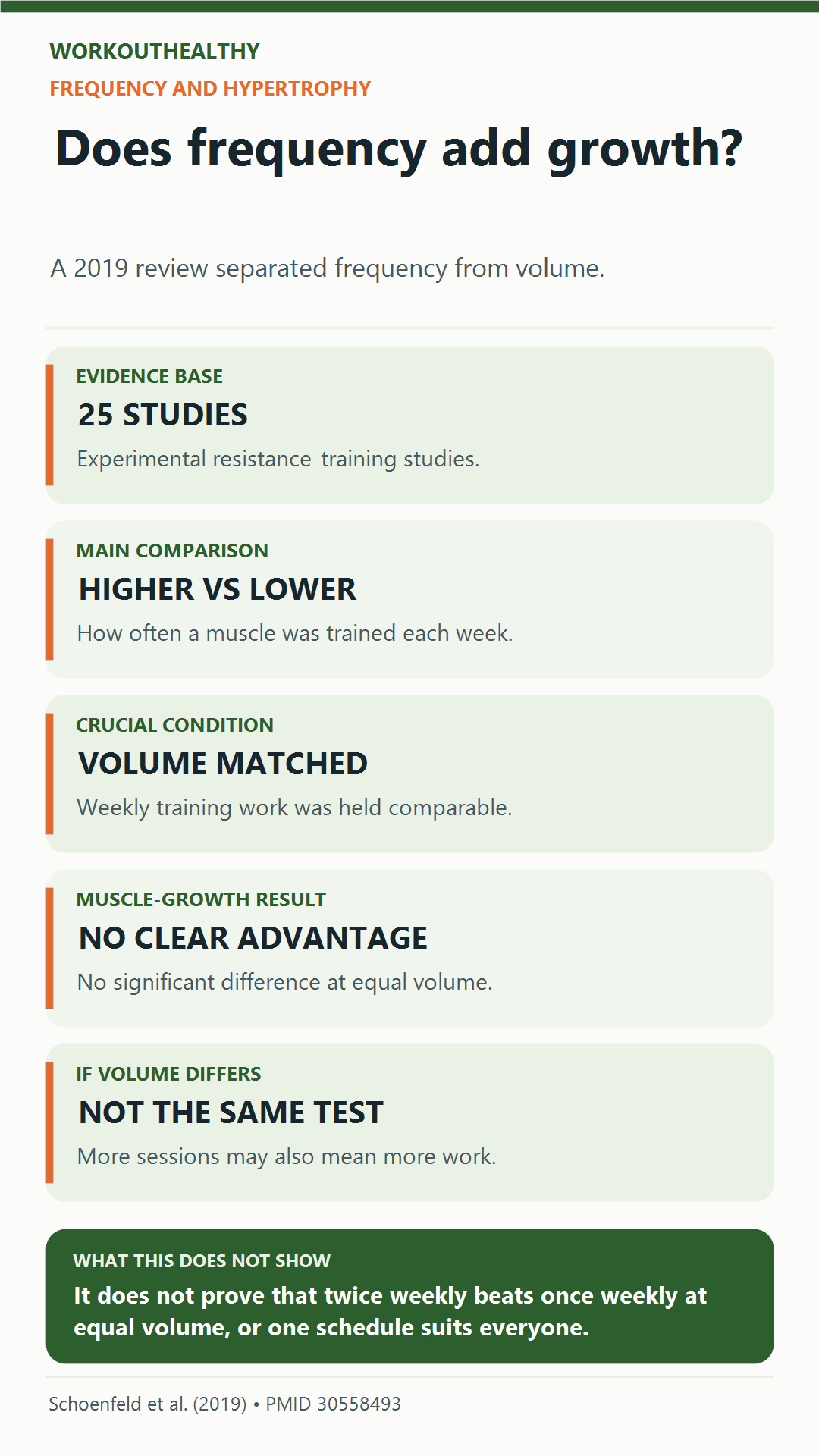
A 2019 meta-analysis pooled multiple studies on training frequency and muscle growth (Schoenfeld, Grgic, & Krieger, 2019).
Training a muscle twice a week beat training it once, when total volume was matched.
Beyond twice a week, the extra benefit from frequency alone got much smaller.
This lines up with the seesaw idea from the video in a real way.
Volume appears to matter more than frequency on its own.
Frequency mostly helps because it lets you fit in more quality volume without one exhausting session.
The same broad principle, that resistance training benefits go beyond just muscle size, shows up in research on whether lifting weights protects brain health as people age.
What Research Shows About Training in a Calorie Deficit
Eating in a deficit while lifting weights changes how the body responds to training.
A 2022 meta-analysis and meta-regression looked at exactly this problem (Murphy & Koehler, 2022).
The researchers pooled data across many resistance training studies conducted during energy deficits.
A larger calorie deficit was linked to smaller gains in lean mass.
Strength gains, however, held up much better than lean mass gains did.
That supports part of what the video calls a red flag.
Part of the mechanism likely involves hormone levels.
A steep calorie deficit can lower testosterone and thyroid hormone output.
Both hormones support muscle building and recovery from hard training.
A smaller, more moderate deficit puts less strain on that hormonal system.
Sleep quality often drops during aggressive dieting as well.
Poor sleep makes hard training feel harder and slows recovery down.
That combination can add to the muscle loss risk from a deficit.
A larger energy deficit was associated with smaller gains in lean mass, even though strength gains were largely preserved.
Protein intake seems to change this picture quite a bit.
A randomized trial tested higher versus lower protein diets during a calorie deficit combined with hard training (Longland, Oikawa, Mitchell, Devries, & Phillips, 2016).
Young men followed a supervised diet and exercise program for a month.
The higher protein group gained lean mass even while losing fat in a deficit.
The lower protein group lost some lean mass along with the fat.
Total weight loss was similar between the two groups.
Body composition was not similar at all.
For context on how extreme some real world protein intakes have gotten, see our breakdown of Jay Cutler’s 1993 diet and what the math actually says.
Together, these two studies point toward a similar conclusion.
A deficit alone does not have to wreck hard earned muscle.
The size of the deficit and daily protein intake both seem to matter a great deal.
Readers curious about the bigger picture can also check our guide to losing weight and muscle mass at the same time.
What This Evidence Does Not Prove
These studies do not prove one exact set count works for every single lifter.
Most volume research reports averages across a whole group of people.
Individual results inside those same studies still varied quite a bit.
The frequency research mostly held total weekly volume constant between groups.
That means it tested frequency on its own, not frequency stacked with much higher volume.
The deficit research cannot hand you your own personal calorie cutoff.
People differ in training history, genetics, sleep, and stress levels.
None of these studies followed people for years at a time.
Most ran for a matter of weeks or a few months.
Longer term effects of these tradeoffs are simply less studied right now.
Most of these studies also enrolled young, healthy, already trained men.
Women, older adults, and complete beginners were far less represented.
Results may not transfer perfectly to every population reading this article.
Beginners in their first year of training often build muscle even in a deficit.
Researchers sometimes call this effect body recomposition.
Experienced lifters usually cannot count on that same effect happening for them.
The more advanced a lifter becomes, the more a deficit tends to work against muscle growth.
Common Mistakes People Make With These Variables
One common mistake is chasing very high volume and a steep deficit at the same time.
Both high volume and a large deficit stress recovery in different ways.
Stacking maximum amounts of both at once often backfires badly.
Another mistake is treating frequency like magic on its own.
Training a muscle five times a week with tiny volume each time will not beat two well loaded sessions.
A third mistake is cutting protein first when calories get cut.
The research above suggests that is close to the opposite of what helps.
A fourth mistake is tracking sets while ignoring how close those sets come to failure.
Sets performed far from failure do not carry the same weight in the research above.
A fifth mistake is judging progress only by the scale during a deficit.
Strength trends and how clothes fit tell a fuller story than body weight alone.
A sixth mistake is never changing the plan at all.
Volume, intensity, and frequency needs shift as a lifter gains experience.
What worked in year one rarely stays optimal by year three.
A Practical Takeaway
Start with a volume range that is realistic to recover from, not the highest number you can find online.
Something in the range the research supports, often ten to twenty hard sets per muscle group weekly, is a reasonable start.
Split that volume across two or three sessions per muscle group instead of one.
Keep most working sets within a few reps of failure.
If you are in a calorie deficit, keep that deficit moderate rather than extreme.
Prioritize protein intake so your body has material to hold onto lean mass.
Track your lifts over time, not only the number on the scale.

If strength starts dropping fast, treat that as a signal.
Ease off the deficit, the volume, or both, and reassess after a couple of weeks.
A simple starting split might use two sessions per major muscle group each week.
Each session could include four to six hard sets taken close to failure.
That lands most lifters inside the volume range the research actually supports.
Add a set here or there every few weeks as recovery allows it.
During a harder or busier stretch of life, back off volume before you back off effort.
None of these three variables works well when pushed to their max at the same time.
Watch the Original Video
Want more like this? Subscribe to WorkoutHealthy Insider for practical explanations behind popular fitness claims.
References
Longland, T. M., Oikawa, S. Y., Mitchell, C. J., Devries, M. C., & Phillips, S. M. (2016). Higher compared with lower dietary protein during an energy deficit combined with intense exercise promotes greater lean mass gain and fat mass loss: A randomized trial. The American Journal of Clinical Nutrition, 103(3), 738 to 746. https://doi.org/10.3945/ajcn.115.119339
Murphy, C., & Koehler, K. (2022). Energy deficiency impairs resistance training gains in lean mass but not strength: A meta-analysis and meta-regression. Scandinavian Journal of Medicine & Science in Sports, 32(1), 125 to 137. https://doi.org/10.1111/sms.14075
Schoenfeld, B. J., Contreras, B., Krieger, J., Grgic, J., Delcastillo, K., Belliard, R., & Alto, A. (2019). Resistance training volume enhances muscle hypertrophy but not strength in trained men. Medicine & Science in Sports & Exercise, 51(1), 94 to 103. https://doi.org/10.1249/MSS.0000000000001764
Schoenfeld, B. J., Grgic, J., Ogborn, D., & Krieger, J. W. (2017). Strength and hypertrophy adaptations between low- vs. high-load resistance training: A systematic review and meta-analysis. Journal of Strength and Conditioning Research, 31(12), 3508 to 3523. https://doi.org/10.1519/JSC.0000000000002200
Schoenfeld, B. J., Grgic, J., & Krieger, J. (2019). How many times per week should a muscle be trained to maximize muscle hypertrophy? A systematic review and meta-analysis of studies examining the effects of resistance training frequency. Journal of Sports Sciences, 37(11), 1286 to 1295. https://doi.org/10.1080/02640414.2018.1555906
Schoenfeld, B. J., Ogborn, D., & Krieger, J. W. (2017). Dose-response relationship between weekly resistance training volume and increases in muscle mass: A systematic review and meta-analysis. Journal of Sports Sciences, 35(11), 1073 to 1082. https://doi.org/10.1080/02640414.2016.1210197
This article is for general information only and is not medical advice. If you have an injury, ongoing pain, or a medical condition, talk to a doctor or physical therapist before you change how you train or eat.