
A YouTube video called “10 Daily Habits That REVERSE Type 2 Diabetes” has been getting real attention.
It centers on one couple who say daily lifestyle changes turned their diabetes around.
That kind of story deserves a careful look at the science behind it.
The real, peer-reviewed term for what these videos describe is not “reversal” or a “cure.”
Doctors and researchers call it type 2 diabetes remission, and it has a specific medical meaning.
Here is what the actual research on diabetes remission shows, and where a title like this one oversimplifies things.
What the Video Claims
The video comes from a channel called Type 2 Diabetes Revolution.
It frames its list of ten daily habits around one couple’s personal story.
Videos like this one typically promote habits such as cutting back on refined carbs, walking after meals, strength training, better sleep, and stress management.
We cannot verify this specific couple’s private medical records or lab results.
The bigger issue is the word “reverse” itself.
It implies a permanent, guaranteed cure available to anyone who tries hard enough.
That is not how the actual clinical research on this topic is described by the scientists who study it.
Type 2 diabetes remission is real and well documented, but it is not the same thing as a permanent cure available to everyone who tries hard enough.
What Type 2 Diabetes Remission Actually Means
Doctors do not typically use the word “cure” for type 2 diabetes.
They use the word “remission” instead, and the difference matters.
Remission means blood sugar returns to a non-diabetic range without taking diabetes medication.
Most clinical definitions require this to last at least three months before it counts as remission.
The largest trial on this topic, called DiRECT, set an even higher bar.
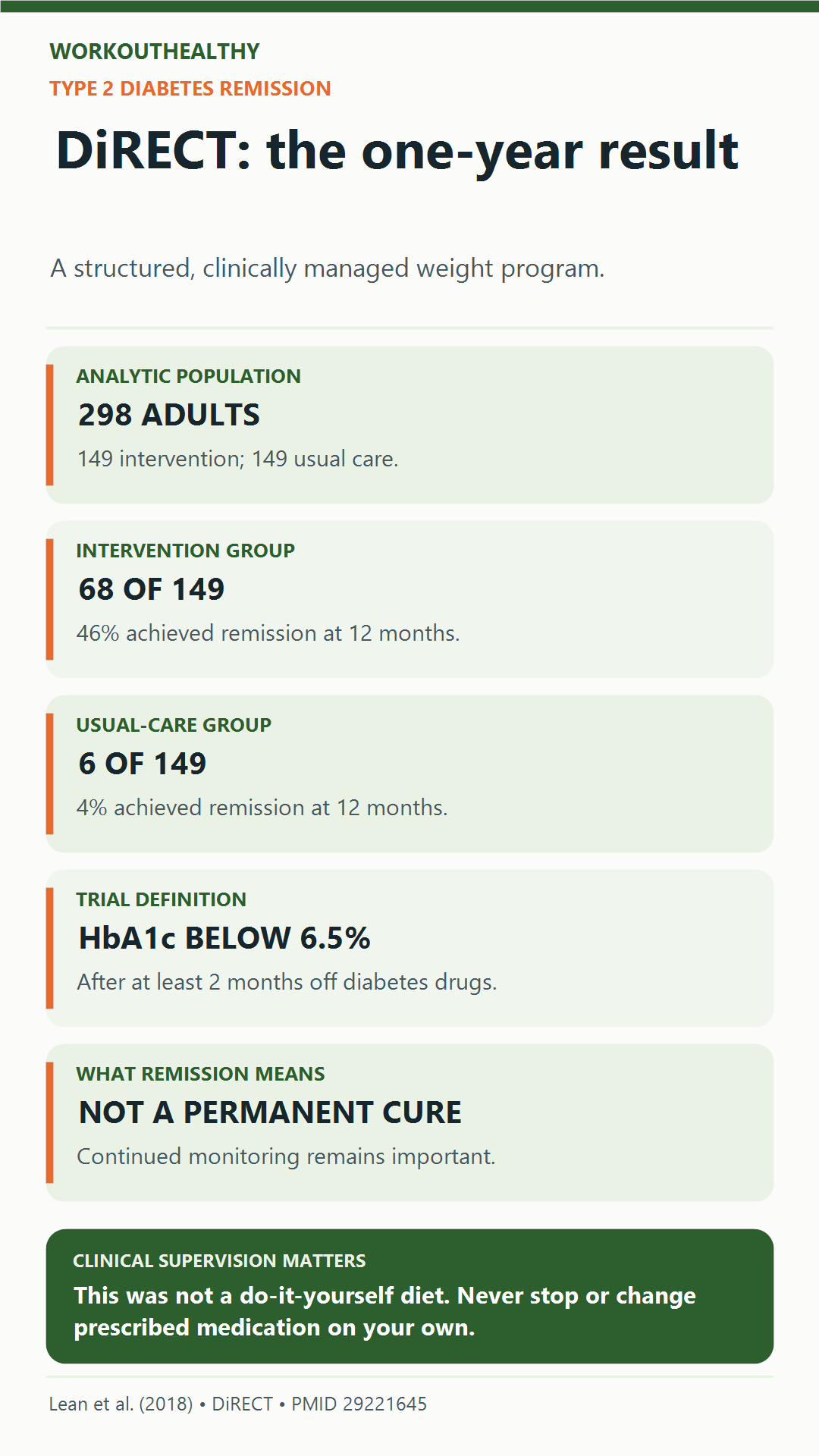
It defined remission as an HbA1c below 6.5 percent, off all glucose-lowering medication, sustained for a full twelve months.
HbA1c is a blood test that reflects average blood sugar over roughly the past three months.
Remission is not automatically permanent once it happens.
Blood sugar can rise again later, especially if lost weight comes back.
This is exactly why researchers avoid promising anyone a lasting cure.
It is also why this article uses the word “remission” instead of “reverse” throughout.
What the Real Research Shows
The DiRECT Trial: Weight Loss and Remission
The strongest evidence on diabetes remission comes from a UK study called DiRECT.
Researchers enrolled 298 adults with type 2 diabetes through their regular primary care doctors (Lean et al., 2018).
Half followed a structured weight management program, and half received standard diabetes care.
The weight management group started with a low-calorie formula diet for three to five months.
They then reintroduced regular food gradually, with ongoing support to help keep the weight off.
After twelve months, 45.6 percent of that group reached diabetes remission.
Only 4 percent of the standard care group reached remission in the same period.
How much weight a person lost made a very clear difference.
Among people who lost 15 kilograms or more, about 86 percent achieved remission.
People who lost 10 to 15 kilograms saw remission rates around 57 percent.
People who lost 5 to 10 kilograms saw remission rates around 34 percent.
That pattern is consistent and important.
More sustained weight loss meant a meaningfully better chance at remission.
Smaller weight loss still helped some people, just fewer of them.
A five-year follow-up of the same participants tracked what happened over the longer term (Lean et al., 2024).
Remission rates fell as the years passed.
By year five, about 10 percent of the original weight management group were still in remission.
That compares with about 5 percent of the original standard care group.
People who kept receiving structured support after the first two years did somewhat better.
Roughly 13 percent of that continued-support group were still in remission at year five.
Across the full five years, the weight management group spent an average of 27 percent of that time in remission.
The standard care group spent only about 4 percent of that time in remission.
This is the part a video titled “reverse” tends to leave out.
Remission is genuinely achievable for a meaningful number of people.
It usually takes real, sustained effort, and it can fade over time without continued support.
Exercise and Blood Sugar Control
Diet is not the only lever that matters for blood sugar.
A large 2024 meta-analysis pooled 126 studies covering more than 6,700 people with type 2 diabetes (Gallardo-Gómez et al., 2024).
Researchers looked at how different amounts and types of exercise affected HbA1c.
The biggest improvements showed up around 1,100 MET-minutes of activity per week.
In practical terms, that is roughly 244 minutes of moderate activity a week, like brisk walking.
It could also look like about 157 minutes of more vigorous exercise a week.
People who started with less controlled diabetes saw the largest HbA1c drops.
Some of those drops were over half a percentage point.
People closer to a healthy range saw smaller, but still real, improvements.
Walking is one of the simplest ways to reach those activity numbers, which lines up with our own coverage of how many miles you should walk a day.
Daily step counts matter for more than blood sugar specifically, including how daily steps relate to overall mortality risk.
Strength training plays a role here too, beyond just calories burned.
Building and keeping muscle can help the body use blood sugar more efficiently.
That is part of why lifting weights supports more than just muscle size.
Sleep and Blood Sugar Control
Sleep is the habit that gets the least attention in most diabetes videos.
A meta-analysis in Sleep Medicine Reviews looked at sleep and glycemic control specifically (Lee et al., 2017).
Researchers found a U-shaped pattern between sleep duration and HbA1c.
Short sleep was tied to HbA1c about 0.23 percentage points higher than normal sleep.
Long sleep was tied to HbA1c about 0.13 percentage points higher than normal sleep.
Poor sleep quality mattered even more than duration alone.
Poor quality sleep was linked to HbA1c about 0.35 percentage points higher.
These are averages across many studies, not a guarantee for any one person.
Still, the pattern is consistent enough that sleep deserves a real place on any daily habits list.
In the DiRECT trial, how much weight a person lost predicted remission far more reliably than any single food or habit on its own.
What This Evidence Does Not Prove
This research does not prove that everyone can achieve remission.
Most people in these studies did not reach remission, even with real effort and support.
It does not prove that any one daily habit works on its own.
The strongest results came from a structured, medically supervised program, not a checklist followed alone.
It does not prove remission is permanent once it happens.
The five-year DiRECT data show remission rates fall over time for many people.
It does not prove that diabetes medication is unnecessary or unsafe.
Medication remains an important tool for many people with type 2 diabetes.
Stopping medication without a doctor’s guidance can be dangerous.
Blood sugar that spikes without warning is a real medical risk.
One couple’s personal story, even a true one, is not the same as a controlled clinical trial.
Individual results always vary based on health history, genetics, and other conditions.
Common Mistakes People Make
One common mistake is trying an extreme, very low-calorie diet without medical supervision.
The DiRECT program was closely monitored by clinicians for safety.
Doing something similar alone can be risky, especially for people already on medication.
Another mistake is stopping diabetes medication as soon as blood sugar looks better.
Blood sugar can look fine for a while and still rise again later.
A third mistake is focusing only on food and ignoring exercise and sleep.
All three habits worked together in the research, not in isolation.
A fourth mistake is losing weight quickly in a way that also costs muscle.
Muscle loss can work against long-term blood sugar control rather than for it.
That tradeoff is worth understanding if you are also concerned about losing weight and muscle mass at the same time.
A fifth mistake is expecting one video’s success story to guarantee the same result for anyone else.
Who Should Check With a Doctor First
Anyone currently taking insulin or diabetes medication should talk to a doctor before changing diet or exercise habits.
Sudden changes can cause blood sugar to drop too low, which can become dangerous quickly.
People with a history of heart disease should also check in before starting a new exercise program.
Pregnant women with diabetes need specialized medical guidance, not general advice from a video.
Anyone with kidney disease should be especially cautious about very low-calorie diets.
People with a history of disordered eating should approach structured diet programs with professional support.
A doctor can order the right blood tests to actually track progress toward remission.

This is not something to guess at from home.
Practical Takeaway
Type 2 diabetes remission is a real, achievable goal for some people.
It usually requires meaningful, sustained weight loss, not a quick fix.
Exercise and sleep both appear to support blood sugar control alongside diet.
None of this replaces a conversation with your own doctor about your own situation.
The habits in the video are not inherently bad ideas.
The word “reverse” oversells what the science can currently promise.
“Remission” is the more honest word, and it still represents real hope backed by real data.
Watch the Original Video
Get the next evidence check.
Five practical fitness stories worth your time, every Friday.
One email a week. No product pitches. Unsubscribe in one click.
References
Lean, M. E. J., Leslie, W. S., Barnes, A. C., Brosnahan, N., Thom, G., McCombie, L., Peters, C., Zhyzhneuskaya, S., Al-Mrabeh, A., Hollingsworth, K. G., Rodrigues, A. M., Rehackova, L., Adamson, A. J., Sniehotta, F. F., Mathers, J. C., Ross, H. M., McIlvenna, Y., Stefanetti, R., Trenell, M., … Taylor, R. (2018). Primary care-led weight management for remission of type 2 diabetes (DiRECT): An open-label, cluster-randomised trial. The Lancet, 391(10120), 541 to 551. https://doi.org/10.1016/S0140-6736(17)33102-1
Lean, M. E. J., Leslie, W. S., Barnes, A. C., Brosnahan, N., Thom, G., McCombie, L., Kelly, T., Irvine, K., Peters, C., Zhyzhneuskaya, S., Hollingsworth, K. G., Adamson, A. J., Sniehotta, F. F., Mathers, J. C., McIlvenna, Y., Welsh, P., McConnachie, A., McIntosh, A., Sattar, N., & Taylor, R. (2024). 5-year follow-up of the randomised Diabetes Remission Clinical Trial (DiRECT) of continued support for weight loss maintenance in the UK: An extension study. The Lancet Diabetes & Endocrinology, 12(4), 233 to 246. https://doi.org/10.1016/S2213-8587(23)00385-6
Gallardo-Gómez, D., Salazar-Martínez, E., Alfonso-Rosa, R. M., Ramos-Munell, J., del Pozo-Cruz, J., del Pozo Cruz, B., & Álvarez-Barbosa, F. (2024). Optimal dose and type of physical activity to improve glycemic control in people diagnosed with type 2 diabetes: A systematic review and meta-analysis. Diabetes Care, 47(2), 295 to 303. https://doi.org/10.2337/dc23-0800
Lee, S. W. H., Ng, K. Y., & Chin, W. K. (2017). The impact of sleep amount and sleep quality on glycemic control in type 2 diabetes: A systematic review and meta-analysis. Sleep Medicine Reviews, 31, 91 to 101. https://doi.org/10.1016/j.smrv.2016.02.001
Medical disclaimer: This article is for general information only and is not medical advice. If you have an injury, ongoing pain, or a medical condition, talk to a doctor or physical therapist before you change how you train or eat.