

A YouTube Video Makes a Bold Claim About Exercise and Cancer
A video from Dr. Chovanec is spreading fast online right now.
Its title promises something big, that exercise can protect you against prostate cancer, and against nearly every other type of cancer too.
For anyone who has watched a parent, partner, or friend go through cancer treatment, a claim like that lands hard.
It also raises an obvious question.
Can something as simple and free as regular exercise actually change your odds of getting cancer, or is this just another health claim that sounds bigger than the science behind it?
What the Video Claims Exercise Does for Cancer Risk
The video frames exercise as one of the most powerful, and most overlooked, tools for lowering cancer risk.
It singles out prostate cancer specifically, then widens the claim to cover cancer risk in general.
The general argument goes like this: moving your body regularly changes your internal environment in ways that make it harder for cancer to take hold in the first place.
That includes lowering chronic inflammation, improving how your immune system finds and clears abnormal cells, and keeping hormones and body weight in a healthier range.
We were not able to independently verify Dr. Chovanec’s specific medical credentials or confirm that every claim in the video traces back to a named, published study.
So this article treats the video as a starting point and a framing, not as a citable source on its own.
What follows is what independent, peer reviewed research actually says about exercise and cancer risk.
The core idea behind videos like this one is simple. Movement is treated as medicine, something already sitting inside most people’s daily routine that could be doing more for cancer prevention than they realize.
What the Real Research Actually Shows
The good news is that the broad idea in the video is not far fetched.
A large 2025 review in the journal Cancers pulled together current evidence on physical activity and cancer across many cancer types.
It found that people with higher levels of moderate to vigorous physical activity had a lower risk of several major cancers compared to the least active people.
Colorectal cancer risk was about 19 to 24 percent lower among more active people.
Postmenopausal breast cancer risk was about 13 percent lower.
Endometrial cancer risk was 20 to 27 percent lower, and liver cancer risk was about 27 percent lower.
Across cancers overall, the more active group showed roughly a 10 to 20 percent lower risk.
A separate 2024 update published in the British Journal of Cancer looked specifically at how physical activity connects to cancer prevention, treatment, and recovery.
It reported that comparing the highest and lowest levels of leisure time physical activity was linked to a relative cancer risk reduction of about 8 to 25 percent, with the strongest evidence for bladder, breast, colon, endometrial, esophageal, stomach, and kidney cancers.
Prostate cancer specifically has its own research too.
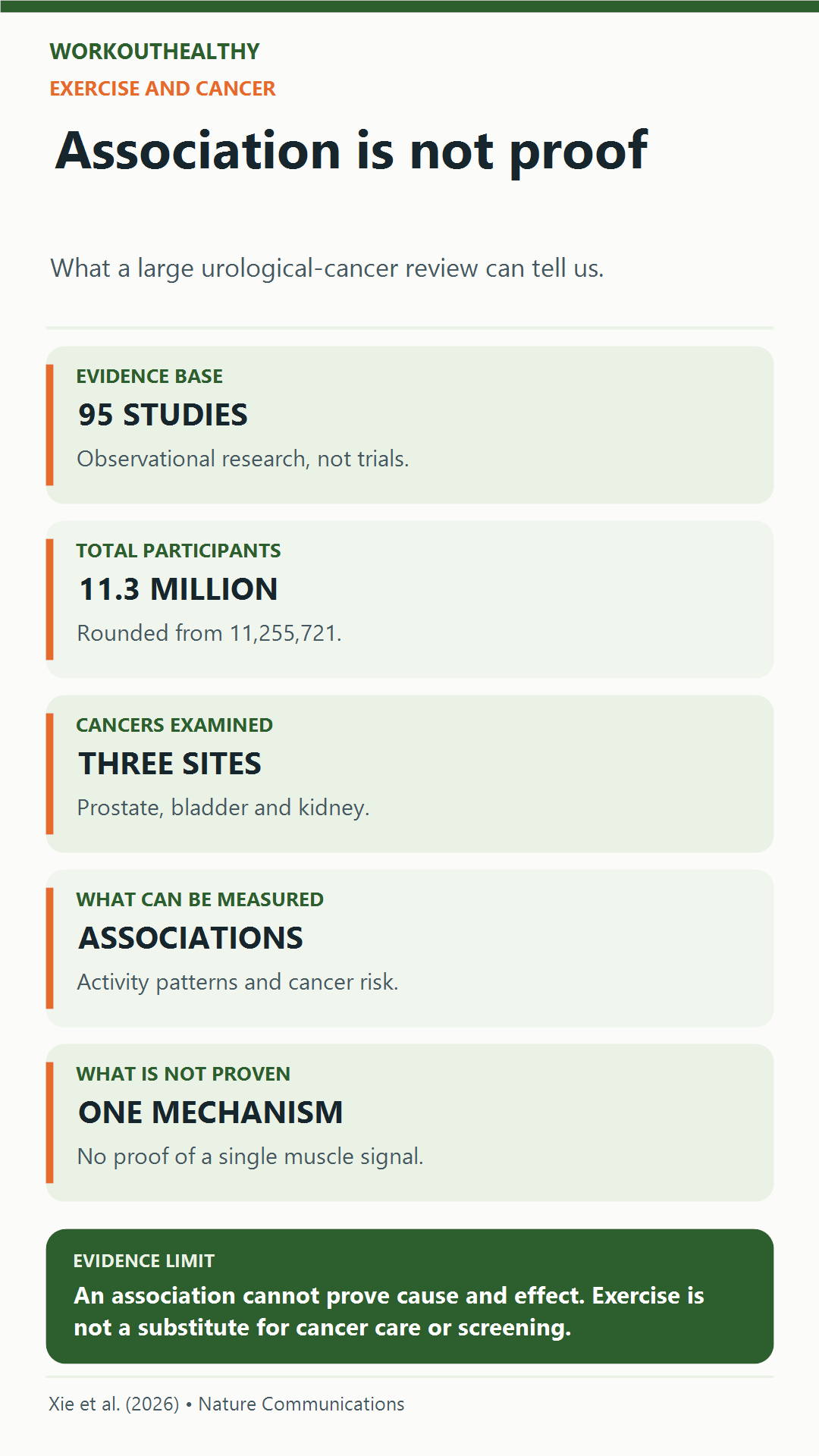
A 2026 meta analysis in Nature Communications combined 95 studies covering more than 11 million people and looked at physical activity and several urological cancers, prostate cancer included.
It found that people with high physical activity levels had about a 13 percent lower risk of prostate cancer than people with low activity levels.
That same analysis found the protective link was somewhat stronger for job related physical activity than for recreational exercise, and stronger in case control studies than in long running cohort studies, which is a useful reminder that not every study measures this the same way.
So the direction of the video’s claim on prostate cancer specifically holds up against real data, even if the exact number differs from whatever was said on camera.
As for why exercise would do this, researchers point to several overlapping mechanisms rather than one single switch.
Regular activity helps regulate insulin and blood sugar, which matters because chronically high insulin levels can promote cell growth in ways that favor tumor development.
It also helps regulate sex hormones like estrogen, which is part of why the effect shows up so clearly in hormone sensitive cancers like breast and endometrial cancer.
Exercise appears to reduce chronic low grade inflammation in the body as well.
Persistent inflammation is one of the environments in which abnormal cells are more likely to survive and multiply.
On top of that, physical activity seems to boost immune surveillance, the body’s ongoing patrol system that looks for and destroys cells that have started behaving abnormally.
Cardiorespiratory fitness itself, the kind measured by something as simple as a stair climbing test, has repeatedly been linked to better long term health outcomes, which fits the same overall pattern.
None of these mechanisms act alone, and researchers are still working out exactly how much each one contributes.
What This Evidence Does Not Prove
It is worth being honest about the limits here, because the video’s framing can make this sound more certain than it is.
First, most of this evidence comes from observational studies, meaning researchers tracked large groups of people over time and compared cancer rates between the more active and less active groups.
That kind of study can show a strong association, but it cannot prove, on its own, that exercise directly caused the lower cancer rate in every single person.
People who exercise more also tend to smoke less, eat differently, and see doctors more regularly, and researchers try to adjust for that, but it is never a perfect fix.
Second, exercise is not a guarantee against cancer for any individual person.
A 13 percent or 20 percent lower risk is a population level number, not a personal promise.
Plenty of people who exercise regularly still develop cancer, because genetics, environmental exposures, and simple chance all play a role too.
Third, and this matters a lot, exercise cannot treat cancer that already exists on its own.
Once cancer is diagnosed, exercise can be a genuinely valuable part of supportive care, but it is not a replacement for surgery, chemotherapy, radiation, or whatever a treatment team recommends.
Framing exercise as a cure, rather than as one part of prevention and supportive care, goes well beyond what any of this research actually shows.
Common Mistakes People Make With This Information
The biggest mistake is treating exercise as a substitute for cancer screening.
Being active does not remove the need for PSA testing conversations, mammograms, colonoscopies, or other screening your doctor recommends based on your age and risk factors.
A second common mistake is assuming that more exercise is always better.
The 2026 urological cancer meta analysis noted specifically that the highest amount of physical activity was not always associated with the greatest benefit, suggesting the relationship flattens out rather than climbing forever.
A third mistake is treating one video, however well produced, as equivalent to the full body of published research on a topic.
A single source can highlight something real and still overstate it, soften the caveats, or skip past the studies that complicate the story.
A fourth mistake is waiting for a diagnosis before starting to move more.
The protective association shows up most clearly in people who were already active well before any diagnosis, not people who start after the fact.
Who Should Talk to a Doctor Before Increasing Exercise
Most healthy adults can safely increase their activity level without medical clearance first.
Some situations genuinely call for a conversation with a doctor before ramping things up.
Anyone currently in active cancer treatment, including chemotherapy, radiation, or recovery from recent cancer surgery, should get an exercise plan approved by their oncology team first.

Treatment can affect blood counts, bone strength, heart function, and energy levels in ways that change what kind of exercise is safe on a given week.
People with known bone metastases need guidance on which movements to avoid, since certain loads can raise fracture risk.
People with lymphedema following cancer surgery, especially after lymph node removal, should get individualized advice on resistance training rather than guessing.
Anyone with new, unexplained symptoms, like unexplained weight loss, blood in urine or stool, a new lump, or persistent unusual fatigue, should see a doctor before anything else.
Exercise is never the right first response to a symptom that needs medical evaluation.
People with uncontrolled heart disease, uncontrolled high blood pressure, or significant joint or orthopedic limitations should also check in with a doctor before starting a more intense routine.
General Exercise Guidelines for Lowering Cancer Risk
For most healthy adults, the general target lines up with standard physical activity guidelines used across major health organizations.
That usually means about 150 to 300 minutes of moderate intensity aerobic activity per week, or roughly half that amount if the activity is more vigorous.
On top of that, muscle strengthening activity on two or more days a week is generally recommended alongside the aerobic work.
Walking remains one of the most accessible ways to start, and it counts fully toward these totals.
If you are wondering how much walking is actually enough on a daily basis, this breakdown of daily walking guidelines is a reasonable place to start.
Consistency matters more than intensity for someone just beginning.
Even simply tracking and gradually raising your daily step count has been linked to meaningfully lower mortality risk in large population studies, separate from the cancer specific data above.
Cutting down on long stretches of uninterrupted sitting also seems to matter on its own, and breaking up sitting time throughout the day is a simple habit worth adding alongside a regular workout routine.
None of this requires expensive equipment or a gym membership to start.
What the research consistently rewards is showing up regularly over months and years, not any single dramatic workout.
Watch the Original Video
Want more like this? Subscribe to WorkoutHealthy Insider for practical explanations behind popular fitness claims.
References
Kruk, J., Aboul-Enein, B. H., Golebiewska, M. E., Duchnik, E., Czerniak, U., & Marchlewicz, M. (2025). Physical activity and cancer incidence and mortality: Current evidence and biological mechanisms. Cancers, 17(9), 1410. https://doi.org/10.3390/cancers17091410
Xie, F., Xie, C., Yue, H., Cui, J., Ma, J., Xu, J., & Yao, F. (2026). The association of physical activity with urological cancer risk: A systematic review and meta-analysis. Nature Communications, 17(1), 3949. https://doi.org/10.1038/s41467-026-70149-0
Yang, L., Courneya, K. S., & Friedenreich, C. M. (2024). The Physical Activity and Cancer Control (PACC) framework: Update on the evidence, guidelines, and future research priorities. British Journal of Cancer, 131(6), 957 to 969. https://doi.org/10.1038/s41416-024-02748-x
This article is for general information only and is not medical advice. If you have an injury, ongoing pain, or a medical condition, talk to a doctor or physical therapist before you change how you train or eat.