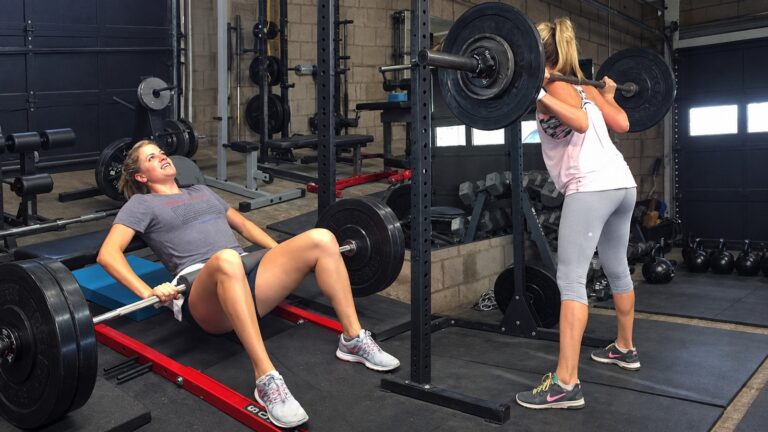

Flow High Performance put out a video called Differences Between Strength vs Hypertrophy Training, and it lands right on a question that trips up a lot of people in the gym.
Should you lift heavy for just a few reps? Or should you do more reps with a lighter weight?
The video draws a clear line between training for strength and training for what trainers call hypertrophy, which is simply the technical word for muscle growth.
This article checks that line against real, peer reviewed research to see what the science actually supports.
What Strength Training and Hypertrophy Training Actually Mean
Strength training usually means lifting a heavy weight for a small number of reps, often somewhere between one and five reps per set.
The goal is simple. You want to move as much weight as possible.
Most strength focused sets sit close to your one rep max, which is the heaviest weight you can lift one single time with good form.
Hypertrophy training aims at muscle size instead of maximum force.
It typically uses moderate loads, often six to twelve reps per set, and it usually adds up to more total sets across a workout.
Rest periods differ too.
Strength work often uses longer rests, sometimes three to five minutes, so the muscles and nervous system can recover before the next heavy set.
Hypertrophy training often uses shorter rests, closer to thirty seconds to ninety seconds, which keeps the muscle under more overall stress.
Both styles sit on the same continuum, not in separate boxes.
A lot of real programs blend both approaches depending on the week or the exercise.
The load on the bar decides how your body adapts, but the two goals overlap more than most gym talk admits.
Why Heavy and Light Loads Push Your Body in Different Directions
To understand why rep ranges matter, it helps to know three ideas researchers use to explain muscle adaptation: mechanical tension, motor unit recruitment, and metabolic stress.
Mechanical tension is just the physical strain a muscle feels when it works against a heavy load.
Lifting a weight close to your max creates a large amount of this tension, and tension is one of the strongest known signals for both strength and muscle growth.
Motor unit recruitment is how your nervous system decides how many muscle fibers to activate for a given task.
A motor unit is a nerve cell plus every muscle fiber it controls, and your body activates more of them, including the biggest and strongest ones, when a task demands more force.
Heavy strength training recruits a high percentage of these units almost right away, because the weight is close to your max from the very first rep.
This pattern follows a well established rule in exercise physiology called the size principle, which says your body calls in smaller motor units first and only activates the biggest, strongest ones once a task gets demanding enough to need them.
Metabolic stress is the burning, pumped feeling you get from doing many reps in a row.
It comes from byproducts that build up in the muscle during higher rep sets, and researchers believe it adds its own separate signal for muscle growth.
In a landmark 2010 review, exercise scientist Brad Schoenfeld laid out mechanical tension, muscle damage, and metabolic stress as the three primary mechanisms behind hypertrophy, and that framework still shapes how coaches think about training today (Schoenfeld, 2010).
Because heavy, low rep sets rely mostly on tension and fast motor unit recruitment, they tend to build maximum strength most efficiently.
Because moderate, higher rep sets combine solid tension with more metabolic stress and more total time under load, they tend to be very effective for muscle size.
What a Closer Look at the Research Shows
The idea that heavy weight is best for strength and moderate weight is best for size has been tested directly, not just assumed.
In 2017, Schoenfeld and colleagues published a systematic review and meta-analysis comparing low load and high load resistance training across multiple studies (Schoenfeld et al., 2017).
They found that high load training, generally over 60 percent of a person’s one rep max, produced meaningfully greater strength gains than low load training.
Muscle growth, on the other hand, was fairly similar between the two loading styles when total training volume was matched.
A larger 2021 network meta-analysis added more precision to this picture.
Lopez and colleagues reviewed a wide range of resistance training studies and found that high loads, roughly 80 percent of one rep max or more, produced the biggest strength improvements of any load range tested (Lopez et al., 2021).
For muscle hypertrophy, though, the same review found no significant difference between low, moderate, and high loads, as long as sets were taken close to failure.
Put simply, heavier weight appears to have a real edge for building strength.
For building muscle size, a wide range of rep ranges can work, as long as the effort and total volume are high enough.
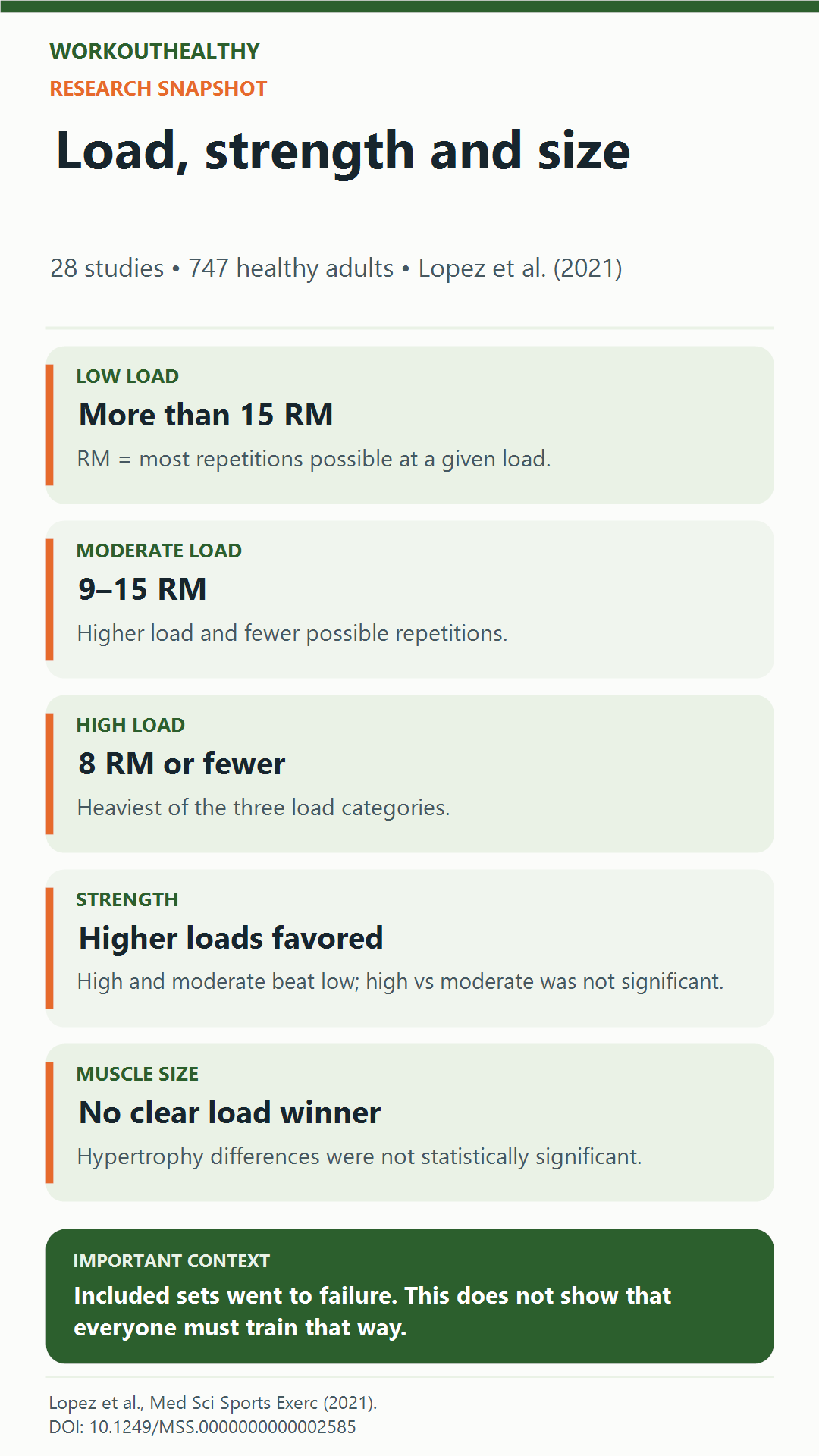
Heavier loads reliably build more strength, but multiple rep ranges can build similar amounts of muscle when the effort is real.
What This Research Does Not Prove
None of this means one rep range is the only correct way to train.
These studies report averages across groups of people, and individual results varied a fair amount even within the same study.
Genetics play a real role in how fast someone builds muscle or strength, and researchers cannot fully control for that in a lab setting.
Training experience matters too.
Lopez and colleagues noted that people newer to lifting tended to gain more muscle overall than people with years of training experience, regardless of the load used (Lopez et al., 2021).
Most of the underlying studies also lasted a limited number of weeks, often eight to twelve, so they cannot tell us much about what happens over years of training.
The line between strength training and hypertrophy training is also blurrier in real life than it looks on a whiteboard.
Getting stronger almost always builds some muscle, and building muscle almost always makes you somewhat stronger, because the two adaptations share a lot of the same underlying biology.
So think of this evidence as showing a general tendency, not a rigid rule that applies exactly the same way to every single person.
This helps explain a training idea called specificity, which says your body adapts most to whatever exact demand you repeatedly place on it.
Since heavy sets repeatedly demand near maximal force, they tend to build that specific quality, raw strength, more efficiently than lighter sets do.
Common Mistakes People Make Chasing Strength or Size
One common mistake is training too far from failure.
Both strength and hypertrophy training depend on real effort, and sets stopped many reps short of failure tend to produce weaker results for either goal.
Another mistake is jumping to heavy weight before technique is solid.
Poor form under a heavy load raises injury risk without necessarily adding useful tension to the muscle you are trying to train.
A third mistake is ignoring total volume.
Doing one heavy set and calling it a workout usually is not enough stimulus for either strength or size, since most of the supporting research uses multiple sets per exercise.
Some people also change their program too often, jumping between rep ranges every week without ever building real momentum in one direction.
Progress in both strength and hypertrophy tends to reward consistency over a period of months, not constant switching.
A fifth mistake is skipping recovery.
Muscles actually repair and grow during rest, not during the workout itself, so too little sleep or too few rest days can blunt progress toward either goal.
Finally, some lifters copy a rep range they saw in a single video or post without checking whether it actually matches their own goal.
Who Should Check With a Doctor or Trainer First
Heavy strength training puts real load on joints, tendons, and the cardiovascular system, so it is not automatically the right starting point for everyone.
Anyone with an existing joint issue, such as a bad shoulder, knee, or lower back, should get guidance before loading up a barbell close to their max.
People with a heart condition or high blood pressure should also talk to a doctor first, since very heavy lifting can briefly spike blood pressure during a lift.
Beginners with limited coaching or shaky form are usually better off learning technique at a lighter, hypertrophy style load before chasing low rep maxes.
Anyone recovering from a recent injury or surgery should get clearance from a physical therapist or doctor before returning to either style of heavy training.
A qualified trainer can also help you choose a rep range that matches your actual goal, your joints, and your current experience level, instead of just copying a routine from a video.
A Simple Way to Structure Sets and Reps for Each Goal
If your main goal is strength, a common structure is three to five sets of one to five reps, using a weight that feels genuinely challenging by the last rep or two.
Rest two to five minutes between sets so you can lift with full effort each time.
If your main goal is muscle size, a common structure is three to four sets of six to twelve reps, again taken close to failure.
Rest closer to sixty to ninety seconds between sets, which keeps the workout efficient without sacrificing effort.
Many programs combine both approaches, using heavier, lower rep work on a main lift like a squat or a floor press, similar to the loading patterns discussed in our floor press versus bench press comparison, and then adding moderate rep accessory work afterward.
This kind of split lets you chase strength on your biggest lifts while still getting enough volume for muscle growth elsewhere in the workout.
If you are unsure where to start, our breakdown of a famous rep range quote from Arnold Schwarzenegger looks at how even elite bodybuilders often mixed rep ranges rather than sticking to just one.
It is also worth remembering that hypertrophy is not limited to traditional weightlifting, and other training styles can trigger real muscle growth too, which our article on whether box jumps can build muscle explores in more detail.
Whichever structure you choose, tracking your sets, reps, and weight over time is the simplest way to know if your training is actually working.

A simple sign that it is time to add weight is finishing every set with a rep or two left in the tank for two workouts in a row.
Watch the Original Video
Want more like this? Subscribe to WorkoutHealthy Insider for practical explanations behind popular fitness claims.
References
Schoenfeld, B. J. (2010). The mechanisms of muscle hypertrophy and their application to resistance training. Journal of Strength and Conditioning Research, 24(10), 2857 to 2872. https://doi.org/10.1519/JSC.0b013e3181e840f3
Schoenfeld, B. J., Grgic, J., Ogborn, D., & Krieger, J. W. (2017). Strength and hypertrophy adaptations between low- vs. high-load resistance training: A systematic review and meta-analysis. Journal of Strength and Conditioning Research, 31(12), 3508 to 3523. https://doi.org/10.1519/JSC.0000000000002200
Lopez, P., Radaelli, R., Taaffe, D. R., Newton, R. U., Galvão, D. A., Trajano, G. S., Teodoro, J. L., Kraemer, W. J., Häkkinen, K., & Pinto, R. S. (2021). Resistance training load effects on muscle hypertrophy and strength gain: Systematic review and network meta-analysis. Medicine and Science in Sports and Exercise, 53(6), 1206 to 1216. https://doi.org/10.1249/MSS.0000000000002585
This article is for general information only and is not medical advice. If you have an injury, ongoing pain, or a medical condition, talk to a doctor or physical therapist before you change how you train or eat.