
Is walking cardio? Yes, walking can count as aerobic exercise when the effort raises your breathing and heart rate enough for you.
An easy stroll or an indoor march may still be useful movement, but the label “walking” alone does not tell you whether that session reached moderate intensity.
A low-impact indoor walking workout can fit that definition without running or jumping. This guide gives a personal effort check and a 20-minute, small-space example with standing and chair-supported options.
When Does Walking Count as Cardio?
The CDC’s talk test gives a quick personal check: at moderate effort you can talk, but singing would be difficult. The CDC also describes moderate relative effort as about 5 or 6 on a 0-to-10 scale, where sitting is 0 and maximal effort is 10.
| During your walk | Practical interpretation | What to try |
|---|---|---|
| You can sing easily and breathing barely changes. | The current version may be light for you, although it still gets you moving. | If appropriate, add a little pace, larger comfortable steps, or gentle arm movement. |
| You can talk but cannot comfortably sing. | This is the CDC’s rule-of-thumb moderate range for many people. | Keep the movement controlled and use the effort that fits your condition. |
| You can say only a few words before a breath. | Effort may be vigorous rather than moderate. | Slow down or choose the supported option if moderate activity is your goal. |
The test applies to your effort, not a universal video speed. Low impact describes the absence of jumping and hard landings; it does not automatically mean low heart-and-lung effort.
A 20-Minute Indoor Walking Example
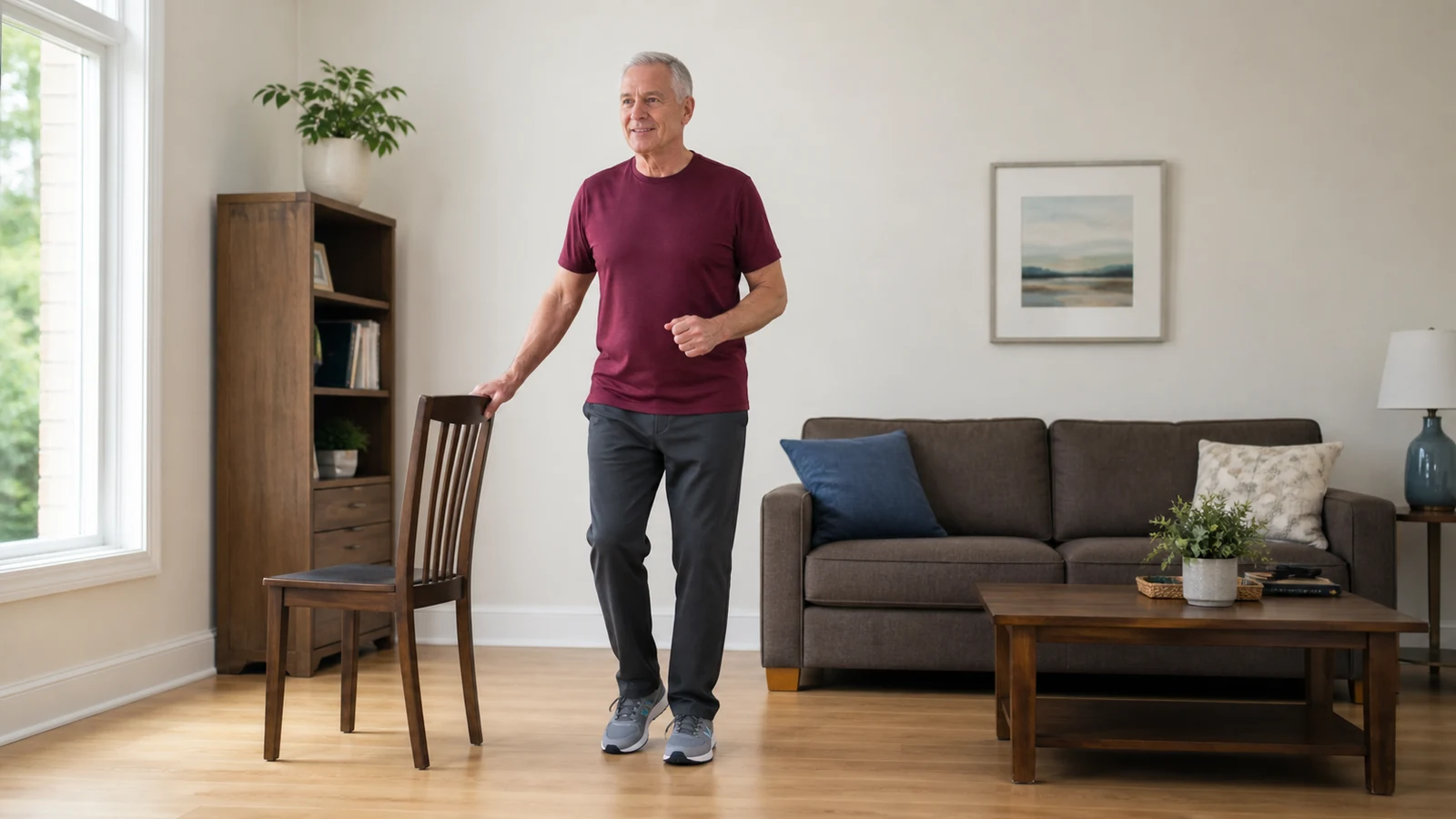
The table is an original small-space adaptation, not a minute-by-minute transcript of the Improved Health video below. Clear the floor, use a stable chair or counter only if it cannot slide, and choose a movement that feels controlled.
| Minutes | Standing option | Chair-supported or seated option | Effort check |
|---|---|---|---|
| 0-2 | Easy march in place. | March holding a stable support or seated alternating knee lifts. | Warm up at an easy pace. |
| 2-4 | Comfortable side steps with a natural arm swing. | Supported side steps or seated alternating foot taps. | Breathing may start to rise. |
| 4-6 | Brisk march with small, comfortable arm movements. | Supported march or faster seated marching if appropriate. | Try the talk test. |
| 6-8 | Alternate four forward steps and four back in a clear space. | Keep marching in place or tap one foot forward at a time. | Stay controlled when changing direction. |
| 8-10 | Return to side steps with an optional easy arm reach. | Supported side steps or seated side taps. | Reduce range if joints object. |
| 10-12 | Brisk march at your own moderate effort. | Supported or seated march at an effort you can manage. | Talk but not sing is a useful target, not a mandate. |
| 12-14 | Small back steps alternating legs, then easy march. | Keep marching or alternate seated heel taps. | Maintain balance before speed. |
| 14-16 | Side steps or an easy figure-eight around open floor space. | Supported side steps or seated alternating taps. | Skip turns if balance is uncertain. |
| 16-18 | Your favorite comfortable march or step pattern. | Choose the supported or seated pattern that feels best. | Check breathing again and adjust. |
| 18-20 | Ease into a slower march, then stop. | Slow supported steps or seated marching. | Cool down gradually. |
Seated and supported options change the amount of work, so do not assume they provide the same aerobic dose as brisk overground walking. Use the talk test and your response rather than counting every two-minute block automatically as moderate cardio.
Why 100 Steps per Minute Is Not an Indoor Rule
Slaght and colleagues’ 2017 systematic review retained 31 English-language articles on adult and older-adult walking cadence. About 100 steps per minute was a general moderate-intensity guide, with potentially higher cadences for older adults; cadence-prescription intervention studies were few. This review-level guidance does not establish your cadence target or the effects of this indoor sequence.
A review of walking-cadence studies discusses about 100 steps per minute as a practical population-level sign of moderate-intensity ambulatory walking. That means people actually walking across ground, where stride and body movement differ from marching in place.
The older version of this article prescribed 100 to 110 steps per minute for its indoor march. The cited research did not validate that threshold for in-place marching, chair stepping, or the specific video, so this guide uses relative effort instead.
Step count can still help you notice whether you are moving more or less than usual. It cannot by itself tell every person whether an indoor session met the moderate-intensity guideline.
What the Research Shows, and Its Limits
For weekly health guidance, the CDC recommends adults aim for at least 150 minutes of moderate aerobic activity and two days of muscle-strengthening activity. A 20-minute walk that reaches a suitable moderate effort can contribute to that aerobic total, while a light session remains worthwhile movement.
The knee-osteoarthritis and mood reviews below summarize broader aerobic and walking programs. Their pooled results do not provide an outcome estimate for this particular Improved Health video or the original indoor example above, and cannot guarantee an individual response.
| Evidence | What it found | What it cannot prove about this video |
|---|---|---|
| 2025 knee-osteoarthritis review, five randomized trials and 459 participants. | Aerobic programs including walking, cycling, stepping, and aquatic activity produced average improvements in fitness and six-minute walking distance versus controls. | That every person with knee pain should use an indoor march, or that it will be pain-free. |
| 2024 walking and mood review, 44 depression and 26 anxiety comparisons. | Walking programs reduced average symptoms relative to inactive controls; study designs varied substantially. | That one 20-minute video treats a mood disorder or is superior to other active exercise. |
| 2018 cadence review. | About 100 steps per minute is an approximate ambulatory-walking intensity heuristic. | A validated speed target for marching in place or seated steps. |
If knee or hip symptoms worsen during a session, shorten the bout, change the movement, or stop instead of pushing through pain. A clinician or physical therapist can help if persistent symptoms or a recent procedure change what walking is appropriate for you.
Common Indoor-Walking Mistakes
Chasing a step count borrowed from outdoor walking is one mistake. The pace, space, arm movement, and support option all change effort, so check your breathing instead.
Another is treating every side step or turn as a balance challenge you must copy exactly. Keep the floor clear, slow the direction change, and use the supported or seated option when needed.
Finally, a low-impact label does not make sharp pain, dizziness, chest pain, or unusual breathlessness something to ignore. Stop and seek appropriate medical advice for concerning symptoms.
Watch the Original 20-Minute Video
For related context, read our guides to walking distance and changing a sitting-heavy workday. These cover separate decisions from whether today’s indoor effort counts as moderate cardio.
Get the next evidence check. Subscribe to WorkoutHealthy Insider for practical explanations behind popular fitness claims.
References
Centers for Disease Control and Prevention. How to measure physical activity intensity and Adult activity guidelines.
Slaght, J., Sénéchal, M., Hrubeniuk, T. J., Mayo, A., & Bouchard, D. R. (2017). Walking cadence to exercise at moderate intensity for adults: A systematic review. Journal of Sports Medicine, 2017, Article 4641203. https://doi.org/10.1155/2017/4641203.
Tudor-Locke, C., et al. (2018). How fast is fast enough? Walking cadence as a practical estimate of intensity in adults. British Journal of Sports Medicine.
Su, S., et al. (2025). Effect of aerobic exercise on cardiopulmonary fitness among people with knee osteoarthritis. BMC Musculoskeletal Disorders.
Xu, Z., et al. (2024). The effect of walking on depressive and anxiety symptoms. JMIR Public Health and Surveillance.
This article is for general fitness information and is not medical advice. If you have an injury, ongoing pain, or a medical condition, ask a doctor or physical therapist which activity suits you.