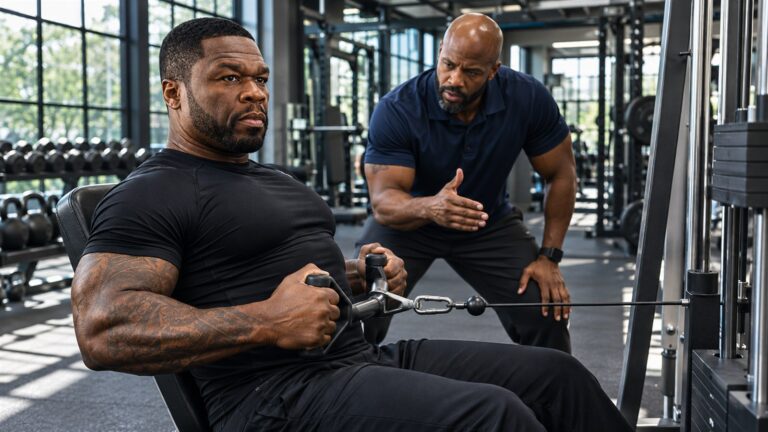

Animal movement exercises use crawls, low squats, and floor transitions to practice coordination and controlled joint motion. This beginner circuit uses five moves from the Strength Side and GMB video: bear walk, frog hop, duck walk, sumo frog, and crab walk.
Start with a short learning round and choose the wrist, knee, or floor-access swaps below whenever a pattern does not feel right. This is an editorial routine, not the 60-minute class tested in the research.
A Five-Move Beginner Circuit
Clear a small nonslip space and start with one easy pass through the table. Rest until you can move deliberately again; speed is optional and is not the point of the first session.
| Move | Starter practice | Use this swap if needed |
|---|---|---|
| Bear walk | Take 3 to 5 small steps forward, then reset. | Hands-and-knees crawl or standing opposite-arm-and-leg march for wrist or floor limits. |
| Frog hop | Make 2 to 4 small, quiet hops or steps from a comfortable squat. | Step rather than jump; use a supported squat if the floor or impact is uncomfortable. |
| Duck walk | Take 3 to 5 small steps at a controllable squat depth. | Stand between steps or do chair sit-to-stands if a sustained low squat bothers your knees. |
| Sumo frog | Practice 2 to 4 slow wide-stance transitions without forcing depth. | Hold a stable support for a comfortable wide-stance partial squat. |
| Crab walk | Take 3 to 5 short steps with the hips lifted only as far as comfortable. | Seated hip lifts or standing hip extension if wrist or floor loading is unsuitable. |
The counts are a simple way to keep a first try brief; they are editorial examples, not doses established by the cited studies. You can omit a move and still practice the others.
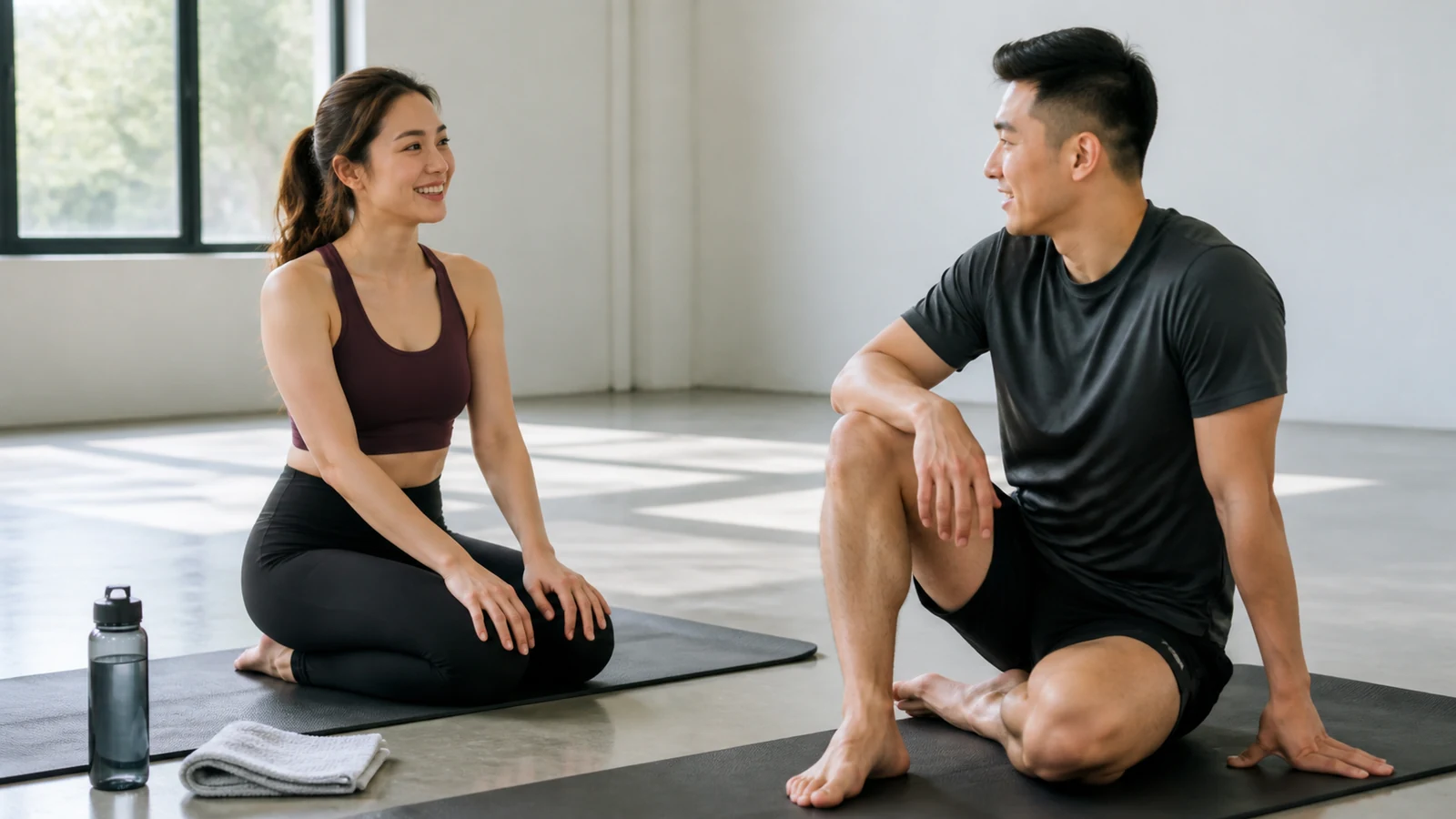
How to Do and Modify the Five Moves
Bear walk
Put your hands under your shoulders and your feet behind you, with knees close to the floor. Take a small step with one hand and the opposite foot while keeping the torso steady.
Pause if wrists or shoulders feel strained. Hands-and-knees crawling reduces the load, while a standing cross-body march keeps the coordination task without floor contact.
Frog hop
Start in a squat depth you can control, place your hands ahead of you, and move the feet forward a small distance. Stepping the feet instead of hopping removes the landing impact.
Keep each landing or step quiet and controlled. If a squat or jump provokes knee pain, use a supported squat or omit this pattern.
Duck walk
Lower into a comfortable squat and take small steps while you can keep your balance. The goal is to control the range you have today, not to stay as low as the demonstrator.
Stand up between steps if the sustained bend becomes uncomfortable. A chair sit-to-stand is a practical no-floor substitute.
Sumo frog
Take a wider stance and move through the wide-legged squat pattern shown in the video. Keep the hip position comfortable and use your hands only as much as balance and control require.
A supported, shallow wide-stance squat keeps the basic leg movement with less floor demand. Avoid forcing a deep hip stretch or jumping ahead to faster transitions.
Crab walk
Sit with feet planted and hands behind you, then lift your hips a little. Move one hand and the opposite foot in small steps without forcing your shoulders backward.
If wrist extension or floor access is a problem, use a seated hip lift or supported standing hip extension instead. Those substitutes are different exercises, not equivalent tests of crab-walk skill.
A Two-Week Practice Example
The plan below is a way to learn the sequence while watching how your joints respond. It is not a dose shown to improve mobility, prevent falls, or replace other strength and aerobic training.
| When | Practice | Decision before progressing |
|---|---|---|
| First few sessions | One easy pass, 2 or 3 days apart; use the table’s starter counts and rest as needed. | Can you finish with controlled steps and no sharp or lingering joint pain? |
| Later sessions | If the first sessions felt manageable, add a second pass or a few steps to one movement, but not both at once. | If form becomes rushed or joints object, return to the earlier version or the swap. |
The suggested spacing and progression are editorial examples, not a copy of the research protocol. If you have an active wrist, shoulder, hip, or knee problem, ask a qualified clinician or physical therapist about an appropriate starting variation.
What Animal-Movement Research Actually Tested
Animal-inspired movement is a general exercise category. Animal Flow is a specific branded system, so this five-move video circuit should not be described as an official Animal Flow class.
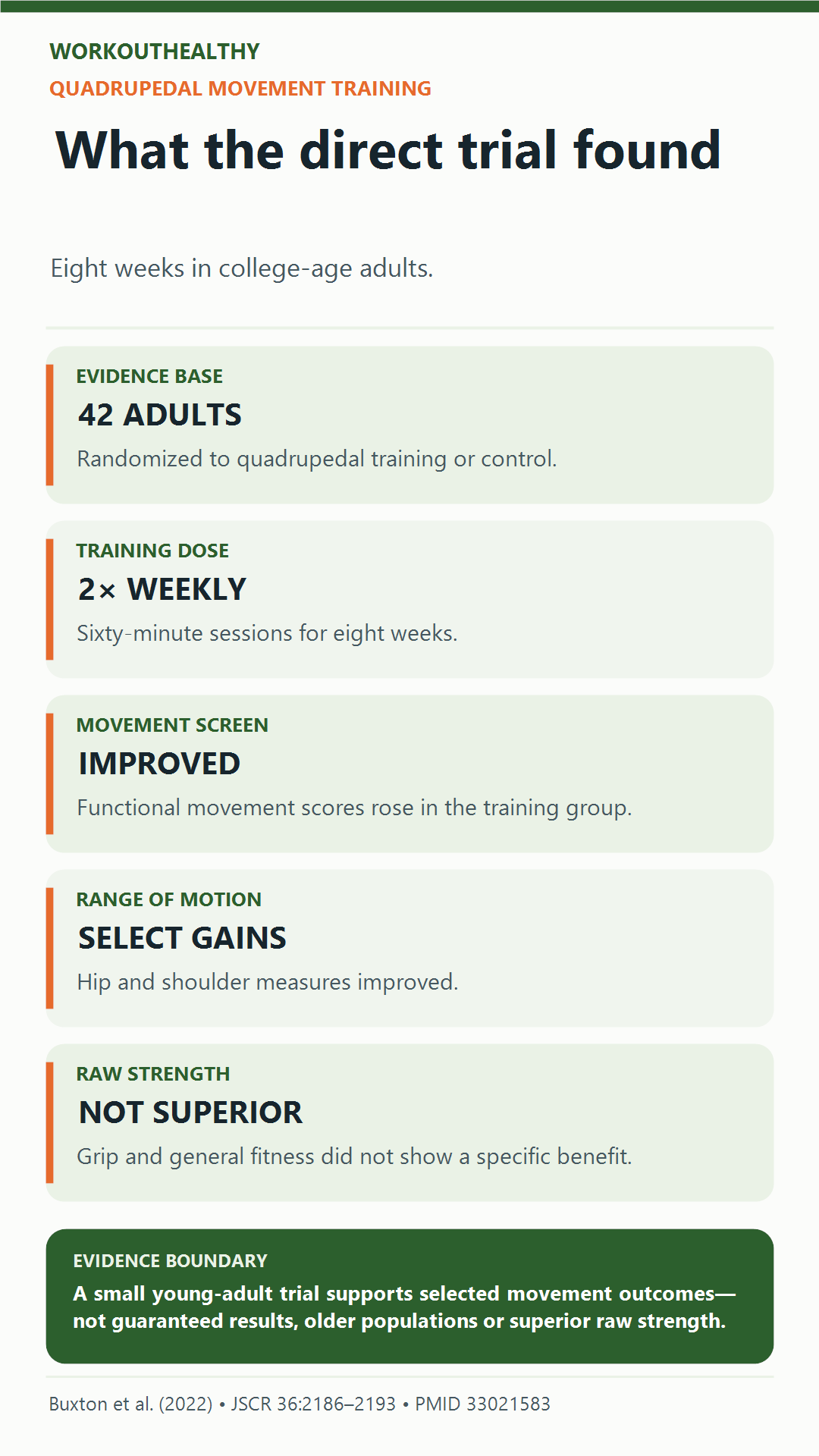
In a randomized study of 42 active college-age adults, the training group added 60-minute quadrupedal movement classes twice a week for eight weeks to its regular activity. Relative to controls, it improved Functional Movement Screen scores and selected active hip and shoulder ranges of motion.
The study did not find a between-group advantage for dynamic balance, handgrip strength, or push-up endurance. It did not test the five-move home circuit above, older adults, injured readers, or falls.
A separate energy-use comparison studied 30 participants during a full 60-minute Animal Flow session. Its average of 6.7 calories per minute cannot be applied to a brief, stop-and-start beginner round.
| Claim | What the studies support | What remains untested here |
|---|---|---|
| Mobility | Selected movement-screen and joint-range gains after eight weeks of full classes in active young adults. | How much a brief five-move home circuit changes those measures. |
| Cardio or calories | Moderate average energy cost during a 60-minute branded session in participants. | Calories or aerobic benefit from this short practice with rest and swaps. |
| Strength, balance, and falls | The eight-week study did not show a between-group advantage for its balance or upper-body strength tests. | Fall prevention or outcomes in older adults, which should not be inferred from other exercise programs. |
Choose these moves for variety if you enjoy them, and keep separate time for walking and strength work. Use our walking guide for walking goals or a dedicated strength routine when strength is your priority.
Common Mistakes to Avoid
Trying to cover a long distance before you can control a few steps can turn the movement into a rushed endurance test. Begin with the small counts in the table and reset whenever your torso or landing control changes.
Forcing the deepest squat in duck walk or sumo frog is another avoidable mistake. Choose a smaller range or a chair variation when the low position is uncomfortable.
Extended-wrist loading appears in the bear, frog, and crab patterns. Alternate or omit those moves if your wrists do not tolerate them instead of assuming soreness must be pushed through.
When to Adapt or Seek Advice
New or worsening wrist, shoulder, hip, or knee pain is a reason to stop the provoking move. A clinician or physical therapist can help choose a suitable version when symptoms, a joint replacement, or recent surgery change what you can safely do.
Pregnancy, balance limitations, and difficulty getting up from the floor can also change which versions are practical. The standing and chair options in the table give a way to participate without copying every ground-based position.
Watch the Five Moves Before You Try Them
Choose a simpler variation whenever a movement needs more range, impact, or wrist loading than you can comfortably manage. Stop for sharp pain, dizziness, or a feeling that you cannot control the movement.
Get the next evidence check. Subscribe to WorkoutHealthy Insider for practical explanations behind popular fitness claims.
References
Buxton, J. D., et al. (2022). The effects of a novel quadrupedal movement training program on functional movement, range of motion, muscular strength, and endurance. Journal of Strength and Conditioning Research, 36(8), 2186-2193.
Buxton, J. D., et al. (2022). A comparison of the energy demands of quadrupedal movement training to walking. Frontiers in Sports and Active Living, 4, 992687.
This article is for general fitness information and is not medical advice. If you have an injury, ongoing pain, or a medical condition, ask a doctor or physical therapist which movements suit you.