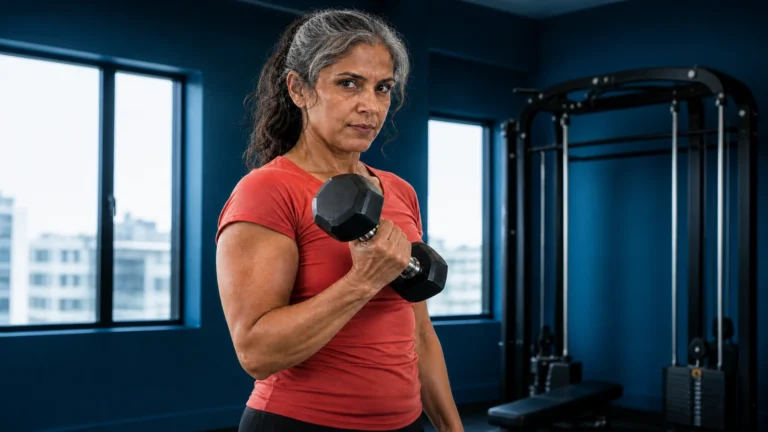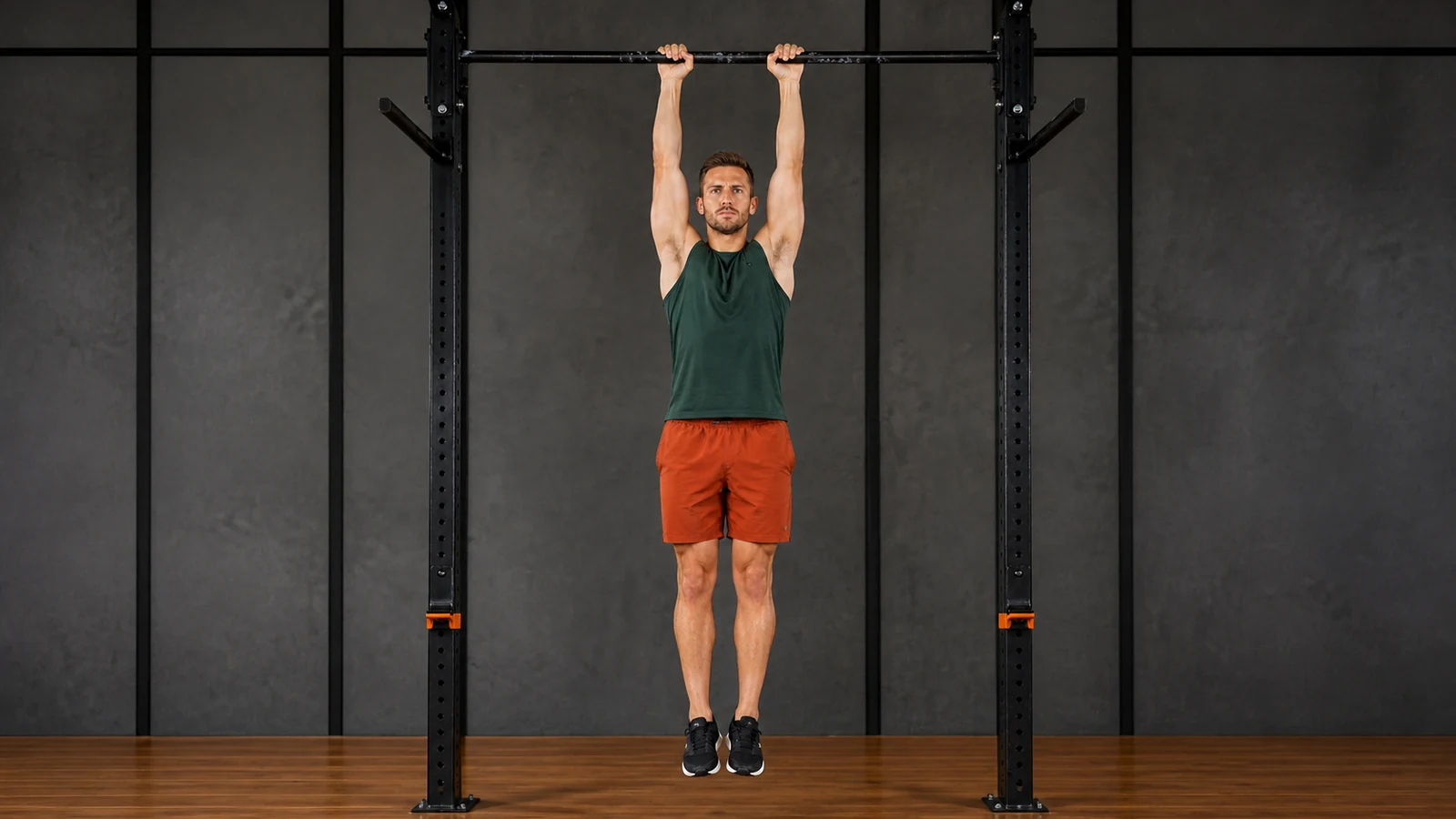

A trainer says three simple positions, done daily, can undo a lot of what modern sitting does to your body: hanging from a bar, resting in a deep squat, and a reverse tabletop stretch.
None of the three needs equipment beyond something to hang from, and the case for at least two of them holds up well against the research.
The Deep Squat
Many people avoid deep squatting because they’ve heard it’s hard on the knees.
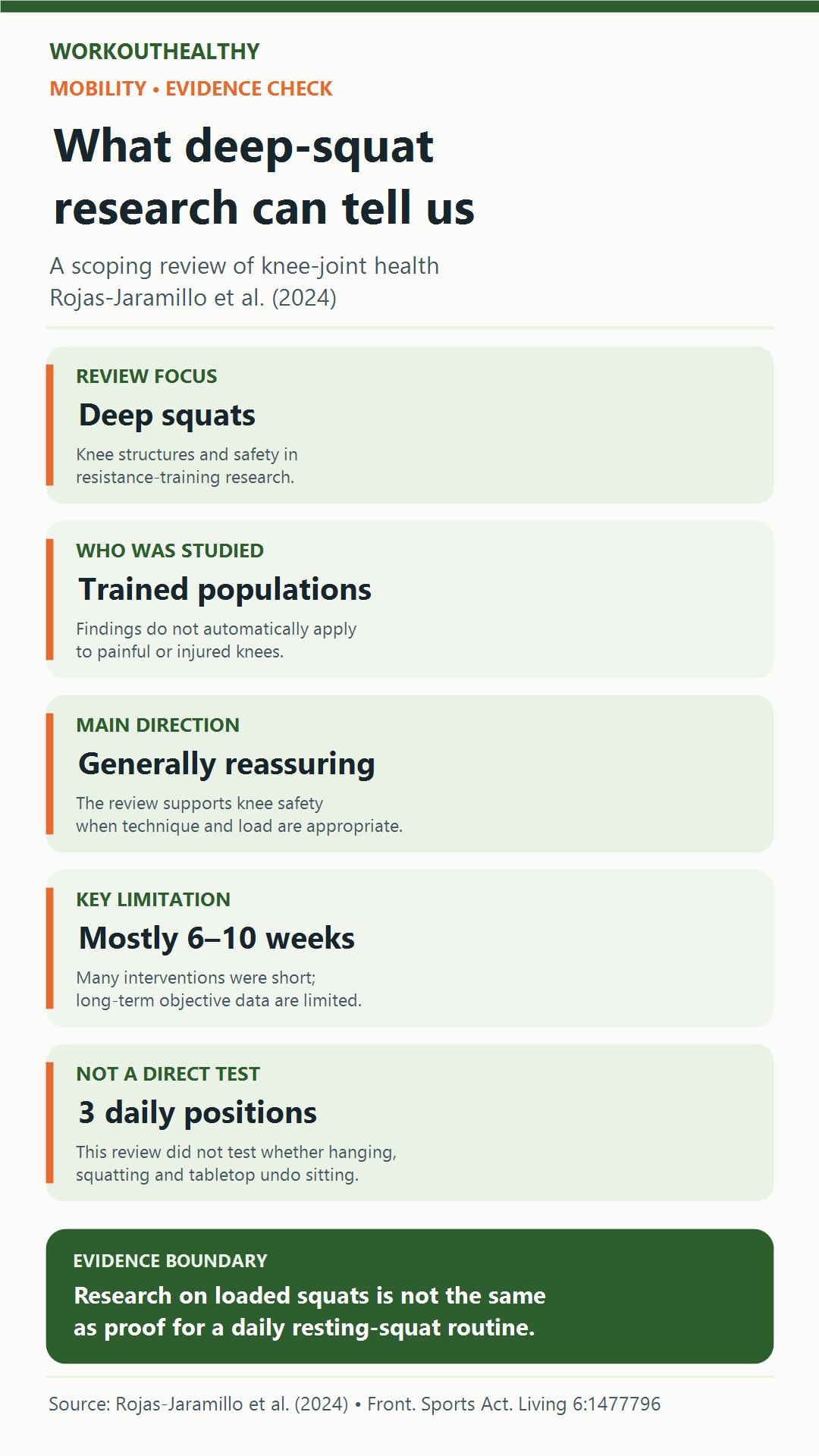
A 2024 scoping review in Frontiers in Sports and Active Living looked at the actual evidence on deep squats and knee joint structures (Rojas-Jaramillo et al., 2024).
The researchers found that the large majority of the studies they reviewed supported deep squatting as safe for healthy knees when the technique is sound, and that concerns about knee damage trace back to older, weaker research rather than current evidence.
That’s a meaningful finding, because a resting deep squat, simply sitting back into a full squat with your heels down, is a position much of the world outside industrialized countries still uses every day without issue.
The Biomechanics: Why a Deep Squat Can Be Safe for Healthy Knees
The old fear about deep squats came from the assumption that more knee bend automatically means more stress on the joint.
The review points to a few reasons that assumption doesn’t hold up.
At the very bottom of a deep squat, the back of your thigh makes contact with your calf.
That contact takes on some of the load, and the review notes this can reduce compressive force at the knee joint by roughly 30 percent compared to what the angle alone would predict.
Cartilage also responds to load the way bone and muscle do.
Regular loading through a full range of motion appears to help cartilage thicken slightly over time, which may give the joint more cushioning rather than less.
Deep squats also activate the quadriceps more effectively than a shallow squat does, even with less weight involved.
That means you can get a real training effect from a deep squat using a lighter load, which is itself a way of reducing the total stress on the joint per session.
The review also found that weightlifters, who squat deep and heavy for years, tend to have more natural laxity in the knee but not weaker ligaments.
If anything, their ligaments were found to be stronger, which fits with a joint that has adapted to a regular demand rather than one that has been worn down by it.
None of this holds up without decent technique.
The review is specific that the feet should stay flat on the ground, the knees should track in line with the feet instead of caving inward, the chest should stay upright, and the spine should stay in a neutral, slightly arched position rather than rounding at the bottom.
The fear that deep squatting wrecks your knees traces back to old, weak research. Current evidence points the other way for a healthy knee with good technique.
Daily Hanging and Grip Strength
Hanging from a bar loads the shoulders and stretches the spine, and it also happens to train grip strength, which turns out to be a genuinely important health marker.
A large international study following more than 140,000 adults found that grip strength predicted the risk of death from any cause more strongly than blood pressure did (Leong et al., 2015).
That doesn’t mean hanging from a bar for a minute a day is a proven longevity intervention on its own.
It means the grip strength a regular hanging practice can build is tied to a real, well documented health marker, which is a more solid reason to do it than “it feels good.”
A Second Look at Grip Strength: What a Half Million Person Study Adds
The PURE study wasn’t a one off finding.
A 2018 analysis in The BMJ followed more than half a million adults in the UK Biobank and looked at grip strength against a wider set of outcomes than just overall death, including cardiovascular disease, respiratory disease, and cancer specifically (Celis-Morales et al., 2018).
Every 5 kilogram drop in grip strength was linked to roughly a 16 to 20 percent higher risk of death from any cause, depending on sex.
The link to cardiovascular death specifically was similarly strong.
Adding a grip strength measurement to standard risk calculators, the kind that already use age, blood pressure, and cholesterol, measurably improved how well those calculators predicted who was at risk.
Two large studies, on two different populations, using two different statistical approaches, landing on the same basic conclusion is a stronger form of evidence than either study alone.
It’s still an association, not proof that training your grip changes your risk directly.
Grip strength may partly be a marker of overall muscle mass and general health rather than a lever you pull on its own.
It is still a real, repeatedly measured signal, and hanging is one of the simplest ways to work it.
A grip strength test takes about ten seconds. Two large studies, on two different continents, found it stacked up against blood pressure and cholesterol as a sign of who was still alive years later.
The Reverse Tabletop
The reverse tabletop, sometimes called a crab position, stretches the front of the shoulders and chest, areas that tend to get tight from hours spent at a desk.
This piece of the routine is closer to general mobility and posture advice than to a specific, heavily studied claim, so treat it as a reasonable stretch rather than a proven fix for any one condition.
What This Evidence Doesn’t Prove
The deep squat research and the grip strength research answer different questions than the ones people often assume they answer.
The deep squat review found an absence of evidence for knee damage in people with healthy knees, using mostly short term studies of 6 to 12 weeks, and mostly in resistance trained people or athletes.
It says much less about someone with an existing meniscus tear, an arthritic knee, or a knee that has been through surgery.
The review is explicit that its safety conclusion applies to people without existing knee pathology and good technique.
The grip strength studies show a strong statistical association between weaker grip and higher mortality risk.
Neither study tested whether training your grip on a bar lowers that risk directly.
It’s possible that low grip strength is simply a marker of poor health that develops for other reasons, rather than a cause of it on its own.
Grip strength is a useful signal to pay attention to.
It is not, by itself, proof that a daily hang adds years to your life.
The reverse tabletop has the least evidence of the three by a wide margin. Nothing in this article should be read as claiming otherwise.
Common Mistakes With All Three Positions
The most common deep squat mistake is letting the heels lift off the ground to force extra depth.
If your ankles won’t let you sit all the way down with flat feet, that’s a mobility limit to work on gradually, not a signal to squat up on your toes.
The second common mistake is letting the knees cave inward toward each other, which shifts stress away from the strongest parts of the joint.
The most common hanging mistake is shrugging the shoulders straight up to your ears the moment you grab the bar.
That turns a shoulder stretch into shoulder strain.
Relax the shoulders down and let the weight of your body do the stretching, especially in the first few weeks.
The most common reverse tabletop mistake is cranking the neck back to look up before the shoulders and chest have opened up enough to support that position.
Let your head hang naturally at first instead of forcing it back.
Who Should Be Cautious
Anyone with a diagnosed meniscus tear, an ACL injury, an arthritis flare, or a recent knee surgery should ask a doctor or physical therapist before adding deep squats, since the research supporting deep squat safety was done in people without those conditions.
Anyone with a shoulder impingement, a labral tear, or a wrist injury should be cautious with hanging, and may need to start with a supported or partial hang rather than a full body weight hang.
People with uncontrolled high blood pressure should also know that gripping hard for a sustained hold briefly raises blood pressure while it’s happening, the same as any other isometric hold.
Anyone with neck problems, a wrist injury, or who is pregnant should check with a doctor before adding the reverse tabletop, since it loads the wrists and involves arching the neck and spine.
How to Build the Habit: A Step by Step Progression
For the deep squat, start by holding onto a doorframe, a pole, or a sturdy piece of furniture for support as you sit back into the bottom position.
If your heels lift no matter what you do, place a small wedge or a couple of stacked books under them at first.
Aim for 30 to 60 seconds in the position, breathing normally, a few times a day.
Over several weeks, rely less on the support and the heel wedge as your ankles and hips loosen up.
You know you’re progressing when you can hold the position with flat feet and no support for a full minute without discomfort in the knees.
For hanging, begin with an active hang, feet still lightly touching the ground or a low box, shoulders pulled gently down away from your ears, for 10 to 20 seconds.
Once that feels controlled, move to a full dead hang with feet off the ground, building toward 20 to 30 seconds, then longer over time.
You know your grip is progressing when you can hang longer without your hands slipping open before your shoulders feel fatigued.
For the reverse tabletop, start with knees bent and feet flat, hands behind you, and simply lift your hips a few inches while keeping your chin tucked toward your chest.
As your shoulders and chest open up, you can let the head tip back slightly and eventually straighten the legs for a fuller stretch.
Stop and back off if you feel a pinch in the wrists or lower back rather than a stretch across the chest and shoulders.
You’re doing all three correctly if you feel a stretch or a controlled muscular effort, not sharp pain, in the joint itself.
Mild muscle fatigue and a deep stretch sensation are expected.
Joint pain is not, and it’s a signal to scale the position back rather than push through it.
Getting Started
None of these three positions require a formal workout.
A minute of hanging, a minute or two resting in a deep squat, and a short reverse tabletop stretch, spread through your day, is enough to start.
For more on staying mobile as you age, see our article on whether standing is really better than sitting, our guide to how many miles you should walk a day, and our coverage of Misty Copeland’s hip replacement recovery.
Watch the Original Video
Get the next evidence check. Subscribe to WorkoutHealthy Insider for practical explanations behind popular fitness claims.
References
Celis-Morales, C. A., Welsh, P., Lyall, D. M., Steell, L., Petermann, F., Anderson, J., Iliodromiti, S., Sillars, A., Graham, N., Mackay, D. F., Pell, J. P., Gill, J. M. R., Sattar, N., & Gray, S. R. (2018). Associations of grip strength with cardiovascular, respiratory, and cancer outcomes and all cause mortality: Prospective cohort study of half a million UK Biobank participants. The BMJ, 361, Article k1651. https://doi.org/10.1136/bmj.k1651
Leong, D. P., Teo, K. K., Rangarajan, S., Lopez-Jaramillo, P., Avezum, A., Orlandini, A., et al. (2015). Prognostic value of grip strength: Findings from the Prospective Urban Rural Epidemiology (PURE) study. The Lancet, 386(9990), 266 to 273. https://doi.org/10.1016/S0140-6736(14)62000-6
Rojas-Jaramillo, A., Cuervo-Arango, D. A., Quintero, J. D., Ascuntar-Viteri, J. D., Acosta-Arroyave, N., Ribas-Serna, J., González-Badillo, J. J., & Rodríguez-Rosell, D. (2024). Impact of the deep squat on articular knee joint structures, friend or enemy? A scoping review. Frontiers in Sports and Active Living, 6, Article 1477796. https://doi.org/10.3389/fspor.2024.1477796
This article is for general information only and is not medical advice. If you have an injury, ongoing pain, or a medical condition, talk to a doctor or physical therapist before you change how you train or eat.