
An ER physician says most falls after 50 are not really the problem.
It’s what happens afterward, the surgery and the long recovery, that changes a person’s life.
Her answer is to train seven movement patterns your body already uses every single day, on purpose and with intent, before a fall ever happens.
The Seven Movements
Dr. Rachel Felber’s list covers the squat, the hip hinge, a lunge or step up, a push, an overhead press, a row, and the farmer’s or suitcase carry.
Each one mirrors something you already do without thinking, standing up from a chair, picking something off the floor, climbing stairs, or carrying groceries.
She calls the carry the most underrated exercise on the list, and it’s easy to see why.
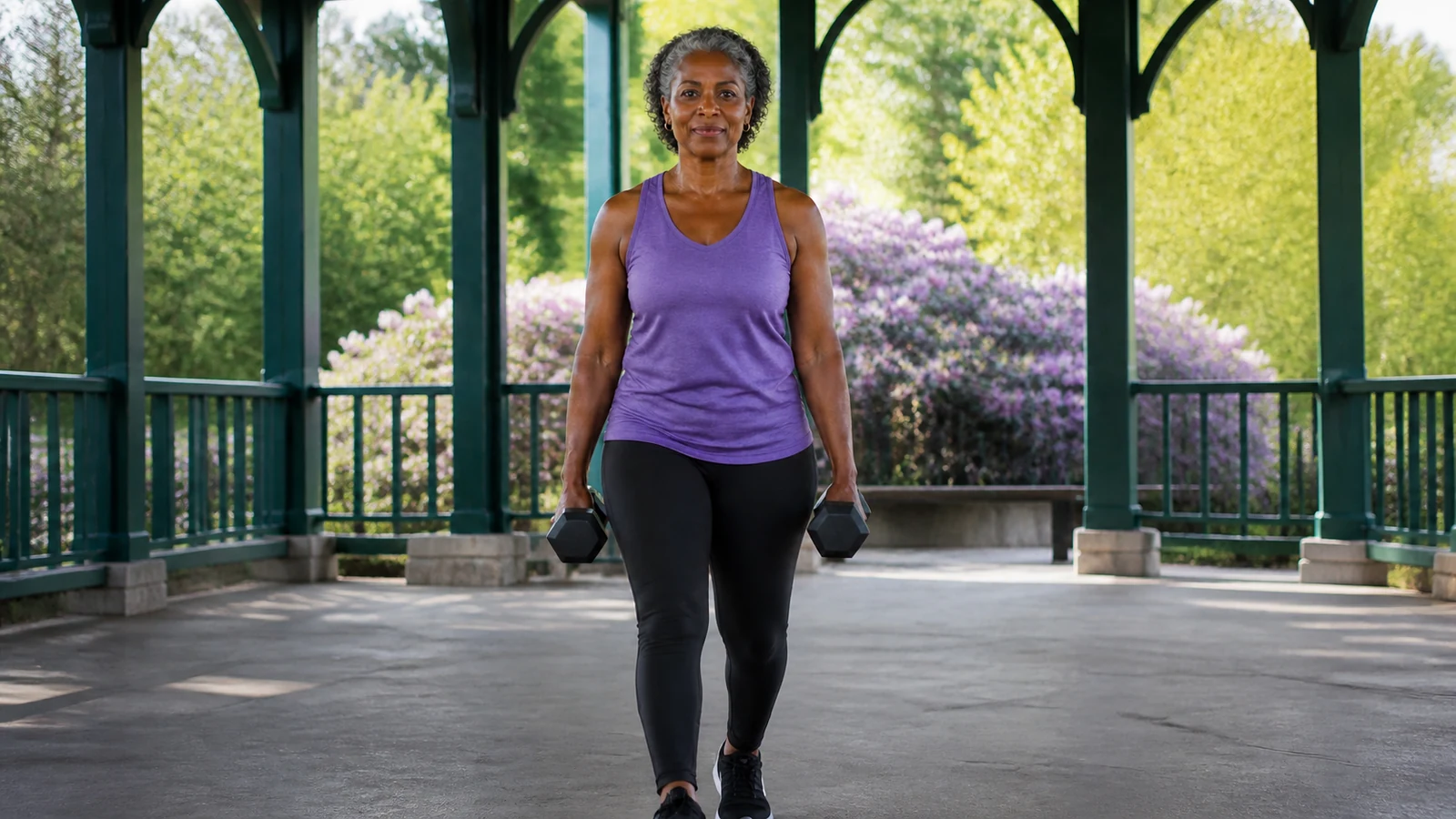
It trains grip, shoulders, and core stability all at once, using nothing more complicated than walking while holding weight.
What the Research Actually Shows
A major Cochrane review pooled dozens of trials on exercise and falls in older adults living in the community (Sherrington et al., 2019).
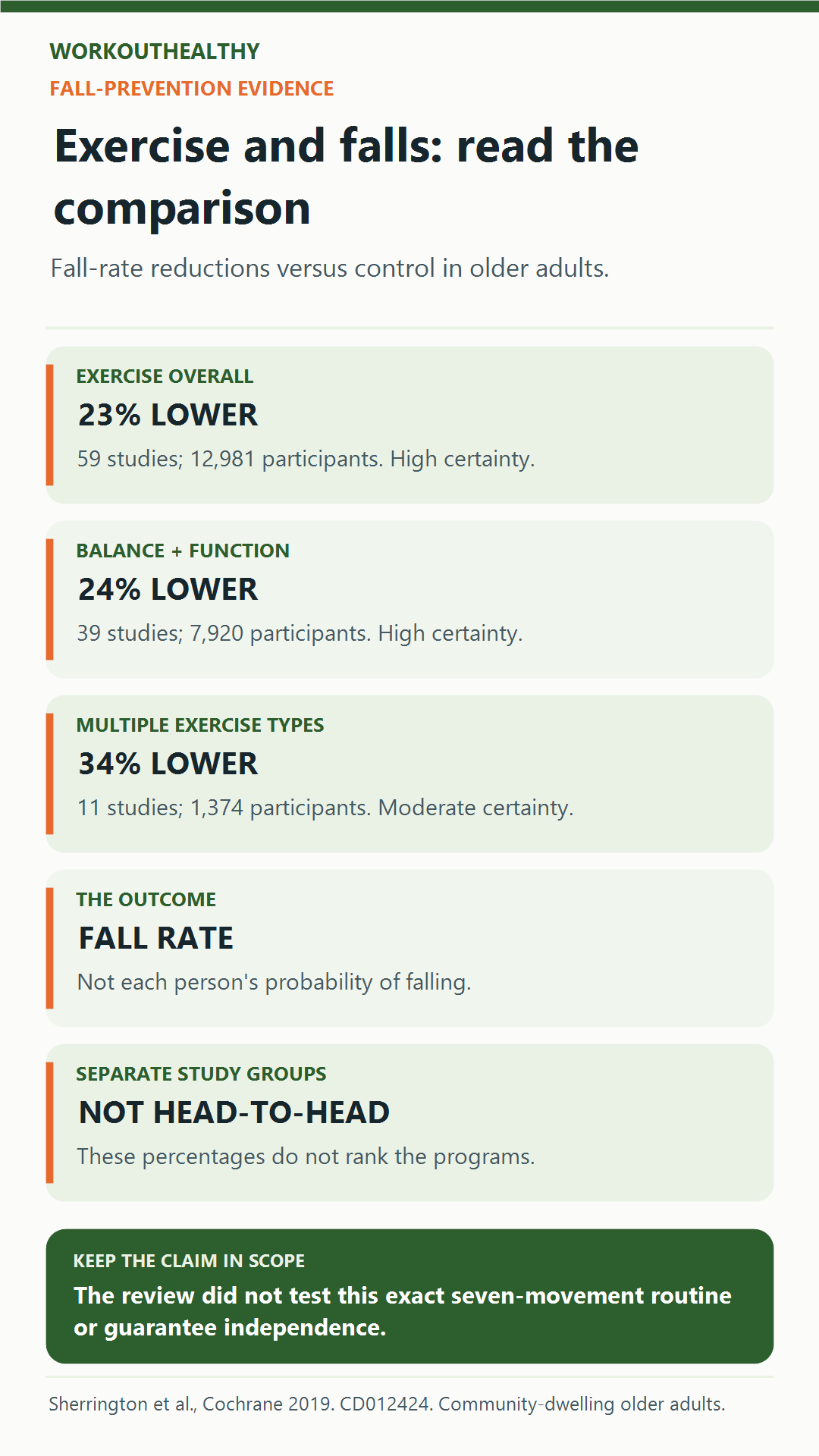
It found that exercise programs reduce the rate of falls by roughly 23 percent overall, with programs that included a strength or resistance component contributing to that protective effect, not balance work alone.
That matters because a fall itself is rarely the whole story.
The review’s authors point out that the real cost is often the injury and the long recovery that follows, which lines up directly with what Dr. Felber describes seeing in the emergency room.
The fall usually isn’t what changes someone’s life. It’s the surgery and the recovery that follows it, and both are far more preventable than most people realize.
Why Grip and Carry Strength Predict So Much
Dr. Felber calls the farmer’s carry the most underrated exercise on her list, and a large international study helps explain why grip strength in particular deserves that kind of attention.
The Prospective Urban Rural Epidemiology study, known as PURE, measured grip strength in 139,691 adults between the ages of 35 and 70 across 17 countries and tracked their health for several years afterward (Leong et al., 2015).
For every 5 kilogram, or about 11 pound, drop in grip strength, the risk of dying from any cause during the study rose by 16 percent, and the risk of dying specifically from cardiovascular disease rose by 17 percent.
Grip strength turned out to be a stronger predictor of death than systolic blood pressure, one of the most widely used measurements in medicine.
Grip strength itself isn’t magic.
Researchers see it as a window into overall muscle quality, nervous system function, and general physical resilience, since a weak grip tends to travel with weakness elsewhere in the body.
That’s likely why a carry, which trains grip strength under load while also demanding shoulder stability and a braced core, touches so many systems connected to healthy aging at once.
Why Combining Strength and Balance Work Beats Balance Alone
The Cochrane review behind the 23 percent overall fall reduction actually breaks its results down further by the type of exercise program used, and the pattern lines up closely with training seven different movements rather than just one.
Programs built mostly around balance and functional training reduced the rate of falls by about 24 percent on their own.
Programs that combined balance and functional work with resistance training reduced falls by about 34 percent, a noticeably larger effect.
That’s the core idea behind training all seven patterns instead of just one or two.
A squat and a hinge build strength.
A carry and a step up build balance and stability at the same time.
Training them together covers more of what the research shows actually protects against falls, rather than leaning on strength or balance work alone.
What the Evidence Does Not Prove
The Cochrane review pooled dozens of trials, but it excluded certain groups, including people recovering from a stroke and people recently discharged from a hospital stay.
Its findings describe generally healthy older adults living independently in the community, not every population that might benefit from exercise.
The review also doesn’t specify one exact dose, meaning it can’t say precisely how many sets, reps, or weekly sessions are required to get the reported benefit.
Programs in the pooled trials varied quite a bit in length and intensity and still produced a real, measurable effect.
The PURE grip strength findings are observational too.
Researchers measured grip strength as it existed naturally in each person rather than randomly assigning some people to train it and others not to.
That means the data show a strong association between having more strength and living longer, but it can’t fully prove that someone who spends years deliberately training grip strength will see the exact reduction in risk the study measured.
None of this weakens the basic case for training these patterns.
It just means the size of the benefit for any one person, following any one specific program, isn’t something a single review or study can promise with certainty.
Grip strength isn’t the goal by itself. It’s a window into how the whole body is holding up, and training it through a real movement like a carry trains everything behind that window at the same time.
Common Mistakes When Starting These Movements
A common mistake with the squat is letting the knees cave inward as the legs get tired, instead of keeping them tracking in line with the toes.
This shifts stress onto the inside of the knee joint and can lead to discomfort over time.
With the hip hinge, the most common error is rounding the lower back instead of hinging from the hips with a flat back.
A rounded back under load is one of the more common ways people strain their lower back during everyday lifting, not just in the gym.
During carries, many people hold their breath or let their shoulders creep up toward their ears.
Breathing steadily and keeping the shoulder blades pulled down and back protects the neck and keeps blood pressure from spiking unnecessarily during the effort.
With the overhead press, a common mistake is arching the lower back to help the weight travel overhead, rather than bracing the core and keeping the ribs stacked over the hips.
This trades shoulder work for lower back strain, which defeats the purpose of the exercise.
A final mistake across all seven patterns is adding weight before the movement pattern itself is smooth and controlled.
Strength should follow good form, not the other way around.
Who Should Check With a Doctor or Physical Therapist First
Women with osteoporosis or a history of a fracture from a minor bump or fall should check with a doctor or physical therapist before adding load to these movements, since certain positions and loading patterns may need to be modified.
Anyone with uncontrolled high blood pressure, a recent joint replacement, or a diagnosed balance disorder such as vertigo should also get individual guidance before starting, since standard progressions may not apply in the same way.
Anyone recovering from a recent fall, a recent surgery, or a recent injury should work with a physical therapist first.
A professional can rebuild these patterns safely at a pace that matches actual healing, rather than a generic timeline.
Pain, numbness, or tingling that changes depending on the movement is not something to push through.
That kind of symptom is worth describing to a doctor before continuing, since it can point to a nerve or joint issue that needs its own evaluation.
Starting Safely
Every one of these seven movements can start small. A squat can begin as standing up from a chair without using your hands.
A row or press can start with a light resistance band before it ever needs a dumbbell.
The goal is to train the pattern your body needs, not to load it heavily on day one.
A Detailed, Practical Way to Train Each Pattern
Start a squat by sitting back into a sturdy chair and standing back up without using your hands.
Keep your chest up, your weight through your heels, and your knees tracking over your toes rather than caving inward.
Once that feels controlled for 10 to 12 repetitions, progress to a bodyweight squat without the chair, then add light dumbbells held at the chest.
Practice the hip hinge by standing with a soft bend in the knees and pushing your hips backward, as if closing a car door with your hips, while keeping your back flat and your chest reaching slightly forward.
A light dowel held along your spine, touching the back of your head, your upper back, and your tailbone, can help you feel when your back starts to round.
Progress from bodyweight hinges to holding a light kettlebell or dumbbell in front of your thighs.
Begin a step up on a low, stable step, pressing through the whole foot rather than just the toes.
Keep your front knee lined up over your ankle instead of letting it drift past your toes.
As balance and strength improve, increase the step height gradually, then add light dumbbells at your sides.
A push up can start against a wall, hands slightly wider than shoulder width, keeping the body in a straight line from head to heels.
As that becomes easy, move your hands to a sturdy countertop, then eventually to the floor, keeping the same straight body line the entire way down and up.
Begin the overhead press seated in a chair with back support, holding light dumbbells or a resistance band at shoulder height.
Press straight overhead without arching the lower back, keeping your ribs stacked over your hips.
Progress to standing once your core can keep your back neutral through the full movement.
A resistance band anchored to a door or a sturdy object works well to start a row.
Pull your elbows back and squeeze your shoulder blades together, keeping your shoulders down away from your ears.
Progress to a light dumbbell row, one arm at a time, supported by a bench or sturdy chair.
Start a farmer’s carry with a light dumbbell or kettlebell in one or both hands, standing tall with your shoulders back and your core braced as if about to be lightly poked in the stomach.
Walk a short, flat distance with even steps, then set the weight down under control.

Increase the distance before increasing the weight, since walking further under control builds the same benefit with less joint stress.
For most of these movements, two to three sessions a week is enough to build noticeable strength within several weeks.
Add small amounts of weight or a few more repetitions only once the current version feels fully controlled for 10 to 12 repetitions in a row.
Across every pattern, the same signs point to good form. Breathing should stay steady instead of being held.
The last repetition of a set should look the same as the first, without a noticeable loss of form.
And there should be no sharp or new pain during the movement, only the normal feeling of muscles working.
For more on training that protects independence as you age, see our article on whether lifting weights keeps your brain young, our coverage of Misty Copeland’s hip replacement recovery, and our look at Gabrielle Union’s fitness routine at 53.
Watch the Original Video
Get the next evidence check. Subscribe to WorkoutHealthy Insider for practical explanations behind popular fitness claims.
References
Leong, D. P., Teo, K. K., Rangarajan, S., Lopez-Jaramillo, P., Avezum, A., Jr., Orlandini, A., Seron, P., Ahmed, S. H., Rosengren, A., Kelishadi, R., Rahman, O., Swaminathan, S., Iqbal, R., Gupta, R., Lear, S. A., Oguz, A., Yusoff, K., Zatonska, K., Chifamba, J., … Yusuf, S. (2015). Prognostic value of grip strength: Findings from the Prospective Urban Rural Epidemiology (PURE) study. Lancet, 386(9990), 266 to 273. https://doi.org/10.1016/S0140-6736(14)62000-6
Sherrington, C., Fairhall, N. J., Wallbank, G. K., Tiedemann, A., Michaleff, Z. A., Howard, K., Clemson, L., Hopewell, S., & Lamb, S. E. (2019). Exercise for preventing falls in older people living in the community. Cochrane Database of Systematic Reviews, 2019(1), CD012424. https://doi.org/10.1002/14651858.CD012424.pub2
This article is for general information only and is not medical advice. If you have an injury, ongoing pain, or a medical condition, talk to a doctor or physical therapist before you change how you train or eat.