
A popular health claim says women can lose more muscle in the few years around menopause than in the two decades before it.
We could not trace that exact comparison to one confirmed study, but the broader pattern behind it is real and well documented.
What Happens to Muscle During the Menopause Transition
A 2024 review in the journal Climacteric describes a cluster of symptoms tied to declining estrogen as the “musculoskeletal syndrome of menopause,” including joint pain, muscle mass loss, and bone density reduction (Wright et al., 2024).
The review notes that more than 70 percent of women experience some musculoskeletal symptom during the transition.
Established: declining estrogen during the menopause transition is linked to real losses in muscle mass and bone density, not just joint discomfort.
Still open: exactly how fast that decline happens for a given individual, and how much of it is estrogen acting directly versus other aging changes happening around the same time.
The honest version of this story is that menopause accelerates real musculoskeletal change, not that one precise countdown applies to every woman.
The Hormonal Mechanism: Why Estrogen Loss Hits Muscle
Estrogen does more in the body than regulate the reproductive cycle.
It also helps activate satellite cells, the repair cells muscle uses to rebuild itself after training, and laboratory research suggests it normally helps hold back the breakdown side of muscle protein turnover.
When estrogen drops, several of these protective jobs fade at roughly the same time.
A 2026 review pulled together human research on menopause, sex hormones, and muscle protein turnover and found that lean mass drops by about 2.5 percent during the years leading into menopause and about 5.7 percent afterward, compared with premenopausal levels, with the fastest rate of loss happening during the transition itself rather than before or after it (Menzies et al., 2026).
The review also found that older women tend to have a blunted muscle building response after eating protein or training, compared to younger women.
It was careful to note that some of the deeper cellular explanations, like changes in mitochondria and inflammation, still rest more on animal and cell research than on direct measurement in menopausal women.
A Second Look: Muscle Loss and Fracture Risk, Not Just Bone Density
Most people hear “menopause and bones” and think only about a bone density scan.
A cohort study following women through the menopause transition, using data from the long running Study of Women’s Health Across the Nation, found that losing more lean muscle mass during the transition was linked to lower bone mineral density at the hip afterward (Shieh et al., 2023).
The more striking part is what happened with fracture risk.
Both muscle loss and fat gain during the transition predicted a higher chance of fracture later on, and that link held up even after the researchers accounted for bone density itself.
In plain terms, a woman’s muscle and body composition appear to affect her fracture risk through more than just what a bone scan shows.
That is a real reason to care about muscle specifically, not just bone, during this stage of life.
What a Real Resistance Training Trial Found
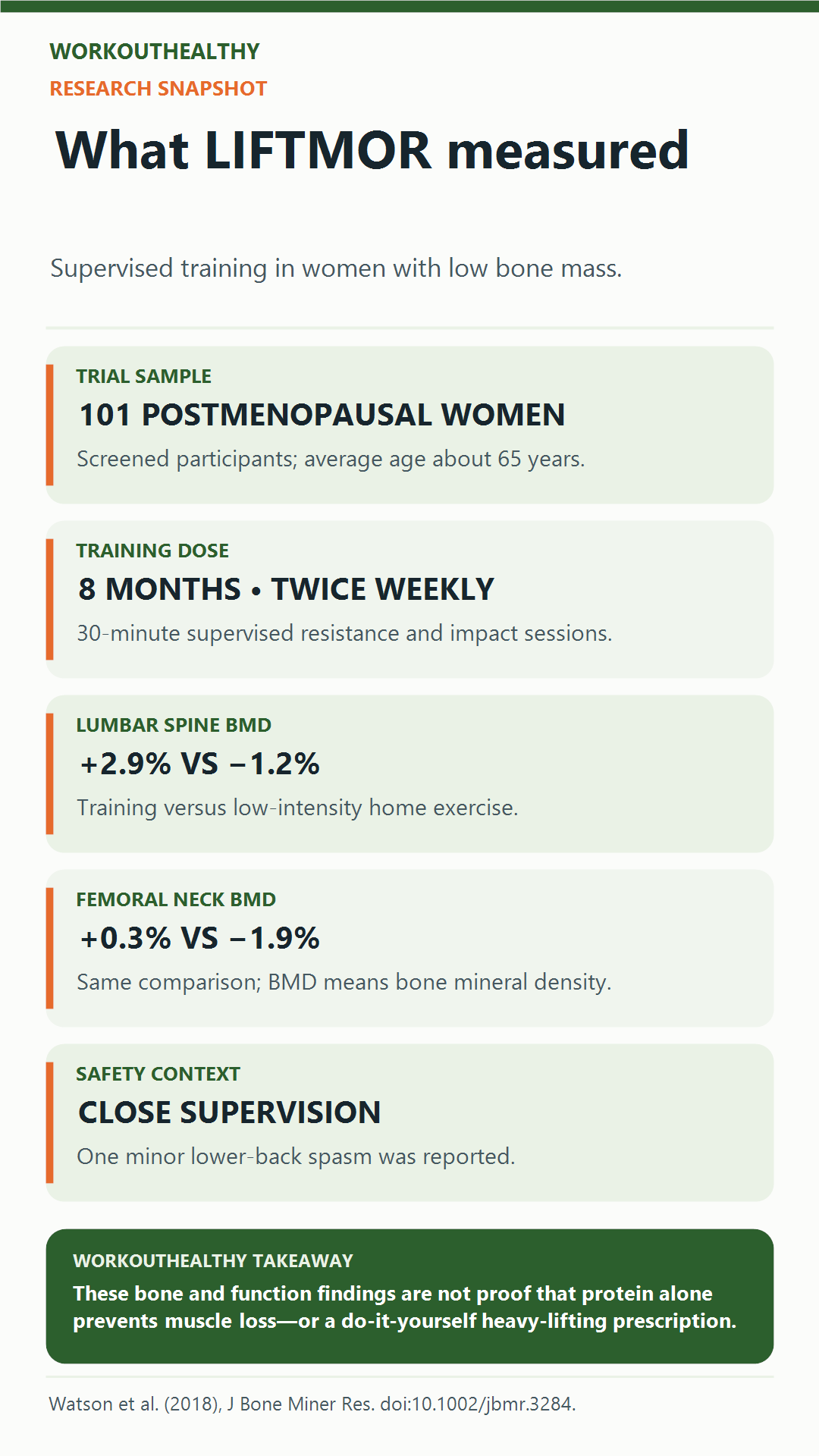
The strongest evidence for doing something about this comes from a randomized controlled trial known as LIFTMOR, which followed postmenopausal women with low bone density through eight months of twice weekly high intensity resistance and impact training (Watson et al., 2018).
Compared to a low intensity control program, the resistance and impact group saw significantly better improvements in bone mineral density at the spine and hip, along with better functional performance measures like back extensor strength.
The training in that study was supervised and intentionally demanding, not a light toning routine.
That detail matters, because it suggests the bigger benefits in this population come from real, progressively loaded resistance work rather than a minimal effort version of exercise.
What This Evidence Does Not Prove
It helps to be specific about what these studies can and cannot say.
The Climacteric review pulls together existing research rather than presenting one new experiment, so it describes a pattern across many studies rather than proving a single mechanism.
The LIFTMOR trial studied women who already had low bone density and who trained under close supervision for eight months.
Its results are strong evidence that this kind of training works for that group, but they do not guarantee the identical outcome for every postmenopausal woman, especially someone starting from a very different fitness or health baseline.
The SWAN data on muscle and fracture risk is observational.
It shows a real statistical link, not a controlled experiment proving that muscle loss by itself causes fractures.
And no study has followed women from the first sign of menopause related muscle change through decades of resistance training to directly confirm that starting earlier prevents a fracture down the road.
Why Protein Alone Is Not Enough
A 2025 review on age related muscle changes describes “anabolic resistance,” a reduced ability of aging muscle to respond to protein intake alone, and recommends pairing higher protein intake with regular resistance exercise rather than relying on diet changes by themselves (Pérez-Castillo et al., 2025).
That lines up with what strength coaches generally recommend: protein supports the muscle building process, but it needs a training stimulus to act on.
In practice, that means a woman focused on preserving muscle after menopause gets more from combining adequate protein with structured resistance training than from either one alone.
Protein gives your muscle the material to rebuild with. Resistance training is what tells it to actually use that material.
Common Mistakes Women Make When Addressing This
The most common mistake is relying only on walking or cardio and skipping resistance training entirely.
Cardio is good for the heart, but it does not provide the loading signal that studies like LIFTMOR used to build bone and muscle.
A second mistake is choosing weights that are too light out of a fear of getting bulky.
The training in LIFTMOR used loads heavy enough to be genuinely difficult for five reps at a time.
A weight you can lift twenty or thirty times without much effort is not creating the same stimulus.
A third mistake is cutting calories hard while also trying to hold onto or build muscle.
The body needs enough total energy, not just enough protein, to support real muscle repair.
A deep calorie deficit tends to work against the exact process a woman is trying to protect.
A fourth mistake is quitting the first time training causes soreness or fatigue. Some early soreness is normal.
The better response is to adjust the dose down slightly and keep going, rather than stopping altogether.
Who Should Check With a Doctor First
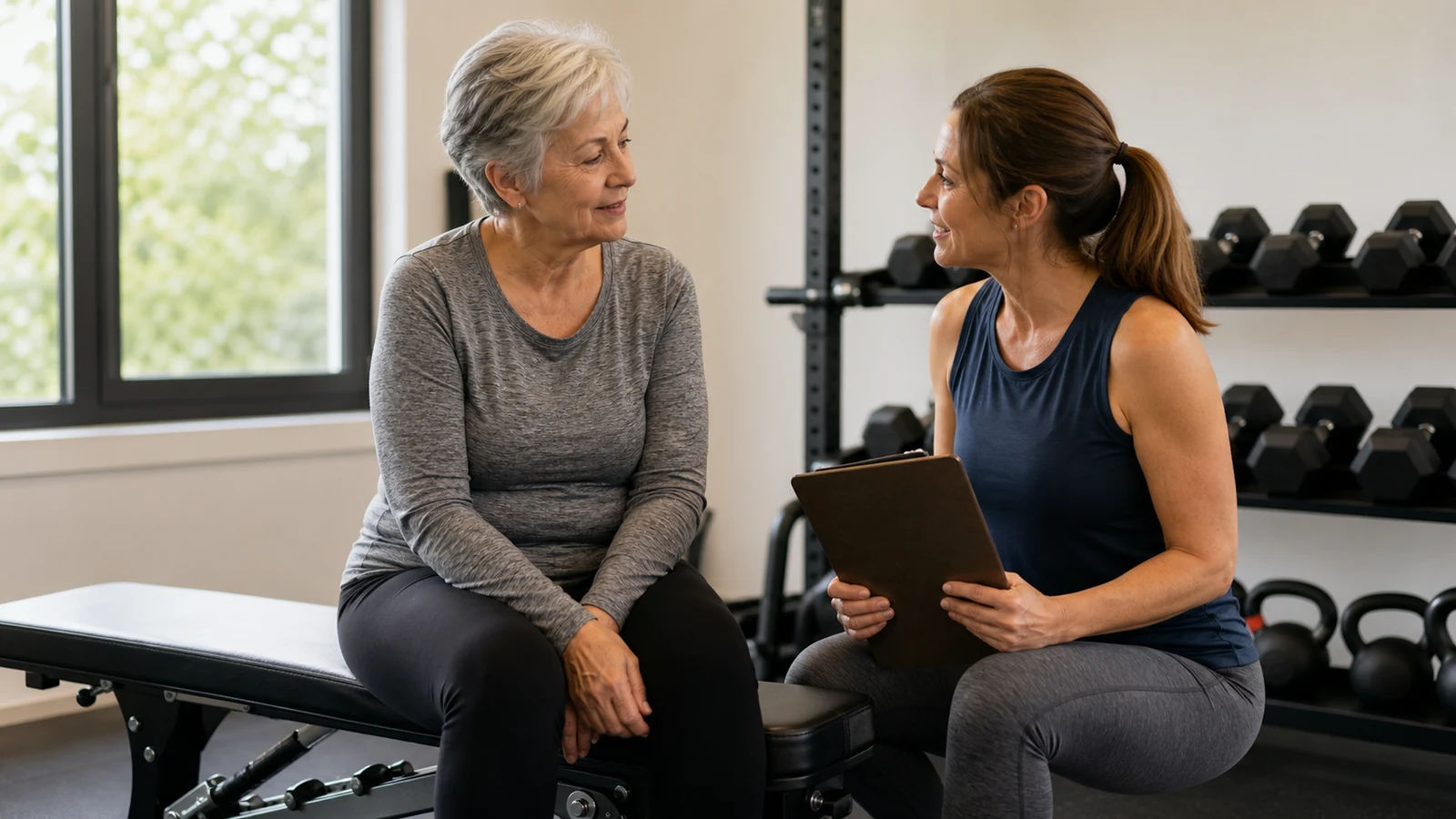
Anyone with diagnosed osteoporosis, a prior fragility fracture, or a known heart condition should talk to a doctor before starting a high intensity program like the one used in LIFTMOR.
That trial itself was run under close professional supervision, in small groups, with a full month of lower load practice before anyone loaded up to the heavier working sets.
The same caution applies to anyone with a joint replacement, an uncontrolled blood pressure condition, or a recent surgery.
Women using hormone therapy or considering it should also bring this topic to their doctor.
The research covered here is about training and diet, not a comparison of hormone therapy against no hormone therapy, so it cannot tell you how that decision interacts with your own muscle and bone picture.
A Practical Starting Point
Aim for structured resistance training at least twice a week, built around compound movements like squats, presses, rows, and hip hinges that load multiple muscle groups at once.
The LIFTMOR protocol itself eased participants in with a full month of bodyweight and light load practice, focused purely on technique, before progressing to heavier working sets performed for five sets of five repetitions.
Progressive overload, gradually increasing weight or reps over time, is what separates a real training stimulus from just going through the motions.
A useful gauge is effort: your last one or two reps in a working set should feel genuinely hard to complete with good form, not something you could repeat another ten times.
On the nutrition side, the review on anabolic resistance points to protein intakes toward the higher end of standard recommendations, in the range of 1.6 to 2.0 grams per kilogram of body weight per day, spread across meals, as a reasonable target for someone actively training to hold onto muscle (Pérez-Castillo et al., 2025).
You will know the plan is working if your working weights are slowly climbing over weeks and months, if everyday tasks like carrying groceries or climbing stairs start to feel easier, and if you can complete your sets with full range of motion and controlled form.
Signs it needs adjusting include joint pain that lingers well past a session, form that breaks down badly on the last reps, or weights that never seem to move up over several weeks in a row.
Our review of what resistance training research shows about brain health covers another reason this habit pays off with age, and our article on unplanned weight and muscle loss explains when a change is worth flagging to a doctor.
For a look at how one well known woman in her sixties approaches training, see our piece on what her routine actually shows.
Watch the Original Video
Get the next evidence check. Subscribe to WorkoutHealthy Insider for practical explanations behind popular fitness claims.
References
Menzies, C., Bowtell, R., Shur, N., & Brook, M. S. (2026). Menopause, female sex hormones, skeletal muscle mass and muscle protein turnover in humans. Journal of Cachexia, Sarcopenia and Muscle, 17(1), e70232. https://doi.org/10.1002/jcsm.70232
Pérez-Castillo, Í. M., Rueda, R., Pereira, S. L., Bouzamondo, H., López-Chicharro, J., Segura-Ortiz, F., & Atherton, P. J. (2025). Age-related anabolic resistance: Nutritional and exercise strategies, and potential relevance to life-long exercisers. Nutrients, 17(22), 3503. https://doi.org/10.3390/nu17223503
Shieh, A., Karlamangla, A. S., Karvonen-Guttierez, C. A., & Greendale, G. A. (2023). Menopause-related changes in body composition are associated with subsequent bone mineral density and fractures: Study of Women’s Health Across the Nation. Journal of Bone and Mineral Research, 38(3), 395 to 402. https://doi.org/10.1002/jbmr.4759
Watson, S. L., Weeks, B. K., Weis, L. J., Harding, A. T., Horan, S. A., & Beck, B. R. (2018). High-intensity resistance and impact training improves bone mineral density and physical function in postmenopausal women with osteopenia and osteoporosis: The LIFTMOR randomized controlled trial. Journal of Bone and Mineral Research, 33(2), 211 to 220. https://doi.org/10.1002/jbmr.3284
Wright, V. J., Schwartzman, J. D., Itinoche, R., & Wittstein, J. (2024). The musculoskeletal syndrome of menopause. Climacteric, 27(5), 466 to 472. https://doi.org/10.1080/13697137.2024.2380363
This article is for general information only and is not medical advice. If you have an injury, ongoing pain, or a medical condition, talk to a doctor or physical therapist before you change how you train or eat.