
A wall sit can raise blood pressure while you hold it. Separately, repeated isometric training may lower resting pressure, but this does not establish a benefit from one hold.
Keep the measurement and timing beside each claim. Use the table to check whether a headline is answering the question you meant to ask.
During the hold and after training are different questions
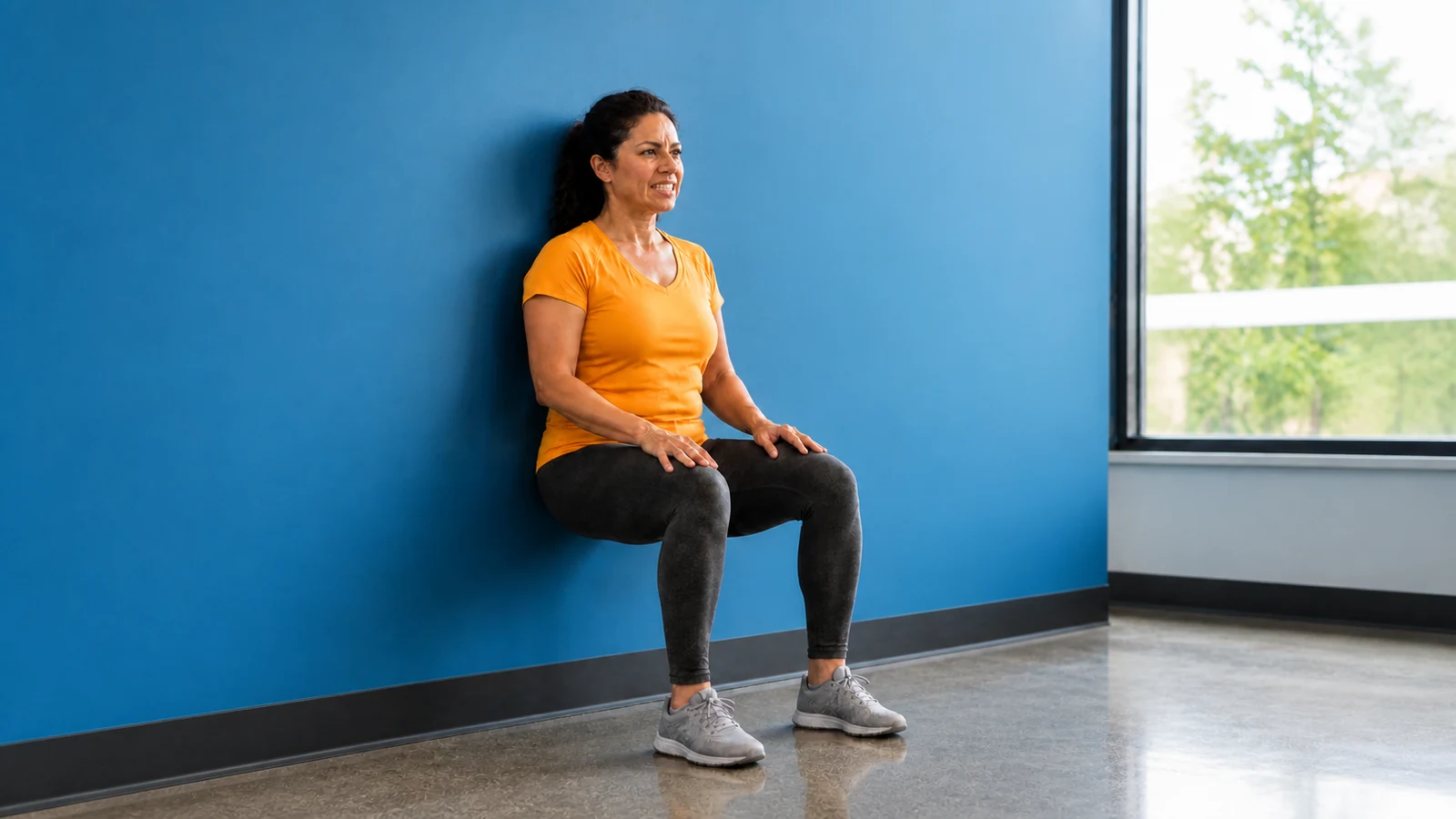
In a wall sit, your thigh muscles contract without moving through a range of motion.
| Question | When measured | What it can tell us | What it cannot tell us |
|---|---|---|---|
| What happens during one hold? | While the person is exercising | The immediate pressure response under that study’s conditions | Whether one hold lowers resting pressure later |
| What happens after a training program? | At rest, after weeks of repeated sessions | Average changes in a study population | An individual’s response or the immediate safety of a hard hold |
What happens to blood pressure during a wall sit?
In a 2014 study, 23 adults with normal blood pressure performed wall squats at several knee angles. The average pressure and heart rate recorded at a deep 90-degree position were higher than at a shallower 135-degree position.
The study reported mean systolic pressure of about 196 mm Hg at 90 degrees and 134 mm Hg at 135 degrees. Those are group measurements during exercise at two different positions, not a prediction for a reader and not a before-and-after resting blood pressure result.
A later laboratory study monitored 62 apparently healthy adults during a wall sit and a plank. Nearly all reached its preset diastolic stopping threshold during the wall sit at around 50 seconds on average, with no adverse events.
No adverse events is reassuring within this selected group. The stopping rule was not an injury finding; several higher-risk conditions were excluded.
Home cuff readings between holds are not the monitored during-hold measurements.
Can repeated wall sits lower resting blood pressure?
A 2023 review pooled 270 randomized trials with 15,827 participants and compared several exercise training categories. The eligible programs lasted at least two weeks, and the outcome was resting blood pressure after training.
Across the pooled trials, isometric training was associated with average reductions of about 8.24 mm Hg systolic and 4.00 mm Hg diastolic versus nonexercise controls. Aerobic training also lowered resting pressure on average.
The isometric pool covered different exercises, schedules, people and measurements. Its direct and indirect comparisons do not predict your response.
Does one minute of wall sitting work like cardio?
A higher heart rate during a hold does not establish aerobic equivalence.
The American Heart Association’s activity guidance includes aerobic activity and resistance work, including isometric resistance. It recommends at least 150 minutes of moderate aerobic activity or 75 minutes of vigorous aerobic activity a week for adults, with a gradual start when needed.
Use the guidance to discuss an appropriate overall activity plan with your healthcare professional.
Read a wall-sit claim with five checks
Before borrowing a result from a headline, fill in the missing details. This works for a news story, a class advertisement or a social post without turning any of them into a treatment plan.
| Check | Question |
|---|---|
| People | Were participants healthy, diagnosed with hypertension, taking medication or selected for another condition? |
| Measurement | Was pressure recorded during a contraction, immediately afterward or at a later resting visit? |
| Exposure | Was this one hold, repeated holds or a program over several weeks? |
| Comparison | Was the comparison another exercise in the same trial or a pooled category from different studies? |
| Claim | Did the study assess a blood pressure outcome, aerobic fitness or a clinical event? |
Consider a fictional headline: “One minute beats cardio.” What exposure and outcome would the study have to test for that comparison to hold?
Changing the exposure repairs only part of the claim. Resting pressure is not an endurance result or a personal prediction.
Who should get individual advice first?
If you have high blood pressure, cardiovascular disease, a recent cardiac event or exertional symptoms, ask your healthcare professional about isometric exercise. The 62-person study did not establish safety for higher-risk groups.
Knee pain or a recent knee operation is another reason to ask a clinician or physical therapist about whether this position suits you. Do not use a wall sit as a self-test of how high your blood pressure can go.
Wall sits and blood pressure: the practical answer
Keep the endpoint beside the claim. Then check who was studied, what was compared and how long the exposure lasted.
Use the five checks above when a headline leaves a detail unclear. They are reading prompts, not personal exercise or treatment instructions.
References
- Edwards JJ, et al. Resting blood pressure and exercise review. British Journal of Sports Medicine. 2023.
- Jones MD, et al. Acute blood pressure responses to plank and wall sit isometric exercise in adults. Journal of Hypertension. 2026.
- Goldring N, Wiles JD, Coleman D. The effects of isometric wall squat exercise on heart rate and blood pressure in a normotensive population. Journal of Sports Sciences. 2014.
- American Heart Association. Getting Active to Control High Blood Pressure.
Medical disclaimer: This is general fitness and health information, not a personal treatment plan. Follow prescribed medication and monitoring, and ask your healthcare professional whether isometric exercise suits your circumstances.