

Can yoga build strength? Some yoga programs have improved measured strength in small studies, but the result depends on the practice, starting level, and outcome tested.
Yoga for strength is most useful when you distinguish a challenging hold from a lasting gain in force. If your goal is a specific lift or pull-up, plan direct practice of that movement as well.
This article began with a WorkoutHealthy Facebook discussion. The conversation is still useful, but its old percentage headline needs qualification because the original sample size was not recorded.
We explain that limit, examine two studies and offer a simple practice review. The review is an original editorial worksheet, not a validated test or an individualized exercise prescription.
Why the old percentages need qualification
The earlier article reported precise shares of readers who counted yoga as a workout, named strength as a benefit or preferred certain styles. Its methodology note says the total comment count was not recorded.
The “44” in this page’s legacy URL refers to that earlier unverified tally. The URL remains in place so existing links continue to reach the article.
Without that denominator and the original coding record, the percentages cannot be independently reproduced. They have been removed from this version and should not be used as estimates of what yoga practitioners generally believe.
A Facebook conversation also has a different design from a representative survey. People choose whether to respond, and their comments may name several benefits or several activities at once.
A current recount would be a new analysis with a new observation date. It would not automatically validate the historical totals, because comments, replies and moderation can change over time.
The useful question that survives those limits is whether yoga can involve muscular work and whether measured strength can improve. Those questions can be examined with appropriate exercise research.
What the public discussion actually adds
The original WorkoutHealthy Facebook discussion is dated May 29, 2024. Readers describe different experiences, including combining yoga with other exercise, demanding classes and uncertainty about what counts as a workout (WorkoutHealthy, 2024).
One visible comment describes yoga as promoting “strength, relaxation, flexibility.” Another reader recommends particular styles, while another disputes whether yoga resembles the usual meaning of a workout (WorkoutHealthy, 2024).
Those responses are useful examples of how people use the word. They are personal accounts, not measurements of muscle size, lifting performance or cardiovascular fitness.
It is possible for a person to find a class challenging and enjoyable without knowing which physical capacity changed. That distinction does not invalidate the experience; it limits the conclusion we can draw from it.
Use the conversation to identify questions worth testing. Use research methods and repeatable measurements to evaluate claims about physical improvement.
Muscular effort and measured strength are different
A posture can require sustained muscular effort to maintain its position. That experience is different from demonstrating a lasting increase in the amount of force a person can produce.
For a training claim, ask what was measured, when it was measured and what the result was compared with. A grip test, a balance test and a report that class felt difficult answer different questions.
“Bodyweight” describes a source of resistance. It does not, by itself, specify the difficulty, progression or training outcome of an entire session.
ACSM’s current resistance-training guidance supports accessible approaches, including home-based routines and elastic bands, while emphasizing a program matched to personal goals (American College of Sports Medicine [ACSM], 2026). That is broader guidance, not a trial of every yoga style.
If your goal is a particular lifting performance, that goal should remain visible in your plan. An activity can be worthwhile even when it does not answer every training question.
A demanding class is an experience. A strength gain is a change you can measure.
A push, legs and core practice block
This is an editorial example for an adult comfortable with basic movement, not a tested four-week yoga program. Ask an instructor to check positioning and choose the easier option whenever balance, breathing, or joint comfort changes.
| Pattern | Starting option | Progression to consider | What to record |
|---|---|---|---|
| Push and shoulder support | Hands against a wall in a supported plank shape | Move to hands on a stable bench, then a floor plank if control stays good | Hold time and whether shoulders and trunk stay steady |
| Legs | Chair pose with a shallow bend and a stable hand support nearby | Use less hand support or a controlled sit-to-stand for a measurable leg task | Comfortable hold time or controlled repetitions |
| Core and lateral support | Side plank with lower knee on the floor | Lengthen the lever only if you can keep breathing and stay aligned | Time for each side and whether one side feels less controlled |
Choose one manageable set of each pattern, rest as needed, and repeat on two or three nonconsecutive days if it fits your routine. Stop a hold before form breaks or pain appears; the example is for observing progression, not for proving a specific dose builds maximal strength.
More seconds in a pose can reflect better endurance, balance, or familiarity rather than a measured increase in maximal force. If strength is the target, pair the log with a repeatable strength task and compare it under similar conditions.
When yoga needs pulling work
Many familiar yoga postures emphasize support, balance and pushing through the hands, with less direct pulling resistance. If your goal is a row or pull-up, add an appropriate row, band pull or supported pull-up progression instead of assuming that longer planks will transfer.
This is a goal-matching decision, not a verdict that yoga is incomplete for everyone. Yoga can remain valuable for reasons other than a particular pulling-strength target.
What one controlled strength study found
Bhunia and Ray (2024) studied 32 physically active male students in a non-randomized controlled study. The yoga group practiced 45-minute sessions six days weekly for 12 weeks, with a changing mix of postures and breathing practices.
They measured back-leg strength, grip strength, flexibility and balance. Back-leg strength increased about 2.3% from baseline by six weeks, followed by a smaller increase by week 12 (Bhunia & Ray, 2024).
These are specific results in a small, young male sample. They do not establish the effect of every class, a universal rate of improvement or equivalence with weight training.
Within-group improvement also deserves care when reading a non-randomized study. Baseline differences, the comparison group and the exact outcome all matter when judging a causal claim.
What the endurance pilot can tell us
Kothari et al. (2023) compared 30 trained and 30 untrained medical students, aged 17 to 25, in a cross-sectional case-control pilot. The trained group performed better on several fitness measures, including estimated maximal oxygen uptake.
The study did not randomly assign students to yoga and then observe a training effect. Its inclusion criteria also allowed yoga training or heavy physical exercise in the trained group (Kothari et al., 2023).
That makes it unsuitable for claiming that yoga alone caused the group difference. The oxygen-uptake result was estimated with a step-test method, not directly measured in a maximal laboratory exercise test.
For your own routine, record the activity you actually perform. A comparison between already trained and untrained students cannot tell you how a particular beginner class will affect you.
Keep your desired outcome in view
Before choosing a class, write down what you want it to contribute. Examples might include learning the practice, enjoying a scheduled activity, working on a suitable balance task or adding variety to a week.
Then decide what evidence would answer that question. Completing sessions can show attendance, but it cannot by itself establish an increase in strength or a change in health.
If you already follow a strength program, keep its exercises, sessions and progression visible. Adding yoga does not require you to erase the structure of the rest of the week.
Our article on box jumps and muscle growth examines a related distinction between a demanding activity and a specific adaptation. Different tasks deserve different measures.
A plan can serve several purposes, but naming those purposes prevents one outcome from standing in for all the others. You can value the class and still ask careful questions about its physical effects.
Choose the actual class, not just its label
The National Center for Complementary and Integrative Health notes that yoga practices vary substantially and that differences between study programs complicate comparisons. It recommends appropriate instruction and modifications for individual needs (National Center for Complementary and Integrative Health [NCCIH], n.d.).
Ask the teacher what the session involves, what experience it assumes and what alternatives are available. A familiar style name does not provide a complete lesson plan.
Useful questions include whether the class is intended for beginners, how much instruction is provided and how participants can adjust the practice. Discuss your relevant limitations rather than relying on someone else’s description of difficulty.
Heat also deserves its own decision. NCCIH identifies overheating and dehydration as particular risks of hot yoga; more heat should not be treated as proof of a better strength stimulus (NCCIH, n.d.).
For a medical condition, injury or pregnancy, discuss appropriate modifications with the relevant clinician and instructor. A challenging photograph is an illustration, not a requirement to attempt that posture.
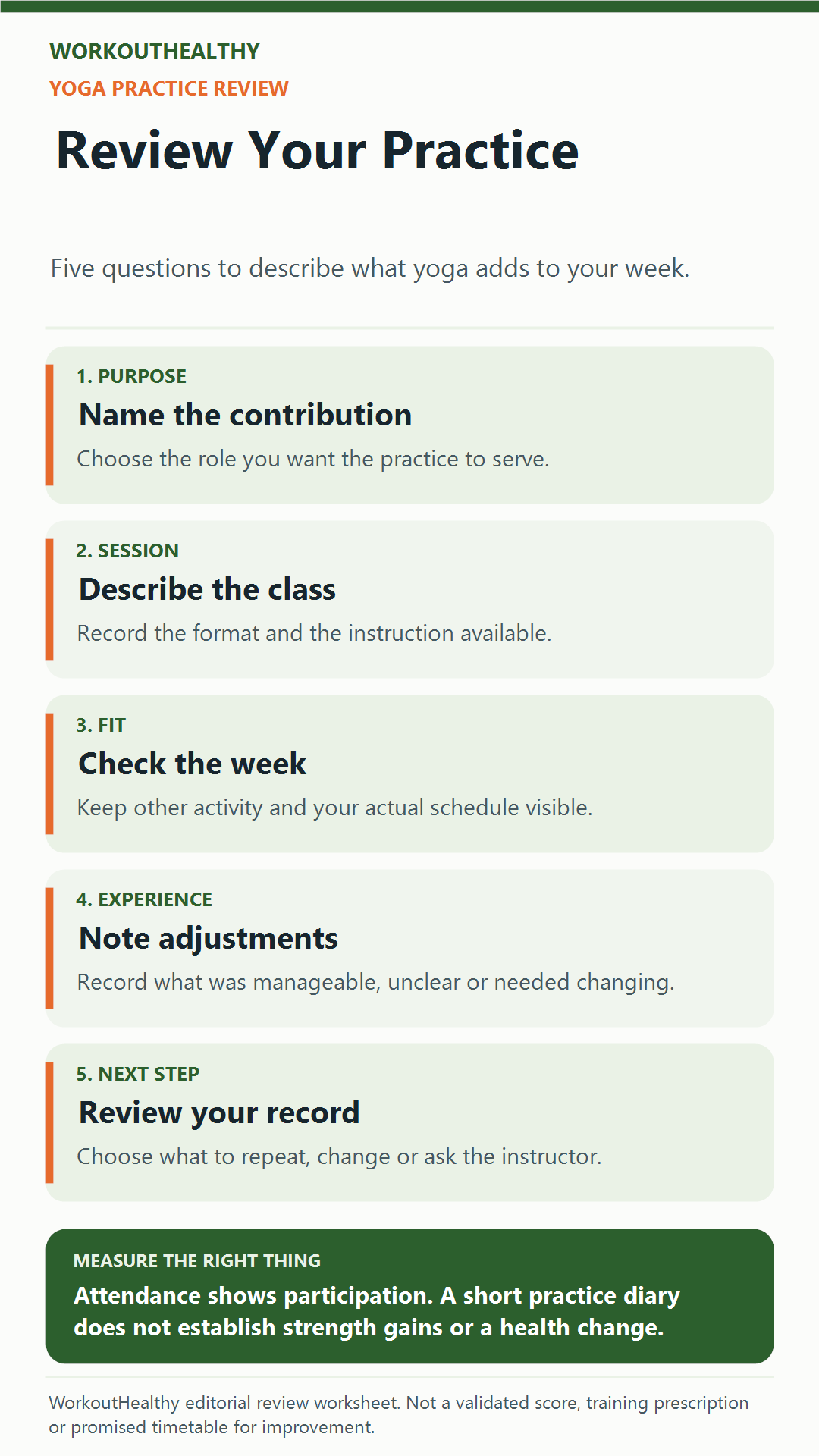
Use a two-week practice review
This is a WorkoutHealthy editorial planning aid, not a validated score or a test of whether yoga “counts.” It is intended to help you describe an appropriate class and its place in your week.
- Purpose: Write the contribution you want from the practice.
- Session: Record the actual class, its format and the instruction available.
- Fit: Check how it fits alongside your other activity and ordinary schedule.
- Experience: Note what was manageable, unclear or needed adjustment.
- Next step: Decide what to repeat, change or ask the instructor.
For example, a person might want to learn a suitable introductory practice while keeping two existing strength sessions. Their record could describe attendance, the movements that needed clarification and any conflict with the calendar.
That is an account of the plan’s usability, not evidence of a two-week physiological transformation. Avoid converting the diary into a promised timetable for strength gains.
When reviewing progress, compare like with like. If you use a repeatable strength task, document the same conditions and the result; if your goal is attendance, count completed sessions.
Our fitness basics guide offers a broader framework for checking training progress. A single class description cannot explain every factor behind a stalled result.
Choose what the practice should add to your week, then review that contribution honestly.
A four-week strength log
Use this blank record alongside the two-week class-fit review above if your goal is measurable progress. Start with an option that feels controlled and repeat a comparable session each week rather than changing every variable at once.
| Week | Push support: option and seconds | Leg task: option and seconds or reps | Side support: left and right seconds | Technique, soreness, and recovery |
|---|---|---|---|---|
| 1, starting point | Record | Record | Record | Record |
| 2 | Record | Record | Record | Record |
| 3 | Record | Record | Record | Record |
| 4 | Record | Record | Record | Record |
Increase a hold modestly or move to a harder variation only when you can breathe normally and repeat the position without pain. If the log stalls, check sleep, weekly workload, and the actual task before treating one number as failure.
The log is an original planning tool, not a validated strength test or a promise of improvement after four weeks. Its main value is showing whether your chosen practice is repeatable and whether a separate strength goal needs more direct resistance work.
The takeaway
Yoga can involve meaningful muscular effort, and a small controlled study reported improvements in specific strength measures. The size, population and design of that study should travel with the claim.
The reader conversation illustrates several views about yoga. Its historical percentages lack the recorded denominator needed for independent verification, so they should not carry a population-wide headline.
Choose an appropriate class, preserve the training structure that serves your goals and record what the practice actually contributes. That is more useful than deciding every outcome from the word “workout.”
The original comment analysis was published on workouthealthy.com in August 2024, written by Alexandra Carandang, and moved here in August 2026. This revision clarifies the statistics and adds research context.
Get the next evidence check.
Five practical fitness stories worth your time, every Friday.
One email a week. No product pitches. Unsubscribe in one click.
References
American College of Sports Medicine. (2026, March 17). ACSM unveils landmark 2026 resistance training guidelines: First update in 17 years. https://acsm.org/resistance-training-guidelines-update-2026/
Bhunia, G. B., & Ray, U. S. (2024). Improvement in muscular strength, body flexibility and balance by yogasana and with reduced detraining effects by yoga breathing maneuvers: A non-randomized controlled study. Journal of Ayurveda and Integrative Medicine, 15(1), Article 100815. https://doi.org/10.1016/j.jaim.2023.100815
Kothari, R., Mittal, G., A, P., & Bokariya, P. (2023). Exploring the effect of yoga on exercise endurance as assessed by cardiorespiratory efficiency tests in exercise physiology laboratory: A pilot study. Cureus, 15(4), Article e38283. https://doi.org/10.7759/cureus.38283
National Center for Complementary and Integrative Health. (n.d.). Yoga: Effectiveness and safety. https://www.nccih.nih.gov/health/yoga-effectiveness-and-safety
WorkoutHealthy. (2024, May 29). Is yoga really a workout? [Facebook post]. Facebook. Original discussion
Fitness note: This article offers general practice information, not an individual training or medical plan. If you have an injury, ongoing pain, pregnancy, or a medical condition, ask a qualified clinician and yoga instructor about suitable options.