

A popular Facebook claim says that ten extra minutes of walking a day was tied to a 15% lower risk of death. The larger body of research supports a useful direction, but it does not establish one guaranteed benefit from one exact ten-minute dose.
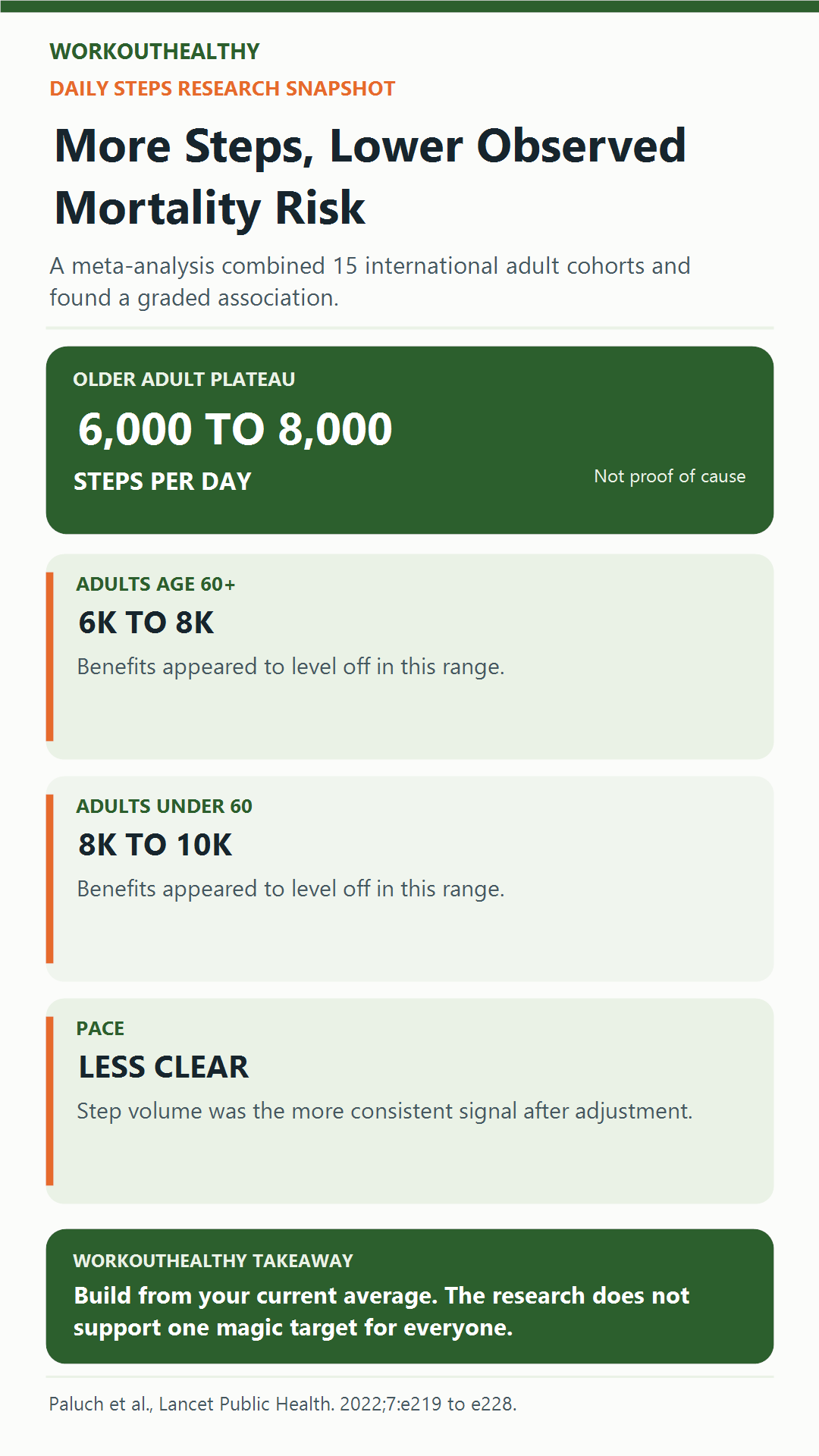
The clearest evidence counts daily steps rather than promising a fixed result from a timer. A 2022 meta-analysis pooled 15 international cohorts and found that higher daily step counts were associated with progressively lower all-cause mortality risk (Paluch et al., 2022).
The useful target is more movement than your current baseline, not a magic number copied from someone else.
What the meta-analysis found
Among adults age 60 and older, the association appeared to level off around 6,000 to 8,000 steps per day. Among adults younger than 60, it appeared to level off around 8,000 to 10,000 steps per day (Paluch et al., 2022).
Those ranges do not mean a person below them has failed or a person above them gains nothing. They describe where the pooled curves flattened in observational data, not a daily prescription.
Why the 15% claim needs context
Minutes and steps are related, but they are not interchangeable. Ten minutes might add a few hundred steps during an easy stroll or well over 1,000 during a brisk walk, depending on pace and the person.
A relative risk percentage also does not tell you an individual’s absolute risk. Age, smoking, illness, medication, fitness, and many other factors influence both how much someone walks and their long-term health.
That is why the safest wording is “associated with,” not “prevents.” People who walk more may differ in important ways that researchers cannot fully remove from observational comparisons.
Daily volume mattered more than one perfect pace
The meta-analysis found a consistent association for total steps, while the results for stepping rate after accounting for step volume were mixed. Peak stepping rates measured over 30 or 60 minutes remained associated with mortality, but time above common pace thresholds generally did not.
Ordinary accumulated movement still matters, even when every walk is not brisk.
Brisk walking still helps build aerobic activity, and current federal guidance recommends at least 150 minutes of moderate-intensity activity each week for adults. The CDC also emphasizes that some activity is better than none (Centers for Disease Control and Prevention, 2023).
If you want to translate steps into distance, our guide to how many miles to walk each day explains why stride length and goals change the answer. You can also use short movement breaks to interrupt long sitting.
The WorkoutHealthy step-floor rule
Find your normal seven-day average, then set a floor that is slightly higher and realistic on a busy day. Keep that floor for two weeks before increasing it again.
The floor should feel repeatable, not heroic. A ten-minute walk is valuable when it helps you clear the floor consistently, but the timer is a tool rather than the outcome.
Look at the weekly pattern instead of judging one imperfect day. Weather, work, recovery, and caregiving can all move the number without changing your longer-term direction.
Make the increase easier to keep
Attach walking to something that already happens, such as lunch, a phone call, school pickup, or the end of the workday. A reliable cue removes the need to make a fresh decision every time.
Indoor laps, errands, and short walking breaks count toward daily volume just as outdoor walks do. The research measured accumulated steps, not scenic routes or uninterrupted exercise sessions.
If pain, balance concerns, or severe fatigue limit walking, choose an amount and surface that fit your ability. A clinician or physical therapist can help adapt the plan when symptoms make ordinary progression difficult.
A small walk earns its place by being repeatable enough to become part of your life.
The bottom line
More daily steps were associated with lower mortality risk across a large pooled dataset, with different plateau ranges by age. That supports gradual increases in walking, but not a guaranteed 15% result from exactly ten extra minutes.
Get the next evidence check.
Five practical fitness stories worth your time, every Friday.
One email a week. No product pitches. Unsubscribe in one click.
References
Centers for Disease Control and Prevention. (2023, December 20). Adult activity: An overview. https://www.cdc.gov/physical-activity-basics/guidelines/adults.html
Paluch, A. E., Bajpai, S., Bassett, D. R., Carnethon, M. R., Ekelund, U., Evenson, K. R., Galuska, D. A., Jefferis, B. J., Kraus, W. E., Lee, I.-M., Matthews, C. E., Omura, J. D., Patel, A. V., Pieper, C. F., Rees-Punia, E., Dallmeier, D., Klenk, J., Whincup, P. H., Dooley, E. E., … Fulton, J. E. (2022). Daily steps and all-cause mortality: A meta-analysis of 15 international cohorts. The Lancet Public Health, 7(3), e219 to e228. https://doi.org/10.1016/S2468-2667(21)00302-9
Medical disclaimer: This article is general product information, not medical advice. The equipment described here is not a treatment for any condition. If you have an injury, ongoing pain, or a medical condition, talk to a doctor or physical therapist before using any of it.