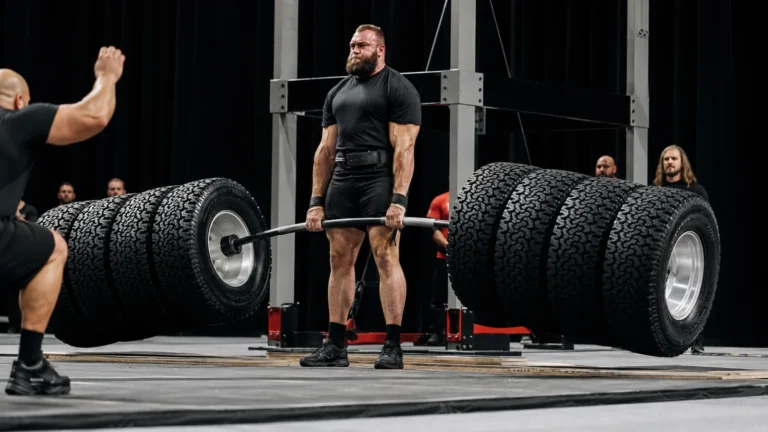

Floor press vs bench press: the short answer
A floor press stops the lowering phase when the upper arms meet the floor, while a bench press usually lets the elbows travel farther below the torso. That changes the bottom range, setup and movement you practice, whether the load is a barbell or dumbbells.
Neither exercise is automatically safer or better for every goal. Use the four-variant table to choose based on equipment, pressing goal and which movement you can control without pain.
Compare all four versions
| Version | Equipment and setup | Bottom position | Practical use and limit |
|---|---|---|---|
| Barbell floor press | Barbell plus a rack and appropriately set safeties or a capable spotter for challenging loads | Upper arms meet the floor; fixed hand spacing | Practice a shorter press with a barbell, but safe unracking and getting out from under the bar matter. |
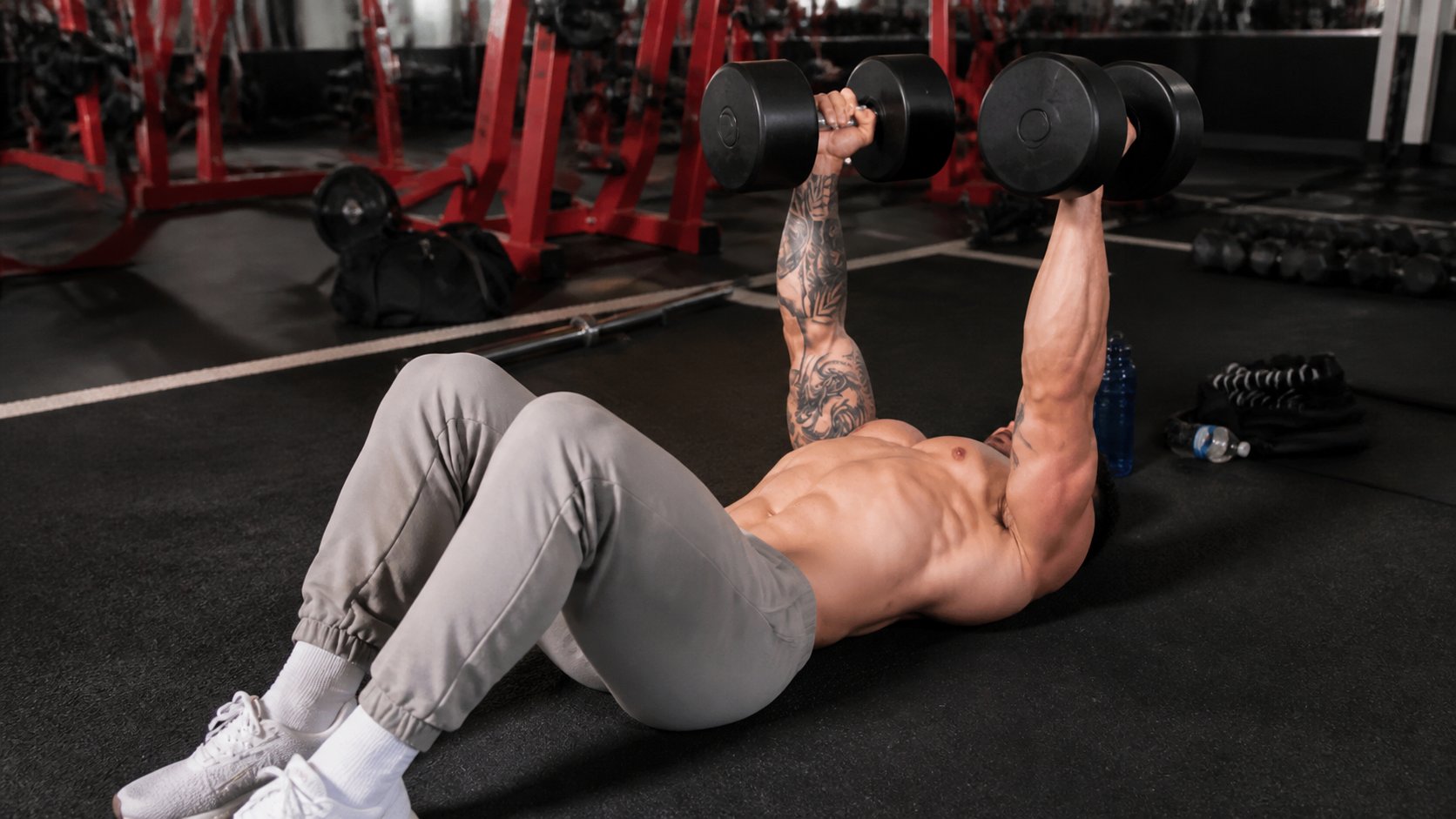
| Dumbbell floor press | Floor and two dumbbells; heavy weights can be awkward to get into position | Upper arms meet the floor; hand angle can vary | Useful when there is no bench or you want each arm to move independently; setup can limit load. |
| Barbell bench press | Bench, barbell and rack; use a spotter or safeties when appropriate | Elbows can move lower as the bar approaches the chest | Specific choice when improving the barbell bench press itself is the goal. |
| Dumbbell bench press | Bench and two dumbbells; plan how to bring weights up and end the set | Elbows can move lower than on the floor, within a range you control | Independent arm paths and grip options, but heavy setup still needs care. |
The table describes typical setups, not a requirement to press through the deepest possible bench range. Grip, body proportions, equipment and symptoms can change the comfortable position for a particular lifter.
What the floor changes mechanically
On a bench, the upper arm can descend past the torso before you reverse the weight. On the floor, contact with the ground usually ends that descent earlier, which makes the press a different range of motion rather than simply a bench press without furniture.
A controlled, quiet touch of the upper arms on the floor can create a repeatable bottom position. Do not slam the elbows into the ground or rebound from it to start the next rep.
Your lower-body position also changes: a bench setup can use a stable foot position and leg drive, while floor pressing uses a different support surface. The floor does not mean the legs are completely uninvolved, and a heavier number in one version should not be treated as a direct test of strength in another.
What the evidence does and does not prove
In a 2019 study of 42 strength-trained men, shorter barbell bench press ranges changed load and velocity measurements, with one-repetition maximum values increasing as tested range decreased. This was a study of partial bench presses, not of barbell or dumbbell floor presses.
A separate 10-week training study in 50 men found that full-range barbell bench practice produced larger improvements across the bench variations tested than the partial-range programs. Its results support practicing the full bench movement when that is the performance goal, but do not establish a floor-press injury rate or prove that floor pressing cannot build muscle.
Muscle activation and force findings from bench-range experiments are also indirect for floor pressing. They should not be turned into a claim that the floor press is a guaranteed triceps exercise, a cure for shoulder pain, or incapable of training the chest.
Choose by goal and equipment
- You compete in or want to improve barbell bench pressing: Keep appropriately loaded barbell bench practice as the main skill when you can perform it comfortably, and use floor pressing as an optional accessory.
- You have dumbbells but no bench: The dumbbell floor press offers a practical horizontal press, provided you can get the weights into and out of position without struggling.
- You want a shorter, repeatable bottom position: Try a floor variation with light load and controlled contact; keep it only if the movement fits your goal and feels tolerable.
- You want a longer controlled press for general training: A bench variation gives that option, but the range you use should remain controlled and symptom-free.
For general muscle and strength goals, either movement can be part of a progressive program. A single exercise does not determine the outcome on its own; the plan, load, practice and recovery also matter.
What if the bench press bothers your shoulder?
The shorter bottom range of a floor press may feel different, but it is not a diagnosis or a promise of shoulder safety. Stop a variation that causes sharp pain, worsening symptoms, or loss of control.
If you are returning from surgery or have ongoing shoulder symptoms, follow the advice of the clinician managing your care before changing the range or load. Forum stories about what felt good for someone else cannot establish what is appropriate for your shoulder.
A qualified coach can help with a movement setup after you have medical guidance where needed. Our guide to deciding whether a trainer is worth it explains what useful coaching should provide.
A simple floor-press fit test
Start with a load you can control easily and make a few deliberate repetitions. Keep the version only if both upper arms contact the floor quietly, your wrists stay in a comfortable position, and you can finish the set without sharp pain.
If the setup is harder than the press, reduce the weight or change the exercise. This is a practical quality check, not a clinical test or a prescription to train through symptoms.
Set up and finish safely
Dumbbells on the floor
Sit with the dumbbells near your thighs, bring them onto the legs one at a time, then roll back while guiding them close to your body. Begin with a manageable pair so the setup does not become an uncontrolled curl or a drop onto the floor.
At the end of the set, bring the dumbbells back toward your torso before sitting up or ask a capable partner for help. Do not fling heavy weights sideways in a shared training space.
Barbell on the floor
Set the rack so the bar can be unracked and reracked from your floor position without reaching or twisting, and use safeties or an appropriate spotter for challenging loads. Do not get under a loaded bar when you lack a reliable way to end a failed rep.
A reliable training partner can help with a setup, but a partner is only useful for spotting when they know the task and can do it safely. A rack with properly placed safeties may be the more dependable solution.
Frequently asked questions
Does floor press build chest muscle?
It is a pressing exercise that uses the chest along with other muscles. The shorter bottom range may change the stimulus, but the cited partial-bench studies do not directly measure floor-press chest growth.
Is the floor press safer for shoulders?
It may be more comfortable for some people because the bottom range is limited, but no universal safety conclusion follows. Pain or postsurgical concerns need individual medical guidance.
Can floor press replace bench press?
It can serve as your main horizontal press when it fits your equipment and goal. If your goal is a stronger competition-style barbell bench press, you will still need to practice that specific movement when it is appropriate for you.
Get the next evidence check.
Five practical fitness stories worth your time, every Friday.
Weekly email with no product pitches. Unsubscribe in one click.
References
- Martínez-Cava and colleagues, 2019, bench press load-velocity measurements at different ranges of motion.
- Martínez-Cava and colleagues, 2022, 10-week full versus partial barbell bench press training study.
This article is general training information, not medical advice. If pressing causes pain or you are returning after an injury or surgery, ask a qualified clinician about the range and load suitable for you.