

A widely shared claim says losing your sense of smell was tied to a 46 percent higher risk of dying within ten years. That number is real, but the study involved older adults and found an association, not proof that smell loss causes death (Liu et al., 2019).
The distinction matters because a change in smell can have many explanations. It can follow an infection, nasal disease, head injury, medication change, or aging, and it can also appear alongside neurological disease.
Smell loss can be a useful health signal without being a diagnosis or a prediction about one person.
What the 2019 cohort study found
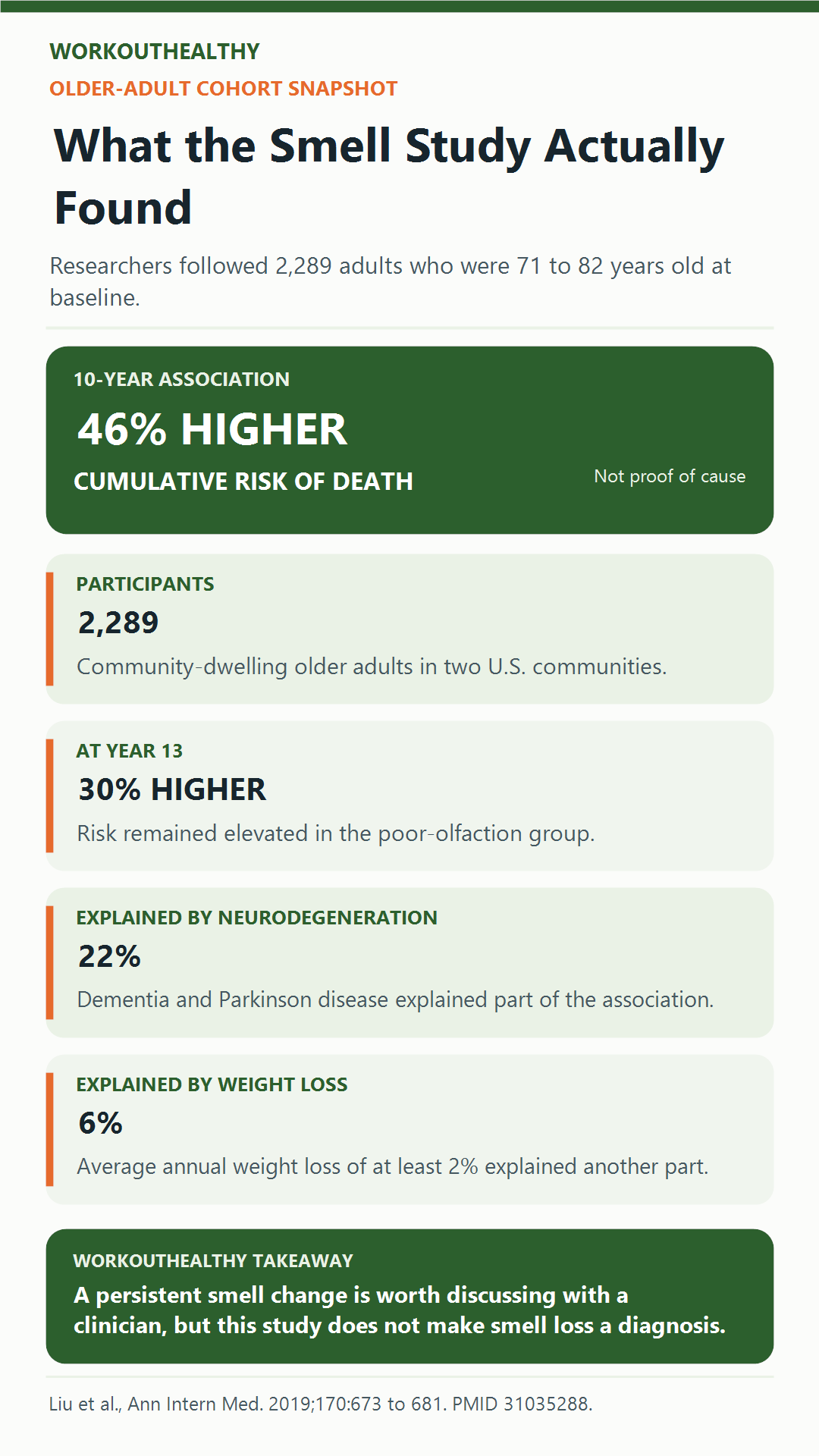
Researchers followed 2,289 community dwelling adults who were 71 to 82 years old at baseline. Compared with participants who had good olfaction, those with poor olfaction had a 46 percent higher cumulative risk of death at year ten and a 30 percent higher risk at year thirteen (Liu et al., 2019).
Neurodegenerative diseases explained 22 percent of the higher ten year mortality association, while weight loss explained another 6 percent. The researchers emphasized that these factors explained only part of the relationship (Liu et al., 2019).
The study was observational, so it cannot show that poor smell directly caused the outcomes. You can read the abstract through PubMed, PMID 31035288.
What the study does not mean
A relative increase in a research group is not a personal countdown. The study did not show that every participant with poor smell had the same risk, and it did not identify one cause that applied to everyone.
The participants were adults aged 71 to 82 at the start, so the finding should not be transferred directly to younger people. It is most useful as evidence that smell function can carry health information in older adulthood (Liu et al., 2019).
Observational research can reveal a pattern while leaving several explanations open. Existing disease, nutrition, aging, and other unmeasured factors may influence both smell and later health.
The WorkoutHealthy persistence rule
The original value is a simple decision rule: a persistent, unexplained change in smell deserves attention even when you otherwise feel well. Note when it began, whether it followed an illness or injury, and whether taste, appetite, or body weight changed too.
That information is more useful to a clinician than trying to interpret one mortality statistic on your own. The National Institute on Deafness and Other Communication Disorders explains that an evaluation may include medical history, an ear, nose, and throat examination, and smell testing.
Common reasons smell can change
Smell problems can follow respiratory infections, nasal growths, head injury, chemical exposure, certain medications, dental problems, and aging. They can also occur with conditions that affect the nervous system (National Institute on Deafness and Other Communication Disorders, n.d.).
That range of possibilities is why a single internet statistic cannot diagnose the cause. A clinician can connect the timing and pattern of the change with an examination and, when appropriate, formal smell testing.
Prepare for a useful appointment
Write down whether the change was sudden or gradual, complete or partial, and present in one or both nostrils. Include recent infections, injuries, medication changes, nasal symptoms, and any change in taste, appetite, or weight.
Also mention whether the problem affects cooking, eating, work, or home safety. Concrete examples help a clinician understand the impact without relying on a vague label such as weak smell.
Why nutrition and safety matter
Smell contributes to flavor, so a reduced sense of smell can make food less appealing. That may affect appetite and weight, especially in older adults who already have trouble eating enough protein and calories.
Our article on losing weight and muscle mass explains why unplanned weight changes deserve context. Regular movement also supports function, and our guide to daily walking mileage offers a flexible starting point.
Smell loss can also make smoke, gas, or spoiled food harder to detect. Working alarms, food date checks, and help from another person can add protection while the cause is being evaluated.
The right response to a concerning association is not panic. It is better observation, sensible safety steps, and appropriate medical follow up.
Get the next evidence check.
Five practical fitness stories worth your time, every Friday.
One email a week. No product pitches. Unsubscribe in one click.
References
Liu, B., Luo, Z., Pinto, J. M., Shiroma, E. J., Tranah, G. J., Wirdefeldt, K., Fang, F., Harris, T. B., & Chen, H. (2019). Relationship between poor olfaction and mortality among community-dwelling older adults: A cohort study. Annals of Internal Medicine, 170(10), 673 to 681. https://doi.org/10.7326/M18-0775
National Institute on Deafness and Other Communication Disorders. (n.d.). Smell disorders. Retrieved August 30, 2026, from https://www.nidcd.nih.gov/health/smell-disorders
Medical disclaimer: This article is general product information, not medical advice. The equipment described here is not a treatment for any condition. If you have an injury, ongoing pain, or a medical condition, talk to a doctor or physical therapist before using any of it.