

How late is too late for caffeine?
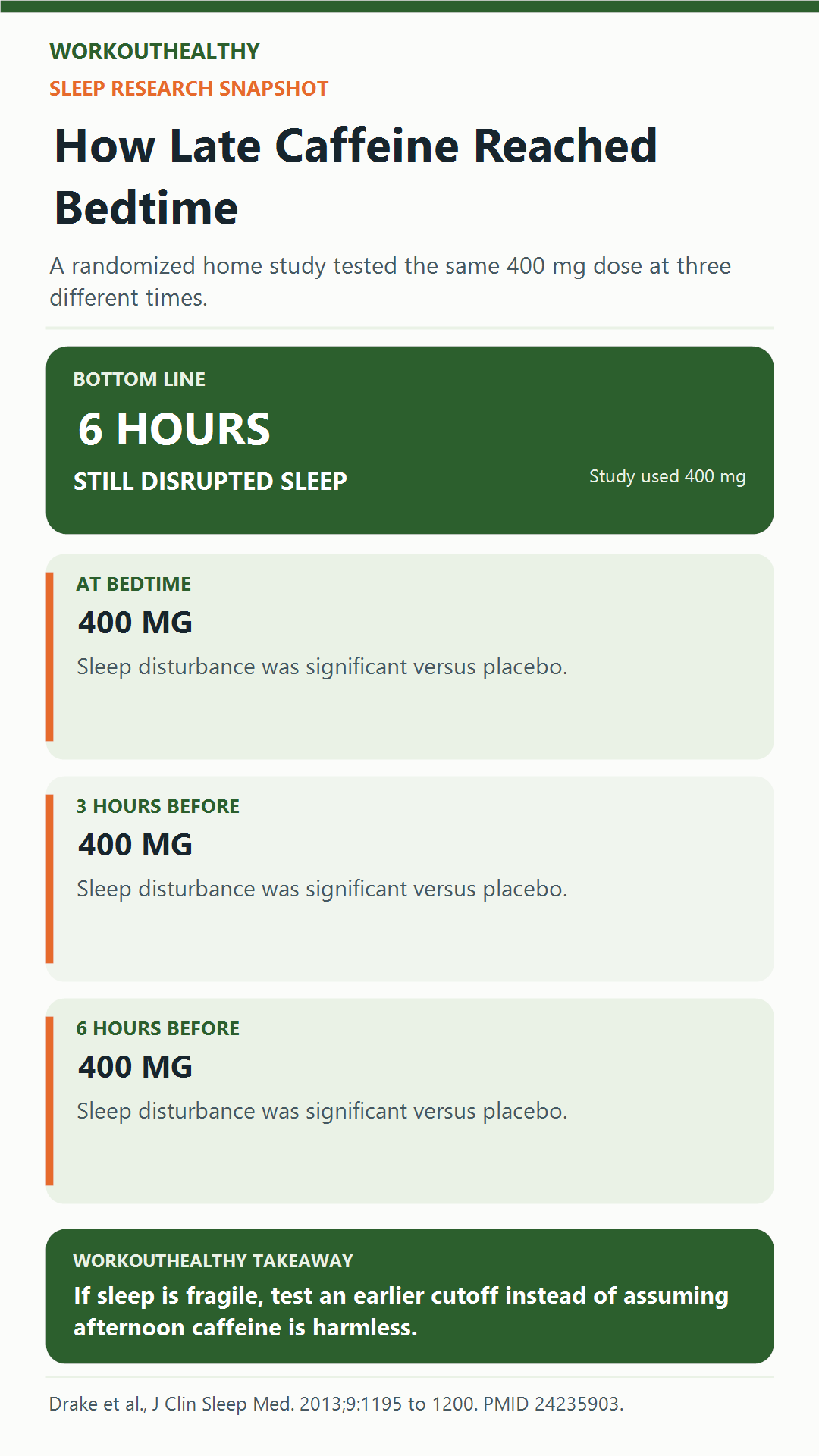
There is no clock time that protects everyone’s sleep: the dose, your usual bedtime, and your response all matter. In a randomized study, a single 400 mg dose disrupted sleep even when taken six hours before bed, so “six hours before bed” is not a universal safe cutoff.
For a 10 pm bedtime, six hours before bed is 4 pm; that is a way to interpret the study timing, not a recommendation to take caffeine at 4 pm. The practical step is to record all caffeine sources and test whether an earlier final dose improves your sleep over several comparable nights.
What the six-hour sleep study actually tested
In Drake and colleagues’ randomized home study, participants received a fixed 400 mg caffeine dose at bedtime, three hours before bedtime, or six hours before bedtime, compared with placebo. Sleep disturbance was significant at all three times.
The trial does not establish what would happen with every smaller dose, a different population, or repeated drinks spread across a day. It also does not identify a universal latest time for coffee or pre-workout supplements.
Use bedtime and dose together
A time-only rule can hide the amount you consumed. A morning coffee, afternoon energy drink, and pre-workout product can add up even when none appears unusually large by itself.
The US Food and Drug Administration cites 400 mg per day as an amount not generally associated with negative effects for most adults. That is a general population reference, not a sleep-timing guarantee or an appropriate target for everyone.
Use the amount printed for the serving you actually take, then check the container’s serving size. The FDA notes that caffeine can also appear in energy drinks, bars, dietary supplements, and some over-the-counter medicines, while drinks sold by cafés may not disclose an exact amount.
Fill in a caffeine and bedtime worksheet
First write your usual bedtime: _____. For each item, multiply the label’s milligrams per serving by the number of servings you used, then record the time you finished it.
| Product | mg per serving | Servings used | mg consumed | Finished at |
|---|---|---|---|---|
| Coffee or tea | _____ | _____ | _____ | _____ |
| Energy drink or soda | _____ | _____ | _____ | _____ |
| Pre-workout or supplement | _____ | _____ | _____ | _____ |
| Other caffeine source | _____ | _____ | _____ | _____ |
Daily total: _____ mg. Time between final caffeine and bedtime: _____ hours.
If a product’s caffeine amount is unknown, mark it “unknown” instead of treating it as zero. A total with an unknown item is an incomplete estimate.
Example: coffee plus a late pre-workout
Suppose a person’s own product labels show 120 mg in an 8 am coffee, 100 mg in a 2 pm drink, and 180 mg in a pre-workout finished at 4 pm. Their example day totals 400 mg, and the final caffeine is six hours before a 10 pm bedtime.
Those amounts are hypothetical label values, not standard amounts for those product types. The example is not equivalent to the study’s single 400 mg dose, but it shows why meeting the FDA’s general daily reference does not answer the separate sleep question.
Try a careful one-week cutoff check
If you already use caffeine late and suspect it affects sleep, write down your current routine for a few ordinary nights. Then move the final caffeine earlier for several nights while keeping bedtime, wake time, and total caffeine as similar as practical; do not add a late dose just to create a comparison.
| Night | Bedtime | Total caffeine / last time | Minutes to fall asleep | Awakenings | Morning rested? 0 to 5 |
|---|---|---|---|---|---|
| Usual 1 | _____ | _____ | _____ | _____ | _____ |
| Usual 2 | _____ | _____ | _____ | _____ | _____ |
| Earlier 1 | _____ | _____ | _____ | _____ | _____ |
| Earlier 2 | _____ | _____ | _____ | _____ | _____ |
Several similar nights are more informative than one unusually stressful evening, but a home log cannot diagnose a sleep disorder or prove caffeine caused a change. Note major changes in alcohol, illness, late meals, or schedule so you do not attribute every difference to caffeine.
If your main goal is to reduce your total dose, do it gradually when possible because the FDA notes that abrupt caffeine withdrawal can be unpleasant. An afternoon walk or a break from sitting can be an activity option when you do not want another caffeinated drink.
Why feeling fine at bedtime can mislead you
Caffeine blocks adenosine receptors involved in sleep pressure, which can make you feel less sleepy without removing the underlying need for sleep. The study measured sleep after caffeine, not merely whether participants felt alert.
Responses differ across people, and the FDA specifically notes that sensitivity and elimination speed vary. A familiar dose that seems harmless to a friend is not evidence that it leaves your own sleep unchanged.
When to seek medical advice
Talk with a health professional if you have persistent insomnia, severe daytime sleepiness, or sleep problems that affect safety. Loud snoring or breathing pauses also deserve evaluation rather than another change to coffee timing.
Ask your clinician about caffeine if you are pregnant or breastfeeding, take medication that may interact with it, or have a condition that may change your sensitivity. The FDA says those circumstances can call for individual limits.
Frequently asked questions
Is caffeine six hours before bed safe for sleep?
No universal conclusion follows from that timing. The 2013 trial found significant sleep disruption after 400 mg taken six hours before bedtime, while different doses and individual responses may differ.
Does 400 mg a day mean my sleep is protected?
No. The FDA’s 400 mg statement concerns an amount not generally associated with negative effects for most adults, while the sleep study examined timing of a substantial single dose.
Does pre-workout caffeine count with coffee?
Yes. Add the labeled caffeine from every serving you consume, including pre-workout, energy drinks, and other supplements, then consider when the final serving was taken.
Get the next evidence check.
Five practical fitness stories worth your time, every Friday.
Weekly email with no product pitches. Unsubscribe in one click.
References
- Drake C, Roehrs T, Shambroom J, Roth T. Caffeine effects on sleep taken 0, 3, or 6 hours before going to bed. Journal of Clinical Sleep Medicine. 2013.
- US Food and Drug Administration. Spilling the Beans: How Much Caffeine is Too Much?
This article is general health information, not a diagnosis or individualized medical advice. A clinician can help if sleep problems persist or caffeine raises concerns related to your health or medicines.