

No, sauna does not count as cardio. Sitting in a hot sauna can raise your heart rate, but it does not count as the aerobic physical activity in the federal activity guidelines.
Sauna use may affect blood pressure and other cardiovascular measures, and researchers are studying whether it adds to the benefits of exercise. It should be considered an optional heat exposure, not a substitute for walking, cycling, swimming, or another activity that moves your body.
Sauna versus cardio: what actually changes?
| Question | Sauna | Aerobic exercise |
|---|---|---|
| Does heart rate rise? | Often, as the body responds to heat. | Usually, as working muscles demand more oxygen. |
| Can blood pressure change after a session? | Yes, short-term changes have been measured. | Yes, short-term changes have been measured. |
| Does it count toward weekly aerobic activity minutes? | No, passive heat is not an aerobic activity. | Yes, when the activity reaches moderate or vigorous intensity. |
| Does this evidence show it replaces fitness training? | No direct evidence establishes that substitution. | Repeated exercise improves cardiorespiratory fitness in trials. |
The key distinction is the source of the demand. In a sauna, your body sends more blood toward the skin to release heat; during exercise, moving muscles also use energy and oxygen while you practice the activity itself.
Why a high sauna heart rate is not a workout score
Heart rate is useful context, but the same number can reflect different stresses. Heat, dehydration, movement, and other factors can all change pulse without producing the same training response.
The practical test is your goal. If you want to build walking or cycling endurance, use walking or cycling as the training and judge progress by what you can do over time, not by the highest pulse you see while sitting in heat.
For a starting walking target, our pace and walking-time guide shows how to turn available minutes into an approximate route distance.
What the study ranking for this question actually tested
A 2021 crossover study of 72 adults with at least one cardiovascular risk factor compared two 30-minute sessions. One was sauna alone at 75°C; the other was 15 minutes of cycling followed by 15 minutes of sauna.
Researchers measured short-term blood pressure and vascular changes, including a follow-up 30 minutes after each session. They did not compare sauna with cycling alone or test whether either session improved endurance after weeks of training.
Some immediate measures looked similar, while the timing and direction of blood pressure changes differed between conditions. That makes the study useful for understanding an acute response, but it cannot show that sauna minutes should replace aerobic exercise minutes.
Could sauna add anything to an exercise routine?
A separate eight-week randomized trial assigned 47 adults with low activity and at least one cardiovascular risk factor to exercise plus post-exercise sauna, exercise alone, or a control group. The exercise groups improved cardiorespiratory fitness, and the group adding sauna showed some additional changes in fitness, systolic blood pressure, and cholesterol compared with exercise alone.
That trial tested sauna with exercise, not sauna instead of exercise. Its small size and specific participants limit how widely the result can be applied, but it offers a more useful question than “Can heat replace cardio?”
What the Finnish mortality study can and cannot prove
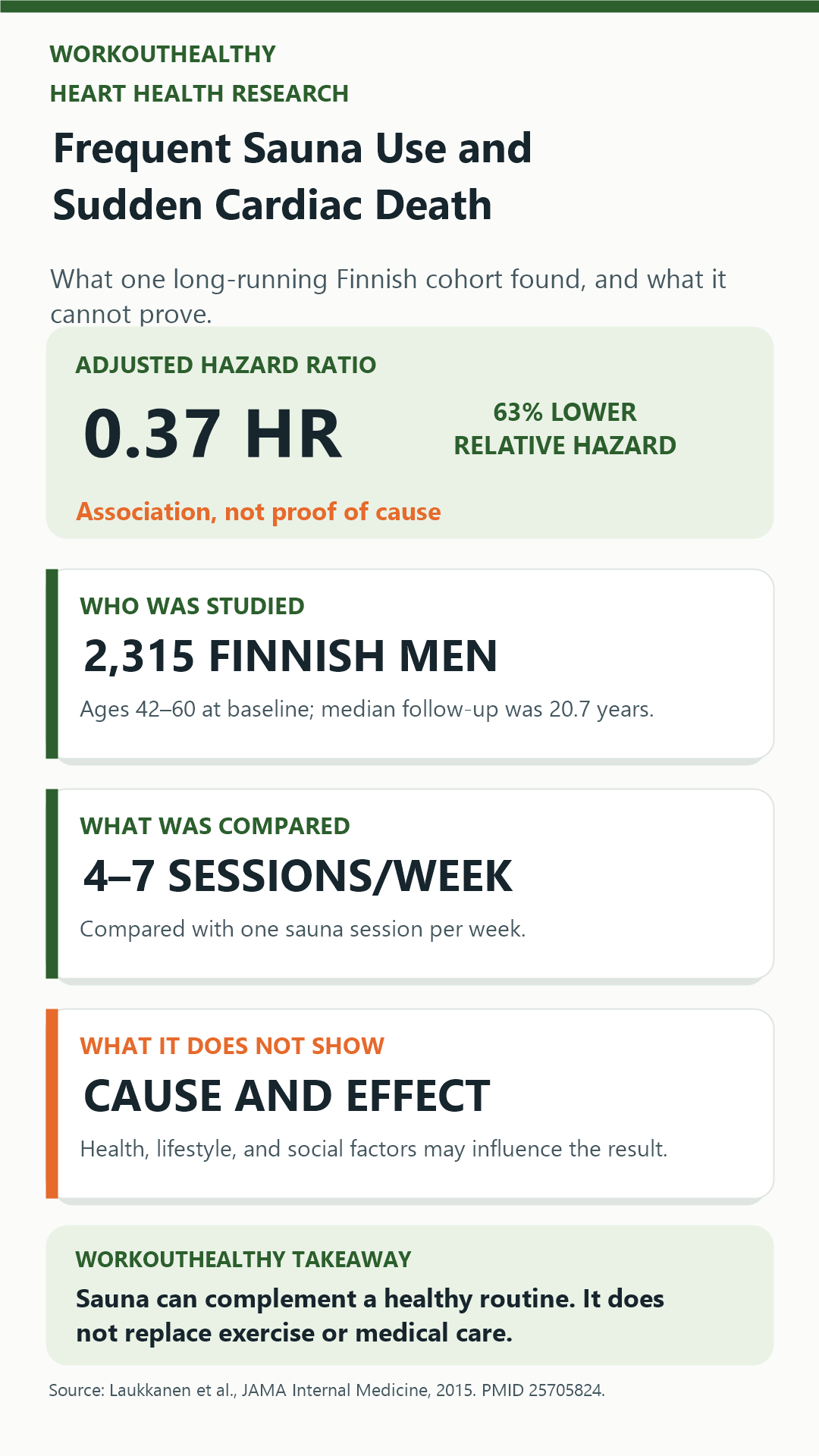
The sauna result often cited in headlines comes from a 2015 study of 2,315 middle-aged Finnish men followed for a median of 20.7 years. Compared with men reporting one sauna session a week, men reporting four to seven had a lower rate of sudden cardiac death, with an adjusted hazard ratio of 0.37.
That is a strong association in this group, but it is not a treatment effect. The men were not randomly assigned to sauna schedules, and differences in health, activity, or social habits could have influenced the result.
The finding also does not establish the same outcome for women, people with different health histories, or every type of sauna. Keep the result in context when deciding whether sauna is worth your time.
How to choose between sauna and cardio
- For aerobic fitness: Keep actual movement in your plan. Brisk walking, cycling, or another activity you can repeat is the direct route to practicing endurance.
- For relaxation: Sauna may be an enjoyable separate habit if heat is appropriate for you, but do not count it as an exercise session.
- For heart or blood-pressure concerns: Ask your clinician before adding intense heat or changing exercise, especially if your condition or medications affect blood pressure.
If you use a sauna, leave if you feel dizzy, faint, or unwell, and avoid alcohol around the session. A clinical review identifies dehydration, low blood pressure, and the combination of sauna and alcohol as safety concerns.
Frequently asked questions
Does sauna count toward 150 minutes of exercise?
No. The guideline counts moderate or vigorous aerobic activity; sitting in heat does not supply those activity minutes.
Is a sauna heart rate of 150 the same as 150 during a run?
No. Matching pulse readings do not show matching muscle work, oxygen demand, or long-term training effects.
Can I use sauna after a workout?
Some people do, and the small randomized trial above tested that combination. It did not establish an ideal dose or prove that the added heat is appropriate for every person.
Sauna heat can produce real cardiovascular responses, but it does not count as cardio training. Treat it as a separate choice alongside a movement routine that fits your abilities and health.
This article is general fitness information, not medical advice. If you have a heart condition, low blood pressure, are pregnant, or have another health concern, ask a qualified clinician whether sauna heat is appropriate for you.