
A South African radio station recently ran a segment on an odd idea.
Radio 702 called it “the surprising benefits of walking in reverse.”
Radio 702 is a talk radio station based in Johannesburg, not a medical or sports science organization.
But the topic it picked is a real one.
Exercise scientists call this retro walking, and they have studied it for decades.
This article looks at what peer reviewed research actually says about walking backward, separate from what a radio host said about it.
Retro walking is a genuine, if fairly niche, corner of exercise science, mostly studied by physical therapy and rehabilitation researchers rather than mainstream sports medicine.
What the Video Claims
The video’s title promises “surprising benefits” from walking backward.
Radio 702 is a general entertainment and talk station, and its fitness segments are not peer reviewed sources.
A full transcript of the segment was not available for this article.
Segments like this one usually repeat a few common claims about backward walking: that it burns more calories than forward walking, that it works different leg muscles, and that it can ease knee pain.
Those claims are worth checking against the actual science instead of taking them on faith.
That is exactly what the rest of this article does.
What Real Research Shows About Knee Pain and Osteoarthritis
The strongest body of research on backward walking is about knee osteoarthritis, a condition where the cartilage inside the knee wears down over time.
A 2021 randomized controlled trial split people with knee osteoarthritis into two groups.
One group did a backward walking program, and the other group did standard exercise therapy.
The backward walking group ended up with less pain, better physical function, and better balance and joint position sense than the standard therapy group (Chen et al., 2021).
A 2026 systematic review pooled the results of multiple randomized trials on this exact question.
It found that adding backward walking to standard physical therapy reduced pain and disability more than standard therapy alone (Lin et al., 2026).
Across several randomized trials, adding backward walking to standard physical therapy reduced knee pain and disability more than standard therapy alone.
The evidence includes controlled trials and a meta-analysis, but the underlying studies are still limited in size and methods.
The results support backward walking as an option within rehabilitation, not a guaranteed pain treatment for every knee condition.
What Real Research Shows About Balance and Fall Risk
Balance is another area where backward walking has real research behind it.
A 2025 systematic review and meta-analysis looked specifically at backward walking training and fall risk in older adults (Kim & Lee, 2025).
It found that structured backward walking programs improved balance test scores compared to no training or to standard training alone.
A separate 2026 study measured how fast older adults could walk backward and compared that speed to standard balance tests.
People who walked backward more slowly also tended to score worse on the Timed Up and Go test, a common clinical measure of fall risk (Gong et al., 2026).
That connection makes sense once you think about what backward walking actually demands.
You cannot see where your feet are landing, so your brain has to lean more on balance and body position sense instead of vision.
What Real Research Shows About Metabolic Health
A smaller body of research has looked at backward walking and metabolic health.
A 2023 randomized study put overweight and obese young adults through eight weeks of treadmill based retro walking training.
The retro walking group saw a bigger drop in C-reactive protein, a marker of inflammation linked to heart disease risk, than a comparison group did (Soman et al., 2023).
The same study also reported improvements in body composition measures for the retro walking group.
This is one study, not a large body of evidence, so it is best read as a promising early finding rather than a settled fact.
It does line up with the general idea that backward walking asks more of your muscles than forward walking at the same speed.
The Mechanism
Backward walking is not just forward walking played in reverse.
It uses a genuinely different gait pattern.
When you walk forward, your heel strikes the ground first and your foot rolls forward onto your toes.
When you walk backward, the forefoot commonly contacts the ground first and your weight rolls back toward the heel.
This changes which muscles do most of the work.
Backward walking leans more on your quadriceps, the muscles on the front of your thigh, to control your knee as it straightens.
Researchers who study knee osteoarthritis think this shift is part of why backward walking helps.
One study measured the actual forces acting on the knee during backward walking and found a lower knee adduction moment, a measurement linked to pressure on the inner side of the knee joint, than during forward walking (Zhang et al., 2025).
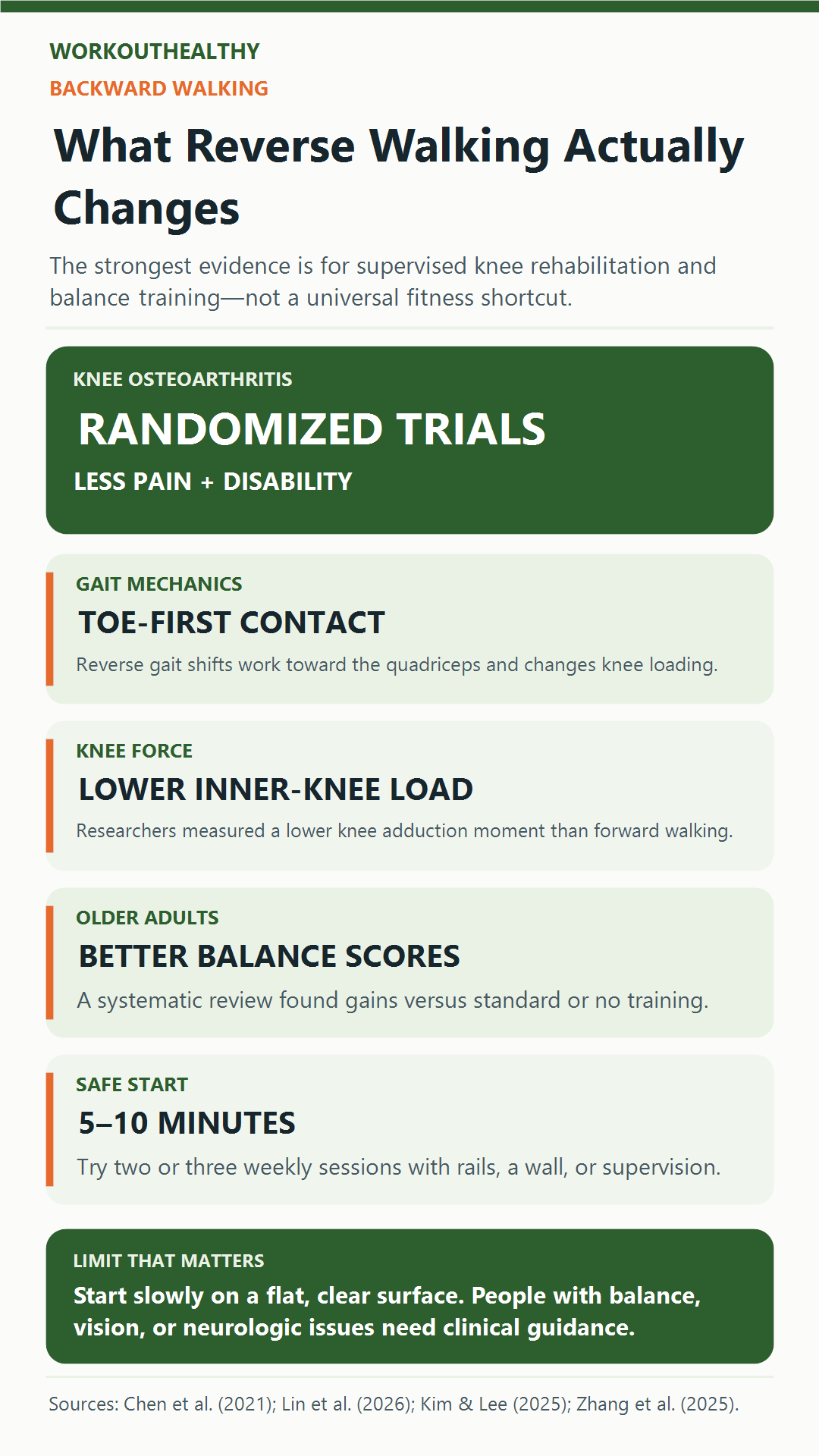
Lower pressure on that part of the knee matters, because that is usually the part that wears down first in knee osteoarthritis.
Researchers measuring knee forces found that backward walking placed noticeably less pressure on the inner side of the knee than forward walking did.
Backward walking also shortens your stride length and keeps your center of gravity lower.
That is part of why it demands more balance and coordination than forward walking does.
Because you cannot see where your feet are landing, backward walking also asks more of your vestibular system, the balance system located in your inner ear.
That is a likely reason researchers keep testing it specifically in older adults and in people with balance problems, rather than treating it as a general fitness trend.
What This Evidence Does Not Prove
None of this research says backward walking is better than forward walking for general fitness.
The knee osteoarthritis studies were done in people who already had diagnosed osteoarthritis, not in people with healthy joints.
The balance studies focused on older adults, not the general population.
The metabolic study followed young overweight adults for only eight weeks, which is too short to say anything about long-term weight loss or heart disease risk.
Laboratory comparisons have measured oxygen use during backward and forward walking at matched speeds. In one small study, backward walking produced a higher metabolic and cardiorespiratory demand under the tested treadmill conditions (Chaloupka et al., 1997).
That does not establish a universal calorie-burn advantage in daily life. Speed, slope, technique, and whether the person has practiced reverse walking all affect the comparison.
We also found no strong evidence that retro walking consistently improves ordinary upright posture in healthy adults. The balance and knee-rehabilitation findings should not be repackaged as proof of a general posture benefit.
Sample sizes in this field are also still fairly small, and more research would help confirm these early findings.
Common Mistakes
The biggest mistake is trying backward walking outdoors or on a treadmill without support the first few times.
You cannot see obstacles behind you, so a curb, a pet, or a piece of furniture becomes a real trip hazard.
Many people also walk backward too fast before their coordination catches up.
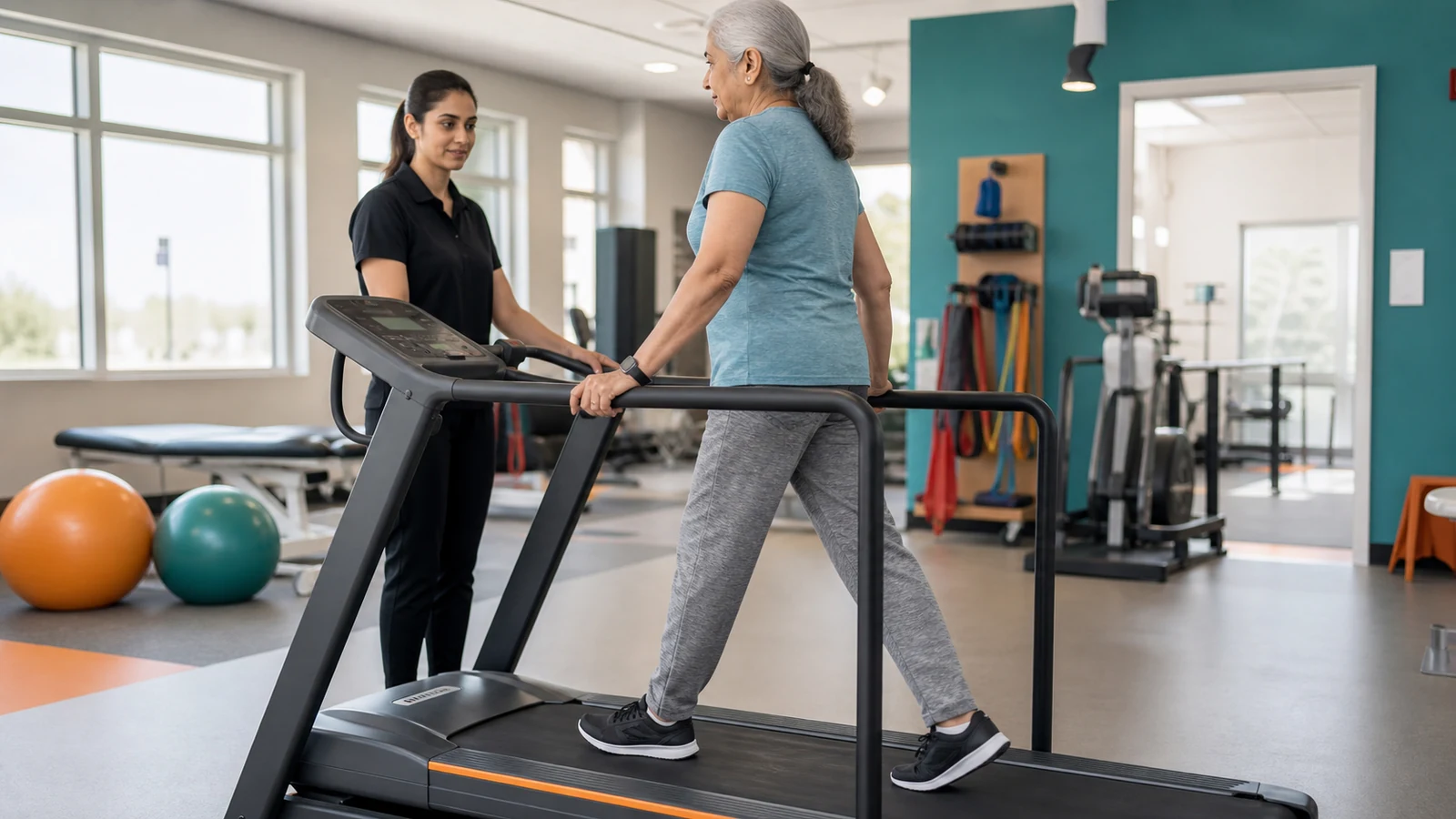
Start slow, on a flat, open, obstacle-free surface, or hold a treadmill handrail until you feel steady.
Another mistake is skipping a warm-up, since backward walking uses your quadriceps and calves differently than forward walking does.
Cold, unwarmed muscles are more likely to feel strained the next day.
Some people also treat backward walking as a full replacement for their normal training instead of an addition to it, including their regular strength work, and our piece on why most readers already favor weightlifting over running covers why that kind of training still matters most.
Doing backward walking on stairs, on uneven ground, or in a cluttered garage is another common mistake, since none of the research behind this article was done in those settings.
Stick to a flat, predictable surface, especially in your first few weeks.
Who Should Be Extra Careful
Anyone with a balance disorder, an inner ear condition, or a history of falls should talk to a doctor before adding backward walking.
The same goes for anyone recovering from a recent knee, hip, or ankle surgery.
If you have had a hip replacement, the kind of careful, staged return to movement described in our Misty Copeland hip replacement recovery article applies here too, and backward walking should only start once a surgeon or physical therapist clears it.
People with severe knee osteoarthritis and significant pain should also check with a physical therapist first, even though research supports backward walking for milder cases.
Anyone with poor vision, neuropathy, or numbness in their feet should be especially cautious, since backward walking removes visual feedback about foot placement that people with these conditions often already rely on more heavily.
Pregnant women in later trimesters, when balance shifts significantly, should also check with a doctor before trying it.
A Practical Takeaway
If you want to try backward walking, start indoors on a flat, clear floor, or on a treadmill at a slow, controlled speed.
Two or three sessions a week of five to ten minutes is a reasonable starting point, based on how most of the research programs above were structured.
Hold a handrail or a wall, or have someone nearby, the first several times you try it.
Build up gradually, the same way you would with any new form of exercise.
Once a session feels steady and easy, you can slowly add a minute or two, the kind of gradual progression a physical therapist would typically use.
Backward walking is not a replacement for your regular walking routine or your daily step count, the kind our guide on how many miles to walk a day covers in detail.
Think of it as one small addition alongside general walking, which carries its own well documented health outcomes, the kind covered in our look at daily steps and mortality risk.
If you have any of the conditions listed above, get clearance from a doctor or physical therapist before you start.
Watch the video
Want more like this? Subscribe to WorkoutHealthy Insider for practical explanations behind popular fitness claims.
References
Chen, Z., Ye, X., Wang, Y., Shen, Z., Wu, J., Chen, W., Jiang, T., Wu, H., & Xu, X. (2021). The efficacy of backward walking on static stability, proprioception, pain, and physical function of patients with knee osteoarthritis: A randomized controlled trial. Evidence-Based Complementary and Alternative Medicine, 2021, Article 5574966. https://doi.org/10.1155/2021/5574966
Gong, Z., Chen, C., Wang, L., Tanigawa, R., Harayama, E., Li, S., & Kishimoto, H. (2026). Backward walking speed and physical balance in older adults. GeroScience. Advance online publication. https://doi.org/10.1007/s11357-026-02149-3
Kim, K. H., & Lee, S. K. (2025). Backward walking training on balance and fall risk in older adults: A systematic review and meta-analysis. Physical Therapy Rehabilitation Science, 14(4), 487 to 494. https://doi.org/10.14474/ptrs.2025.14.4.487
Lin, L. H., Peng, Y. L., Yen, L. W., Tsai, Y. L., & Cheng, C. H. (2026). Effectiveness of backward walking exercises combined with conventional rehabilitation programs on managing pain intensity and disability in patients with knee osteoarthritis: A systematic review and meta-analysis of randomized controlled trials. Physiotherapy Theory and Practice, 42(1), 217 to 231. https://doi.org/10.1080/09593985.2025.2550532
Soman, A., Chandy, S., Alkhathami, K., Ramamoorthy, B., & Alqahtani, B. (2023). Retro walking treadmill training reduces C-reactive protein levels in overweight and obese young adults: A randomized comparative study. Health Science Reports, 6(4), Article e1169. https://doi.org/10.1002/hsr2.1169
Zhang, M., Wang, S., Lu, J., Pang, J., Wang, P., Chen, B., & Zhan, H. (2025). Effects of backward walking on external knee adduction moment and knee adduction angular impulse in individuals with medial knee osteoarthritis. Bioengineering, 12(10), Article 1057. https://doi.org/10.3390/bioengineering12101057
Chaloupka, E. C., Kang, J., Mastrangelo, M. A., & Donnelly, M. S. (1997). Cardiorespiratory and metabolic responses during forward and backward walking. Journal of Orthopaedic & Sports Physical Therapy, 25(5), 302 to 306. https://doi.org/10.2519/jospt.1997.25.5.302
This article is for general information only and is not medical advice. If you have an injury, ongoing pain, or a medical condition, talk to a doctor or physical therapist before you change how you train or eat.